Showing posts with label yamaha. Show all posts

Nov 28, 2019

Seat of the Pants Performance Comparisons

A few years ago, when I was still capable of riding half-quickly and competently off-road, I was riding with a group of Twin Cities Dual Purpose guys north of the Cities. The “route” was a convoluted collection of gravel and paved roads with the occasional single-track and deep sand trail tossed in to provide the illusion of a dual-purpose outing. It might have been one of the first opportunities I had to test my new-to-me WR250X somewhere outside of my daily 6 mile urban commute. It turned out, there was more than just a riding competency and bike capability test available on that ride. One of the other guys had recently bought a used WR250R that had been barely-used and farkled up with a loud “performance” pipe, a Power Commander fuel programmer, a hacked-up air box, and the original owner had removed the AIS and EXUP systems and the “flapper-valve.” Pretty much all of the “performance” weirdness every kid who ever bought a WR might do without any of the nasty riding crap actual motorcyclists would have done first. Both of our bikes had been owned by such children and the WR/R owner had yet to begin the long process of returning the bike to original status and peak overall performance. I got after that immediately and my bike was all the way back to bone stock the day of that ride.

After 30 or 40 miles of the group ride, we all stopped for lunch and the WR/R guy and I compared notes. He was pretty tired of the exhaust noise and wondered if any of the modifications had actually improved the bike’s performance. You might figure, I always assume any “improvements” made by shade tree goobers is a downward evolution. Having been an engineer for most of my career, my appreciation for amateurs is very limited-to-non-existent. We decided that, when the opportunity presented itself we’d “performance test” the bikes on every sort of terrain we’d be riding on for the rest of the day. In our case, “performance testing” mean drag racing the two bikes at every opportunity. Mostly, a drag race eliminates skill from the equation; the outcome is pretty much determined by the bike with the best powerband and peak horsepower. As an unintentional handicap, I was spotting the WR250R about 50 pounds, since that bike’s owner was at least that much lighter than me. He was also a decade younger and a much better, more aggressive rider, for whatever that is worth.

To cut to the chase, the end result was no surprise to me and disappointing to him. On pavement, my WR250X consistently held the advantage. We would start out neck-and-neck, but after 3rd gear my WR/X would begin to pull away until around 70mph when the WR/R began to fall into the distance. On gravel, the results were mixed; pretty much whoever got the best start would end up in front. In deep sand, I got my ass handed to me, mostly based on his skill and my cowardice and, probably, that 17” front wheel that tends to plow into the sand. I was year or two away from having my left hip replaced and, by then, anything that required a firm foot on the ground was out of the question.

So, our shade tree, seat-of-the-pants evaluation of the usual collection of silly “improvements” kids make to the WR/R/X Yamahas was that more is less. You’d hope that doing all of that crap would not have made a 250 slower with an additionally 50 pound load, but it did.

Some of those modifications are, and should be, highly illegal. Yamaha did several things to make the WR/R/X bikes emissions legal, for the US, EU, and Japan. Defeating emissions controls is a federal and state violation and I despise the fact that our states and cops are too lazy and incompetent to enforce emissions violations. In fact, I resent having to pay taxes for cops who don’t care about exhaust noise but pretend to be enforcing the peace (and quiet) of the communities that employ them. Imagining that a low tech sheet metal worker could out-engineer Yamaha is pretty hilarious, at best. The only “tuning” aftermarket pipe manufacturers do is “noise enhancement.” They know you imagine louder being faster and play to that market.

Some of the other “improvements” might actually do something useful, if the entire bike was re-tuned to compensate for the huge change in intake and exhaust pressure curves. However, most goobers are done with their project once they tack on the expensive crap and wouldn’t consider spending another $1,500 on dyno testing and tuning. So, like the 99% dumbasses in The Marching Morons, they mistake noise and an unpredictable and peaky power band for improvement and degrade the motorcycle while wasting money on junk that just irritates the general public, wastes fuel, adds more pollution to the environment, and devalues their motorcycle investment.

The fact is that you can pretty much assume that every dollar you “invest” in aftermarket performance modifications will result in a fifty-cent reduction in the resale value of the motorcycle. You might, occasionally, find a kid who will pay inflated money for a farkled-up mess, but you’ll have to be astoundingly lucky to stumble on to one of those characters who actually has money.

Oct 14, 2019

I Remember Liking This, I Think

Believe it or not, in late August I finally pretty much got the WR back together. It took all day to do it. Nothing went well. Thanks to my last season of commuting on Minnesota roads, the rear axle was rusted to the inner spacing sleeve; probably the result of too many months of neglect during the commotion between the end of my work life and retirement and the move to Red Wing. I spent a solid two hours working that axle out of the wheel. It came out cleanly but damn that was exhausting. 

Then, I clearly forgot everything I ever knew about removing a tire, because I made that job a lot harder than it should have been (do NOT forget the soapy water, dumb ass!). After wrestling with getting the tire off for way too long, I soaked the tire in soapy water and it practically fell off of the wheel. How do you forget lessons like that, outside off the likely Alzheimer's onset? I have probably replaced at least 250 motorcycle tires in my lifetime and used a few hundred gallons of soapy water in the process. The end of that project left me feeling like the dumbest guy in Minnesota.

The bolts that hold the rear sprocket to the wheel were about half-seized and there went another hour, just removing six bolts.The damn screw that holds the chain guard in place was seized, too. Another long, painful half-hour there.That was good timing, though. That plastic guard protects both the top and bottom of the swingarm from the chain was worn but not so much that the wear allowed the chain to do damage to the swingarm. That long-travel suspension can cause the chain to tear up both sides of the swingarm, but none of that had occured. I've replaced that guard routinely with every sprocket change, each time before it was a problem. s

The chain should have been easy, but since I did a dozen or so projects (that didn't require decent eyesight) between when I hauled my tools down to the basement and some friends helped me move the bike into the basement, I managed to bury my rolling garden seat into a corner and pile crap on top of it; which is where my chain breaking tool was finally found. Another hour down, so I ended up resorting to a clip master link, because I forgot how to use the damn tool for the riveted link and I was running out of day and patience. Finally, ready to install the rear wheel and . . . the damn rear aftermarket (Sumo) brake pads are clearly too thick. Another miserable hour burned. At least those giant thick pads ought to last a while.

Finally, the bike is all back together, except for some piddly stuff I can deal with later. And the freaking bike jack won't release. Patience gone, I pretty much ripped the bike off of the stand, wrestled it out of the basement and into the garage, and I'm done for the day. Tomorrow, I'll pick up the tool pile and haul it all up to the garage, sweep up the mess, install the new battery and front sprocket cover, and, maybe, have time for a short test ride. I sorta remember enjoying working on my motorcycles, but after today those memories might have been replaced with something else. I have really been enjoying the simplicity of working on my eBike and it might be a long stretch for me to get back to hassling with all of the unnecessary crap that comes with a full size motorcycle.

And that was my August "spring maintenance" day.

Oct 4, 2019

SOLD: 2008 Yamaha WR250X Supermoto

After a lot of anguish, changing-of-the-mind, and reminiscing, in early April 2020 I put my Yamaha WR250X up for sale on Craig's List. Mostly, due to health reasons, it's become more clear every day that I'm not going to be doing any big miles on a motorcycle from here out. I wish it weren't true, but it is.The bike sold after the ad had been online for about two weeks.

2008 Yamaha WR250X Supermoto

I have ridden my WR250X for 8 of the last 9 years commuting to work in St. Paul (10 miles round trip), over most of New Mexico and Colorado, and around even more of Minnesota and Ontario.  I am at the end of my 55 years of motorcycling. I love riding this motorcycle and it is the best all-around two-wheeled transportation I have ever owned. It really hurts to be selling it, but I haven't ridden it for a year and a half and I don't see that changing.

If you've read my Minnesota Motorcycle Monthly column, "Geezer with A Grudge," you've heard a lot about my experience with my WR250X. During the 9 years that I've owned this motorcycle it has been adventurous, economical (at least 55mpg under all conditions), interesting, versatile, reliable, dependable transportation. Thanks to Yamaha's terrific fuel injection system, the WR250X starts in any kind of weather, including -25F Minnesota winters. For all but the last year, my spring maintenance and trip preparation routines were almost as much a part of my motorcycle life as the actual riding. I replaced the chain, sprockets, rear tire, fluids, brakes, battery, and engine oil this past September (2019). The front tire has less than 500 miles of use. The bike has a little over 24,000 miles on the odometer.


YAMAHA SPECIFICATIONS
Engine and Transmission
Displacement: 250.00 ccm (15.26 cubic inches)
Engine type: Twin, four-stroke
Power: 30.31 HP (22.1 kW)) @ 10000 RPM
Torque: 23.70 Nm (2.4 kgf-m or 17.5 ft.lbs) @ 8000 RPM
Compression: 11.8:1
Bore x stroke: 77.0 x 53.6 mm (3.0 x 2.1 inches)
Valves per cylinder: 4
Fuel system: Injection
Fuel control: Double Overhead Cams/Twin Cam (DOHC)
Ignition: TCI
Cooling system: Liquid
Gearbox: 6-speed
Transmission type, final drive: Chain
Fuel consumption: 3.31 litres/100 km (30.2 km/l or 71.06 mpg)
Chassis, Suspension, Brakes and Wheels
Rake (fork angle): 25.0°
Trail: 76 mm (3.0 inches)
Front suspension: Inverted fork
Front wheel travel: 269 mm (10.6 inches)
Rear suspension: Single shock
Rear wheel travel: 264 mm (10.4 inches)
Front tyre: 110/70-17
Rear tyre: 140/70-17
Front brakes: Single disc. Hydraulic disc. Hydraulic disc.
Front brakes diameter: 298 mm (11.7 inches)
Rear brakes: Single disc
Rear brakes diameter: 230 mm (9.1 inches)
Physical Measures and Capacities
Weight incl. oil, gas, etc: 136.0 kg (299.8 pounds)
Seat height: 894 mm (35.2 inches) If adjustable, lowest setting.
Overall height: 1,191 mm (46.9 inches)
Overall length: 2,115 mm (83.3 inches)
Overall width: 810 mm (31.9 inches)
Ground clearance: 259 mm (10.2 inches)
Wheelbase: 1,425 mm (56.1 inches)
Fuel capacity: 7.57 litres (2.00 gallons)
Oil capacity: 1.50 litres (0.10 quarts)
Accessories and Improvements
* IMS 3 Gallon durable, cross-linked Polyethylene Tank
* K&N Air Filter
* 14-54 Sprocket set (new) with Case Saver Kit
* Acerbis Handguards
* YamaLink WR250X Lowering Link
* Flatland Engine Case Bashplate
* easily removed Spitfire windscreeen
* RotoPax 1 Gallon Fuel Pack and mounting plate
I have the stock shock link, fuel tank, seat, luggage rack cover, and most of the stock parts that I've replaced with aftermarket bits.

I have always garaged this motorcycle (except when I bought it into my basement for maintenance) and I always do a complete maintenance before putting it away for the winter. After sitting untouched all winter, the motor fired up instantly with the new battery this spring, just like every other year. The engine does not use oil and my oil change interval has always been 3,000 miles. I always use Valvoline or Mobile One synthetic motorcycle oil. The valve clearances were last checked at 12,000 miles and they did not need adjustment. This motorcycle and I have done several 600+ mile days together and I wouldn't hesitate to take this motorcycle on cross-country mile trip in its current condition. If I only could, there is no chance I would be selling it today.

If you are looking for a test ride, be sure you bring a copy of your motorcycle endorsement, insurance evidence, at least a helmet and preferably real motorcycle gear, and a deposit. 


 And there she goes.

Jun 24, 2019

Buy Low, Sell High?

Last winter, when some friends helped me wedge my WR through the garage door into the basement shop, I had high hopes for this spring. In January, I wrote “For the first time since I left California in 1991, I have a warm, well-lit indoor space to work on my bike for the rest of the winter. This will be the most fun spring motorcycle prep in decades.”

Within a month, I began to experience double-vision problems that turned anything that requires vision into headache-inducing misery. The bike is still on the jackstand, exactly where I put it in January; untouched, except for being rolled around to get the shop-vac to all of the basement flooding we “enjoyed” this spring. The double-vision is an early symptom of myasthenia gravis,as Wikipedia puts it, “a long-term neuromuscular disease that leads to varying degrees of skeletal muscle weakness. The most commonly affected muscles are those of the eyes, face, and swallowing.” My father suffered from this disease in the last two decades of his life and it isn’t pretty. This isn’t just the end of my motorcycling life, but driving a cage, bicycling, walking, eating, drinking, and breathing are all up for grabs.

My eyes have never been anything special, as anyone who saw me on a motocross track could attest. I have been legally blind in my left eye since childhood and my right eye has been going far-sighted for more than a decade and both eyes are clouded by cataracts. You don’t know what you’ve got till it’s gone, though. Two mediocre eyes are better than one. Stereoscopic vision and binocular depth perception is greatly undervalued until you don’t have it. I can’t even reliably reach for a glass of water and expect a predictable result. I wear an eye patch most of the time, which mostly reinforces my low opinion of my crappy right eye.

A long-time rule of mine has been “when in doubt, throw it out.” I applied that rule, last spring, to my trusty 2004 V-Strom and sold it to someone who would use it as much and as seriously as I did. Off and on that summer, I missed the 650 and, occasionally, wished I still had it, but mostly I wished I wasn’t 70, worn-out, and lame. By June, 2018 I decided I had taught my last MSF class and “retired” from the Minnesota program. I had pipe-dreams of doing adventures on the WR, though: going places I would no longer have the gumption to take a bike as large and heavy as the V-Strom. Clearly, that isn’t in the cards.

What prompted this was my motorcycle insurance premium notice and 2019 ID cards just arrived in the mail. For the first time in 50-some years, I am not going to be putting out a few hundred dollars to insure my motorcycle(s). For the time being, I will put that envelope aside, on the desk, hoping that something changes and I get another year of riding; by some miracle. I am waffling, but I need to take the bike out of the garage, do some of the basic maintenance tasks to get the bike ready to sell, and write up an ad. But, for now, I’m going for a bicycle ride while I still can.

Jun 3, 2019

Are Motorcycles History?

Scanning my old employer’s website, I noticed that Century College's Basic Rider Course schedule for 2019 includes fewer classes, in total, than I used to teach almost at that school in a single season: down from more than 100 courses on 3 ranges to 26 courses on one range. Dakota Tech is down by similar numbers: from more than 80 courses on 4 ranges to 41 on two ranges this season. According to friends who still teach, last year DCTC cancelled a lot of it's classes, often the day before the class was scheduled to run. St Paul College is scheduling 26 courses. I retired last year, after all of my classes in Red Wing and all but one at DCTC cancelled in 2017 and I had my first bout with double-vision. Staying certified was going to be more of a hassle and expense than it would be worth. (That turned out to be an understatement as my double-vision root-cause has been diagnosed as myasthenia gravis.)

At least in Euro-ville, 60% of all new bicycle sales are eBikes. I can't find a solid figure for the US, but based on the growth of a few name companies that can't keep up with the orders I suspect that's a shift here, too. The industry word is that ebike growth is exponential and motorcycle sales are in decline. If you do a Google search on "motorcycle dealers closing" limited to the last year only, you get a depressing number of hits; including insider stories about how motorcycle imports and exports are slowing up practically everywhere. These are interesting times. That “change” thing is proving itself to still be a constant.

Lots of dealers, like River Valley in Red Wing, didn't see much of a recovery in motorcycle sales after 2007-12 and moved on put more effort into boats and ATVs. A bunch of dealers (especially on the coasts) are adding eBikes to their sales floors. Yamaha, Ducati, and KTM either have eBikes to sell or are in serious development. Hardly just bought a kids' ebike company. Of course, HD could just be recognizing how lame their customers are and acting accordingly. Yamaha's eBikes are grossly overpriced: $4-6k, but they might figure it out before they totally lose their place in consumers' sights. KTM's offerings will probably need a mortgage refi, but their victims always seem to have spare cash or credit.

One of the funniest things I've read about this business and customer shift has been from traditional bicycle shops who imagine that repairing eBikes is "different" or more complicated than fixing a motorcycle. Current breed bike shops often charge as much as $50-80 to swap out an ebike tire, especially a back tire on rear-hub driven models. eBike repairs are different than motorcycle repairs, for sure; about 1Mx easier. Anyone who can troubleshoot fuel injection or electronic ignition could do anything necessary on an eBike without any training at all.

May 1, 2019

Show Stoppers

For the last month or so, my 71-year-old vision problems have multiplied into what appears to be a show stopper for what I had hoped might be my last years as a motorcyclist. Last year, about the same time, I had a sudden bout with double-vision that took me out of the driver’s seat until I ended up with a variation in my glasses prescription that involved prisms. (I have no idea how that works, but it did for about a year.) Early March, this year, it happened again, but way worse. Another visit to the optometrist and I learn that my eyes’ offset has flipped and that is an indication of something serious going wrong. So far, none of the various tests I’ve undergone have enlightened either me or the docs. 

I don’t know about you, but I am not inclined to be a one-eyed motorcyclist. I’ve put in a bunch of miles on the bicycle this spring, one-eyed, and it sucks. When I was young and even more foolish than now, I imagined that losing my hearing would be worse than losing my eyesight. I’ve been involved in music for my whole adult (and most of my youth) life and my hearing was once something I took some pride in. Old age, noise exposure, stupidity, and bad luck have taken a toll on my hearing. I’m at the age Sir George Martin was when he decided it was time to hang up his golden ears. I don’t think I ever had golden ears, but they were pretty damn good for a lot of years. Now, they aren’t. Following that realization comes the current problem with my eyes.

Luckily, my close vision hasn’t been much effected. Which is why I can write this without being driven nuts. All this likely means that I might be selling off my only motorcycle, my 2008 Yamana WR250X yet this spring. I sold my V-Strom last spring, after discovering that I no long had the strength or will to wrestle with a 400 pound motorcycle. If I were capable of loving a motorcycle, that amazing 2004 650 was as close as I will ever get. It just never let me down and was always a delight to ride. My WR is a close second, but I will likely never end up spending as much long-distance, day-after-day time on the WR unless I get a couple more years with some cure for this vision problem. If I sell the WR, I will likely be done as a motorcyclist.

I might also be done as a cage driver. My overall sight in my right eye (the good one) is pretty sad. My distance judgement was never great, even with glasses, but one-eyed it is non-existent. My father had similar probably at about my age and ended up having his license taken away after several rear end crashes that were all his fault. I am not going to do that. I have always believed that one crash in the back of another vehicle should disqualify someone from ever driving anything heavier than a bicycle. It means you are stupid or physically disabled enough to be incapable of safe driving. That applies to me, too.

Jan 6, 2019

Real Luxury

IMG_9599[1]For most of my semi-adult life, I’ve been more than a little jealous of people who have a heated, comfortable workspace.

Two years ago, I put considerable effort into installing a “real door” between our basement and our lower garage. This was a big part of the reason for going through all the misery of disassembly 60 years of cobbled-together door frames. 3 layers of 2”x10” jack studs and headers tacked on top of each other as the water and rot ruined the last layer the previous owners just shrunk up the door by 4” and ignored the basement garage. You can see the old hobbit door at the far right against the wall in this picture.

A couple of the incredibly generous and cool guys from the Red Wing Iron Works Motorbike Club showed up this morning to help me wrestle the bike from the garage into the basement. It went as easily as I could have hoped (still not a one-man job, especially when the one man is an old fart). For the first time since I left California in 1991, I have a warm, well-lit indoor space to work on my bike for the rest of the winter. This will be the most fun spring motorcycle prep in decades.

I have a bunch of new parts (chain and sprockets, back tire, oil and fluids) to swap out and a couple cool mods to make and the WR will be ready to go somewhere when it warms up.

Nov 30, 2015

My Motorcycles: 1992 Yamaha TDM 850

_reaso2 Learn (a lot) more about this bike
The TDM and I had a long and profitable love affair. The second picture [see below] is of my bike on the way back from Steamboat Springs, CO. Sorry the clarity is so mediocre. This photo shows every accessory I had on the bike. The picture at right is from when I got lost on a dirt "road" expedition at Flaming Gorge, Utah and picked up a cactus spike in the rear tire. I sort of thought that picture might be all that would remain of me when I ran out of water. A tire plug and 3 CO2 cartridges got me back on the road and I lived to screw up another day.

I bought my first TDM in March of 1994, in Denver, Colorado. I first rode a TDM during a Yamaha promotional tour, also in Colorado, in 1992. It was love at first sight and lust after that first ride. The TDM's cost about $9,000 out the door, in 1992. That was so far out of my price range that it might as well been a custom bike. But by 1994, Yamaha dealers were blowing out TDM's (along with a couple of other badly marketed flops) for as little as $4,000, new with full warranty. I bought mine, used with about 3,000 miles, at the beginning of the price reduction cycle for $4,200 with a set of Kerker pipes and a Corbin seat. It seemed like a good deal at the time, but the collapse of the TDM's dealer value put a bit of bite into my usual buyer's-remorse.

tdm I put ninety-some thousand miles on that bike in six years. Most of those miles came in the first two years. I did two extended trips on the TDM. Obviously, my days of using motorcycles as primary transportation were coming to an end. After moving to Minnesota, the "adventure touring" aspect of the TDM's design became less a part of my motorcycling activity. Between becoming a grandfather and the long Minnesota winters, most of my motorcycling was limited to commuting to work and short weekend morning trips into the country-side.

I bought my second TDM in the spring of 1999. It had less than 8,000 miles and I'd hoped to start over with a less "seasoned" TDM. The problem is that this bike had been whipped long and put up wet. It had been treated with considerably less than loving care and, by the time I'd gone through the bike fixing abuse and neglect, I was less confident of this bike than I was of my original TDM. I sold it in early spring, 2000, and had planned to stay with my original bike . . . until the SV distracted me. I sold my original TDM, yesterday (as of this writing, June 4, 2000).

Weird tale of karma. The guy who bought my old bike managed to dump it in the road in front of my house. He bought it, anyway, which saved us both a lot of hassle. The next day, I dumped my new SV650 on a turn that I've made a few dozen times, with no effort or stress. I think I broke my foot in that wreak, which makes me wonder what happened when the TDM went away. Did I catch that guy's karma or did mine infect us both when I let my old, dependable, bike go away? A ghost in the machine?

The "TDM List's Website" (the reference above the picture) was a great resource for prospective TDM users. They've hung on to an unabbreviated article I wrote (Steamboat Springs 1997) for Minnesota Motorcycle Monthly (the short version), practically, since I wrote it. The list provided me with technical information, advice on repairs and parts, and friends. It must be one of the oldest motorcycling on-line groups around. The bike hasn't been imported into the US since 1993, but these guys keep the memory of Yamaha's great bike as alive as if Yamaha still thought Americans rode motorcycles for fun and practical transportation.

The TDM is a weird combination of a sport bike and a big bore dual-purpose motorcycle.  The bike has a much longer than typical suspension travel, both front and rear, a tall upright seating position, extremely stable handling, and a very narrow profile.  I rode my TDM down one of the sections of a Colorado regional observed trials and managed to get it between the rocks and trees with about as much trouble as some of the intermediate riders had with their trials bikes. That was one of my proudest moments on a motorcycle. The TDM gets fair mileage, about 46-50 mpg, and with it's big tank you can get very close to 300 miles per tank on a long, moderate speed ride. I think I made a terrible mistake selling my TDM.

Post-Mortem: Seven years later, I'm still sorry I sold my TDM. I own a 2004 Suzuki V-Strom DL650 now. The V-Strom is close to the TDM, but it is not a TDM. The Yamaha is still the best street bike I've ever owned. A friend recently bought a 1992 TDM and, after considerable wrangling with the carburetion due to the bike's having suffered improper long-term storage, is demonstrating what a great motorcycle the bike is/was. I'm jealous. The TDM is more fun to ride than the V-Strom. It's quicker, skinnier, has a better suspension, a lower seat height, more ground clearance, is easier to service, and is more stable on dirt roads.

The TDM had a reputation for being "weird looking." Today, dozens of motorcycles from Japan to Europe are imitating the look of the TDM. An extreme example of this is the 2008 Benelli Tre K which is an absolutely knockoff of the TDM's styling. Goes to show, what's cool now was "weird" yesterday.

TDM Modifications and Accessories
Five-Star Centerstand
One of the dumbest things that's happened to motorcycles in the last decade is the disappearance of centerstands. The Five-Star is/was made in Germany. Apparently, Europeans aren't any more interested in centerstands than Americans. Five-Star quit making this part in the late 90's and people have been digging for a substitute ever since. Some folks thought it lowered the ground clearance too much, especially on peg-dragging turns. I didn't ever have a problem with that, but I'm not that adventurous, either. My experience with a pair of these stands was good enough that I wouldn't be anywhere without one.

ClearShield Windshield
I bought the very first one of these ever built. I wrote it up in an article I did for Rider Magazine and I thought it did a good job for what it was intended. It provides decent weather protection from the neck down. However, it doesn't decrease the wind noise for the rider.

Kerker Exhaust System
This came with my first TDM. The pipes are light and noisy as hell. I, eventually, sold them and went back to stock. I got tired of the evil looks I was getting from my neighbors.

Supertrapp Exhaust System
This came with the second TDM I owned. The Supertrapps were a lot less irritating than the Kerkers and equally light. For what that's worth. Still, I'd rather have the stock pipes and be able to ride into my driveway with the motor on, late at night. I seriously doubt that any aftermarket company can improve a modern Japanese motorcycle manufacturer's performance. But the weight is a big deal, for racers. Either the Kerkers or Supertrapps probably weigh a fifth of the stock pipes.

Carburetor Modifications
I did both the shim correction and the Factory carb kit to the two TDM's I owned. Unfortunately, neither of the bikes were very similar when the job was done, so I can't give you a report of which was the best setup. The TDM is a miserably difficult bike to work on, in some ways. The fairing, side covers, tank, and aircleaner have to come off to get to the carbs. I wasted most of a winter doing the Factory setup on my second TDM and I'm not convinced I saw any improvement. The shim correction, on the other hand, is well worth doing. Replace the emulsion tubes while you're in there and you'll see an improvement in mileage and low end performance.  

Nov 23, 2015

My Motorcycles: 1986 Yamaha TY350 Trials

ty350

For no good reason, I'd barely used this bike when I gave it up. (Ok, there was a pretty good reason. I’d bruised my right knee badly enough that the bone was beginning to atrophy. My orthopedic surgeon recommended that I buy a crutch and lay off of physical activity for at least a year to let the bone heal. If that didn’t work, I’d have bought a fake knee about 1998.)

I bought it in Colorado, when I thought I might take advantage of the nearby Ramparts Motorcycle Park. I didn't. I moved it to Minnesota, where I built a small trials course in our yard. I'd probably used the bike a total of 20 hours in the six years I've owned it. I sold it in 1998, after wreaking a knee in my backyard (doing yard work, not riding). In retrospect, this was another bike that I wish I'd have hung on to a while longer. At the time, I was told I wouldn't recover from the knee injury and would, probably, end up with a plastic knee. With careful exercise and Glucosamine, I discovered there was an alternative. Almost ten years later, my knees are fine; better than they were when I was 30, in fact. Now, I wish I had a trials bike.

If I'd have had a bike like the TY350 when I was young and actively riding trials, I'd have loved the sport much more. Since I had the RL250 at that time, I learned to love watching trials but sort of lost the drive to do it myself. After the knee injury, I let the TY sit in the garage, untouched for three years and, on a half dozen kicks, it fired up and ran like someone has been taking care of it all along. I bought a new rear fender and a pair of half-decent air filter elements, which brought all of the TY's pieces up to decent standards. When I sold it, the bike looked great, ran strong, and started on the 3rd kick on a 35F day, once again after being left unattended for months.

Its old fashioned drum brakes aren't up to doing modern trials tricks, but they worked well enough for a plugger like me. The TY350 seems to be indestructible, based on the abuse I'd given it, something I'm definitely not. I needed a time machine and 25 fewer years on my joints. The engine is obsolete, a throwback to the slow rev'ing, high torque days of trials engine design. The bike is way over-weight, by modern standards. The engine didn't rev instantly, launching the bike up a vertical incline like a wheeled cougar, but I could putt up my backyard pile of rocks with confidence. The brakes weren't 1-finger tight, but I could control the TY350 on a downhill slide into a creek bed.

The suspension is equally backwards. However, all of the parts worked together pretty well. I might never be able to hop a trials bike, but I could get over a 4' tall log. With all that, I might have been a half-decent novice rider on the TY if I'd have known I'd be getting my knees back.

Nov 16, 2015

My Motorcycles: 1983 Yamaha XTZ550 Vision

Learn more about this bike

vision83 Like the '82, this Vision was a great bike. For some reason, the '83 Vision didn't sell at all in CA until 1985. Once they left the showroom floors, you couldn't find one, anywhere. I watched for an '83 right up till I found one in 1988. I bought the bike, rode it for my last three years in CA and took it with me to Colorado.

The '83 was an especially terrific Colorado touring bike, the fairing's heating system added about two months to my riding season in that state. While friends were hiding in their cages, I rode for all but about two months of the first two years I was in Colorado. The fairing provided great coverage, some storage, and the heating vents worked so well that I can't figure out why more bikes don't do it. The Vision was way ahead of its time. Too much vision?

The only downside to the bike was that the added weight of the fairing seemed to overwhelm the brakes, slightly. The '82 Vision had strong, positive feeling front brakes. The '83 brakes were slightly mushy and not nearly as powerful. Plus, the front end tended to sag under rough road riding. Still, it was a decent motorcycle and it served me well for more than 50,000 miles.

The Corbin seat (in the picture) was a custom design that I drew up on CAD and shipped to Corbin, along with the stock seat frame). It worked pretty well, but I got carried away with my attempt to lower the seat height and the Corbin slightly cramped the riding position with no advantage. For whatever that's worth, it was a fairly cool looking seat and really comfortable for a passenger.

The Vision was so versatile that I only took my XT350 out of the Colorado garage one time, and ended up selling that bike a couple of months later. If the TDM hadn't come along, I might still be riding the '83 Vision. I can't say enough about what a great bike this was.

I put about 50,000 miles on the '83 before selling it to a guy who came all the way to Colorado from Southern California (in the winter) to pick it up. It was still in great shape and ran flawlessly. The guy didn't even want to test ride the Vision. I started it for him and we loaded it into his truck and away he went. I took this picture a couple of days before it left my life. I didn't want it to escape my memory the way the CX500 and others had. The new owner seemed more interested in the stock seat I'd kept in like-new condition, so maybe he was more of a collector than a rider or could see that the Corbin had some design problems.

Nov 9, 2015

My Motorcycles: 1986 Yamaha XT350 Enduro

Learn more here 1986-Yamaha-XT350-White-Red-5173-0

Again, a bike for which I've had to steal a picture. This pic is pretty much exactly what my XT looked like, dead stock. However, if I’d have found a 2000 XT it wouldn’t have mattered. Other than color changes the 2000 is not even a little bit different than the 1986.

I owned my XT for 6 years and loved it for most of that. The TDM and my old age finally eliminated my need for the bike and it sold for what I'd paid for it. XT's don't show up, often, for sale because they're such terrific bikes.

In California, I watched for one for two years, when I found it I got into a bidding war with three guys who hadn't even been out to see the bike yet. I was the winner because I was there with cash. When I sold mine in 1995, I was on the other end of the same situation in Colorado.

I used my XT, mostly, for commuting in Southern California, along PCH between Costa Mesa and Long Beach. Because California drivers are practically talentless and most are mental cases, I wanted a bike that could jump off-road without hesitation. The XT suspension could take a curb as well as most bikes can roll over smooth highway. I can't guess how many times I left the road and ran for the safety of someone's front yard, while commuting to school in Long Beach. I watched as two to a dozen cars, then, piled into each other, burying the spot I'd vacated a few moments earlier. Once, I decided the air must be too thin for the average Californian's pollution-damaged brain and I rode nearly five miles on the sidewalk paralleling PCH. The place is a nutbin, but the XT350 was my way to escape joining the wacko bloodbath.

The other great advantage was in parking. CSULB would let me park my XT by the bicycle racks. I could practically ride up to my classes and step off the bike into my classroom.

Being a lazy bonehead, I allowed a little tuning to get between me and using the XT regularly in Colorado. Moving the bike, which was perfectly tuned in California, to Denver resulted in major jetting problems. The XT always ran way too rich in Colorado and a trip to Ramparts highlighted how far away from prime the tuning was. I had a miserable weekend trying to keep the 350 running in the 8,000 foot altitude of the motorcycle park. I couldn't even keep the other guys in sight, while I fought stalling, loading-up, and the other symptoms of a super-rich fuel-air mixture. Locally, I got some terrible jetting advice from the Yamaha Aurora shop and the twin carburetor low/high rev system defeated me. Out of disgust (mostly with myself), I quit trying to figure out the bike and sold it. The moment my buyer loaded the XT on to his truck, I knew I'd made a mistake. 

For almost a decade, I watched for a replacement, even an exact replacement, for almost 15 years nobody appeared to be getting rid of their XT's.  I wish I'd have never sold the one I had.  Finally, the WR250X came along and wiped the memory of the XT’s brilliance from my mind.


Oct 26, 2015

My Motorcycles: 1982 Yamaha XTZ550 Vision

Learn more about this bike
82xtzvision The Yamaha Vision was a great bike, for me. The picture above isn't really of the bike I owned. I snagged this picture from the Yamaha Vision Users webpage, because I never, ever, took a picture of my own '82 Vision. I can't explain why. (There's no accounting for when and why I might use a camera, because I really disliked taking pictures at almost any time. In the digital world, that's changed, but the hassle of carefully handling film and delivering it to a store for developing just didn't interest me.) My own '82 Vision had a Rifle fairing, which made the bike extremely comfortable and provided decent protection from rain and weather. Otherwise, it looked exactly like this bike. Bone stock. The only other modification I made to my '82 was a tapered headstock bearing to calm the bike's tendency to shake at higher speeds.

I owned this bike in Southern California, where it was an excellent compromise between road-worthiness and maneuverability. The Vision is reasonably light, moderately quick, powerful enough to carry two comfortably, a fuel miser (>55mpg for an easy 200 mile range), and has a narrow engine and transmission that is ideal for California's lane-splitting tactic. The motor was exceptional smooth and reliable and the riding position is a slightly aggressive mostly-upright neutral standard posture. The Vision was a terrific commuter bike.

A lot of the bad rap on the Vision was unearned. Some folks complained that the stator was under-designed and burned up easily. I put a lot of miles on two of these bikes and never had that problem. However, I am a believer in engineering specs and the standard text on lead-acid batteries gives them a two-year expected lifetime (regardless of warranty BS). I was religious about abandoning batteries on my Visions, as regularly as possible, every two years.

Another "flaw" was the starter O-ring. When you overfill the oil (even microscopically), this O-ring wouldn't stand up to the minor change in pressure and oil would flow into the starter motor. This happened on both of my Visions and I had the starter rebuilt each time.  After rebuilding the starter, I replaced the Yamaha O-ring with a comparable, but slightly heavier/thicker, part found at a local auto parts store and never had the problem again on either bike.

The final glitch in my Vision ownership was head-shake at medium speeds. It took a while to get decent advice on this, for the '82. A great mechanic, who was the head guy for Beach Yamaha in Huntington Beach, CA, recommended changing out the head bearings with tapered bearings. He did the work, on both bikes, and that permanently solved the problem.

I put about 60,000 miles on the '82 before selling it to a friend of a friend. It was still in great shape and ran flawlessly. The new owner promptly smashed the Rifle fairing with his garage door. He, mostly owned motorcycles for the pleasure of having possessions, so, for him, the bike was ruined. I doubt that it ever left his garage until he sold it. Weird.


Nov 27, 2013

Motorcycle Review: – 2012 Yamaha Super Ténéré

Go Everywhere, Do Anything

All Rights Reserved © 2012 Thomas W. Day
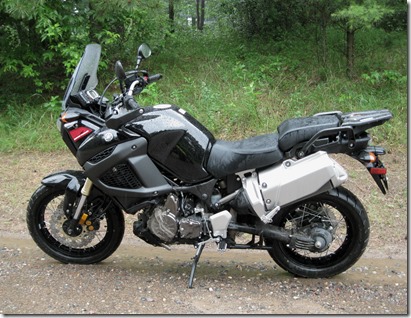
yamaha_super_tenere (13)[After riding the big BMW GS, I realized how much I really liked the Ténéré. In a head-to-head shootout, the BMW would be clobbered by all of the Ténéré’s features, function, and performance. For my own money, however, I wouldn’t consider either bike “useful.” They both return a crappy 40-something-mpg and that’s disgraceful in a $4/gallon world. My fuckin’ motor home gets 22mpg, for crap’s sake and it has a kitchen, bathroom, double bed, and pulls a motorcycle on a trailer.]

Way back at the end of my trophy-less, always in the middle-of-the-pack 125cc motocross "career," a local Yamaha dealer tried to convince me that I'd have more fun on an open class bike; a YZ400. To seal the deal, they cut me loose on the YZ in a big field behind the shop for the afternoon. From that day on, my make-a-wish dream has been to be given an open class motocrosser and a couple of hours on a golf course. Man, I shredded that field. You can dig a trench on a YZ400 way faster than with anything Caterpillar makes. Not that much later, BMW introduced the "adventure touring" genre and I have always wondered what could you do with a 1200cc dirt bike?

My first impression of the Yamaha XTZ1200Z Super Ténéré (the "Ténéré" is a desert or wilderness in the south central Sahara) came last fall when Yamaha was shipping one copy of the 'Super Ten' (from here out, referred to as "ST" with my apologies to Honda) around its Minnesota/Wisconsin/Iowa dealers to show off and attract customer pre-orders. Back then, Yamaha dealers were requiring a $500 non-refundable deposit on all ST orders. Our ST review bike came from Moon Motorsports in Monticello where this model's 2012 MSRP is $14,831 and Moon's asking price is $13,499. The 2012 models come in "Impact Blue or Raven." I think "raven" must be black, since our test bike was black.

2012-06-18 013 There is a lot that feels familiar in the ST. The 270° 1199cc, dry-sump parallel twin is a distant relative of the (beloved by me) 1992-93 Yamaha 850 TDM's motor. The ultra-dependable fuel injection and large fuel capacity connects to my Suzuki V-Strom's best touring traits; all-weather starting and altitude independence. There is a lot of unfamiliar stuff, too. The ST's ABS and smart Unified Braking system (application of the front brake provides some rear braking unless the rear brake is also used), the MotoGP-heritage two-position YCC-TTM (Yamaha Chip Controlled) fly-by-wire throttle and traction control, and the modern hypoid-gear shaft drive are strange territory for me. Above all, the 1200cc torque and power is about as odd an experience, for an ex-125cc racer and 250cc commuter, as space travel: what to do with these new super powers?

The first obstacle to overcome was the 575 pounds and 34.25" seat height. I'm 5'9" and I'm old. However, swinging a leg over the ST's tiered seat was surprisingly easy and . . . where did Yamaha hide the weight? I imagine if I were forced to push the ST out of a muddy ditch, I'd discover where the weight went. However, the bike absolutely does not feel 125 pounds heavier than my 650 V-Strom. To get used to riding a "large" motorcycle, I'd spent a couple of weeks riding the V-Strom everywhere I usually ride my 250. It was a waste of time. In the saddle, the ST feels light. Flipping the bike up on the centerstand was effortless. Touching the ground from the seat means I'm was on my toes, but keeping the bike upright at stop lights or putting a foot down in tight turns was no problem. The bike feels light in motion, too. In all of the important ways, the ST feels more like my WR250X than my 650; weight, handling, and response. The steering is tight and the bike's balance is excellent. On the MSF range, I could U-turn the ST inside the 20' box and all of the MSF range exercises are easier to perform on the ST than my 650. The bike is nimble.

When I searched out other reviews' impressions of the ST, I was surprised to see several complaints about the power. As usual, I'm no expert on the kind of power-to-the-road delivery the BMW or KTM big bikes provide, but the ST does more than I need, power-wise. Passing acceleration in the "Touring" mode is absolutely beyond anything legal. Whipping past a half-dozen hippobikes strung out in a slow-moving line on MN95 south of Taylor's Falls was quick and effortless and nearly sold me the bike on the spot. To my experience, the bike is quick. It will pull hard at anything over 2k rpm and the faster you spin it, the faster it wants to go. Being a new bike, I did not take it to the 8k redline, but I did let it roll up to 6-7k for a few short moments and it takes some effort to hang on when you let all 108 of those ponies have their head. Yamaha's promotional video for the ST has a lot high speed desert racing and weird lifestyle marketing. The desert is something hard to come by in Minnesota, but the video does establish the ST's off-road credentials (if you are that good). I found the ST to be stable and comfortable on the freeway (in a pouring rain with scuba visibility), more fun than a pool full of supermodels on tight, twisty back roads, and happy as a Duc on the track on slick and wet clay and gravel roads. In fact, I was more confident in the rough and unstable surfaces on the ST than on my little WR250X.

Which brings up the ST's performance options. I tried riding the ST without the traction control and in the "Sport" fuel injection mapping mode. The bike is almost scary without the electronic babysitting. Throttle response is instant, if a little irregular. The power gets to the back wheel fast enough that I had some concern about pulling the front wheel off of the ground at speeds above 60mph. That might be the reason for buying a 1200cc "adventure bike," but I'd just as soon not have to worry about unintended front wheel levitation. After a few miles, I went back to the "touring" mode and put the traction control in "normal" status. Yamaha seems to believe riding without the traction control is not recommended. When you shut off the key, the traction control returns to "normal" mode. Under some conditions, the traction control will automatically disable itself and warning lights will inform the rider of this status change. Personally, I'd sacrifice the "mode" options for a touring cruise control. This bike is made for knocking down big miles and I don't need performance when 1200cc's is barely contained with the traction control in the mildest setting.

As for the ABS braking system, I thought it was flawless. However, off-pavement I didn't have much problem accidentally "defeating" the ABS system. On a moderate whoop on a fire road north of Sandstone, the bike came down with the ABS fault light blinking. I caught a little air and left the throttle on for stability, but I was feathering the front brake anticipating a quick turn ahead. I shut the bike off, worrying that I'd broken something, but after inspection I fired it back up and the ABS light stayed off. Later, I was playing motocrosser on a slick clay road, using the front brake while hanging on to my throttle position to slide the back tire around the corner, and the ABS light came back on. This time, I kept riding and discovered how easy it is to slide the back tire without ABS assistance. Kind of fun, but not something an old fart needs to mess with on an expensive borrowed motorcycle. 

The transmission is typically Yamaha; smooth, predictable, and precise. The gear ratio seems a little close and more sportbike-oriented than dual-purpose. 75mph in 6th gear results in an engine spin of about 3,800 rpm. The same rotation rate means that 1st gear tops out at around 25mph. That's a bit quick for tight woods work, slow-going through stream beds, or sandy OHV trails. Maybe that's not the purpose Yamaha intended the bike for, but it's the kind of adventure ride they're advertising. The hydraulic clutch is predictable with a reasonably light feel.

right_side_cowlingThe battery, ABS motor fuse, and toolkit are hidden behind the right side cowling, which is removed by four 1/4-turn Allen screws. The toolkit is the typical throw-away stuff, but the compartment Yamaha designed for the kit is large enough for real adventure touring tools. Four more screws and the upper right cowling is off, exposing the the bike's other 12 fuses. The left side cowling is removed with six Allen screws and two plastic push pins. That cover hides the ultra-thin radiator and fan. The left side access brought back my least favorite memories of the TDM; too many parts that get lost in field repairs. It's hard to imagine that continuing the self-retaining fasteners from the right side to the left would have much effect on the cost of a $14,000 motorcycle. Yamaha calls the tail lights "R1 signal" indicators, but I'd call them the WR250R/X lights. Enough of the ST's parts are multi-tasked that the repair part prices are pretty reasonable.

bottom_case_hazardsOne British video review of the ST experienced an instant loss of engine fluids. From a view of the underside of the bike, I think the two oil drain bolts (oil tank and crankcase) are the likely culprits. Their location is handy for servicing, but they protrude beyond the bottom of the engine cases and are one of the first things the engine will contact. The shiny "oil element" cover is in the same predicament and if that piece breaks the oil pump is exposed. Yamaha has an accessory $205 welded 3mm aluminum skid plate and I would not leave home without it. The stock plastic piece is purely cosmetic.

The video above is the best off-road comparison I've seen on the bikes in this category, but it's the one where the ST dumps its engine oil about 4 minutes into the video. So, we don't learn much about how the ST stacks up against the competition.

Other Yamaha accessories include a taller windscreen and side deflectors, an engine case guard, side cases, a top case, a tank bag, a low (33.26" as opposed to the stocker's 34.25") seat, and mounting plates for your cell phone, GPS, radar detector, and the rest of the junk you play with when you should be watching the road and traffic. The aftermarket suppliers have cranked up production for this farkle magnet, too. Touratech practically has a whole catalog devoted to the ST that will allow you to add at least 120 pounds to the bike and double your investment. Other companies are cranking out crashbars, skidplates, and polished aluminum/titanium/unobtainium covers for all of the perfectly serviceable plastic, plated, and painted bits Yamaha installed on the ST.

The exhaust note is oddly loud and raspy. Not powerfully loud or Ducati-raspy, but still louder than I expected. The large (a lot of that size is a heat shield) down-pointing pipe has a catalytic converter and two-stage oxygen sensors to keep the FI system tweaked for EPA requirements, altitude, and fuel economy. The 45-component exhaust system is probably not light and the aftermarket industry has cranked up all manner of louder, lighter, more hooligan-appealing products to irritate your neighbors and knock the snot out of the bike's already-questionable fuel efficiency.

The fork spring preload setting is 8-position adjustable, along with adjustable compression and rebound damping. The rear shock preload and rebound damping are also adjustable. When I first saddled up the ST, I thought the suspension was set excessively stiff. Once I took the bike away from the freeway, I realized that, like a dirt bike, this motorcycle is designed to go straight at obstacles. The harder you ride it, the smoother it feels.

My first fill up (at 202 miles) demonstrated that the ST's mileage calculator is surprisingly accurate. The bike said it was getting 43.4mpg and I found it really got 43.9mpg. If the tank capacity is 6 gallons, the reserve warning comes on with about a 1.5 gallons of fuel left in the tank (the manual says 1.3 gallons); or with a reserve range of at least 60 miles. I am clinging to the delusion that 44mpg is not good enough for my next bike because I desperately do not want to buy a $14,000 motorcycle at this point in my geezerhood.

seat_heightThe seat height can be lowered about an inch by removing a plastic bracket under the seat (see illustration). This is an incredibly clever, simple adjustment that couldn't be much easier to perform. Yamaha also sells a lower-than-stock seat that provides another inch of height advantage. The seat itself is well designed, comfortable, and allows lots of movement while providing good grip. The seat, bars, and peg position make standing for the rough stuff comfortable and practical. The top of the seat cover is made from a textured material that allows movement while preventing accidental sliding. After removing the seat with the key, pulling two screws from the front of the passenger seat and removing that seat reveals a larger carrier adding the bike's luggage capacity (the racks are rated at 11 pounds each). The underside of the rider's seat holds an Allen wrench for removing the cowling covers.


2012-06-18 004There is enough content in the bike's console to keep most of us entertained for miles. The information available from that easy-to-read 4"x8" electronics package includes a large digital speedo, an analog tach, turn indicator, fuel status, traction control status, drive mode, a clock, the over-all odometer plus two trip odometers and a fuel reserve odometer, instantaneous and average fuel consumption data, intake air and coolant temperature, and self-diagnostics. The LCD and tach backlighting is adjustable. Two switches at the bottom edge of the console allow access to all of this information and set the time and miles/kilometers readout. A button on the left side of the console selects the traction control selection. The handlebar switches are standard, with the addition of a "drive mode" switch on the right side. There is a power connector (lighter jack) on the cowling for accessory electronic devices. The fairing is all business. Headlights, gauges, wiring, the radiator, electronics packages, fuses, brake components, cabling, are all easily accessible for maintenance and repairs. The headlights broadcast a rectangular beam that covers the road ahead and the edges of the road well enough than an old blind guy has some confidence in night riding. The mirrors are the best I've ev3r experienced. I can see what's behind me and vibration-generated blurriness is an absolute minimum.

The Yamaha owners' manual is reasonably complete, with simple procedures documented, some disassembly data, and the usual riding warnings, engine start-up and controls' operation descriptions, and "see your dealer" instructions for anything more complicated than remedial repairs and maintenance.

The brand/model options in this category come from the usual suspects: BMW's R1200GS ($14,990 for the basic bike, $16,935 with ABS, heated grips, bag mounts, hand guards, and GPS), Ducati's Multistrada 1200 ($16,999 for the standard bike, the $19,995 Sport-version, and the $21,995 Pike's Peak Special Edition), KTM's 990 Adventurer ($14,898), Moto Guzzi's Stelvio 1200 NTX ($15,990 with side-cases, ABS, etc.), and Triumph's Tiger 1200 Explorer ($15,699 with fly-by-wire and ABS). All of these motorcycles are well-suited for the intended adventure touring function.  The Yamaha's pricing puts the bike in good position, relative to its competition.

Before riding the ST, I had no idea that my V-Strom's front suspension was so mediocre. Getting back on the road, on my own bike, I was almost overcome by the desire to turn back and write a check for the Super Ten. My tightwad self prevailed and after a few dozen miles, the new riding standard began to fade into the background and by the time I made it home the V-Strom seemed just fine. Really. I'm not kidding. Damn it. I'm good.

Without the exceptional generosity and efforts of Moon Motorsports, Kyle Erickson, and Matt Kobow, my portion of this review would have been impossible. I'd like to personally thank them for their kindness and assistance.

Engine  
Type 1199cc, liquid-cooled, 4-stroke 2-cylinder DOHC
Bore x Stroke 98.0 x 79.5mm
Compression Ratio 11.0:1
Fuel Delivery Fuel Injection with YCC-T
Ignition TCI: Transistor Controlled Ignition
Transmission Constant mesh, 6-speed
Final Drive Shaft
Suspension / Front 7.48-in travel telescopic fork, adjustable preload, compression and rebound damping,
Suspension / Rear 7.48-in travel, Monoshock, adjustable preload and rebound damping
Brakes / Front Dual 310mm hydraulic disc, ABS/Unified Brake System
Brakes / Rear 282mm single disc
Tires / Front 110/80R 19M/C
Tires / Rear 150/70R 17M/C
Length 88.6 in
Width 38.6 in
Height 55.5 in
Seat Height 33.26 or 34.25 in
Wheelbase 60.6 in
Rake (Caster Angle) 28.0°
Fuel Capacity 6.0 gal
Fuel Economy** 40 mpg
Wet Weight*** 575 lb
Warranty 1 Year (Limited Factory Warranty)