Showing posts with label motorcycle review. Show all posts

Oct 4, 2017

Why I Don’t Do Reviews

You might have noticed, both in the blog and in MMM, I don’t do many reviews these days. When it comes to bike reviews, MMM got tired of defending my “right” not to be impressed with everything I swung a leg over. So did I. I don’t get the opportunity, on my own, to ride many motorcycles long enough to form an opinion. Mostly, the bikes I get offered are not interesting enough for me to write about and I’m pretty satisfied with the equipment I own. So, my motivation to risk life and limb to experience something different is vanishingly small. There are, in fact, about a half-dozen new motorcycles that I’m interested in riding and the rest just don’t hold much attraction.

For example, at the last (for 2017) MN MSF instructor bike night our host brought four bikes: a KTM, the Kawasaki 300 Ninja, the Honda CB300f, and a CB500f. I sorta wanted to test ride the CB500f, but couldn’t generate enough motivation to gear up and take it out. The other three are cool bikes, but not something I’m fired up about anymore. Ten years ago, absolutely. Today, not so much. I’m old, remember? The Versys 300? Now that’s a whole different ball of string. I’d love to test that bike. I might even trade in my WR250X on the right day.

As for gear, I’ll probably still find a thing or two to try out in the next couple of years, but I have a garage full of stuff I don’t use at all or rarely use. I don’t need anything more and I’m in the process of getting rid of a lot of unused gear. Interestingly, I get a lot more inquiries about doing product reviews with sales incentives. I’m really glad I don’t need the money (I can use it, I just done need it.), because some of these characters don’t even care if I’ve ever seen their products. They just want sales links and will pay for hits and sales.

So, bike and product reviews are mostly (or entirely) in my rearview mirror. I had fun with some of those motorcycle experiences and was flatout miserable on a couple. (Remember the Hyosung GV650 or the Honda VT1300CT?) I’m glad I had the experiences and I’m satisfied with having done as much of it as I wanted to do.

Sep 1, 2015

Motorcycle Reviews and Me

I’ve bitched about product reviews from several industries, including motorcycles, for almost two decades. Now that 99% of magazines count on advertising revenues rather than subscriptions for their income, editors/writers are more worried about pissing off an advertiser than providing value to readers. One of the things that first attracted me to writing for MMM were the reviews I read in those late 90’s editions. Far from soft and fluffy, some of the reviewed bikes took a beating. My benchmark product magazine is and always will be the version of Dirt Bike Magazine the ultimate geezer (even when he was a kid) Rick Sieman (SuperHunky) edited. He’s still at it, a bit, with articles like “Worst Dirt Bikes of All Time” and better. For the rest of the written world, readers don’t amount to much in terms of attempts at value provided. In fact, we’re not really “readers” in modern magazine vocabulary, we’re “customers.” Just like the MSM when talking about American citizens, we’ve lost our citizenship and become “consumers.” For my money, if the printed word disappears from existence it won’t be missed if I never again find myself referred to as a consumer or customer.

15-hd-street-750-6-largeWhen I heard my friend and ex-editor Sev Pearman (oddly pseudo-named “Mark Descartes”) would be reviewing the new aimed-at-the-hipsters Harley 750 for MMM, I had moderate hopes. Sev can be both obscure and direct, depending on the subject and his mood. When he is obscure, I have no idea what he is talking about on any subject including those where I am more versed than he. This review was one of those times.

15-hd-street-750-3-largeInterestingly, Bruce Mike’s paired review of the same bike was pretty informative. The question I’d asked Sev, off-line on FB, about the odd combination of a 28” seat height, the "below your knee" peg placement, and ground clearance. The picture of Sev on the bike looked cramped. I speculated that, “There must be about 3" of ground clearance.” In fact, unloaded there is 5.7”. Couple that with the closest thing to suspension travel HD provides (“Seat Height, Laden 25.7”) and my 3” guess was pretty close. (Damn, I’m good.) Bruce described the seating position succinctly, “The ergonomics were not good. I’m a short guy and the pegs and seat made me feel like I was too tall.” And “I put close to 150 miles on this bike and with the stock seat, bars, and pegs, it was not without discomfort.” That’s about what I expected from the provided dimensions .

Here’s my real complaint about this kind of review, though. As I wrote to Sev, “Comparing the 750 to other Hardlys makes the bike look . . . better. It might have been useful (to new riders) to mention that the "more powerful" Hardly 750 makes 10hp less than, say, the V-Strom 650 and about the same torque and includes ABS for similar money.” His response was, “One cannot rail on H-D for doing the same-old same-old then curse them when they produce something (gasp) modern.” I can and will. While finally realizing that air cooling and carbs are for lawn tractors and museums is a nod toward “modern,” it’s a long, long way from 2015 technology and getting further every day.

It’s true that everyone’s cruiser offerings are pretty primitive, but review after review calls these “small” hippobikes “starter bikes.” Would you put your kid on a 60 pound, coaster brake, single-speed, 26” Schwinn cruiser as a starter bicycle?  Yeah, I know that’s what I started on and it’s a pure miracle I’m alive to talk about it. I crashed that POS bicycle into mailboxes, fire hydrants, buildings, and cars before I began to realize my father didn’t know shit about picking a bicycle for a kid. Apparently, the whole motorcycle publishing industry got it’s cue from my father: a high school business teacher who was baffled by a newspaper wrapping machine to the point that he’d hand-rubber-band 1,000 newspapers rather than try to unclog a string jam.

Jul 17, 2015

Bike Review: Honda NC700X

2012-Honda-NC700X-Beauty_04_LROne of the side bonuses of my trip west with Scott Jarrett was a brief opportunity to ride his well-broken-in Honda NC700X. We swapped bikes for a brief period crossing northern Nebraska and that gave me the chance to play with the bike and get a feel for its handling. This isn’t a real review. I didn’t beat Scott’s bike up at all, like I often am accused of doing when MMM gets a test bike. The “test” was on Nebraska/US20 and, if you’ve been there you know it’s pretty straight and level. I didn’t have a chance to mess with cornering much and I really didn’t put the bike to any sort of handling strain. So, this is more of an impression write-up than a test. [I didn’t take any pictures of the bike while we were riding, so all of the images in this write-up are from the WWW.]

First, right from the start the NC700 feels small (especially compared to my 2004 V-Strom). You sort of perch on top of the bike, rather than being seated “in” the bike. In that way, it reminds me of the Buells I’ve ridden. With a 60.6” wheelbase and 474 pounds wet, the NC700X feels a lot lighter and smaller than it is. Small or not, the bike is plenty stable at speed and the handing is predictable. It just takes a little getting used to, if you’re familiar with a different style of rider position. Thanks for the under-seat fuel tank and low-slung in-line twin engine layout, the weight feels really, REALLY low. My V-Strom, in comparison, feels heavy and awkward at low speeds.

NC700X wheelThe first thing I always test before I get going is the bike’s brakes. The single front disk, for example, seemed conservatively cheap compared to the dual disks I’m used to. The disk is mounted close to the center of the wheel, which allows for a bit more leverage on the wheel and probably a lot less flex in the wheel during hard braking. It is not a small disk, although the pads are about the same as my V-Strom’s dual disk system. Regardless, you get a suitably aggressive front brake action, in spite of the single disk. Scott and my bike have similar miles and his brakes were easily as solid feeling as my V-Strom’s. I’m on my 3rd set of pads and I suspect Scott is still on his first, for whatever that’s worth. As usual, a strong application of the rear brake provides pretty much non-existent stopping power. Any time I try this “test” I have to wonder how people who rely on the rear brake live through a day.

Lots of early reviews complained about low power and sluggish response from the NC’s motor. I didn’t notice the absence of power, although it doesn’t accelerate like the V-Strom. It’s plenty quick enough for practical travel. Scott had his bike loaded up with luggage and I’m not light, but the bike provided plenty of practical passing power and pulled 6th gear up the grades we travelled without problem. The economy, on the other hand, kicked ass. While I turned in a series of 45-53mpg tank fills, Scott was regularly in the mid-60’s to low 70mpg zone. Obviously, we were travelling at the same speeds, so it was all in the motor making the difference. The NC’s super quiet engine and exhaust noise was a pleasure on the road. The main highway noise was the tires and wind. The transmission is despicably Honda; so good it makes all other motorcycle brands seem inferior. You can fumble through all 6 gears without a lick of skill, barely considering the clutch, and every shift will be flawless. Neither my Yamaha or my Suzuki hold a candle to the Honda’s transmission operation. That has been true for every Honda I’ve ridden or owned (except for one massively abused exception).

NC700X cockpitThe rider’s vantage-point is, as I mentioned before, not really “in the bike.” There is not real fairing protection and the cute but worthless windshield doesn’t offer much of a break from the wind. Scott had added an extension to the windshield that he thought provided a little more of a helmet noise buffer. All I can say is that I felt a lot more exposed on the NC700 than on my V-Strom with a Madstad bracket and the stock windshield. If you’re going to ride an NC in the rain or cold, bring good gear or you’ll be wet and frozen.

The NC’s 32.7” seat height is respectively low, which is a good thing for shorter riders. The only thing I would have changed, right off the bat, on the NC is the seat. It is, to put it politely, cramped and uncomfortable. The slope tends to stuff your nuts into the tank and the position feels restrictively limited. Sargent, for example, makes a decent looking replacement for their usual bucket-full of cash. Long days in the saddle will be uncomfortable until you fix this shortcoming.

In all, I liked the NC700 as much as expected I might. If I were replacing my V-Strom, the NC700X (with ABS) would be at the top of my list of options.

Jan 24, 2014

Motorcycle Review: 2012 BMW R1200GS

Adventure Touring's Founding Father

All Rights Reserved © 2012 Thomas W. Day

BMW1200GS13
I have no idea where this building was. I stumbled on it while wandering around the Minnesota River Valley.

BMW was the first manufacturer to take the whole "adventure touring" genre seriously, in 1980 with the R80G/S model. Since then, BMW has been hammering this market with a collection of excellent on/off-road motorcycles ready for an adventure when the right owner comes along. In its odd way, the BMW GS bikes carry a special kind of prestige among motorcyclists and the bike-curious. Famous people like Neal Pert, Harrison Ford, Orlando Bloom, and Ewan McGregor and Charley Boorman have put the R1200GS in front of millions of television viewers and readers. The rest of us dream about hitting the right lottery numbers so we can be like Ewan and Charley. Two-and-a-half days on an R1200GS and I was almost ready to blow a couple of bucks on my own Power Ball delusion.

After being pleasantly surprised that I could swing a leg over our test bike, my next surprise was discovering that the boxer doesn't kick off instantly. You have to stick with the starter button long enough for all that mass to get swinging. When it first fires up, the motor tosses off an odd vibration and takes a few moments to settle into a comfortable low engine speed rumble. At low engine RPM's, the motor shakes the whole chassis in old fashioned twin style. The exhaust isn't loud, but it's not 2012 politically correct. It's noisy enough that you can blip the throttle to wake up a dozing cager at a stop light. Honestly, I liked the sound enough that popping the motor slightly just off-idle while I'm wasting time at a light was mildly entertaining. Cruising down the super-slab puts the motor at about 4krpm at 70mph. There is a lot of horsepower and torque left from that point to the bike's 8.5k redline. The EFI throttle mapping is aggressive and when you whack the throttle in gears 1-4, be ready to loft the front wheel. At BMW's estimated 42mpg, the 5-gallon tank could deliver a 200-mile range and while the EFI calculator claimed that I'd been getting 42-48mpg, my fuel receipts indicated that I got 32, 34, and 38mpg over almost 400 miles. Shifting is predictable, precise, and no unusual movement is required. Maybe to make the faithful feel comfortable with this radical modern concept, all of that great feel is accompanied with the historical Euro-primitive "clunk" sound on each shift, up or down. The rest of the power transmission is typically BMW.

The R1200GS handling is legendary for a reason. The bike instills confidence, on and off-pavement. The universal design of the GS is slightly slanted toward all sorts of civilized riding situations, the twistier the better. Still, the bike works better than 516 pounds should be expected to work off-road. The weight feels low and in most situations I barely noticed that it is a big bike. The BMW is a little scary in deep sand, but that's probably more me and $18k motorcycles than an actual deficiency. On the MSF course, the GS was maneuverable enough to handle all of the tight cornering exercises inside of the lines designed for our 250cc trainers.

The riding position with the low seat might be too constricted for taller riders, but BMW has several options with the stock seat that can lift the seated position another two inches. I was on the bike, almost non-stop for 200 miles, twice, and comfort was never an issue. In rough riding situations, standing on the pegs requires a little more rearward stance than I consider ideal, because of the big engine cases. It's not uncomfortable and it works, but it's a little restrictive. The skinny footpegs do not work for me. The little rubber insert is easily removed and should be tossed as far from the bike as possible at earliest convenience. Wider serrated pegs would be the first aftermarket piece I'd put on the GS. The bike's handling is predictable and only seems out of its element when you're not pushing it hard enough. Big semi divots in a dirt road are best taken hard and fast, while the usual Minnesota freeway engineering flaws are rougher than expected. The single-sided swingarm is, as always, maintenance-friendly, beautifully executed, and downright cool. The tubeless wheels and wire hubs are solidly trick.

With or without ABS, the GS has an integrated braking system that applies both brakes with front brake application. The rear brake is plenty powerful on its own. The BMW's ABS system is more aimed at on-road conditions. In loose gravel or sand, the rear brake pulsates and the front is too grabby for a balls-to-the-wall panic stop that relies on ABS for control. In fact, I'd be inclined to turn off ABS on a long off-road trip. On pavement, the BMW's brakes are firm, powerful, and predictable.

BMW1200GS6
What's under the BMW's seat.

Turn the seat lock toward the back of the bike and the passenger seat comes off, revealing extra storage rack space. Turn the key toward the front and the rider's seat can be removed without messing with the passenger seat and you can get at the battery, the "rider's manual" storage, the tool kit, and a helmet security loop. All of the electrical systems, except the auxiliary LED headlight circuit, are electronically fused, so resetting one of those systems after a fault only requires switching the ignition off and on. The rest of basic maintenance is pretty well considered, too. Removing the right side cover exposes the air filter and servicing that unit is as simple as it should be. Servicing the brakes, wheels and tires, suspension, and the usual electrical culprits (lights) has been designed to be simple and fairly tool-free. Early in the test, I discovered the oil level was a little low. Topping off the oil pointed out a little gripe I have with BMW's maintenance procedure. The oil fill is on the top of the right side cylinder and the inspection window is under the left size cylinder. 

BMW1200GS25
All the available information from the "multifunction display; from the BMW rider's manual.

The "multifunction display" looks pretty unused, in its normal state. Typically, fuel status, water temperature, the gear indicator, turn signals, an ABS status light, the odometer or one of the two tripmeter options, and one of the on-board computer functions are all that is displayed. However, if all hell breaks loose on the bike, the data display could be pretty well jammed with fault information. The fault displays include warnings for tire pressure faults, a "needs service" indicator, battery charge fault, emergency engine operation mode, low oil pressure, low oil level, headlight failure, and a collection of alpha/numeric codes for troubleshooting purposes. The display is, in fact, a full-service troubleshooting tool with a collection of really cool hidden capabilities that service techs rely on in repairing electronics-heavy modern motorcycles.


BMW1200GS24
The whole rider's information package.

From a rider's perspective, the whole console is functional and user-friendly. The analog tach and speedometer are easily interpreted, especially in the dark, and where you'd expect them to be. The speedo is large and the main item in the instrument cluster, just like it should be (140mph/230kph max). The tach is at the top with an 8.5krpm redline. Just below the tach is the very bright LED display and below that is the previously-discussed multifunction display. The instrument cluster is fortified by a serious looking crash bar and completely shielded by the windscreen.

BMW1200GS21
Just a little of the stuff you can do with your left thumb.

The bike has a collection of switches near the left grip for the usual turn-signal, horn, and lights operation, plus switches to cycle the computer display function (INFO), a switch for disabling ABS and the Automatic Stability Control (ASC) functions, and a switch for controlling the Electronic Suspension Adjustment (ESA) options. The INFO switch cycles the computer functions through a clock, two trip odometers, ambient temperature, average speed, fuel consumption, estimated remaining range, and oil level. Our bike did not have either of the ASC or ESA options.

Our test bike did come with about $1,600 of optional features, including a lowering setup, heated grips, hand guards, an on-board computer, and the super-sexy cross-spoke wheel package. Other options include electronic suspension adjustment (ESA), automatic stability (traction) control (ASC), and an anti-theft system. Going for every BMW GS option adds about $3,600 to the $16,150 base price.


BMW1200GS5
A look at the ZTechnik accessories.

Because the R1200GS has been around for a while, Touratech, ADVDesigns, and lots of aftermarket suppliers have dozens of farkles and useful accessories for the R1200GS. You could almost double-down on your $16,500 base model investment from their catalogs. Our test bike came with a tall ZTechnik windscreen and that company's mirror extenders and an accessory shelf for power connectors and your GPS or radar detector. With the mirrors extended an extra 3", they provide a completely unobstructed view of where you have been. The very-adjustable windshield mount allows for considerable alteration of the shield's angle and height. I'm not usually convinced that I like tall shields and the ZTechnik was no exception. I suspect I'd like the stock shield and mirror positions better than that rig.

I'm not a fan of motorcycles with character, but the BMW's character is "competence." Lots of little things are done well. From a kickstand that never offers a moment of insecurity, even when you're putting it down in soft dirt, off-camber, when you're tired and distracted to a motor that just does what it's supposed to do. It's a stupid little thing, but one I appreciated every time I parked the bike. Even the BMW's key is beefed-up. Instead of having the key notches on the outside of the key, BMW has put the notches on the inside of the key slot, making the key stronger and the lock a lot harder to pick. If you add the anti-theft option to the bike, picking the lock won't help a thief ride away on your bike. The Electronic Immobilizer System (EWS) handshakes with your smart key to determine if you're using an authorized key. If you aren't, the bike stays immobilized. The ignition is disabled until it is deactivated by a remote control if or a special code is entered by way of switching the key off and on. Damn, that's tricky!  The auto-cancelling turn signals were a nice surprise. I haven't had that convenient feature since my '83 Yamaha Vision and I've missed it. The heated grips were completely new experience. Sev turned them on just before I rode away from his house and by the time I made it home, I was plotting heated grip installation on my V-Strom.

BMW1200GS17Monday night, I put the big BMW back on the freeway for the last time. Traffic was heavy and a little competitive. The big bike effortlessly puts me where I want to be, when I want to be there. In that environment, a gear indicator is useful. The GS pulls hard at any RPM above 1,000, so it's hard to feel the shift points surrounded by noisier vehicles. From my home to Leo's South, I have 27 miles of urban traffic to collect my last thoughts about this motorcycle. Owning a R1200GS is out of my socio-economic class, but I can almost imagine putting in a couple of evil years to change sides in the Class Wars, just to own a big GS. I am going to miss this motorcycle. It looks so good sitting next to my WR250X in the garage.

Thanks to the folks at Leo's South, Wayne and Randy Bedeaux, for making this terrific motorcycle available for review. This was an especially generous loan, since it was one of their personal bikes. If it were mine, I wouldn't let this babe out of my sight.

Originally published in Minnesota Motorcycle Monthly, March 2013.

Model

R 1200 GS $16,150 MSRP

  • Engine
  • Type
  • Air/oil-cooled flat twin ('Boxer') 4-stroke engine, two camshafts and four radially aligned valves per cylinder, central balancer shaft
  • Bore x stroke
  • 101 mm x 73 mm
  • Capacity
  • 1,170 cc
  • Rated output
  • 110 hp (81 kW) at 7,750 rpm
  • Max. torque
  • 89 ft-lb (120 Nm) at 6,000 rpm
  • Compression ratio
  • 12.0 : 1
  • Mixture control / engine management
  • Electronic intake pipe injection / BMS-K+ digital engine management with overrun fuel cut-off, twin spark ignition
  • Emission control
  • Closed-loop 3-way catalytic converter, emission standard EU-3
  • Performance / fuel consumption
  • Maximum speed
  • Over 125 mph (200 km/h)
  • Fuel consumption per 100 km at constant 90 km/h
  • 55 mpg, at a constant 55 mph
  • Fuel consumption per 100 km at constant 120 km/h
  • Fuel type
  • Unleaded super and premium.
  • Electrical system
  • Alternator
  • three-phase alternator 720 W
  • Battery
  • 12 V / 14 Ah, maintenance-free
  • Power transmission
  • Clutch
  • Single dry plate clutch, hydraulically operated
  • Gearbox
  • Constant mesh 6-speed gearbox with helical gear teeth
  • Drive
  • Shaft drive
  • Chassis / brakes
  • Frame
  • Two-section frame consisting of front and rear sections, load- bearing engine-gearbox unit
  • Front wheel location / suspension
  • BMW Motorrad Telelever; stanchion diameter 41 mm, central spring strut, spring preload with 5-position mechanical adjustment
  • Rear wheel location / suspension
  • Cast aluminum single-sided swing arm with BMW Motorrad Paralever; WAD strut (travel-related damping), spring pre-load hydraulically adjustable (continuously variable) at handwheel, rebound damping adjustable
  • Suspension travel front / rear
  • 7.5/7.9 inches (190 mm/200 mm)
  • Wheelbase
  • 59.3 inches (1,507 mm)
  • Castor
  • 4 inches (101 mm)
  • Steering head angle
  • 64.3°
  • Wheels
  • Cast aluminum wheels
  • Rim, front
  • 2.50 x 19"
  • Rim, rear
  • 4.00 x 17"
  • Tyres, front
  • 110/80 R 19
  • Tyres, rear
  • 150/70 R 17
  • Brake, front
  • Dual disc brake, floating brake discs, diameter 305 mm, 4-piston fixed calipers
  • Brake, rear
  • Single disc brake, diameter 265 mm, double-piston floating caliper
  • ABS
  • BMW Motorrad Integral ABS (part-integral), can be switched off
  • Dimensions / weights
  • Length
  • 87 inches (2,210 mm)
  • Width (incl. mirrors)
  • 36 inches (915 mm)
  • Height (excl. mirrors)
  • 57 inches (1,450 mm)
  • Seat height, unladen weight
  • 33.5/34.3 inches (850/870 mm) low seat: 32.3 inches
    (820 mm), lowered suspension: 31.1 inches (790 mm)
  • Inner leg curve, unladen weight
  • Unladen weight, road ready, fully fuelled 1)
  • 516 lbs (229 kg)
  • Dry weight 2)
  • 461 lbs (209 kg)
  • Permitted total weight
  • 970 lbs (440 kg)

BMW's R1200GS Website

http://www.bmwmotorcycle.com/2012_r1200gs_bmw_info.htm

Photos:

BMW1200GS1BMW1200GS2IBMW1200GS3BMW1200GS4BMW1200GS7BMW1200GS8BMW1200GS9BMW1200GS10IBMW1200GS11BMW1200GS12BMW1200GS14BMW1200GS15BMW1200GS16BMW1200GS18BMW1200GS19BMW1200GS20BMW1200GS22

BMW1200GS23

Nov 30, 2013

MOTORCYCLE REVIEW: 2009 Kawasaki Versys KLE650

All Rights Reserved © 2009 Thomas W. Day

Gus handed over the Versys at about 8PM on a rare temperate early April evening. Our test bike was decked in Kawasaki's Candy Lime Green, which was a nice thought after this particularly nasty winter. The weather was perfect, mid-70s, but the sun was going down fast. I had been fighting off a cold or flu all day long, but I thought I’d take a chance on getting in some early evening and night miles before calling it a day.

The Versys is truly a “naked bike” and the tiny shield provides minimal wind protection. Still, I immediately liked the Versys during the downtown freeway-cager-dual. The skinny profile, high seat (33.1"), standard knee-bend, well-positioned mirrors, and quick throttle response puts the rider in a good position to survive urban traffic pitfalls. I headed north of the cities and tooled around a couple of familiar small lake roads.

I compare everything to my V-Strom’s lights and the KLE650 compared well. I’m not a fan of night riding, but if I absolutely had to cover some miles at night the Versys’ lights would make it safe and reasonably comfortable. I kept an eye out for hoofed rats and put in about 60 miles before calling it a night.  The nicely tucked-in signal lights do their job, too.

versys1 When I pulled into my garage, I took some time to scope out the Versys’ details. The console is ergonomically neat and useful.  The front suspension gives 5.9" of travel and the rear is good for 5.7", pretty similar to adventure touring numbers. The shock has adjustments for the spring preload and rebound damping, as do the forks. The underseat territory exposes easy access to a small tool bag, owners' documents, the battery, fuse holder, and a pair of helmet hooks. There is room under the seat for a decent tool kit. Both levers are adjustable to fit your reach and style of shifting and braking. The rear brake is also conveniently adjustable. After a few moments of fooling with the controls, I had the bike feeling as familiar as my regular ride. The air filter is hidden deep under the tank and plastic, which makes cleaning of that oiled screen device slightly cumbersome. The stainless exhaust/catalyzer is brilliantly contained under the engine, with the output aimed at the ground adding an additional bit of noise suppression that will irritate the loud pipe punks into feats of engineering foolishness. From the side, it looks like the convoluted under-engine exhaust is protected by a bashplate, but it’s just a cosmetic plastic panel hiding the pipe. The exhaust shape does, however, eliminate most of the aftermarket centerstand options. versys-6

It's hard not to compare the Versys to my V-Strom, so I'll just give in to that fault and make the best of it. The Kawasaki is 28 pounds lighter and has a 5 1/2" shorter wheelbase and a seat height that is 1" taller than the Suzuki. That results in a bike that feels smaller and more nimble. In the garage, standing next to my V-Strom, the Versys looks unnaturally svelte, or the V-Strom looks like something that would invite a verse or two of Sir Mix Alot's "I Like Big Butts." The Versys' narrow profile is perfect for urban commuting, especially if you are lucky enough to live somewhere enlightened enough to allow filtering and lane-splitting.

According to Kawasaki's marketing literature, the Versys (marketing-cutesy-speak for "Versatile System") is a sportbike. The suspension, upright riding position, tall seat height, and styling hint at something else. The KLE650 may be competition for the V-Strom, but the Versys is a different animal. Gus compared it to the early 90's Yamaha 850 TDM, although it might be even closer to the intent of the 900 TDM that Yamaha has kept selling right up to 2009 in Europe and other civilized parts of the world. Kawasaki is not aiming the Versys at the KLR adventurer touring crowd the way Suzuki pointed the V-Strom. This is more of an adventure commuting bike. The roughest road Kawasaki probably intended for the Versys would be cobblestones or practically any St. Paul residential street. The Rest of the World has enjoyed the Versys' ancestor—the KLE500 parallel twin adventure touring bike—since 1991 and, in 2007, Kawasaki replaced and upgraded that versatile vehicle with the 650 which made it to the US in the 2008 lineup.

Kawasaki says, “The Versys was created for pavement riding on back-roads and city roads. As a result, the fuel injection system was . . . fully mapped so the mid-range from 3000-6000 revs would receive a nice and strong response from the throttle.”  I expected a little more bottom end performance, but once I got used to having to rev the motor above my usual shift points I found plenty of performance in the 650 twin. On the highway, 6th gear at 4000rpm = 55mph and 5000 = 70mph. At the end of the shifting cycle, the bike always felt like it could use another gear, but that was partially because I was trying to take it easy during the break-in miles. The mid-sized twin rolls smoothly away from stops at anything over 2000rpm and the power was usable near 1500rpm. If you downshift late, you'll still have plenty of power to pull smoothly through the tightest corners. During my ride, the Versys got 45.5mpg over a wide range of plugging-along-in-town and hauling-ass country road miles.

versys-3 For my test ride, I headed north out of St. Paul into the countryside. The view from the seat is unobstructed by the tiny shield and "clean air" is all that hits your helmet, since the shield is too low to provide coverage or turbulence above mid-section. Taking my favorite two-lanes toward Taylor's Falls, I kept a light hand on the new engine while getting a feel for the bike's handling. Winding my way to Red Wing, I had nothing but fun trying to find the Versys' limits on Wisconsin's county Letter Roads.  Like the late-80's Honda 650 Hawk, the Versys chassis is up for anything the motor can deliver. That adds up to a confidence-inspiring ride providing challenge for experienced riders and fun for newbies. On the way up the viewpoint in Red Wing, I almost touched a toe in the switchbacks. Maybe later in the season, I'll be able to push the bike hard enough to make it work a little, but in April I'm lucky to have moments of mild competence. On the way back from Red Wing, I slipped up and found myself on a fairly hostile gravel road and the Versys handled it at least as well as my V-Strom. I think there is an adventure touring bike barely under the surface of the KLE650's sportbike veneer.

 versys-9 No perfect day goes uncontaminated. By late afternoon, I'd managed to evolve my earlier symptoms into a full blown flu. On a sunny 50oF day, I was shivering from chills, my joints ached, I'd filled the helmet with snot, and I'd coughed and sneezed so often that my face shield was opaque. Even with all of those complaints, the Versys was comfortable. In fact, I think the KLE650's is fitted with the first Japanese factory seat that I think could be described as "competent." I'd put in about 300 miles and 8 hours on the bike with my loaded 'stich courier bag slung across my back for my first "long" ride of the season and my knees still worked, my back was no worse for the wear, and I'd had fun. 

In the August issue, Motorcyclist Magazine called the 2008 Versys the "Motorcycle of the Year," which created a blast of late season arguments. When a Versys found its way to the middle of the campground at last year's Boring Rally, it drew a crowd of admirers. Before the recession hit, Kawasaki was bombarded by an email campaign asking the company to bring the Versys to the US. If the economy doesn't do in this effort from Kawasaki, the Versys ought to be a hit. With an MSRP of $7,099, the Versys is priced $400 below Suzuki's popular V-Strom.

Accessory/farkle manufacturers have been busy creating add-ons for the KLE650. Kawasaki/MRA are providing larger windshields and an adjustable top spoiler. GIVI has created tall windshields, luggage, and rear racks. Several companies make aftermarket seats. Zeta offers the XC Deflector handguards with an "optional LED flasher strip." You can buy suspension lowering kits. The usual suspects make hooligan-style exhaust and slip-on systems. For the adventurer touring crowd, Mototoys of Australia makes a stylish bashplate and at least one US farkle supplier is working on a centerstand.

Specifications

Maximum Torque 44.9 lb/ft @6,800 rpm
Cooling Liquid
Fuel Injection Digital fuel injection with two 38mm Keihin throttle bodies
Ignition Digital CDI
Transmission 6-Speed
Final Drive O-Ring Chain
Frame Semi-double cradle, high-tensile steel
Rake/Trail 25°/4.3 in.
Front Tire Size 120/70-17
Rear Tire Size 160/60-17
Wheelbase 55.7
Front Suspension / wheel travel 41mm hydraulic telescopic fork with adjustable rebound and preload / 5.9 in.
Rear Suspension / wheel travel Single offset laydown shock with adjustable rebound and spring preload / 5.7 in.
Front Brake Type Dual 300mm petal discs with two-piston caliper
Rear Brake Type Single 220mm petal disc with single-piston caliper
Fuel Tank Capacity 5.0 gal.
Seat Height 33.1
Curb Weight 454.1 lbs.
Overall length 83.7 in.
Overall width 33.1 in.
Overall height 51.8 in.
Color Candy Plasma Blue, Candy Lime Green
Warranty 12 months
Good Times™ Protection Plan 12, 24, 36 or 48 month

Nov 27, 2013

Motorcycle Review: – 2012 Yamaha Super Ténéré

Go Everywhere, Do Anything

All Rights Reserved © 2012 Thomas W. Day
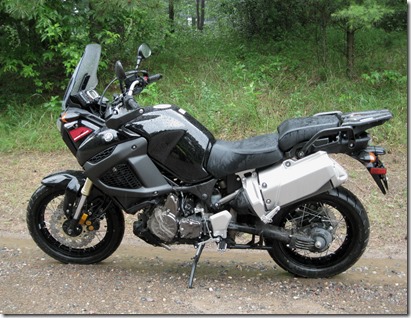
yamaha_super_tenere (13)[After riding the big BMW GS, I realized how much I really liked the Ténéré. In a head-to-head shootout, the BMW would be clobbered by all of the Ténéré’s features, function, and performance. For my own money, however, I wouldn’t consider either bike “useful.” They both return a crappy 40-something-mpg and that’s disgraceful in a $4/gallon world. My fuckin’ motor home gets 22mpg, for crap’s sake and it has a kitchen, bathroom, double bed, and pulls a motorcycle on a trailer.]

Way back at the end of my trophy-less, always in the middle-of-the-pack 125cc motocross "career," a local Yamaha dealer tried to convince me that I'd have more fun on an open class bike; a YZ400. To seal the deal, they cut me loose on the YZ in a big field behind the shop for the afternoon. From that day on, my make-a-wish dream has been to be given an open class motocrosser and a couple of hours on a golf course. Man, I shredded that field. You can dig a trench on a YZ400 way faster than with anything Caterpillar makes. Not that much later, BMW introduced the "adventure touring" genre and I have always wondered what could you do with a 1200cc dirt bike?

My first impression of the Yamaha XTZ1200Z Super Ténéré (the "Ténéré" is a desert or wilderness in the south central Sahara) came last fall when Yamaha was shipping one copy of the 'Super Ten' (from here out, referred to as "ST" with my apologies to Honda) around its Minnesota/Wisconsin/Iowa dealers to show off and attract customer pre-orders. Back then, Yamaha dealers were requiring a $500 non-refundable deposit on all ST orders. Our ST review bike came from Moon Motorsports in Monticello where this model's 2012 MSRP is $14,831 and Moon's asking price is $13,499. The 2012 models come in "Impact Blue or Raven." I think "raven" must be black, since our test bike was black.

2012-06-18 013 There is a lot that feels familiar in the ST. The 270° 1199cc, dry-sump parallel twin is a distant relative of the (beloved by me) 1992-93 Yamaha 850 TDM's motor. The ultra-dependable fuel injection and large fuel capacity connects to my Suzuki V-Strom's best touring traits; all-weather starting and altitude independence. There is a lot of unfamiliar stuff, too. The ST's ABS and smart Unified Braking system (application of the front brake provides some rear braking unless the rear brake is also used), the MotoGP-heritage two-position YCC-TTM (Yamaha Chip Controlled) fly-by-wire throttle and traction control, and the modern hypoid-gear shaft drive are strange territory for me. Above all, the 1200cc torque and power is about as odd an experience, for an ex-125cc racer and 250cc commuter, as space travel: what to do with these new super powers?

The first obstacle to overcome was the 575 pounds and 34.25" seat height. I'm 5'9" and I'm old. However, swinging a leg over the ST's tiered seat was surprisingly easy and . . . where did Yamaha hide the weight? I imagine if I were forced to push the ST out of a muddy ditch, I'd discover where the weight went. However, the bike absolutely does not feel 125 pounds heavier than my 650 V-Strom. To get used to riding a "large" motorcycle, I'd spent a couple of weeks riding the V-Strom everywhere I usually ride my 250. It was a waste of time. In the saddle, the ST feels light. Flipping the bike up on the centerstand was effortless. Touching the ground from the seat means I'm was on my toes, but keeping the bike upright at stop lights or putting a foot down in tight turns was no problem. The bike feels light in motion, too. In all of the important ways, the ST feels more like my WR250X than my 650; weight, handling, and response. The steering is tight and the bike's balance is excellent. On the MSF range, I could U-turn the ST inside the 20' box and all of the MSF range exercises are easier to perform on the ST than my 650. The bike is nimble.

When I searched out other reviews' impressions of the ST, I was surprised to see several complaints about the power. As usual, I'm no expert on the kind of power-to-the-road delivery the BMW or KTM big bikes provide, but the ST does more than I need, power-wise. Passing acceleration in the "Touring" mode is absolutely beyond anything legal. Whipping past a half-dozen hippobikes strung out in a slow-moving line on MN95 south of Taylor's Falls was quick and effortless and nearly sold me the bike on the spot. To my experience, the bike is quick. It will pull hard at anything over 2k rpm and the faster you spin it, the faster it wants to go. Being a new bike, I did not take it to the 8k redline, but I did let it roll up to 6-7k for a few short moments and it takes some effort to hang on when you let all 108 of those ponies have their head. Yamaha's promotional video for the ST has a lot high speed desert racing and weird lifestyle marketing. The desert is something hard to come by in Minnesota, but the video does establish the ST's off-road credentials (if you are that good). I found the ST to be stable and comfortable on the freeway (in a pouring rain with scuba visibility), more fun than a pool full of supermodels on tight, twisty back roads, and happy as a Duc on the track on slick and wet clay and gravel roads. In fact, I was more confident in the rough and unstable surfaces on the ST than on my little WR250X.

Which brings up the ST's performance options. I tried riding the ST without the traction control and in the "Sport" fuel injection mapping mode. The bike is almost scary without the electronic babysitting. Throttle response is instant, if a little irregular. The power gets to the back wheel fast enough that I had some concern about pulling the front wheel off of the ground at speeds above 60mph. That might be the reason for buying a 1200cc "adventure bike," but I'd just as soon not have to worry about unintended front wheel levitation. After a few miles, I went back to the "touring" mode and put the traction control in "normal" status. Yamaha seems to believe riding without the traction control is not recommended. When you shut off the key, the traction control returns to "normal" mode. Under some conditions, the traction control will automatically disable itself and warning lights will inform the rider of this status change. Personally, I'd sacrifice the "mode" options for a touring cruise control. This bike is made for knocking down big miles and I don't need performance when 1200cc's is barely contained with the traction control in the mildest setting.

As for the ABS braking system, I thought it was flawless. However, off-pavement I didn't have much problem accidentally "defeating" the ABS system. On a moderate whoop on a fire road north of Sandstone, the bike came down with the ABS fault light blinking. I caught a little air and left the throttle on for stability, but I was feathering the front brake anticipating a quick turn ahead. I shut the bike off, worrying that I'd broken something, but after inspection I fired it back up and the ABS light stayed off. Later, I was playing motocrosser on a slick clay road, using the front brake while hanging on to my throttle position to slide the back tire around the corner, and the ABS light came back on. This time, I kept riding and discovered how easy it is to slide the back tire without ABS assistance. Kind of fun, but not something an old fart needs to mess with on an expensive borrowed motorcycle. 

The transmission is typically Yamaha; smooth, predictable, and precise. The gear ratio seems a little close and more sportbike-oriented than dual-purpose. 75mph in 6th gear results in an engine spin of about 3,800 rpm. The same rotation rate means that 1st gear tops out at around 25mph. That's a bit quick for tight woods work, slow-going through stream beds, or sandy OHV trails. Maybe that's not the purpose Yamaha intended the bike for, but it's the kind of adventure ride they're advertising. The hydraulic clutch is predictable with a reasonably light feel.

right_side_cowlingThe battery, ABS motor fuse, and toolkit are hidden behind the right side cowling, which is removed by four 1/4-turn Allen screws. The toolkit is the typical throw-away stuff, but the compartment Yamaha designed for the kit is large enough for real adventure touring tools. Four more screws and the upper right cowling is off, exposing the the bike's other 12 fuses. The left side cowling is removed with six Allen screws and two plastic push pins. That cover hides the ultra-thin radiator and fan. The left side access brought back my least favorite memories of the TDM; too many parts that get lost in field repairs. It's hard to imagine that continuing the self-retaining fasteners from the right side to the left would have much effect on the cost of a $14,000 motorcycle. Yamaha calls the tail lights "R1 signal" indicators, but I'd call them the WR250R/X lights. Enough of the ST's parts are multi-tasked that the repair part prices are pretty reasonable.

bottom_case_hazardsOne British video review of the ST experienced an instant loss of engine fluids. From a view of the underside of the bike, I think the two oil drain bolts (oil tank and crankcase) are the likely culprits. Their location is handy for servicing, but they protrude beyond the bottom of the engine cases and are one of the first things the engine will contact. The shiny "oil element" cover is in the same predicament and if that piece breaks the oil pump is exposed. Yamaha has an accessory $205 welded 3mm aluminum skid plate and I would not leave home without it. The stock plastic piece is purely cosmetic.

The video above is the best off-road comparison I've seen on the bikes in this category, but it's the one where the ST dumps its engine oil about 4 minutes into the video. So, we don't learn much about how the ST stacks up against the competition.

Other Yamaha accessories include a taller windscreen and side deflectors, an engine case guard, side cases, a top case, a tank bag, a low (33.26" as opposed to the stocker's 34.25") seat, and mounting plates for your cell phone, GPS, radar detector, and the rest of the junk you play with when you should be watching the road and traffic. The aftermarket suppliers have cranked up production for this farkle magnet, too. Touratech practically has a whole catalog devoted to the ST that will allow you to add at least 120 pounds to the bike and double your investment. Other companies are cranking out crashbars, skidplates, and polished aluminum/titanium/unobtainium covers for all of the perfectly serviceable plastic, plated, and painted bits Yamaha installed on the ST.

The exhaust note is oddly loud and raspy. Not powerfully loud or Ducati-raspy, but still louder than I expected. The large (a lot of that size is a heat shield) down-pointing pipe has a catalytic converter and two-stage oxygen sensors to keep the FI system tweaked for EPA requirements, altitude, and fuel economy. The 45-component exhaust system is probably not light and the aftermarket industry has cranked up all manner of louder, lighter, more hooligan-appealing products to irritate your neighbors and knock the snot out of the bike's already-questionable fuel efficiency.

The fork spring preload setting is 8-position adjustable, along with adjustable compression and rebound damping. The rear shock preload and rebound damping are also adjustable. When I first saddled up the ST, I thought the suspension was set excessively stiff. Once I took the bike away from the freeway, I realized that, like a dirt bike, this motorcycle is designed to go straight at obstacles. The harder you ride it, the smoother it feels.

My first fill up (at 202 miles) demonstrated that the ST's mileage calculator is surprisingly accurate. The bike said it was getting 43.4mpg and I found it really got 43.9mpg. If the tank capacity is 6 gallons, the reserve warning comes on with about a 1.5 gallons of fuel left in the tank (the manual says 1.3 gallons); or with a reserve range of at least 60 miles. I am clinging to the delusion that 44mpg is not good enough for my next bike because I desperately do not want to buy a $14,000 motorcycle at this point in my geezerhood.

seat_heightThe seat height can be lowered about an inch by removing a plastic bracket under the seat (see illustration). This is an incredibly clever, simple adjustment that couldn't be much easier to perform. Yamaha also sells a lower-than-stock seat that provides another inch of height advantage. The seat itself is well designed, comfortable, and allows lots of movement while providing good grip. The seat, bars, and peg position make standing for the rough stuff comfortable and practical. The top of the seat cover is made from a textured material that allows movement while preventing accidental sliding. After removing the seat with the key, pulling two screws from the front of the passenger seat and removing that seat reveals a larger carrier adding the bike's luggage capacity (the racks are rated at 11 pounds each). The underside of the rider's seat holds an Allen wrench for removing the cowling covers.


2012-06-18 004There is enough content in the bike's console to keep most of us entertained for miles. The information available from that easy-to-read 4"x8" electronics package includes a large digital speedo, an analog tach, turn indicator, fuel status, traction control status, drive mode, a clock, the over-all odometer plus two trip odometers and a fuel reserve odometer, instantaneous and average fuel consumption data, intake air and coolant temperature, and self-diagnostics. The LCD and tach backlighting is adjustable. Two switches at the bottom edge of the console allow access to all of this information and set the time and miles/kilometers readout. A button on the left side of the console selects the traction control selection. The handlebar switches are standard, with the addition of a "drive mode" switch on the right side. There is a power connector (lighter jack) on the cowling for accessory electronic devices. The fairing is all business. Headlights, gauges, wiring, the radiator, electronics packages, fuses, brake components, cabling, are all easily accessible for maintenance and repairs. The headlights broadcast a rectangular beam that covers the road ahead and the edges of the road well enough than an old blind guy has some confidence in night riding. The mirrors are the best I've ev3r experienced. I can see what's behind me and vibration-generated blurriness is an absolute minimum.

The Yamaha owners' manual is reasonably complete, with simple procedures documented, some disassembly data, and the usual riding warnings, engine start-up and controls' operation descriptions, and "see your dealer" instructions for anything more complicated than remedial repairs and maintenance.

The brand/model options in this category come from the usual suspects: BMW's R1200GS ($14,990 for the basic bike, $16,935 with ABS, heated grips, bag mounts, hand guards, and GPS), Ducati's Multistrada 1200 ($16,999 for the standard bike, the $19,995 Sport-version, and the $21,995 Pike's Peak Special Edition), KTM's 990 Adventurer ($14,898), Moto Guzzi's Stelvio 1200 NTX ($15,990 with side-cases, ABS, etc.), and Triumph's Tiger 1200 Explorer ($15,699 with fly-by-wire and ABS). All of these motorcycles are well-suited for the intended adventure touring function.  The Yamaha's pricing puts the bike in good position, relative to its competition.

Before riding the ST, I had no idea that my V-Strom's front suspension was so mediocre. Getting back on the road, on my own bike, I was almost overcome by the desire to turn back and write a check for the Super Ten. My tightwad self prevailed and after a few dozen miles, the new riding standard began to fade into the background and by the time I made it home the V-Strom seemed just fine. Really. I'm not kidding. Damn it. I'm good.

Without the exceptional generosity and efforts of Moon Motorsports, Kyle Erickson, and Matt Kobow, my portion of this review would have been impossible. I'd like to personally thank them for their kindness and assistance.

Engine  
Type 1199cc, liquid-cooled, 4-stroke 2-cylinder DOHC
Bore x Stroke 98.0 x 79.5mm
Compression Ratio 11.0:1
Fuel Delivery Fuel Injection with YCC-T
Ignition TCI: Transistor Controlled Ignition
Transmission Constant mesh, 6-speed
Final Drive Shaft
Suspension / Front 7.48-in travel telescopic fork, adjustable preload, compression and rebound damping,
Suspension / Rear 7.48-in travel, Monoshock, adjustable preload and rebound damping
Brakes / Front Dual 310mm hydraulic disc, ABS/Unified Brake System
Brakes / Rear 282mm single disc
Tires / Front 110/80R 19M/C
Tires / Rear 150/70R 17M/C
Length 88.6 in
Width 38.6 in
Height 55.5 in
Seat Height 33.26 or 34.25 in
Wheelbase 60.6 in
Rake (Caster Angle) 28.0°
Fuel Capacity 6.0 gal
Fuel Economy** 40 mpg
Wet Weight*** 575 lb
Warranty 1 Year (Limited Factory Warranty)