Showing posts with label kawasaki. Show all posts

Jan 8, 2022

I Shouda Been A Contender

When I was young, still “made out of rubber and magic,” and full of unfounded confidence in my invulnerability I restarted my motorcycling life with a purchase of a 1971 Kawasaki 350 Big Horn. Motorcycles had been a big, then a small, then a non-existent, and back to big part of my life from when I was 15 until a year before my first kid was born in 1971. I didn’t buy the Big Horn new. It had belonged to an old Texas rancher who imagined that he could easily step down from horses to a motorcycle and discovered that he’d be relegated to a pickup instead. Today, I can relate to his dilemma, but back then I just saw his age-related misfortune as an opportunity. I paid a fraction of new price for a barely used bike and immediately went back to my old off-roading habits.

In those days, Hereford, Texas was a slightly prosperous west Texas ranching and cattle-feeding town with a side order of sugar beets and cotton. Today, it is practically a ghost town. Then, we had Honda, Suzuki, Kawasaki, and Eurotrash dealers, a hill climbing area, a barely-out-of-town motocross track, and hundreds of miles of poorly maintained farm-to-market roads that, often, were barely more than tractor tracks leading as far away as a rider would want to travel on an off-road motorcycle of the day. One of the guys I worked with, a welder named “Charlie,” was a local “bad influence” motocross phenom who rode a 250 Kawasaki piston-port motocrosser and who had found the Big Horn for me. He and I spent a fair number of evenings and weekends banging tanks at the Hereford track and flipping over backwards showing off at the hill climb area. It was all his fault that I almost missed the birth of my daughter, Holly, because he’d signed us both up for a Sunday race in Dalhart the weekend she decided to venture into the world.
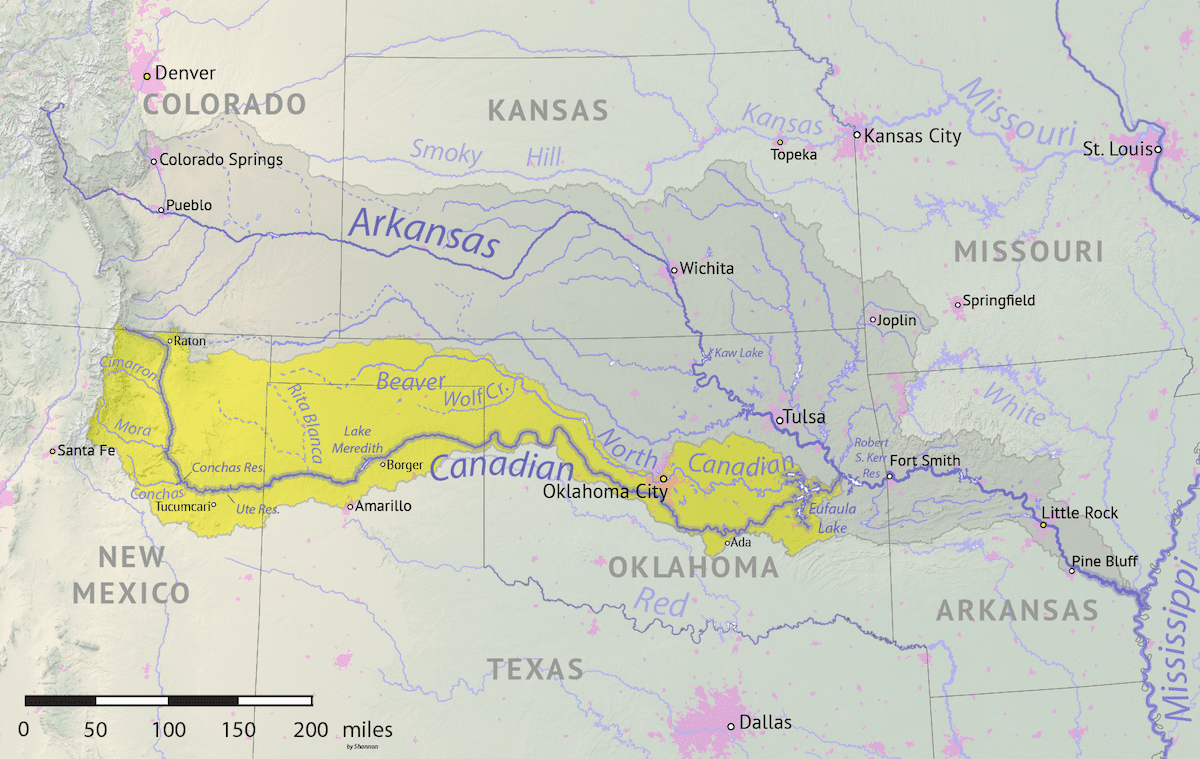
South Canadian River – Las Animas County, CO | San Isabel National ForestSince becoming a father ruined that weekend’s escape, A few weeks late, I signed the two of us up for the end-of-season race, the Canadian River Cross-country. A 120 mile race that started on the west end of Lake Meredith, a pitiful hole that might have been a lake at some time, but was just a big ditch most of the year in the 70s. From there west to New Mexico, the Canadian “River” was a long, wide trench with spotty pools of water, usually surrounded by rocks. I do not remember where exactly the race ended. 1971 was a LONG time ago. I remember my wife was really pissed that, after working a 90 hour week, leaving her home alone with a new baby, I was going to escape all of that bliss for a day and “go racing.” I was probably the least excited-to-be-a-young-father guy on the planet at that moment and her arguments were absolutely valid but unconvincing. Charlie was coming because he had a pickup and a great tool kit, but his interest in Cross-country was so slight that, after the first section, he turned back, loaded up his bike, and drove to the end to wait for me to show up so he could go home and get back to motocross.

I was “determined.” When I lined up with the other open class bikes, maybe 20 of us, it was the first race I’d been in since my rough scramble days on the Harley 250 Sprint. The juices were flowing, I thought i was ready to race and, even, win, and my Big Horn was faster than snot. Heavy as a buffalo, but really powerful for the time. In recent years, I’ve been told that my motorcycles are “unfit for off-road purposes,” and I just laugh at that idea because most of those characters wouldn’t even consider a mess like the Canadian River Cross-Country on a 2022 enduro. My Big Horn was heavy (400+ pounds), barely-suspended with Boge shocks (maybe 3 1/2” of travel) and the stock forks, only made real power (33hp) when the motor was wound up past 4,000 RPM, and ungainly as hell. Every bike I’ve owned from my 125 ISDT to my XT350 to my TDM850 or V-Strom adventure bikes have been far more off-road capable than that Kawasaki so-called “enduro.” In late-1971, I had no idea that there were much better options and if I had been it wouldn’t have mattered because they weren’t available or affordable in West Texas.

The flag fell and off we went. I’d spent some time boning up on the warning flags and less than 10 miles in that education paid off. Just before we entered a tight, blind, hard left in the riverbed, one of those flags fluttered just enough to clue me in that there was a hazard. The hazard turned out to be a substantial pile of rocks that was littered with bikes, bike parts, and riders. I managed to come to a stop before piling into the guy who was in front of me. He didn’t. I paddled through a narrow passage and climb to the other side of the rocks and kept going. From here out, my memories are really clouded.

I know I crashed at least a dozen times in the next 100-some miles. I remember seeing a fair number of bikes and riders stuck in swampy sand, piled into rocks, logs, and each other. I remember, somewhere near the end, smacking my engine case on some rocks, busting the cases, and slowly losing the transmission fluid over the remaining miles. I remember only being able to shift from 1st to 2nd with no neutral or other gears in the last few miles. I remember losing power like crazy and barely motoring past the finish line. Charlie was there waiting for me and we loaded my bike back into his pickup. I remember drinking something, probably beer, on Charlie’s tailgate waiting for the results. I definitely remember a long period of no motorcycle, lots of overtime, and recriminations from my wife, while I reassembled and repaired the damage to my bike from that race.

My big memory, biggest in fact, of that race was discovering that because “only” three open class bikes finished, the organizers decided that they would only trophy to 2nd place, instead of 4th as planned and announced. I guess they wanted to save money on their crappy $5 plastic trophies. I got a fuckin’ ribbon, instead, but my finishing position wasn’t even listed, since I didn’t trophy. I raced motorcycles for another ten years, ending with a series of busted ribs, toes, and fingers. I never again came close to being on the podium. I pointed, in Nebraska, well enough to progress from Novice to Expert in the “Enduro Class,” but that was a quantity-over-quality achievement.

In the 1980s, when my daughter was skateboarding with her soon-to-be-famous boarding friends in Huntington Beach, she used to wear a tee-shirt that said, “I wish I were as fast as my father remembers he was.” I guess that is about as close as I will ever get to a motorcycle trophy.

Dec 26, 2018

Face-Planting Across the Ages

350bhornIt was spring 1971 and I was well on my way into parenthood at 23 years old, a trade school dropout, living in Hereford, Texas and working 80-90 hours a week at $3.25 an hour servicing the electronic scales on cattle feed trucks. What a life! One of my new friends at my new job turned me on to a deal on a 1970 Kawasaki F5 Bighorn 350. It didn’t take long and, if I wasn’t stuck behind the wheel of the company Chevy C10 pickup blasting my way from one feedlot to the next, I was on that motorcycle. It was my first 2-stroke and the first bike I seriously tried to prep for off-road racing. 28 raging horses with a rotary valve fueled motor, a 5-speed transmission, electronic ignition, aluminum wheels, Hatta forks (at least 3” of travel), lime green paint job, and . . . lights. I don’t think Kawasaki advertised the weight. Maybe metric weights and measures numbers don’t get that big. If it was less than 400 pounds, wet, I’d be astounded.

70s helmetMy last gasps of freedom before becoming a father and really needing to rack up overtime at work would be two races: the Canadian River Cross-Country Race and a state series motocross in Dalhart, Texas. The Canadian River race was first and I was “preparing” for that race by blasting across the Texas plains on some friend’s property every spare evening could get away from work. Helmets were optional at most Midwestern 60’s motorcycle events and I had one, a gold metal flake open face unit just like the one in the picture at left. But I often took it off when I got where I was going because riding off road was “so much safer than being on the highway.” Everybody knows that, right? It, honestly, wasn’t much of a helmet and the only reason I owned it was because the rancher who sold me the motorcycle included the helmet. When I arrived at the field where I often practiced riding fast, I would sometimes take off the helmet and stick it on a fence post to be picked up when I got back from playing racer. 

One weekend afternoon, I snuck out of work and rode my Kawasaki to the practice field and for whatever reason I popped the gate loop, rode through the gate, reattached the loop, and headed into the field with my helmet still on my head. I rode around the field for a long while and after I tired of going fast, spinning around in dirt-bomb circles, and racing down the dry creek bed on the property, I decided to practice jumping big rocks. The Canadian River race was notorious for having rock piles that had to be either ridden over or you had to drag your bike across the rocks or take the long way up the river bank and back down, hoping you didn’t miss a check point in the process. Some of those river banks were a long trip up, around, and back down. If you could do it, hopping over the rocks trials-style was the way to go and I needed a lot of practice if I would be able to use that tactic in the race. 

The Bighorn’s 350 motor was an unpredictable bitch. You never really knew what would happen when you opened up the throttle. Plus or minus a hundred rpm at 3,000 rpm would be the difference between flipping over backwards or charging full speed ahead without enough torque to clear a dime under the front wheel. Hopping logs and rocks on that bike required a lot of clutch and throttle work. I was having a pretty good day working on the technique when I suddenly wasn’t. I’d been working a fairly large pointy rock from several angles when I got the full speed ahead torque-less response and slammed my front tire solidly into the rock, launching me over the bars head-first into the rock, flipping over that and landing on my back in a pile of goatheads. I remember hearing something that sounded like gunshot just before the lights went out. 

The day I wake up and can’t remember where I am or who I am will be sponsored by the many times I’ve been concussed in my life. This was one of those times. 

I don’t know how long I lay on my back in the goatheads, but it was long enough that when I decided to rejoin the west Texas population of humanoids my shirt was covered in blood. I managed to get to my feet, pull the Bighorn upright and swing a leg over it, and sit there semi-balanced for a bit longer until I remembered where I was and how to get out of there. By that time, my lime green gas tank was blood red. I was really losing a lot of blood and I didn’t know where it was coming from. I rode back to the gate, did the unloop and relooping thing, and rode to my friends’ house. I think I was hoping for a hose to clean myself and the bike off and a bandage for my lip. By then, I had figured out that I’d punched a hose clamp bolt (from the toolbag on my crossbar) through my upper lip. I could feel the wind on my teeth while I rode, even though my mouth was closed. It didn’t hurt much, yet, but I suspect it would soon. 

I got to their house and, luckily for me, they were home. I freaked them out a good bit; looking like someone had taken an axe to my face. One of the couple was a nurse and she quickly realized that my face needed stiches and she did them right there in their kitchen. Six stiches, I think. While she was stiching up my face, he took a hose to the bike and my gear. About the time the nurse was applying iodine to her handiwork, he came into the kitchen with my helmet in his hands. “Was this from today?”: He pointed to a triangular-shaped hole in the center of the very top of my helmet. 

“Nope. That’s something new.” 

We loaded my bike into his pickup and drove out to where I was fooling around when I crashed into the rock and there was a lot of gold metal flake paint on the point of that rock. I must have been launched headfirst into the largest spearhead in Texas. It was a crappy helmet, but it wasn’t crappy enough to let that rock get through to my skull. That was the first time a helmet saved my life. 

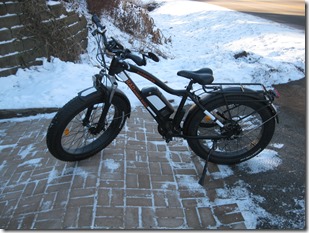
IMG_9575 Page forward to December 2018. I’m 70 and the only big moment in life I’m anticipating is my next bowel movement. No kids on the way and no demanding, unrewarding, dangerous as hell job to worry about. My grandson gave me his fairly worn-out eBike earlier this winter and I just got it back on the road. 

I bought a new winter helmet, since my usual bicycle helmet is colder than wearing nothing and isn’t really much protection. When the mailman delivered the new helmet, I had a bunch of normal errands to do and a bike ride on a 38oF December day seemed like the perfect excuse to go for a ride. I put on about 12 miles bombing around town and enjoying both the ride and my new much warmer gear (including some Bar Mitts I picked up at Red Wing Bicycle while I was downtown). Just to put some more miles on the battery and see what kind of range the bike had hauling my lard ass around town, I headed out the Cannon River Trail toward the Anderson Center at the west edge of town. I came to the gate that blocks all traffic except fat tire bikes (like mine), cross-country skiers, and hikers and scooted between the bars on to the trail. 

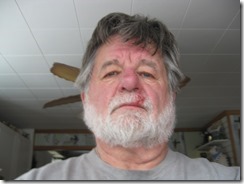
IMG_9591I made it about 30’ on the partially melted slush and the front tire zipped out from under me and dumped me face-first into the road. The slush was soft and slippery, but didn’t provide any buffer between me and the asphalt path. If you look at the middle of the front of the helmet, you’ll see the nice new dent I put in my nice new helmet on its first day on my head. Once again, I was knocked punchy for a few moments, but not unconscious this time. 

IMG_9589Once again, I punched a hole through my lip, but this time it was with a tooth. Once again, I coated my coat, pants, and bike with blood, but the hole was normal and self-healed after a couple of hours. Weirdly, it leaked saliva all over my lip for a couple of days, but it didn’t swell up all that much and while it pretty much squashed any whistling I might have wanted to do it wasn’t that limiting otherwise. No serious kissing, please. I might have been able to whistle through the hole before it closed up, but I didn’t think to try. Too late now. 

I wouldn’t have been out there on the snow if I hadn’t had the helmet, but I’d have been out there sometime this winter. You just have to ride snow sometime if you are going to live in Minnesota and be a biker. Once again, a helmet kept me from bashing my tiny brain out.

Jan 4, 2016

My Motorcycles: Kawasaki KL250 Super Sherpa

Back to Basics

All Rights Reserved © 2008 Thomas W. Day

When I got back from Alaska, I'd had enough of riding a touring bike on dirt roads. Going upside down and backwards at 50mph with 500 pounds of motorcycle and gear grinding up the roadway in front of you will change you that way. I had regretted selling my XT350 Yamaha from the day I sold it and had been watching for something like that bike ever since. I got more serious about that search in July of 2007.  One of the guys in the local dual purpose motorcycle group advertised a 2001 Kawasaki KL250 Super Sherpa on the list and I took it, sight unseen. The price was right, the size was right, and I knew this guy's word was good, so if he said it was in good condition, it would be in good condition.

2000 Kaw Sherpa 001 kawi_k1 The picture at left is of my 2000 KL250 Super Sherpa just before I sold it. The picture at right is the Australian version, called the "Stockman." Aussies get a lot of the coolest stuff from Japan and I think we should give up on getting anything useful out of Iraq and Afghanistan and immediately invade Australia to get their motorcycles. Everything about the Stockman is what I hoped to get with my own Super Sherpa. I was a little disappointed.

A friend drove me across town to pick up the bike. I took it for a test drive, swapped money for motorcycle, and drove it home through city streets to get a feel for the bike's character and problems. It turned out to have plenty of problems. It had been ridden hard and put up bent a few times and some of the bent bits bothered me more than others. When I got it home, I took it apart and began to straighten out the things I though desperately needed fixing. A couple of levers, a new front fender, new handlebars, new grips, new tires (yanked the knobbies and replaced them with street-oriented Bridgestone Trail Wings), a new chain and sprockets, a new air filter, a serious carb cleaning, and the bike was ready to ride.

I rode often it for three solid years; to work, on errands, on meandering trips into the countryside, and anywhere I would ride a bigger bike as long as the trip total doesn't exceed a few hundred miles. The bike is comfortable, insanely fuel efficient (70-90mpg!), fun to ride around town, lightweight, mostly easy to work on, and an absolute blast off road. The Sherpa is no motocrosser, but it's a fun trail bike. It's not powerful, but it can get out of its own way. I've even played trials with it, going up a staircase at work and hopping logs in my back yard. The 10" of ground clearance makes for a pretty versatile off-roader. 

2000 Kaw Sherpa 003 As a local commuter, the KL250 was a pleasure and real budget saver. When I was careful with the throttle, I could squeeze around 90mpg from a 1.4 gallon tank of fuel. If I was hammer-handed, the little guy still gave me 65-75mpg and a lot of fun. The bike is easy to park and, if you can't find a normal parking space, the Sherpa is enough of a Sherpa (you Bultaco fans know what I mean) to climb some stairs and park where the bicycles park. Top speed is about 70mph, according to the speedo. I mounted a GPS  but didn't get enough time with the touring rig to double check either the speedo or the mileage accuracy, but the bike seemed to keep up with normal freeway traffic. It's wailing at top speed, though. If there were a tach, it would probably be near redline.

My used bike came with a KLR's high fender in front. On the highway, I noticed some front end weirdness that seemed to be linked to that big fender flailing around in the wind. I dumped the high fender for an old, ugly red Acerbis low fender that I had lying idle in my garage for 15 years. The bike became more stable at speed and I lost a little mud clearance off-road. For my purposes, the trade-off was a good move. I had the Kawasaki low fender, but never bothered to try to make the KL look pretty while I was riding it. I prettied it up just before I sold it. 

Replacing the knobbies with street-aimed "trials tires" was a good move. The knobbies made the bike absolutely terrifying on grated bridges and rain grooves. The Trail Wings are a great improvement, but real street tires would improve mileage, highway stability, and street traction. I may keep looking for the perfect DP tire for this bike. Since the KL is so light, I'm unconvinced that I need knobbies to get me out of the kinds of dirt and mud situations I'm likely to experience. So far, this has been true in deep sand, muddy dirt roads, and all sorts of rock and gravel single-tracks. If trials tires do the job for Dougie Lampkin, they would probably work for me and they did fine for as long as I owned the Sherpa.

2009 Sherpa 001 The Sherpa was a work in process. To make the Sherpa a decent touring bike, I expanded the range of the 1.4 gallon fuel capacity to about 3 gallons. I added Acerbis Rally Guards, a tail rack, Eclipse bags, a small MotoFizz tailbag, and a GPS mount and electrics.  The bike was ready to go on a long North Dakota tour when it blew the countershaft oil seal and dumped all of the engine oil in a few feet. It took a season to put it back together, but my confidence in the bike was too low to trust the little guy for anything seriously adventurous. Before I sold it, I pulled off all of my mods and sold them independently. 

The seal seat design is retarded, at best, and the oil seal problem is a well-known issue with the 2000 Super Sherpa. Kawasaki used a seal that, apparently, doesn't grip to the cases and is easily pushed out. It's possible there was a breather problem, but I found no evidence of that. After replacing the seal, it still leaked; slowly, but surely. I replaced the seal, again, and it still leaked. I couldn't figure out the carb problem from the last time it gummed up and I gave it to a friend who discovered the oil seal seat stops just before a beveled bit of the case housing. If he tapped the seal flush to the outer case, the seal got bound on that bevel and leaked. -Not an intuitive or impressively secure design. It turned out that I managed to lose the anti-backfire spring during the last cleaning and that's why it gave me so much trouble starting and running smoothly. I gotta get a bike lift. Seeing all of that stuff would have been a lot easier if I wasn't crawling around on my garage floor to do maintenance. I'm too old for lying on concrete.

2009 Sherpa 004The Super Sherpa is about the only modern DP bike with a reasonable seat height. However, that low seat height has a cost. One price paid is the slight difference between the bottom of the fuel tank and the carb fuel inlet. This close relationship means the fuel pressure is barely enough to push fuel past the float needle. Add a fuel filter and you might not be able to get the last half-gallon out of the tank. When I put a small ceramic fuel filter on my stock tank, I lost about 30 miles of range due to this problem. The gas was there, I just couldn't get it into the carburetor. Even worse, the reserve petcock position wouldn't give me much more than a 1/4 mile before the bike sputtered to a stop. With all of the tiny anti-pollution jets and air passages, the tank filter isn't enough to keep particles from stopping up the carb and an accessory filter isn't a possibility. That means regular carb cleaning is part of owning a Sherpa.

After a year of messing with the Sherpa, I decided to return it to mostly stock form. I went back to the stock low fender, not as effective as the Acerbis fender, but less color-jarring. I reinstalled the stock tank, removed the handguards, and cleaned it up to sell. After all that, I rediscovered how much fun this little bike is to ride. For its intended purpose, urban commuting and light weight off-roading, the Kawasaki Super Sherpa KL250 is a decent, well-behaved motorcycle.  Since I replaced it with a fuel-injected Yamaha WR250X most everything I liked about the Sherpa will still be in my stable. The one thing I will be losing is that great mileage. The WRX squeezes 60-65 miles from a really carefully managed gallon, but more typically turns in 55mpg consumption.

Since I didn't need it anymore, I kept a little hope alive that my grandson might want to go off-roading with me. He expressed exactly zero interest in motorcycling last summer and, again, this summer. So, I put the Sherpa on Craig's List and it went in a week to the first caller.

KL250 Specifications

Engine
Four-stroke, DOHC, 4-valve single cylinder  
Bore x Stroke
72.0 x 61.2mm  
Fuel System
Single 34mm Mikuni BST34 carburetor  
Transmission
Six-speed  
Frame Type
Semi-double cradle, high-tensile steel  
Front suspension/wheel travel
36mm telescopic fork / 9.1 in.  
Front Tire Size
2.75 x 21  
Front brakes / rear brakes
Single hydraulic disc / Single hydraulic disc  
Overall width
30.7 in.  
Seat height
32.7 in.  
Ground clearance
10.6 in.  
Curb weight
282.1 lbs.

Kawasaki KL250 Accessories

Air Filter

From my experience, this is a no-brainer. I replaced the stock filter with a K&N. I have had K&N filters in every vehicle I have owned since my 1973 Rickman 125 ISDT and my 1973 Toyota Hilux pickup. Call me "superstitious," but I think those filters have added something to the incredible reliability I've experienced in my vehicles. I don't consider a K&N filter an aftermarket "accessory." I think the lack of a K&N filter is simply an incompetent motorcycle design that has to be rectified before the bike is a reliable vehicle.

Kawasaki's Rear Luggage Rack

This is a middle-of-the-road piece of equipment that isn't great but is far from bad. Like many factory racks, the Kawasaki piece has a 5 pound recommended max load capacity. Obviously, that is close to useless, so I'll be exceeding their recommended capacity by 2-4x. I plan to take the Sherpa on a trip or two, so the ability to carry some luggage is going to be critical.

Eclipse P38 Saddle Bags

I've had these bags since my 1st Yamaha TDM. On the Sherpa, they work well, minimally affect handling, and hold a fair amount of junk. Like a Colorado neighbor who'd used his P38's for years of commuting, my bags are severely bleached out but they still work flawlessly. I had to build a heat shield to keep the exhaust from baking the right side bag, but it was fairly simple and seems to work fine.

Nov 2, 2015

My Motorcycles: 1986 Kawasaki KLR 600

If you're a glutton for punishment, you can learn more about the KLR600.

klr600 You might be able to tell from all the non-stock stuff on this bike that I really wanted the KLR to be my personal statement about motorcycling. I spent way too much on accessories and customizing the KLR600. When it was all said and spent, the brutal fact remained; this was the worst, least functional motorcycle I'd ever owned. The KLR600 couldn't get out of it's own way. It's only claim to fame was electric start. Otherwise, the bike was a monster loser in every way. In many ways, the KLR more resembled the first Kawasaki I'd ever owned (the 350 Bighorn), than any other bike I've had.

The suspension was soggy, made even more awful by the extra weight the 6 gallon Acerbis tank lent to already pitiful forks. The motor was anemic and easily overheated, even though it was watercooled. The handling was poor on pavement and awful on dirt. Rain grooves turned the KLR into something nightmarish. So did stream crossings. Mileage was a mediocre mid-30's, unless you babied the throttle like you were driving a GM Suburban. The seat height was too tall for comfort while the ground clearance was not much better than the '82 Yamaha Vision street bike it replaced. I could go on for pages. In short, the KLR 600 sucked.

I built the custom, stainless steel saddlebag racks, you see at the back of the bike (just below the "600" on the seat). The design allowed me to use a variety of bicycle panniers, saving a lot of money and adding a lot of options for in-town and touring luggage. It worked a lot better than the bike did.

Our relationship even ended badly. I sold the bike to a German tourist, in Southern California. The kid promptly killed the engine by riding it for several miles with the kickstarter half engaged, trapped behind his leg. When the starter gear seized, it took out a piece of the cases and he ignored that noise just as he'd ignored the grinding of the starter gear. After the engine oil was emptied out, the engine seized and that stopped him.

On discovering that he'd managed to turn his $1,600 investment into a pile of trash, he sued me in small claims court. Fortunately, he was stupid enough to explain what he'd done to the judge, while still expecting me to foot the bill for his stupidity, and the judge laughed him out of court, after giving him a short lecture on the word "used." Still, I wasted a morning of my life and several hours getting ready to present my case. For a while, I thought the KLR was never going to let me escape from its clutches. (pun intended)

Sep 21, 2015

My Motorcycles: 1971 Kawasaki Bighorn 350

Learn more about this bike

350bhorn The Kawasaki Bighorn was my first real dirt bike. The link above tells you a lot about this history of this rotary-valved, 350cc two-stroke, 33-hp, 400+ lb. monster. It's important to remember, however, that these guys appear to like ancient motorcycles. What I remember most about my green machine was its unpredictability. The bike would do something different every time you applied the throttle, tried to turn, tried to stop, or tried to start it up in the morning. Occasionally, I felt like I knew what I was doing on this bike, when it went where I pointed it, as fast as I'd intended it to go. Usually, I felt like streamers dangling from the handlebars as the Big Horn rocketed into some obstacle that I'd intended to wheelie over, slid into a low-side because the motor busted the back wheel loose when I thought I had it loaded up enough to guarantee traction, or launched me into a high-side when the bike hooked up when I felt sure I could power through a turn steering with back wheel slip.

I'm pretty sure the Bighorn weighed more than my 1992 850 TDM street bike. It sure handled worse, on or off road. But it did start me off on a lot of years of fun and adventure. And it was a pretty cheap bike to get started on ($300 for a like-new 1971 F5 in 1972). Since I fell down and broke bits of it almost every time I went riding, it was helpful that parts were cheap, too..

The one and only competition I ever attempted with the Bighorn was the Canadian River (Texas) Cross Country Race, in (I think) 1972). I was one of four open class bikes to finish the race, about 30 started as I remember. Because so few finished, the promoter only trophied to third class. All of the other classes trophied to fifth. It was one of the few times I had a chance to leave a race with something more than bruises and stories to tell and I'm still pissed about missing out on that piece of chrome plated plastic. Later, I managed to earn a few ribbons and some tires or accessory parts racing motocross and such, but that race was the last event I rode that actually offered a trophy and the last time I was in a position to earn one.

I moved the Big Horn with me from Texas to Nebraska, but quickly ended up on a Rickman 125 ISDT and the Big Horn ended up in a neighborhood kid's garage after the kid pulled the air filter in a misdirected attempt to "get more power." He got a burst of power, just before the leaned out mixture seized the piston and never managed to find enough money to put it back together. When I moved, the bike was being chewed up by garage mice and I doubt that it ever ran again.

Nov 30, 2013

MOTORCYCLE REVIEW: 2009 Kawasaki Versys KLE650

All Rights Reserved © 2009 Thomas W. Day

Gus handed over the Versys at about 8PM on a rare temperate early April evening. Our test bike was decked in Kawasaki's Candy Lime Green, which was a nice thought after this particularly nasty winter. The weather was perfect, mid-70s, but the sun was going down fast. I had been fighting off a cold or flu all day long, but I thought I’d take a chance on getting in some early evening and night miles before calling it a day.

The Versys is truly a “naked bike” and the tiny shield provides minimal wind protection. Still, I immediately liked the Versys during the downtown freeway-cager-dual. The skinny profile, high seat (33.1"), standard knee-bend, well-positioned mirrors, and quick throttle response puts the rider in a good position to survive urban traffic pitfalls. I headed north of the cities and tooled around a couple of familiar small lake roads.

I compare everything to my V-Strom’s lights and the KLE650 compared well. I’m not a fan of night riding, but if I absolutely had to cover some miles at night the Versys’ lights would make it safe and reasonably comfortable. I kept an eye out for hoofed rats and put in about 60 miles before calling it a night.  The nicely tucked-in signal lights do their job, too.

versys1 When I pulled into my garage, I took some time to scope out the Versys’ details. The console is ergonomically neat and useful.  The front suspension gives 5.9" of travel and the rear is good for 5.7", pretty similar to adventure touring numbers. The shock has adjustments for the spring preload and rebound damping, as do the forks. The underseat territory exposes easy access to a small tool bag, owners' documents, the battery, fuse holder, and a pair of helmet hooks. There is room under the seat for a decent tool kit. Both levers are adjustable to fit your reach and style of shifting and braking. The rear brake is also conveniently adjustable. After a few moments of fooling with the controls, I had the bike feeling as familiar as my regular ride. The air filter is hidden deep under the tank and plastic, which makes cleaning of that oiled screen device slightly cumbersome. The stainless exhaust/catalyzer is brilliantly contained under the engine, with the output aimed at the ground adding an additional bit of noise suppression that will irritate the loud pipe punks into feats of engineering foolishness. From the side, it looks like the convoluted under-engine exhaust is protected by a bashplate, but it’s just a cosmetic plastic panel hiding the pipe. The exhaust shape does, however, eliminate most of the aftermarket centerstand options. versys-6

It's hard not to compare the Versys to my V-Strom, so I'll just give in to that fault and make the best of it. The Kawasaki is 28 pounds lighter and has a 5 1/2" shorter wheelbase and a seat height that is 1" taller than the Suzuki. That results in a bike that feels smaller and more nimble. In the garage, standing next to my V-Strom, the Versys looks unnaturally svelte, or the V-Strom looks like something that would invite a verse or two of Sir Mix Alot's "I Like Big Butts." The Versys' narrow profile is perfect for urban commuting, especially if you are lucky enough to live somewhere enlightened enough to allow filtering and lane-splitting.

According to Kawasaki's marketing literature, the Versys (marketing-cutesy-speak for "Versatile System") is a sportbike. The suspension, upright riding position, tall seat height, and styling hint at something else. The KLE650 may be competition for the V-Strom, but the Versys is a different animal. Gus compared it to the early 90's Yamaha 850 TDM, although it might be even closer to the intent of the 900 TDM that Yamaha has kept selling right up to 2009 in Europe and other civilized parts of the world. Kawasaki is not aiming the Versys at the KLR adventurer touring crowd the way Suzuki pointed the V-Strom. This is more of an adventure commuting bike. The roughest road Kawasaki probably intended for the Versys would be cobblestones or practically any St. Paul residential street. The Rest of the World has enjoyed the Versys' ancestor—the KLE500 parallel twin adventure touring bike—since 1991 and, in 2007, Kawasaki replaced and upgraded that versatile vehicle with the 650 which made it to the US in the 2008 lineup.

Kawasaki says, “The Versys was created for pavement riding on back-roads and city roads. As a result, the fuel injection system was . . . fully mapped so the mid-range from 3000-6000 revs would receive a nice and strong response from the throttle.”  I expected a little more bottom end performance, but once I got used to having to rev the motor above my usual shift points I found plenty of performance in the 650 twin. On the highway, 6th gear at 4000rpm = 55mph and 5000 = 70mph. At the end of the shifting cycle, the bike always felt like it could use another gear, but that was partially because I was trying to take it easy during the break-in miles. The mid-sized twin rolls smoothly away from stops at anything over 2000rpm and the power was usable near 1500rpm. If you downshift late, you'll still have plenty of power to pull smoothly through the tightest corners. During my ride, the Versys got 45.5mpg over a wide range of plugging-along-in-town and hauling-ass country road miles.

versys-3 For my test ride, I headed north out of St. Paul into the countryside. The view from the seat is unobstructed by the tiny shield and "clean air" is all that hits your helmet, since the shield is too low to provide coverage or turbulence above mid-section. Taking my favorite two-lanes toward Taylor's Falls, I kept a light hand on the new engine while getting a feel for the bike's handling. Winding my way to Red Wing, I had nothing but fun trying to find the Versys' limits on Wisconsin's county Letter Roads.  Like the late-80's Honda 650 Hawk, the Versys chassis is up for anything the motor can deliver. That adds up to a confidence-inspiring ride providing challenge for experienced riders and fun for newbies. On the way up the viewpoint in Red Wing, I almost touched a toe in the switchbacks. Maybe later in the season, I'll be able to push the bike hard enough to make it work a little, but in April I'm lucky to have moments of mild competence. On the way back from Red Wing, I slipped up and found myself on a fairly hostile gravel road and the Versys handled it at least as well as my V-Strom. I think there is an adventure touring bike barely under the surface of the KLE650's sportbike veneer.

 versys-9 No perfect day goes uncontaminated. By late afternoon, I'd managed to evolve my earlier symptoms into a full blown flu. On a sunny 50oF day, I was shivering from chills, my joints ached, I'd filled the helmet with snot, and I'd coughed and sneezed so often that my face shield was opaque. Even with all of those complaints, the Versys was comfortable. In fact, I think the KLE650's is fitted with the first Japanese factory seat that I think could be described as "competent." I'd put in about 300 miles and 8 hours on the bike with my loaded 'stich courier bag slung across my back for my first "long" ride of the season and my knees still worked, my back was no worse for the wear, and I'd had fun. 

In the August issue, Motorcyclist Magazine called the 2008 Versys the "Motorcycle of the Year," which created a blast of late season arguments. When a Versys found its way to the middle of the campground at last year's Boring Rally, it drew a crowd of admirers. Before the recession hit, Kawasaki was bombarded by an email campaign asking the company to bring the Versys to the US. If the economy doesn't do in this effort from Kawasaki, the Versys ought to be a hit. With an MSRP of $7,099, the Versys is priced $400 below Suzuki's popular V-Strom.

Accessory/farkle manufacturers have been busy creating add-ons for the KLE650. Kawasaki/MRA are providing larger windshields and an adjustable top spoiler. GIVI has created tall windshields, luggage, and rear racks. Several companies make aftermarket seats. Zeta offers the XC Deflector handguards with an "optional LED flasher strip." You can buy suspension lowering kits. The usual suspects make hooligan-style exhaust and slip-on systems. For the adventurer touring crowd, Mototoys of Australia makes a stylish bashplate and at least one US farkle supplier is working on a centerstand.

Specifications

Maximum Torque 44.9 lb/ft @6,800 rpm
Cooling Liquid
Fuel Injection Digital fuel injection with two 38mm Keihin throttle bodies
Ignition Digital CDI
Transmission 6-Speed
Final Drive O-Ring Chain
Frame Semi-double cradle, high-tensile steel
Rake/Trail 25°/4.3 in.
Front Tire Size 120/70-17
Rear Tire Size 160/60-17
Wheelbase 55.7
Front Suspension / wheel travel 41mm hydraulic telescopic fork with adjustable rebound and preload / 5.9 in.
Rear Suspension / wheel travel Single offset laydown shock with adjustable rebound and spring preload / 5.7 in.
Front Brake Type Dual 300mm petal discs with two-piston caliper
Rear Brake Type Single 220mm petal disc with single-piston caliper
Fuel Tank Capacity 5.0 gal.
Seat Height 33.1
Curb Weight 454.1 lbs.
Overall length 83.7 in.
Overall width 33.1 in.
Overall height 51.8 in.
Color Candy Plasma Blue, Candy Lime Green
Warranty 12 months
Good Times™ Protection Plan 12, 24, 36 or 48 month

May 9, 2012

Back to Basics

All Rights Reserved © 2012 Thomas W. Day
When I got back from Alaska, I'd had enough of riding a touring bike on dirt roads. Going upside down and backwards at 50mph with 500 pounds of motorcycle and gear grinding up the roadway in front of you will change you that way. I had regretted selling my XT350 Yamaha from the day I sold it and had been watching for something like that bike ever since. I got more serious about that search in July of 2007.  One of the guys in the local dual purpose motorcycle group advertised a 2001 Kawasaki KL250 Super Sherpa on the list and I took it, sight unseen. The price was right, the size was right, and I knew this guy's word was good, so if he said it was in good condition, it would be in good condition.


The picture at left is of my 2000 KL250 Super Sherpa just before I sold it. The picture at right is the Australian version, called the "Stockman." Aussies get a lot of the coolest stuff from Japan and I think we should give up on getting anything useful out of Iraq and Afghanistan and immediately invade Australia to get their motorcycles. Everything about the Stockman is what I hoped to get with my own Super Sherpa. I was a little disappointed.

A friend drove me across town to pick up the bike. I took it for a test drive, swapped money for motorcycle, and drove it home through city streets to get a feel for the bike's character and problems. It turned out to have plenty of problems. It had been ridden hard and put up bent a few times and some of the bent bits bothered me more than others. When I got it home, I took it apart and began to straighten out the things I though desperately needed fixing. A couple of levers, a new front fender, new handlebars, new grips, new tires (yanked the knobbies and replaced them with street-oriented Bridgestone Trail Wings), a new chain and sprockets, a new air filter, a serious carb cleaning, and the bike was ready to ride.

I rode often it for three solid years; to work, on errands, on meandering trips into the countryside, and anywhere I would ride a bigger bike as long as the trip total doesn't exceed a few hundred miles. The bike is comfortable, insanely fuel efficient (70-90mpg!), fun to ride around town, lightweight, mostly easy to work on, and an absolute blast off road. The Sherpa is no motocrosser, but it's a fun trail bike. It's not powerful, but it can get out of its own way. I've even played trials with it, going up a staircase at work and hopping logs in my back yard. The 10" of ground clearance makes for a pretty versatile off-roader. 

As a local commuter, the KL250 was a pleasure and real budget saver. When I was careful with the throttle, I could squeeze around 90mpg from a 1.4 gallon tank of fuel. If I was hammer-handed, the little guy still gave me 65-75mpg and a lot of fun. The bike is easy to park and, if you can't find a normal parking space, the Sherpa is enough of a Sherpa (you Bultaco fans know what I mean) to climb some stairs and park where the bicycles park. Top speed is about 70mph, according to the speedo. I mounted a GPS  but didn't get enough time with the touring rig to double check either the speedo or the mileage accuracy, but the bike seemed to keep up with normal freeway traffic. It's wailing at top speed, though. If there were a tach, it would probably be near redline.

My used bike came with a KLR's high fender in front. On the highway, I noticed some front end weirdness that seemed to be linked to that big fender flailing around in the wind. I dumped the high fender for an old, ugly red Acerbis low fender that I had lying idle in my garage for 15 years. The bike became more stable at speed and I lost a little mud clearance off-road. For my purposes, the trade-off was a good move. I had the Kawasaki low fender, but never bothered to try to make the KL look pretty while I was riding it. I prettied it up just before I sold it. 

Replacing the knobbies with street-aimed "trials tires" was a good move. The knobbies made the bike absolutely terrifying on grated bridges and rain grooves. The Trail Wings are a great improvement, but real street tires would improve mileage, highway stability, and street traction. I may keep looking for the perfect DP tire for this bike. Since the KL is so light, I'm unconvinced that I need knobbies to get me out of the kinds of dirt and mud situations I'm likely to experience. So far, this has been true in deep sand, muddy dirt roads, and all sorts of rock and gravel single-tracks. If trials tires do the job for Dougie Lampkin, they would probably work for me and they did fine for as long as I owned the Sherpa.

The Sherpa was a work in process. To make the Sherpa a decent touring bike, I expanded the range of the 1.4 gallon fuel capacity to about 3 gallons. I added Acerbis Rally Guards, a tail rack, Eclipse bags, a small MotoFizz tailbag, and a GPS mount and electrics.  The bike was ready to go on a long North Dakota tour when it blew the countershaft oil seal and dumped all of the engine oil in a few feet. It took a season to put it back together, but my confidence in the bike was too low to trust the little guy for anything seriously adventurous. Before I sold it, I pulled off all of my mods and sold them independently. 

The seal seat design is retarded, at best, and the oil seal problem is a well-known issue with the 2000 Super Sherpa. Kawasaki used a seal that, apparently, doesn't grip to the cases and is easily pushed out. It's possible there was a breather problem, but I found no evidence of that. After replacing the seal, it still leaked; slowly, but surely. I replaced the seal, again, and it still leaked. I couldn't figure out the carb problem from the last time it gummed up and I gave it to a friend who discovered the oil seal seat stops just before a beveled bit of the case housing. If he tapped the seal flush to the outer case, the seal got bound on that bevel and leaked. -Not an intuitive or impressively secure design. It turned out that I managed to lose the anti-backfire spring during the last cleaning and that's why it gave me so much trouble starting and running smoothly. I gotta get a bike lift. Seeing all of that stuff would have been a lot easier if I wasn't crawling around on my garage floor to do maintenance. I'm too old for lying on concrete.

The Super Sherpa is about the only modern DP bike with a reasonable seat height. However, that low seat height has a cost. One price paid is the slight difference between the bottom of the fuel tank and the carb fuel inlet. This close relationship means the fuel pressure is barely enough to push fuel past the float needle. Add a fuel filter and you might not be able to get the last half-gallon out of the tank. When I put a small ceramic fuel filter on my stock tank, I lost about 30 miles of range due to this problem. The gas was there, I just couldn't get it into the carburetor. Even worse, the reserve petcock position wouldn't give me much more than a 1/4 mile before the bike sputtered to a stop. With all of the tiny anti-pollution jets and air passages, the tank filter isn't enough to keep particles from stopping up the carb and an accessory filter isn't a possibility. That means regular carb cleaning is part of owning a Sherpa.

After a year  of messing with the Sherpa, I decided to return it to mostly stock form. I went back to the stock low fender, not as effective as the Acerbis fender, but less color-jarring. I re-installed the stock tank, removed the handguards, and cleaned it up to sell. After all that, I rediscovered how much fun this little bike is to ride. For its intended purpose, urban commuting and light weight off-roading, the Kawasaki Super Sherpa KL250 is a decent, well-behaved motorcycle.  Since I replaced  it with a fuel-injected Yamaha WR250X most everything I liked about the Sherpa will still be in my stable. The one thing I will be losing is that great mileage. The WRX squeezes 60-65 miles from a really carefully managed gallon, but more typically turns in 55mpg consumption.

Since I didn't need it anymore, I kept a little hope alive that my grandson might want to go off-roading with me. He expressed exactly zero interest in motorcycling last summer and, again, this summer. So, I put the Sherpa on Craig's List and it went in a week to the first caller.

KL250 Specifications

Engine
Four-stroke, DOHC, 4-valve single cylinder
Bore x Stroke
72.0 x 61.2mm
Fuel System
Single 34mm Mikuni BST34 carburetor
Transmission
Six-speed
Frame Type
Semi-double cradle, high-tensile steel
Front suspension/wheel travel
36mm telescopic fork / 9.1 in.
Front Tire Size
2.75 x 21
Front brakes / rear brakes
Single hydraulic disc / Single hydraulic disc
Overall width
30.7 in.
Seat height
32.7 in.
Ground clearance
10.6 in.
Curb weight
282.1 lbs.

Kawasaki KL250 Accessories

Air Filter
From my experience, this is a no-brainer. I replaced the stock filter with a K&N. I have had K&N filters in every vehicle I have owned since my 1973 Rickman 125 ISDT and my 1973 Toyota Hilux pickup. Call me "superstitious," but I think those filters have added something to the incredible reliability I've experienced in my vehicles. I don't consider a K&N filter an aftermarket "accessory." I think the lack of a K&N filter is simply an incompetent motorcycle design that has to be rectified before the bike is a reliable vehicle.

Kawasaki's Rear Luggage Rack
This is a middle-of-the-road piece of equipment that isn't great but is far from bad. Like many factory racks, the Kawasaki piece has a 5 pound recommended max load capacity. Obviously, that is close to useless, so I'll be exceeding their recommended capacity by 2-4x. I plan to take the Sherpa on a trip or two, so the ability to carry some luggage is going to be critical.

Eclipse P38 Saddle Bags
I've had these bags since my 1st Yamaha TDM. On the Sherpa, they work well, minimally affect handling, and hold a fair amount of junk. Like a Colorado neighbor who'd used his P38's for years of commuting, my bags are severely bleached out but they still work flawlessly. I had to build a heat shield to keep the exhaust from baking the right side bag, but it was fairly simple and seems to work fine.

Apr 7, 2012

Call Me "Doubting Thomas"

My MMM editor, Sev, is convinced that I hold grudges for too long. I hadn't thought about this much, but after our conversation and a recent event I realized that he's right about the first half. Regarding the second part of that assumption, I think I hold my grudges for exactly the right amount of time. The conversation began when I doubted the validity of the surface-skimming review we recently published on the Hyosung GT250. The two page love-fest-without-a-fault puff piece seemed to be more of a marketing blurb than an MMM review. Even the loud exhaust system was given a PR polishing ("I had to repeatedly look behind me to see what big bike was coming up on me. The exhaust sounding so powerful, I was sure I was going to get lapped."). The oversized picture of the vintage-looking GT showed too much detail because the marginal quality welds were obvious even in black-and-white. The positive side of the review was that it appeared to be, mostly, promoting a good local dealer; Mill City Motors. The negative side was that it appeared to be more of an apology to Hyosung than an actual critical review.

My history with Hyosung has to get in my way, though. That's where this discussion began. The fact is, I am a firm believer in "Screw me once, shame on you. Screw me twice, shame on me." I don't forgive and forget easily. In my studio service business, I have an unbending policy that says if you don't pay me 60 day after I invoice you, the next time you need me I'll ask for a retainer before I leave home. If I don't get it, I don't do the work. If you manage to find a way to stiff me for any amount of money, I'll block your telephone number from my business and any email will go directly to the Junk folder and be automatically trashed. I'm old. I have more work than I want. I don't need new customers and people who don't pay their bills don't even qualify as "customers." They're just freeloaders.

I was reminded of my habit, again, this past week. I did some audio work for MPR and the school where I work with students from one of my classes. We've done this project a half-dozen times with some pretty substantial local bands in the past. The most recent event was with a very local band with a minimal following and who drew a couple dozen people to the show we recorded. Afterwards, the band went prima donna on us and inserted themselves into an "approval" process of the show that will probably result in the the show's cancellation. Honestly, that works for me. And from here out, if I'm asked to do anything with that group or the group's members, I'll find somewhere else to be. Burn me once . . . you know the story.

I've applied the same logic to my vendors for decades. In the motorcycle world, I've been burned twice on motorcycles: once on a brand new 1974 Suzuki RL250 and once on a barely used 1986 Kawasaki KLR600. Both bikes were unreliable crap and the Suzuki actually cost me a bit of money when I had next-to-none. It was the second new motorcycle (and the last) I've owned. I bought it in 1974 for $1,100 and a year later Suzuki dropped the price on the RL to $700 to unload their 1974 inventory and bail out of trials forever. Obviously, I took a beating; value-wise. I didn't consider owning another Suzuki until the SV650 had been well shaken out and I bought a nearly new 1999 in 2000 for about 1/2 of Blue Book. I bought my 2nd Suzuki in 2006, when I bought my barely used DL-650 for 2/3 of Blue Book. The Kawasaki was a POS from the day I bought it and the longer I owned it, the more disappointing it was. Even selling that bike was a problem. I didn't own another Kawasaki until I bought my 2000 KL250, used and cheap, in 2005. That bike was also a disappointment and I don't expect to own that brand again. Compare those experiences with my Honda, Yamaha, and, even, Rickman/Zundapp bikes and I'm uninspired to experiment again.

There is a restaurant rule that says something like, "It takes $5,000 in advertising to get a customer to try a new restaurant and 5 seconds of poor service to push that customer back out the door. It will take 5 years of marketing to get that customer to try it again." Choose your numbers, but the fact is in a world with lots of options, you don't get a lot of chances to satisfy your customers. There are no do-overs in life or business. I may be a "moto-journalist," but that doesn't make me a sucker or a shill. I'm too old and too cranky to kiss up to a half-assed Korean manufacturer of questionable quality or character. I'll give them a decade and we'll see if they are still around to review after they've settled in a bit.

There are a collection of manufacturers that I won't buy from, based on past experience and an overwhelming number of acceptable alternatives: Tascam, Sony, Presonus, Adobe, MOTU, Toshiba (Toughbooks aren't), and ProCo are among the list. The list of companies I look for when buying is probably a lot longer. I'd bet you have your biases, too. I bet even Sev has a few. Why should I pretend to be different than I am? Why would I want to?

Jul 11, 2011

Second Chances

Last night, I sold my 2000 KL250 Kawasaki Super Sherpa. The buyer was an older guy who showed up to check out the bike on a big Kawasaki cruiser of some sort. (Sorry, they all look alike to me. He told me what it was, but I just don't care.) He took the bike for a long test ride, both on the street in in my backyard "test range," we haggled a bit, he put down some money and said he'd be back the next day with the cash.

The next morning, he called and wanted me to put all of the LD stuff on the bike for him so he could see that it all fit. I didn't express a lot of motivation. It felt like he just wanted to jerk me around. Later that day, he called and said he was having second thoughts and didn't want the bike after all. I had three other buyers who I'd already told the bike was sold. I've already deposited the deposit check, so giving him his money back is out of the question, at least until the check clears. He seemed to think that was unfair. Not having been in this position before, I don't know what to think.

Oddly, other than the hassle and wasted time, I'm sort of relieved. I had some alternative plans for the Sherpa that I wasn't all that happy about canceling. On the wild chance that my grandson gets over teenage angst and decides he wants to ride a motorcycle, the Sherpa would be hard to beat. I sort of thought about keeping it around as a backup bike for when friends need a temporary ride. It is an insanely fun motorcycle around town and sometimes gets nearly 100mpg.

Like most carbureted motorcycles, it's a pain in the ass to start in the winter and starting is not all that reliable anytime the temperature gets below 40F. I think that's fixable, but so far the fix has eluded me. So, for the time being it's still a project bike. I might put it right back up on Craig's List, but I'm in no hurry at the moment.

I've heard of this kind of funky transaction, but this is my first experience with a sale that turned into no sale. What do you do with the deposit? I've been on the other end of this sort of transaction before, but it never occurred to me to renege on the transaction once I have said "I'll take it." Must be a cowboy thing.

Jul 13, 2009

All Dressed Up, Need Someplace to Go

When I was in Nova Scotia last summer, a card table full of old men at a campground were telling Hardly jokes (once they figured out I wasn't riding a Harley) to pass the time during a week-long rainstorm. The only one I remember was, "How are a Laborador dog and a Harley Davidson motorcycle alike? They both like to ride in the back of a 3/4 ton pickup truck and drool."

I have my Sherpa up and working again, after the countershaft seal catestrophe, but it now drools like a Hardly. I replaced the seal, twice, and the o-ring, once, and it's not leaking enough to be able to tell if it's the seal or the o-ring, but every morning there is a spot of oil below the countershaft sprocket. I can't see any sign that I'm losing oil at any dangerous rate, after 100 miles post repair, but I'm obviously losing oil, a drop at a time.

Yeah, I know, all the color-uncoordinated parts make the bike look like it just escaped from a salvage yard. More evidence that I will never develop a sense of style. You should be impressed that I even notice the color clashes at all. Two decades ago, I would have ignored any such comments as "gay eye for the straight guy" piffle. Now that I think about it, I don't feel much different today. I like the way the bike looks. It's obviously mine.

That aside, I'm really regretting not having been able to take the Sherpa to North Dakota. My new seat design is painless for at least a couple of hours on the road between breaks. The larger pegs make standing for extended periods much more comfortable. The luggage works and I can easily carry enough gear for a week camping trip. The 15 tooth sprocket makes crusing at two-lane speeds comfortable (freeway speeds are still a little hectic) and I can still get over logs and rocks without too much bar-yanking. The bike cruises comfortably at about 60-65mph, where the stock sprocket made the engine seem more strained at that speed. On the other hand, acceloration in 6th gear is pretty lame. The new Bridgestone DP tires work well on and off-road. The 3.2 gallon tank gets me at least 250 miles between filling stations. Changing the fork oil to a synthetic mixed for around 16 weight instead of 10 (mfg's recommendation) makes the compression damping rate a little stiff, but the rebound feels much better on really rough terrain, especially when I'm loaded with gear.

With all the luggage space, this is the cool way to travel around town. I can haul a pretty decent grocery trip in all three bags, even without expanding the MotoFizz. I never have to worry about finding a parking place. On a brief trip downtown to school last week, I hopped the curb, rode up the school's stairs, and parked next to the bicycles. If I'd have been there longer, someone would have complained, but I wasn't. Saved myself $0.75 and had fun doing it.

I gotta find someplace to go on the little guy to justify all that work this spring. I'll probably carry a seal and o-ring and a quart of oil with me, just in case. Once burned . . .

Jun 13, 2009

The Best Laid Plans (and mine)


Last Friday, I was feeling confident. I'm a week away from the coolest LD trip I've ever taken and I have everything lined up and set to go. I'm going to explore the backroads, ghost towns, and out-of-the-way places of North Dakota. I've been looking forward to this trip for a year, maybe two. I've installed new everything-that-matters on my 2000 Kawasaki KL250 Super Sherpa (chain and sprockets, tires, brakes, changed the fluids everywhere, rebuilt the rear shock, checked and tightened every bolt, fastener, and clamp). I built a custom touring seat, installed a larger off-road tank, wired up a GPS, sorted out luggage and camping gear, and installed a tweeky-cool headlight. When all that was reassembled, I thought the little bike was ready for a 400 mile shake-down cruise to Duluth.

The North Dakota ride was supposed to be a point of honor demonstration that a little bike can do big things. My route sheet lines out 2500 miles of dirt roads, limited access trails, and tractor ruts, along with a few hundred miles of two lane pavement. After checking everything twice, I fired up the Sherpa to check my new brakes and made it about 5' before the countershaft seal let go, dumping the engine oil out practically instantly. Nobody local had any parts for the Sherpa, so I ordered the seal and other bits on-line. Kawasaki didn't have the parts nationally, so it took all of the week for the seal to arrive. In the meantime, an internet Sherpa expert suggested that I should have replaced the o-ring, too. All I could do was hope he was wrong, since that advice came too late for the parts order.

In the meantime, I started to get my Suzuki V-Strom prepared for a modified version of the trip. No nearly as much dirt, no tractor rut trails, and a way pared down version of the original plan, mostly on two-lane roads.

Two days before the takeoff date, the parts arrive. The seal retention design leaves a lot to be desired. In fact, there is no retention design, other than slipping the seal into the seat and hoping it stays. I'm less than impressed. I install the seal and go for a bicycle ride with my dog, while the Permatex cures.

About three blocks from home, I turn left and the dog goes right and stops and I end up on the asphalt with a two-max-sized bandage rip in my elbow, a road rashed knee, and a severely chastened dog.

After doing a half-assed first aid job on myself, I decided to give the Kawasaki seal a test; it leaks. The expert was right, I should have replaced the o-ring, too.

To be honest, I shouldn't have been surprised. My "luck' with Kawasaki machines has been mediocre, at best. My first Kawi was a 1971 350 Big Horn, one of the lamest, heaviest, worst designed two-strokes in Japanese history. It and I battled out way to the end of the Canadian River Cross Country in 1972, crossing the finish line stuck in 2nd gear, with the forks all but seized, and various bits of the Big Horn littered over the last 100 miles of dry river bed. I sold the bike to a high school kid who promptly took off the silencer and the air filter and siezed the motor in less than 25 miles. He even asked me for a refund afterwards.

My second Kawasaki experience was with the original KLR600, the 1984 model. I didn't have any particular problems with the KLR, but it was the lamest excuse for a motor I've ever experienced and the least dirt-capable dual purpose probably ever built. The German kid who bought the KLR hung on to it for less than 100 miles before he tangled the kickstarter behind his leg, grinding the starter gear for several miles before the transmission blew up. He sued me for the repairs in small claims court and was disappointed when the judge disagreed with his view of responsibility.

My opinion of Kawasaki is only slightly above my opinion of military-industrial manufacturers, especially since Kawasaki Heavy Industries makes products for aerospace, oil tankers and other big ships, and all kinds of equipment where the buyer is often spending someone else's money and is less concerned with quality, reliability, and such things. If the Sherpa hadn't fallen into my hands for a relatively reasonable price, there is no chance that I would have gone looking for a Kawasaki. In fact, I was looking for a DR350 or an XT350 when I fell into the Sherpa. When I get back from North Dakota, I'll be looking again.

The Sherpa is going to have to wait a couple of weeks or more for me to get back to it. In a couple of weeks, I'll have a pair of seals and a pair of o-rings waiting for me and I'll try the repair again. I have to admit, I'm disappointed enough in the bike to be a little soured on it. That's not rational, but there you go. I don't remember claiming to be the only rational human on the planet.