Showing posts with label helmet. Show all posts

Jan 4, 2021

“Anybody Can Ride One”

My wife is a morning television addict. We live in a rural area with no over-the-air television available and I’m too cheap for cable, so she watches the late night talk shows in the morning. The irritating noises coming from our living room inspired a hunt for the best noise-cancelling, Bluetooth, in-ear monitors so that I could avoid the morning squawking noise of Seth Myers and Jimmy Kimmel’s dry sarcasm that makes the awful seem even worse. Sometimes she is so inspired by what she sees that she is compelled to “share” it with me. This morning that interruption was inspired by a Kimmel interview with David Letterman. Apparently, Letterman bought Regis Philbin a Vespa scooter under the assumption that “everybody knows how to ride a motor scooter.” Like so many folks on Harleys every summer weekend around the nation, it turns out that assumption is idiotic. Of course, Philbin crashed after traveling a few feet on the scooter. "He could have been killed. He actually could have been killed. The last night before he retires he comes over, and I kill him," Letterman said with a laugh. "... Nobody checked him out on it, because the assumption was, A, anybody can ride a scooter. And B, certainly Regis will ride a scooter."

Back when I was still teaching the Minnesota Motorcycle Safety classes, in 2011, I wrote a Geezer rant I titled “#101 It's Not A #&^%#@ Wheelchair.” I summed up my irritation in that essay with, “My generation seems to have created a lot of people who think the laws of physics can be influenced by money, the legal system, and by a heartfelt ‘I wanna.’ Velocity and acceleration (up or down) are ruthless. Gravity is insensitive to your brittle bones and inflexible joints. You don't get special consideration on the highway simply because traffic is moving ‘too fast’ or you can't muster up the courage to make the bike stop or turn (or keep up with the flow of traffic). Other highway users expect you to ‘drive it or park it.’ Being handicapped on a motorcycle is often fatal.” Almost always, in fact. I don’t know where “anybody can ride a scooter” comes from. Sure, they have small flat wheels that almost balance themselves, but that doesn’t help at all with turning, stopping, or being aware of traffic and hazards and figuring out what to do about those hazards in an emergency.

While my wife was taking a break from her morning television routine, she was reminded of my father and his “scooter experience,” which actually was an electric wheelchair. He’d been house-bound for several years by the symptoms of progressive myasthenia gravis, failing eyesight, and CHF. My step-sister thought it would be good for him to get out of the house and she, Medicare, and the VA bought him an electric wheelchair. For a couple of days, he was like a kid with a brand new motorcycle. He rode that thing around his neighborhood, to the local grocery store, and had a great time. My step-sister, on the other hand, almost had heart failure watching him blindly (literally) barrel through busy intersections and head-on into traffic without a clue that people were dodging him and freaking out at the sight of an overweight old man in an electric wheelchair in the middle of the road. Eventually, some technical issue came up with the wheelchair and he went back to watching his big screen television and 14-hours-a-day of Fox News propaganda. It could have been as simple as the battery being run down, my father was that technically inept, and nobody showed him how to use the charger. When he died, a couple of years later, the wheelchair looked brand new. He proved that it isn’t true that “anybody can ride a wheelchair.”

In the late 1970s, we were living in a small Nebraska town and a friend, the drummer in a band I’d been in, decided he wanted to buy a motorcycle so he could ride with his friends. I was a dirt-only motorcyclist at the time and had been for 15 years, but I helped him find a good buy on a barely-used Honda CX500 Deluxe, gave him a little instruction about how to ride the bike, convinced him to buy a helmet, a decent leather jacket, some boots, and gloves. And off he went. The friends he wanted to ride with were an assortment of cruiser wannabe-biker types with a couple of actual hardcore bikers—prison tats and criminal records and all. None of the be’s and wannabes wore any actual motorcycle gear and they quickly convinced him to dump the helmet, boots, gloves, but he could keep the jacket for cool days. They also “helped” him install ape-hangers and disable the front brake, partly because the stock brake line wasn’t long enough. Not even a whole month into this experience, he flew off of the road in a mild turn, plowed through a barbed-wire fence, and tumbled almost 100’ before he ended up in a tangled heap in a corn field.

His head injury left him with a speech impediment for the rest of his life and other neurological damage that left him pretty much a very young stroke victim. His legs were broken so badly that there was talk about amputating one or both, but they ended up reassembling him with pins and rods so that he could hobble around on his own. Of course, he was no longer a musician. You have to be able to flex everything in your legs and feet to operate a high hat and kick drum and the rest of his coordination and strength wasn’t up to handling the sticks. So, he’s mostly just been a barfly for the last 40 years, luckily he had a significant inheritance to cover his expenses and to provide him with shelter. Like Regis and my father, my friend (and several of his friends over the next few years) proved that it isn’t true that “anybody can ride a motorcycle.”

The industry, of course, has a vested interest in convincing as many people as possible that they belong on an expensive motorcycle that will enhance their lifestyle and self-image. Unfortunately, the so-called “motorcycle safety” industry is usually directly connected to the manufacturers (MIC/MSF, for example) and their vested interests are all about “putting butts on seats” with minimal interference from actual safety concerns. Thanks to them and their efforts, goofballs like David Letterman are deluded into believing the hype and imagining "that anybody can ride a scooter."

Jul 8, 2019

Visible When It Counts

A "feature" of teaching is regular, frustrating failure: failure to communicate, failure to connect, failure to even be able to verify your own existence when you see the "results" of your students' test answers. If you are one of the many Americans who believe that teaching is a lucrative, rewarding, interesting job, I recommend you try it. Too often, it is just frustrating and doesn't even come close to compensating enough for the hassle. Many people who are teachers have the credentials to do something more financially and psychically rewarding and many do so after a very short stint in education. Teaching, as a calling, requires something that is rare to non-existent in modern life, "A good teacher is like a candle. It consumes itself to light the way for others."  You can only do that or so long. If you are smart, not very long at all.

When I hear the usual whining bleat of people working menial jobs who don't think their tips are big enough, I think of all the jobs that don't get tipped at all that don't pay anywhere near enough to compensate for the crap they take from an ungrateful public. In fact, most jobs don't get tips, a decent or livable income, or respect or gratitude. Teachers are high on the list of people in that category. In fact, the well-educated and trained teacher this article featured, "Why a South Carolina teacher quit at 28 — and shared her resignation letter with the world," left teaching for a waiting job which pays better, requires fewer hours, and is way less unreasonably demanding. I'm not complaining about my stint, either as a college instructor or a motorcycle safety instructor. I was in pretty good financial shape when I started those jobs and, mostly, I did them to keep from dipping into my retirement savings before I actually retired and, for a long while, because they were fun jobs. Not having to take the administration of either of those establishments particularly seriously was a giant insulator between my sanity and their general purpose weirdness. If I had been a recently graduated instructor with no financial resources and the typical blob of college debt, my situation would have been drastically different.

The only "tips" I have received from my students have been calls and emails and the occasionally note thanking me for helping them find a career or ride a motorcycle safely. Those come few and far between, not much more than a dozen times in 20 years and thousands of students. Most people think they have paid for a teacher's time and they deserve whatever comes from that. The rare student knows that is not true.

So, with that whining background behind us, a few days ago my grandson, Wolf, called to thank me for all of my years of riding tips, safety harping, and encouragement after he had a near-miss traffic incident when a cager ran a stoplight and nearly clipped him from his eBike.  Of course, the driver was fumbling with a cell phone and "didn't see" either the light or the bicyclist. She also didn't slow down after mouthing "I'm sorry" and drove off without even checking to see if he or his bicycle were damaged. What else is new, right?

Wolf, has been commuting year-round in Minneapolis by eBike for two years, going on three, and we've had lots of conversations about counter-steering, swerving, braking, and relentless paranoia with the understanding that anyone needing 4-wheels to balance a vehicle is, by default, a moron. Unlike so many of the people who filtered through the so-called "motorcycle safety program," Wolf learned a lot of hard lessons on his bicycle on empty streets in the early-morning hours (he worked night shift for a year) where errors like braking in the corners, applying brakes suddenly, riding with fingers resting on the brakes, and slight lose of attention put him on the ground in the ice instantly, but without a lot of morbidity/mortality risk because he is an AGAT guy. (See the picture at right for a bit of his winter riding gear.) After two years of well-developed braking habits, that event we all hope will never happen did and his smooth, strong application of both brakes brought the bike to a complete stop just before hitting the cager-nitwit. She brushed against his front wheel with her back bumper and almost pulled the bars out of his hands, but the contact was so slight that he didn't go down.

I'm going to guess that I have made at least 750 people miserable in my MSF Basic Rider Courses (BRC) over the last 18 years. In all that time, I have probably had no more than a half-dozen people thank me for anything other than passing them at the end of the course. Many of the people who did pass shouldn't have because they didn't have the skills, attitude, or awareness to be safe on motorcycles in real traffic. The old BRC wasn't even close to a serious safety and skills program and the new one is simply a joke intended to put as many butts on seats as possible. My grandson suffered mightily under my nagging from when he first started to ride a 16" wheel bike almost 17 years ago until this past winter. In many ways, all of the good things I have learned about riding and teaching over the last 50 years all ended up in his lap. When he was 15, we took a Rocky Mountain tour and many bikers were convinced that he was being abused in having to wear full gear, all the time, regardless of the heat. We had a lot of conversations about motorcycle operation, maintenance (his job was the check the tires and do a visual examination at every fuel stop). He did a great job, including noticing a fork seal leak that became a serious problem a few miles outside of Laramie, WY. We lucked into a great Suzuki shop there with a mechanic who knew that there were a LOT of Suzuki seals that would fit in my V-Strom.

If there were anyone on the planet who I would like to have influenced, it would be Wolf. Getting that call was the best tip I could have ever hoped for.

Jul 3, 2019

Seven Dead in New Hampshire

A motorcycle group called "Jarheads MC" ended up in a group crash that killed seven members and injured several others. A friend called to ask for my take on the crash. I don't watch much news these days, the news is always depressing and increasingly stupid, so I just wander through the tail end of my life singing a Steely Dan song, "Any World I'm Welcome To." While we talked, I checked out the news on the web. I know I was supposed to be feeling compassion for "fellow motorcyclists," but the news report didn't generate much of that from me. I have phased from ambivalence-to-numb regarding the dumb stuff that happens to bikers decades ago. (Motorcyclists are different and I do still care about stuff that happens to them.)

One of my least favorite gigs when I was teaching "motorcycle safety" classes (which especially deserves the quote hint in this situation) was trying to run an Experienced Rider Course with a pack of bikers. There would typically be 11 bikers on 11 totally illegal hippobikes with, at best, one or two competent riders in the group and four or five totally incompetent bikers and the rest in-between but closer to incompetent than competent. And every one of those hippobikes made as much noise as a 1940's farm tractor without a muffler of any sort. The worse the rider, the louder the pipes. The level of entitlement and foolishness from the group would just reek, "I am a member of a gang and we're scary. I need loud pipes on my bike to warn you that an incompetent fool is sharing the road with you. Take care of me because I can't take care of myself." The worst-of-the-worst for this kind of course would be a gang of "law enforcement officers," who would not only be lousy riders on illegal bikes but the most arrogant, entitled folks on the planet. Nothing tops a cop who is also a military veteran for someone who believes the world owes him fear disguised as "respect." Regardless of the make-up of the group, they too often all brought their required helmets strapped to the bike seat or in a saddlebag, just to make sure the instructors knew they didn't believe in that shit. So, when I hear one of the many stories of biker gangs getting involved in one more multi-vehicle pile-up, I'm not surprised, shocked, outraged, or even particularly interested. These are the people who overwhelmingly make up the 30-40% of all motorcycle fatalities that are single vehicle crashes.

In one report of the crash, a relative of one of the dead bikers said of the truck driver, "As long as he pays a price. He has caused lot of harm to a lot of families. If has a problem, he shouldn't be on the road. If he is a bad actor, he doesn't belong on the street. He caused enough of a tragedy. Enough is enough." I wish that rule were applied to motorcyclists. "Enough is enough." It's time motorcyclists were required to take responsibility for their lousy driving habits and the total criminal irresponsibility of pirate parades.

As usual, the cops are confused and irrational. “The pickup driver, Volodoymyr Zhukovskyy, 23, an employee of a Springfield, Massachusetts, trucking company, was not seriously hurt. The National Transportation Safety Board, which is investigating, said he was interviewed at the scene by police and allowed to return to Massachusetts.” First they sent the truck driver home after taking his information, then they drove to his home and arrested him on a "fugitive from justice" charge, then released him again. Nothing like muddying the waters of an already dumbed-down American media machine and the Marching Moron public. Bikers are riled up and the tiny portion of the American public who can think are wondering what really happened and if anyone will ever know.

I think it's safe to assume the eye witness reports from the bikers will be useless. Most likely, they didn't have a view of what happened, due to their concentration on riding within reach of each other, so anything that happens seems like an unavoidable hole opening in the earth. A surviving rider said, “It was just an explosion . . . with parts and Al and everything flying through the air. He turned hard left into us and took out pretty much everyone behind me. The truck and trailer stayed attached and that is why it was so devastating . . . because the trailer was attached and it was such a big trailer, it was like a whip. It just cleaned us out.” If that’s true, it sounds like 1) the truck driver was passing after the first bike or two went by and plowed into the middle of the group or 2) turning at an intersection not realizing the oncoming traffic was moving so fast or 3) fooling with his cell phone or some other distraction and wandered into the opposite lane and panicked. In the picture above, the road is pretty clearly marked as a no-passing zone.

An uncle of one of the riders said, ‘‘The truck was coming in the opposite direction. It’s hard to figure how he could hit 10 motorcycles without getting out of the way.” Obviously, the bikers were following way too close for safety. What else would they be doing. That rolling bowling pin crap is one of many reasons to stay away from group rides, especially pirate parades. I hate to think the uncle was wondering how a truck pulling a trailer could have avoided 7 bikers. The real question is how did 7 motorcycles end up tangled together by one truck? Motorcycles only have one practical defense in all traffic situations; maneuverability. Hippobikes, of course, are not real motorcycles and are really just suicide machines looking for a place to happen. So, it's not hard to figure how 7+ motorcycles couldn't find a way to get out of the way. Their typical reaction is to scream, panic, and fall over (that's "I had to lay 'er down" translated to plain English).

There are some curious aspects to the biker group, though. Only one of the fatalities was over 60. That's depressing. I keep hoping that younger people will learn from my braindead generation's many mistakes and stay away from Hardlys and the incompetent biker crowd. There is nothing that I like about motorcycle packs, peaceful or otherwise. They are “rolling bowling pins” and this truck driver almost got a ten pin strike. I have had a strong opinion about lines and biker parades for all of my life. I want to feel more compassion for these folks, but it mostly affects me like reading about a group of climbers getting killed free-climbing Yosemite's El Capitan; except without the admiration for the climbers' courage and physical skills. I guess this is more like hearing a bunch of young fat people  whine about their diabetes, physical disabilities, and likely premature death while gorging themselves on McDonalds Fatty Meals: what did you think was going to happen?

Jun 17, 2019

Why It's Not So Obvious

All Rights Reserved © 2010 Thomas W. Day

"Wear all the gear all the time." 
 
"Never go anywhere without full protection."

". . .  there is no doubt after the first time a young kid crashes his little motorcycle that the idea of what might happen, and that it can hurt, takes hold."1

"Approximately 80 percent of reported motorcycle crashes result in injury or death; a comparable figure for automobiles is about 20 percent."

You've heard it all. The politically correct choices are AGAT (All the Gear, All the Time) or Most of the Gear, All of the Time (MOGAT). Don't get me wrong. The intelligent choice is to gear up every time you ride. That idiot's claim, "If I think I'm going to do something risky, I'll put on the gear," makes about as much sense as saying "If I think I'm going to crash, I'll wear a helmet." Riding is risky. If you think you're going to crash, don't ride. Why that isn't obvious is lost on me. 
 
Those of us who started riding as kids probably have a better feeling for the disconnect between good gear advice and reality. My first (1964 or 65) racing gear was a pair of Converse high top canvas tennis shoes, a pair of Justin leather work gloves, Levis, a jean jacket, and sunglasses. I was racing either a left-turn only circle or on a modified figure "B" track with 4-6 equally well-dressed young men. None of us had ever seen a helmet outside of WWII movies. Nobody was shooting at us, so why would we need helmets? There was no AMA or any other rule-setting organization to interfere with our insanity. We just showed up at the track a couple of miles outside of town and rode 5-lap races until we got tired. A few months of that and we started putting a few dollars into a pile and awarding prize money. Someone set up a hotdog stand and sold drinks out of a cooler. Money changed hands and we kept racing in spite of the commerce. A few guys got hurt: broken arms, toes, fingers, and such. Most of us managed to get through a day of racing with no more than a few cuts and bruises.
 
Later, when I really got into off-road riding, I adopted a 3/4 helmet, gloves, lineman's boots, and lightly padded jeans and a nylon jersey. I crashed a lot, at races and in practice and goofing around. Between ages 20 and 28, I spent a fair amount of time flying over the bars, sliding down the road with the bike in front or behind me, flipping over backwards, and crumpled in a heap. All through that period, I managed to go uninjured. The lesson I took from all that good fortune was obvious: I am indestructible. I wasn't foolish enough to really believe that I couldn't be hurt. I got hurt often at work. I just managed to convince myself that on a motorcycle, I was "too good" to get busted up.
 
In early 1976, that all came to an end. Practicing for Sunday's motocross, I managed to crash and break all of the toes on my left foot. My brand new Hi-Point boots had to be cut off of my foot because the foot swelled up so quickly that I couldn't get the boot off myself. I might have cried when that happened, not from pain but from seeing my $150 boots ruined. $150 was a lot of money (for me) in 1976. A few months later, practicing again, I crashed and broke all the ribs on my left side. That event ended my period of invulnerability. I have rarely since thought of myself as being lucky, tough, or unbreakable. From then out, I was clear on how much pain I could tolerate and how quickly that point could be passed.
 
The difference between me and a real motorcycle racer was that new vulnerability added several seconds to my lap time and I never regained the confidence I needed to go WFO for extended periods. I kept riding and racing for the next four years, but I spent those years in the back of the pack. In 1982, I sold my dirt bikes and bought a used Honda CX500, upon which I moved myself to California in the early spring of 1983. My family followed a few months later by train. As insignificant as it was, my racing "career" was finished and I have never since lined up at a start gate with twenty testosterone-jacked young (or old) men. 
 
I have, however, put nearly a half-million miles on a collection of street bikes in several states and two non-US countries. Mostly, I've managed to stay rubber-side-down on my street bikes and the only breaks in that record have been on outback single-track trails or gravel roads. With that many hours on the road without mishap, it would be easy to start shedding gear.  I wear more equipment on my daily commute than I used to wear racing. What kind of sense does that make? Why not drop the armored pants? What could it hurt to ride in light-weight comfortable shoes occasionally? I'm just going to work, why bother with the helmet? Big Minnesota Mommy says I only need to wear eye protection and a speedo. If she doesn't think I need all that gear, what am I wearing it for? 
 
I've seen the results of naked biker crashes and it's not pretty. The lucky guys bust their heads open and die on the spot. The unluckiest guys end up sucking the meals out of a straw and staring at a hospital ceiling for the rest of their lives. In between, people spend their lives recovering from a fraction-of-a-second lapse. I'm not man enough to risk that for a little breeze blowing in my hair or the relief from a few degrees of discomfort. I like my skin where it is and my bones properly connected. I'll give it to you straight: I'm a coward. "I cover the stuff I want to keep."

Dec 26, 2018

Face-Planting Across the Ages

350bhornIt was spring 1971 and I was well on my way into parenthood at 23 years old, a trade school dropout, living in Hereford, Texas and working 80-90 hours a week at $3.25 an hour servicing the electronic scales on cattle feed trucks. What a life! One of my new friends at my new job turned me on to a deal on a 1970 Kawasaki F5 Bighorn 350. It didn’t take long and, if I wasn’t stuck behind the wheel of the company Chevy C10 pickup blasting my way from one feedlot to the next, I was on that motorcycle. It was my first 2-stroke and the first bike I seriously tried to prep for off-road racing. 28 raging horses with a rotary valve fueled motor, a 5-speed transmission, electronic ignition, aluminum wheels, Hatta forks (at least 3” of travel), lime green paint job, and . . . lights. I don’t think Kawasaki advertised the weight. Maybe metric weights and measures numbers don’t get that big. If it was less than 400 pounds, wet, I’d be astounded.

70s helmetMy last gasps of freedom before becoming a father and really needing to rack up overtime at work would be two races: the Canadian River Cross-Country Race and a state series motocross in Dalhart, Texas. The Canadian River race was first and I was “preparing” for that race by blasting across the Texas plains on some friend’s property every spare evening could get away from work. Helmets were optional at most Midwestern 60’s motorcycle events and I had one, a gold metal flake open face unit just like the one in the picture at left. But I often took it off when I got where I was going because riding off road was “so much safer than being on the highway.” Everybody knows that, right? It, honestly, wasn’t much of a helmet and the only reason I owned it was because the rancher who sold me the motorcycle included the helmet. When I arrived at the field where I often practiced riding fast, I would sometimes take off the helmet and stick it on a fence post to be picked up when I got back from playing racer. 

One weekend afternoon, I snuck out of work and rode my Kawasaki to the practice field and for whatever reason I popped the gate loop, rode through the gate, reattached the loop, and headed into the field with my helmet still on my head. I rode around the field for a long while and after I tired of going fast, spinning around in dirt-bomb circles, and racing down the dry creek bed on the property, I decided to practice jumping big rocks. The Canadian River race was notorious for having rock piles that had to be either ridden over or you had to drag your bike across the rocks or take the long way up the river bank and back down, hoping you didn’t miss a check point in the process. Some of those river banks were a long trip up, around, and back down. If you could do it, hopping over the rocks trials-style was the way to go and I needed a lot of practice if I would be able to use that tactic in the race. 

The Bighorn’s 350 motor was an unpredictable bitch. You never really knew what would happen when you opened up the throttle. Plus or minus a hundred rpm at 3,000 rpm would be the difference between flipping over backwards or charging full speed ahead without enough torque to clear a dime under the front wheel. Hopping logs and rocks on that bike required a lot of clutch and throttle work. I was having a pretty good day working on the technique when I suddenly wasn’t. I’d been working a fairly large pointy rock from several angles when I got the full speed ahead torque-less response and slammed my front tire solidly into the rock, launching me over the bars head-first into the rock, flipping over that and landing on my back in a pile of goatheads. I remember hearing something that sounded like gunshot just before the lights went out. 

The day I wake up and can’t remember where I am or who I am will be sponsored by the many times I’ve been concussed in my life. This was one of those times. 

I don’t know how long I lay on my back in the goatheads, but it was long enough that when I decided to rejoin the west Texas population of humanoids my shirt was covered in blood. I managed to get to my feet, pull the Bighorn upright and swing a leg over it, and sit there semi-balanced for a bit longer until I remembered where I was and how to get out of there. By that time, my lime green gas tank was blood red. I was really losing a lot of blood and I didn’t know where it was coming from. I rode back to the gate, did the unloop and relooping thing, and rode to my friends’ house. I think I was hoping for a hose to clean myself and the bike off and a bandage for my lip. By then, I had figured out that I’d punched a hose clamp bolt (from the toolbag on my crossbar) through my upper lip. I could feel the wind on my teeth while I rode, even though my mouth was closed. It didn’t hurt much, yet, but I suspect it would soon. 

I got to their house and, luckily for me, they were home. I freaked them out a good bit; looking like someone had taken an axe to my face. One of the couple was a nurse and she quickly realized that my face needed stiches and she did them right there in their kitchen. Six stiches, I think. While she was stiching up my face, he took a hose to the bike and my gear. About the time the nurse was applying iodine to her handiwork, he came into the kitchen with my helmet in his hands. “Was this from today?”: He pointed to a triangular-shaped hole in the center of the very top of my helmet. 

“Nope. That’s something new.” 

We loaded my bike into his pickup and drove out to where I was fooling around when I crashed into the rock and there was a lot of gold metal flake paint on the point of that rock. I must have been launched headfirst into the largest spearhead in Texas. It was a crappy helmet, but it wasn’t crappy enough to let that rock get through to my skull. That was the first time a helmet saved my life. 

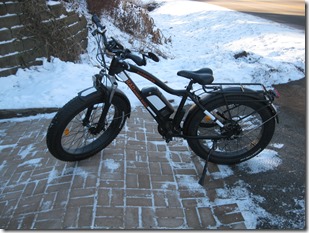
IMG_9575 Page forward to December 2018. I’m 70 and the only big moment in life I’m anticipating is my next bowel movement. No kids on the way and no demanding, unrewarding, dangerous as hell job to worry about. My grandson gave me his fairly worn-out eBike earlier this winter and I just got it back on the road. 

I bought a new winter helmet, since my usual bicycle helmet is colder than wearing nothing and isn’t really much protection. When the mailman delivered the new helmet, I had a bunch of normal errands to do and a bike ride on a 38oF December day seemed like the perfect excuse to go for a ride. I put on about 12 miles bombing around town and enjoying both the ride and my new much warmer gear (including some Bar Mitts I picked up at Red Wing Bicycle while I was downtown). Just to put some more miles on the battery and see what kind of range the bike had hauling my lard ass around town, I headed out the Cannon River Trail toward the Anderson Center at the west edge of town. I came to the gate that blocks all traffic except fat tire bikes (like mine), cross-country skiers, and hikers and scooted between the bars on to the trail. 

IMG_9591I made it about 30’ on the partially melted slush and the front tire zipped out from under me and dumped me face-first into the road. The slush was soft and slippery, but didn’t provide any buffer between me and the asphalt path. If you look at the middle of the front of the helmet, you’ll see the nice new dent I put in my nice new helmet on its first day on my head. Once again, I was knocked punchy for a few moments, but not unconscious this time. 

IMG_9589Once again, I punched a hole through my lip, but this time it was with a tooth. Once again, I coated my coat, pants, and bike with blood, but the hole was normal and self-healed after a couple of hours. Weirdly, it leaked saliva all over my lip for a couple of days, but it didn’t swell up all that much and while it pretty much squashed any whistling I might have wanted to do it wasn’t that limiting otherwise. No serious kissing, please. I might have been able to whistle through the hole before it closed up, but I didn’t think to try. Too late now. 

I wouldn’t have been out there on the snow if I hadn’t had the helmet, but I’d have been out there sometime this winter. You just have to ride snow sometime if you are going to live in Minnesota and be a biker. Once again, a helmet kept me from bashing my tiny brain out.

Jun 11, 2018

What it all Means

Ever think about that butcher's chart Icon plastered all over the Airframe Statistic? Your first thought should be how many first impacts occur to the areas of the head unprotected by all helmets that are NOT full face: 45%. Those ridiculous things I can only describe as “toilet bowl helmets” add another 12% of unprotected area over traditional 3/4 coverage helmets. I’m not kidding when I say, “That is not a helmet.” It is barely a hat.

May 31, 2017

A Smart Helmet

The question is, would you wear a smart helmet? Another question might be would you buy one? But here’s an opportunity to go one step further and build your own:

Protect Your Smarts, Build a Smart Motorcycle Helmet

Aug 17, 2015

#120 That Is Not A Helmet

http://www.amazon.com/Geezer-with-A-Grudge/dp/B007RPQJ24

All Rights Reserved © 2013 Thomas W. Day

Everybody is getting on the "motorcyclists ought to be wearing helmets" bandwagon. MPR did a segment a few weeks about about the burst of motorcycle deaths in early 2013 and how few of the dead and buried were wearing "helmets." One of the local television noise generators repeated that theme and "moderated" the common sense recommendation by interviewing someone from ABATE spewing their tired "everyone just needs to look out for us" and "training is the answer" song and dance. For once,

ABATE and AAA were on the same page in that spring death-match propaganda blitz. They both quoted the same statistic that reported "wearing a helmet in a crash reduces the risk of death by 35 percent and the risk of brain injury by 67 percent." ABATE added the word "only" to each of those numbers, attempting to prove that helmets didn't really do much toward making motorcycles less suicidal. Sometimes, I'm not sure whose side those guys are on.

AAAhelmetAAA's front section AAAAdvice article ("Motorcycle Helmets Save Lives") included the picture at right. I see that as a failure to communicate. That silly looking lid is not a helmet. It barely qualifies as a hardhat. It's possible that useless baseball cap might provide some protection if a cup of crushed ice were dropped from a second story window and it landed squarely on top of the rider's head. Not likely, but possible. The chances that a pudding bowl helmet will save your life, your consciousness, or your pretty face is pretty predictable, though.

helmet-impact
It should be pretty obvious that a beanie helmet is good for about 20% of the impact that will coming your way when you hit the asphalt. If we wanted to be overly-optimistic, we could add the 19.3% of the forehead hits to the protected area, but I do not feel that is realistic. For example, Mr. AAA Douchebag's helmet at left makes a special effort to show his shiny forehead so that his admiring fellow douchebags will know who he is. That exposed area and the edge of the helmet above it provides plenty of leverage for the sliding surface to pull the helmet up and, possibly, away from that critical and fragile area of the skull. At least Mr AAA Douchebag has a 3/4 helmet on his pointy head.

gayhelmetGay little biker beanies (Don't get your panties in a wad, girlymen. I mean "happy" or "festive.") like the thing at left are pretty much useless as protection 80% of time when a helmet hits the road. Unless you can figure out how to slide down the road on the top of your head (without grinding through the cheap plastic this sort of cheeseball helmet is made from), you might as well be wearing a bicycle helmet (another useless piece of mal-designed "protective gear"). This kind of hat is a designer statement, like high-heeled red shoes. It is not armor. Obviously, biker beanies automatically go with biker face (see douchebag at left, again) and there would be no point in spending all those hours in front of the mirror practicing your biker face if you were going to wear a real helmet and be a real motorcyclist. How would anyone know how serious you are if they can't see your scowl?

I have no idea what percentage of helmet wearers are wearing this kind of crap, but when I see the words "Harley Davidson," "motorcycle death," and "was wearing a helmet" in the same news report, I automatically assume this silly shit is what the cops included in their crash report as a "helmet." If I haven't made myself clear by now, I do not consider anything of the sort even close to a motorcycle helmet. The sound of blubbering, poorly-tuned tractor motors naturally ties to either no helmet or awful helmets and . . . death by motorcycle. On the rare occasion I see a hippobike rider wearing a real, full-face helmet, it always causes me to do a double, or triple, take. Exposing my natural prejudices to the air of honest admission, it also automatically forces me to re-evaluate all of my preconceived notions about Harley owners. "If the guy is wearing real gear, is it possible his bike is not garage candy? Probably. Can I imagine that he rides it to work and for general transportation? Probably. Damn. Now where do I pigeon-hole this dude?"

I realize that nobody dresses to impress me. I don't even try to impress me. But I suspect I'm not the only motorcyclist who has a similar check-list. Even more important, you should know that your designer hat is not a real helmet and it will more than likely be useless in a crash. You might imagine that you're not going to crash and won't need a real helmet, anyway. I suspect those dead folks the media clowns were talking about this spring didn't plan on dying, either. Plan for the worst, hope for the best.


Jul 24, 2013

Joe Gives It Up

Right wing blogger, Joe Soucheray, has decided to join the ranks of the four-wheeled and disabled. He was the epitome of the late-life-biker when he bought his first motorcycle and has been some sort of totem for that crowd ever since. As he said, "I didn't have anything in my experience that would have protected me from that. I didn't have anything in my bag of tricks that could have saved me from an oncoming vehicle not seeing me and making a left turn in front of me." Obviously, there are lots of things every experienced rider uses for evaluating and planning for those regular occurances. Joe just didn't have either the experience, judgement, or skills to be a regular motorcyclist and, finally, he realized that being an occasional, recreational garage-candy owner is fuckin' dangerous.

For Joe, motorcycling was always about propping up his aging self-image. A motorcycle was a tool to make himself feel cool. He could wallow in "the potato-potato-potato thwap of a Harley, or the silky smooth revs of a Japanese bike, or the Spitfire flying across the English Channel vibe of a British ride. I rode to ride, not to get anywhere quickly. I didn't need the bike for my daily commute and never used a bike to commute." If we kept statistics on that kind of rider, I'm certain they would be grossly overrepresented in crash data.

Good move, Joe. Now, keep your cell phone in your pocket and try to concentrate on driving your car without killing the rest of us.

Jun 23, 2012

Ragheads on Wheels

A while back, one of the local MSF coaches told me I should check out the Parts Unlimited catalog for do-rags. More recently, Paul Young pointed me at Iron Horse Helmets (a mis-named website if there ever was one) to look at the neoprene face masks. Considering that the children who wear this crap are about as rabid anti-helmeters as douchebags get, you have to wonder why they want to cover their ugly faces and bald heads with napkins and wet-suit material. I've worn a wet suit in the ocean, but I can't imagine the up-side to wearing one on my face on a hot summer day. 


However, having looked at images like the one at left, I get it. This is a "truth in advertising" thing. A clown mask for a clown. Makes perfect sense. We all know what's under the mask and this is clearly an improvement. If Lady Bird Johnson were alive, she'd call this "highway beautification." If you click on the clown mask, you can see the whole collection, all 182 of them, of Iron Horse's neoprene face bags. Maybe you can find one that is just right for your next convenience store hold-up. In fact, I'd sort of like to know why cops don't fire a few warning shots into these things just to get the morons' attention? Seems like a reasonable response to someone wearing a mask in public. 


The napkin craze is totally over the top. There are at least eight pages of these girlyman things in the Parts Unlimited catalog (click the the nancyboy's picture at right and feast your eyes on the douchebaggery). Amazing. You'd think the napkin pages would be followed by a selection of pancake premixes and griddles. If I'm gonna look like a fool, I at least want to be cooking something edible while I do it. (Damn that kid has a lame "biker stare." He looks about as badass as Bill Clinton after a two day intern-boinking binge.)


Crap! I bet I know what the next non-helmet biker hat craze will be: a chef's hat. Everything the dochebags love is wrapped up on one stupid looking hat: uselessness, clownish appearance, a way to hide a bald head, and head wear that makes a Harley look like it's moving faster than a crawl. Freakin' awesome. Right now, the typical chef's hat costs about $3. We should corner the market and wait for the biker clowns to catch up to us, then sell hats for $10 each (the going price for biker napkins). Tell me that the fruitcake on the left doesn't look like he belongs on a Harley. 

Mar 29, 2012

MN Helmet Law

Big surprise, ABATE is opposing the new attempt to pass a helmet law in Minnesota. I can't remember the last time I agreed with ABATE, but this is sort of one of those times. I disagree on the need for a helmet law. Motorcyclists lost their "freedom" argument when seat belt "violations" became a primary offense in Minnesota. (Babble on about cagers wearing helmets, but we all know that's a non sequitur.) Our out-of-proportional miles ridden to highway deaths statistics are more than enough to move any sensible legislator to either do everything possible to improve motorcycle safety statistics or get the damn things off of the public roads. I'd rather they do the first.

ABATE chitters about having government "focus on public awareness, rider education, and crash prevention" as if that has a chance in hell of accomplishing anything. "Public awareness" of what? The 0.0001% of traffic that motorcycles amount to on a typical roadway? How about increasing the public's awareness that most motorcycle crashes are the fault of the motorcyclist (look at Colorado's data, for example)?

"Rider education" is such a empty promise that the MSF cautions its state providers not to try to connect training with lower mortality, morbidity, or crash statistics because "in societies where rider training was both widely available and in generally mandatory, they were unable to find conclusive evidence that riders without training were more likely to be involved in accidents." Wikipedia has a fairly extensive page on Motorcycle Training and their entry is consistent with everything I've read.

And, finally, "crash prevention." Gotta love that brilliant idea. "Hey, I just thought of something, let's all quit crashing." That'll work. We just put our heads together and make a wish, "I wanna stay rubber-side-down for ever, so help me Kenny Roberts."

Nope, the place where I agree with ABATE is the idiotic kiss up to rich guys on garage candy that allows folks who can put up a half-million dollar "reparation security" on their motorcycle "that provides medical expense benefits of at least $250,000 and at least that amount for the total of income loss, replacement services loss, funeral expense loss, survivor's economic loss, and survivor's replacement services loss." As Bruce Mike said in his From the Hip column this month, if this makes sense why can't the same 1%'ers "demand the same option regarding seat belts?"

Just pass the helmet law, fools. Quit trying to find revenue venues that you can pretend are not "taxes" (like every other charge, fine, levy, fee, or resource enhancement you fruitcakes who signed the No New Taxes Pledge have tacked on to the 99% to protect the assets of the 1% who own your useless asses) and do something useful. Either man-up and pass a helmet law or stick your heads back in the mud and pretend you're giving taxpayers some value for their money.

Jun 23, 2011

Asphalt Wars

This past weekend, one of the nicest people I've had in a motorcycle class took a hard spill near the end of the course. She entered a curve a little fast and decided to apply brakes while the bike was leaned over. The bike dropped into a lowside so fast that she didn't even have time to get her hands down to cushion the fall.

[This guy demonstrates the crashing "technique" pretty well.]

Unfortunately, our student was poorly protected by her gear. She really tore up her chin with a face-plant and her eye protection (sunglasses) caused significant bruising and abrasions to her right eye. Her 3/4 helmet provided about 3/4 protection, but since face plants account for 40-70% of injuries and impact points in crashes (depending on whose statistics you use) that description is misleading.

For me, her crash was harsh reminded of how unforgiving nature is. I haven't seen someone go down that hard for a few years. She was probably going about 15mph before braking, so her impact speed was no more than 10-12mph. The front tire slid out so quickly, she didn't even know she was in trouble until she was inches from the ground before reacting. She hit face-first, followed by a hard twist to her back, and a hard bounce across the asphalt where she lay still on her back for a few seconds. During that second bounce, her head was about 2' from the ground before coming back to earth hard. She tried to get up, failed, and lay back down with some muscle twitching before going still. The other coach and I signaled for the rest of the class to shut down and we ran for her. The other coach beat me to her by yards and he kept her still while I shut off her bike and moved it away from her. She was coherent but seriously in shock and bleeding. We patched her up, as best our medical kit allowed, and got her back to the trailer to take stock. She is a nurse and provided considerable assistance in her own care. She is tough and practical, so it really helped that there was absolutely no hysterics on her part. I was probably in less control than the actual victim. My co-coach was clearly the better care provider of the two of us.

A few years back, a couple of days before a long trip, I crashed my bicycle at about 2-5mph and shredded my right forearm. That incident was a reminder of how important a little gear can be, even at low speeds. Last weekend's crash was another wake-up call. The side and back of her helmet was rashed deeply. It is entirely possible that she would have been dead or seriously injured without that helmet, but it's also true that she would have been unhurt with a real helmet. Other than the head injuries, she had some minor scrapes on her arms and one shoulder. If she'd have wanted to continue the class, she could have without the head injuries.

Regardless of the pseudo-statistics the anti-helmet crowd blows around at us, the overwhelming majority of motorcycle deaths are due to head injuries. Not wearing a helmet is evidence of ignorance and foolishness and nature abhors a fool (the universe is full of vacuums, but fools don't live in a vacuum for more than a few seconds). Two of the three motorcycle deaths I have witnessed would have been prevented by a helmet. I suspect I just witnessed what would have been a fatal crash, but instead it was turned into painful but minor injuries by a helmet. A real helmet would have eliminated all but the slightest of those injuries. Motorcycle gear would have made the crash into a non-event. AGAT, folks. Wear it or pay the price.

Oct 21, 2010

Perfect Motorcycling Weather

I've said this before, but fall is my favorite time to ride. The weather is usually pretty predictable in Minnesota, unlike spring. So, I can count on knowing what to wear and what to expect when I hit the road. It's cool enough to need gear and warm enough to be comfortable without all the bulky underlayers that I'll be packing on in a month or so. Tires still start the ride warm enough to have some grip.

But the best part is, for some reason, the motorcycle seems to be a whole lot happier to be working in cool weather. I don't mean that my trusty V-Strom minds the heat, but the engine just feels more alive on a cool fall morning. The throttle seems to be directly connected to the rear tire. It's probably an illusion, but it's one I like.

Sev, the MMM editor, had me all primed, this weekend, to get to ride a new Triumph (2011 Sprint GT) or Ducati (2011 Monster 796) for a review. He let me down, though. Apparently, there are better suited folks than me on tap to ride those two cool bikes. I'll probably get first dibs on the next Hyosung POS. No competition for reviews on that sort of ride.

Honestly, I have mixed emotions about test riding motorcycles. There is a nasty statistic that claims that a substantial number of motorcycle crashes occur on borrowed or new motorcycles. I can believe that. Getting used to a new ride takes some time. If I had my druthers, I'd druther test ride on a closed track. At least, I'd rather put a few dozen miles on a new bike on that closed course before I venture out into the vicious and nutty world of cagers and truckers.

Since a Triumph or Ducati isn't in the works for me, I'm going to make some miles in Wisconsin this weekend. On my V-Strom. By myself. I love this weather, so I'm not complaining.

Feb 14, 2010

NHTSA Crash Data for 2008

NHTSA has published two interesting bits of 2008 data: the Motorcycle Helmet Use and Head and Facial Injuries analysis and the 2008 Motorcycle Traffic Safety Facts data. Some of the more sobering facts from the Motorcycle Traffic Safety Facts analysis was "NHTSA estimates that helmets saved 1,829 motorcyclists’ lives in 2008, and that 823 more could have been saved if all motorcyclists had worn helmets" and "Per vehicle mile traveled, motorcyclists are about 37 times more likely than passenger car occupants to die in a traffic crash." Motorcylists are more likely to die drunk than any other vehicle operator and the state with the highest percentage of drunk motorcyclists deaths is Deleware. New Mexico riders are the least likely to be wearing helmets, at 4%.

Oct 21, 2009

10 Reasons NOT to Wear A Helmet

All Rights Reserved © 2009 Thomas W. Day

I've spent way too much ink ranting about why helmets are good for you. I'm a believer in protective gear, but that's just me. Most crash landings begin with a face plant, so I think anything short of a full-face is mostly pointless. You can argue that the DOT thinks a beanie-brain-bucket is "protection," but I'm unconvinced. The federal government is the last place I'd look for technical advice.

If you have some question about how well your gear will work in a crash, put a bow in your do-rag or button down your beanie and slam your face against a hard surface. If you snap off your front teeth and break your nose, you might decide to buy a real helmet before you try the same exercise on hard, unforgiving asphalt at 30mph.

Lots of solid cases have been made for every piece of protective equipment that is sold today. Other than the "live free and die young with a really gory corpse" and the "I scream like a baby when I put one of those boxes over my head" arguments, not many people have spent time (or beer or mixed drinks) coming up with good reasons not to wear a helmet, especially a full-face helmet. So, with a beer and a mixed drink in hand(s), I thought I'd give it a shot.

  1. Nobody will ever say anything you want to hear. You are past 25, so you'll never enjoy any new music beyond this point. You ride without a helmet because you are trying to destroy your hearing.
  2. You can’t smoke inside a full-face helmet. Cigars are especially incompatible with face shields and such. Since smoking is one of those "little suicide" activities, making the step to a larger, less passive, suicidal activity (riding helmet-less) is a short jump.
  3. You can't eat or drink and ride. Even jerky is tough to filter through a face shield. Forget about ice cream cones. Since you're proud of your stylish American bulk, you are more concerned with getting your daily caloric intake than worrying about the goo inside your skull. You ride to eat and eat while you ride.
  4. Hip wrap-around sunglasses won't easily stuff into a helmet, so, you're stuck wearing dorky geek glasses. This has inspired several shade manufacturers to make dorky geek glasses and call them hip. My last visit to a Harley shop was made much more entertaining by the collection of $5 tinted industrial safety glasses being sold as designer shades for twenty-times what those same frames (made of more durable materials) would bring in a welding supply shop. Looking like a geek has never been so expensive.
  5. You can't pick your nose and wear a helmet. Even if you could get a useable finger past the shield, the chin guard gets in the way. Personally, I think that's a good thing because a small pothole and a cruiser's suspension would probably result in a finger poking through the back of your skull.
  6. Telephones, you gotta have 'em, but you can't do telephones and wear a decent helmet. These days, nobody can do anything or go anywhere without a cell phone, so it's damned important that you be able to answer the important question of the day (which is either “Can you hear me now?” or "Where are you now?" or "Waz up?") whenever it's asked. The entire planet revolves around the concept that someone's lack of planning is someone else’s emergency, no matter how trivial the problem. Wingers display insane levels of connected-ness lunacy with headset installations in their helmets and Microsoft Office displays on their face shields. You, however, simply need to be able to answer the phone when it rings.
  7. An excellent reason for not wearing a full face helmet is that you have nothing to lose. You hate your job, your wife is having an affair with your boss, your kids are on crack, and you're broke. What's the worst thing that could happen? You crash and survive, but are stuck at home recovering on the couch while your wife and boss hold business meetings in your bedroom.
  8. Good hair days, you can’t have ‘em and wear a helmet. Helmets will turn any hair style to a greasy pancake look. Which raises an important question, does Donald Trump ride to work every day? Is his bad hair because of a helmet or did an ugly squirrel curl up and die on his head and the Donald hasn’t taken the time from his busy, motivational day to have one of his Fox News eunuchs scrape it off?
  9. The "vision thing." From listening to years of lame excuses about helmets obstructing vision, I've decided this isn't about being able to see, but it's about being seen. Racers, two and four-wheel varieties, wear helmets and nobody needs to see better than those folks. After spending $45,000 on a custom cruiser, you probably want people who know that you have that kind of credit line. We're all equal inside a helmet and you're probably not happy about that.
  10. Finally, the best reason to not wear a helmet is that you know your genetics have absolutely nothing of value to contribute to the human race and you want to make the ultimate Darwinian sacrifice for the greater good of the species. Good for you. Your contribution to the universe will not be remembered, but you are still doing a good thing. Consider immediate sterilization so that no nasty little accidents happen before your nasty big crash.

I think I've provided sufficient justifications for those cute little bikini-beanie "helmets" and the 100% Dacron-reinforced do-rag fashion statement. Even though it's very likely that any crash you may have will result in a face-plant, it's important to consider there are a lot of important things that you can't do while wearing full face protection. What's a little cosmetic surgery and a lot of dental work worth compared to the important issues discussed in this highly academic analysis?

As spectacular as my list is, you can probably think of even better reasons to avoid protecting the insides of your skull. Feel free to contribute your best justifications.

Sep 29, 2009

Snell Loyalty

People are loyal to the oddest things. For a couple of decades scientists and testing engineers have questioned the Snell standards. A key part of Snell's standards is the dual impact (same location) test and the 300g internal impact allowance. Those two bits mean that the helmet must be harder (less able to spread impact) both on the shell and in the internal impact liner. A while back, Motorcyclist magazine did some of their own testing and cast some aspersions on the Snell standard. More recently, the New York Times published a piece called Sorting Out Differences in Helmet Standards.

I'm not here to argue the standards. I read the Motorcyclist article and was impressed with the authors' thoroughness. At the time, I'd traded my comfortable old (highly damaged) Shoei X11 (a Snell helmet) for a brand new non-Snell HJC CL-15. The new HJC was the first non-Shoei, non-Snell helmet I'd owned since the early 1980s. That first HJC was the first of three HJC helmets that I've owned since. While my Shoei's have saved my bean from several scrapes, nothing about the crashes I've experienced have tested Snell's extreme standards. I'm, apparently, inclined to get off at 20-50mph, on dirt trails and deep gravel or sand, and I have yet to land on top of my head. I have scraped the paint off of the side of my full-face helmets and gouged the snot out of the faceshields.

On a MN motorcycle chat site, the responses to the NYT article went like this:
  • "The advantage in my eyes to a Snell rating is that I know the helmet's been validated to the guideline. "
  • "Until the standards are re-written its just a holy war and I'll continue to wear my RF1000 helmet replete with 05 Snell standards. "
  • "My helemts [sic] (full face always) have always been snell rated, but I am an Arai loyalist and they don't make anything less than snell rated--and honestly--I wouldnt want it any other way."
  • "Usually the NYT limits its coverage to political and scientific thingsthat they don't understand. Now they've added international standards setting to the stew."
I think it's interesting that a testing lab can generate so much customer loyalty, even with other testing labs, scientists, and engineers disagree with those results. No, I don't know what that means. Yes, I'd love to hear your opinions.

Jun 2, 2009

Who Wears What on Their Head?

I know, stereotyping people is politically incorrect and the people who most hate political correctness seem to scream the loudest for it when their ox gets gored. Helmets, being the personal and fashion statement that they are are prime candidates for an exercise in profiling. Being the crotchety old bastard that I am, I can't resist the opportunity.

My first and most consistent observation about helmets is, "Those who need it the most object the most strongly."

In a typical basic motorcycle training class, "students" are supposed to show up with their own, DOT-approved helmet. Anything with "DOT' stamped on the back will suffice and the DOT will stamp any damn thing. I have no idea what criteria the DOT uses for coverage, but I suspect the top of the head is all they bother to protect. If a very soft space rock were to fall from the sky and land on top of the owner of one of these sad jokes, it might protect him/her. If the same sad jokester were to flip from his motorcycle, landing on top of his head, skidding to a stop while still balanced on top of his head, this helmet might provide sufficient protection. In any real crash, you might as well be wearing a plastic beanie. Want to take a guess what kind of prospective "motorcyclist" (other than Carrot Top) wears this kind of comedy paraphrenalia?

I'll save you the effort. The owner of this comedy prop is usually 50+ years old, 150 pounds overweight, as uncoordinated and physically incapacitated as South Park's Timmy and missing a mental connection or eleven million. If it's true that a crash is 49% likely to result in a faceplant this kind of helmet is all but worthless. Every once in a while, someone looking just like the dude in the picture makes an appearance. He's always totally confident of his riding ability and is only in class because he can't get his hippobike through the DMV's course. Remember him?

Dropping the bar to ludicrous, we have the Nazi bowl fans. Even dumber, some of the clowns piss on patriotism by putting an American flat sticker on their facist totem. If my father were 40 years younger, I'd like to introduce these clowns to someone who sacrificed a good bit of himself to stomp out this symbol and the evil it represents. As it is, I make it a point to remind them of who they are celebrating and my best guess why and let them babble their excuses for worshing evil. Honestly, I'd rather these characters didn't take a training course because Darwin ought to have a clear shot at them. Enough said.


It's hard to say anything seriously bad about a half-helmet. We've probably all owned one, especially those of us over 40. They've probably saved our asses and brains a few times, if we've put any miles on at all. They are protection and they protect some of the most vunerable areas. If claustrophobia is your problem, this is the helmet for you. There are some really good half-helmets and they provide most of the protection that you need.

Lots of BRC students show up in a half-helmet and many of them are ready to be convinced that a real helmet would be a better bet against injury. In the classroom, I always offer bo smash my face (while encased in my helmet) against a table while a student does the same wearing their toilet bowl or half-helmet. Nobody takes me up on it, though. I'm not kidding, I'm up for it if you are.


Of course a "real helmet" is a full-face helmet. Anything less is a compromise. Flip-ups included, since the hinge is a clear weak-link. A full-face helmet provides all the protection a helmet can give. racers wear nothing less. Today, even trials riders are wearing full-face hats. Mine saved my face from being ground into hamburger on the Dempster Highway two years ago and I will always remember the look of that fiberglass ground down to where bits of foam was showing through the shell. That could have been bone.

A few years back, a friend's boyfriend bragged that everything about a helmet prevented him from being a safe rider. A few weeks later, he parked his face on the freeway at 40mph and is still undergoing reconstruction surgery. I'll put my opinion and experience against his any day.

Thomas Day

Mar 1, 2009

Product Review: HJC CL-15 Full Face Helmet

All Rights Reserved © 2009 Thomas W. Day

The long affair was over. I walked away, only looking back once, later wishing I'd taken one last picture to remember our time together and the painful end. My friends all said I should have left sooner, much sooner. My parents were simply ashamed of me. My wife had held her tongue for so long that she was about to burst into mocking derision every time she saw me leave the house. Finally, even I saw the light (actually, I saw gouges cut so far into the fiberglass that small bits of foam were exposed), I had to leave my old Shoei X11 helmet and find a new lid.

I was stuck in Seattle with a smashed up helmet and, while the folks at this bike shop were good to me, asking me to pay full list for anything is almost taken as a life-threatening gesture. After taxes, a new bottom-of-the-line Shoei from Seattle Cycle would be more than $450 and I've already spent $600 on new tires, a heavy duty chain, brakes, and gloves. I'm decision-seized and almost ready to go out into the world with my old, massively damaged, but still mostly comfortable Shoei.

The salesman is going overboard with his "once you've gone Shoei you can never go cheaper" routine. I react poorly to pressure sales tactics. Usually, the salesperson gets exactly the opposite reaction he/she expects: I don't buy anything when I'd fully intended to buy something. I am, however, a discount buyer. When I can, I buy my motorcycles, clothing, furniture, and computers second hand. If I'm not getting at least 50% off, I wait until I can get 50% off of most everything I buy new. I'd buy used food if I could figure out how to safely digest it.

However, the helmet is wrecked. So, I kept looking. I found a bright yellow HJC helmet and tried it on. The salesman says "you won't like it, it's not a Shoei." But I did like it.

The HJC CL-15 fit really well, the visibility was better than my old lid, and it was much lighter than my Shoei. As if I expected to get a straight answer, I asked about the quality of the HJC brand and received "it's a cheap helmet, it won't last as long as your Shoei." I paid a small fortune for the Shoei and wore it a good two seasons beyond the expected lifetime because I wanted to get my "money's worth." Maybe a helmet that won't have such a tight grip on my billfold-memory would be a good thing. It was Seattle-expensive, but not so painfully prohibitive that I couldn't justify replacing my ruined lid.

On the road, I discovered the miracle of actual ventilation. The CL-15 flows air. On a cold morning, I opened up the chin vent, and in motion the fog vanishes and I can breathe normally. I thought my X11 was quiet, but the CL-15 is much more quiet. Like the Shoei, the famous V-Strom "buffeting" is unnoticeable due to the aerodynamic design of the helmet.

The face shield is designed so that I can flip it all the way up, at freeway speeds, and it doesn't shake or threaten to rip itself from the helmet. It stays in place, also at every intermediate setting. In the worst crosswinds I've ever experienced, in North Dakota (surprised?), I latched down the shield and that added a little stability to the helmet and quieted down the noise a bit, too. When I got home and went shopping for a backup face shield, I discovered the HJC shields are almost half the price of Shoei replacements. The shield is easily removed and reattached with a simple mechanism. The shield "securing system" parts are repairable and reasonably priced.

The cheek and crown pads are removable for cleaning. The chin strap is fastened with an old fashioned D-ring system with a securing snap to keep the end from rattling in the wind.

HJC warrants the CL-15 for a year (limited warranty). The helmet is Snell and DOT approved. After 18,000 miles of use, my CL-15 is still quiet, well ventilated, and comfortable. I'm happy with my cost-justified decision and expect to live with this helmet for a few more years before I have to deal with a buying decision on this piece of protective equipment again.