Showing posts with label cruisers. Show all posts

Oct 10, 2023

Noisy Kids Who Go Nowhere

I was sitting in my backyard, mostly enjoying the quiet country environment, but being intermittently blasted by various noise machines: motorcycles, jacked up pickups, sportscar-poser Honda Civics, totally illegal-for-street-use ATVs, and other noisy toys. After the umpteenth laughable Hardly yard implement passed by, I started thinking about the two motorcycles I've owned with aftermarket exhaust systems and the one with a hacked up stock pipe.

Back in 1993, I bought a like new 1992 Yamaha TDM from a doctor. I have no idea what he thought a TDM was, but he had spiffed it up with a custom Corbin seat, a Kerker pipe, and some nice luggage. By the time I got home, less than 20 miles later, I went to work replacing the Kerker with the stock pipe (which had been included in the sale). I found a victim for the Kerker with an ad at my local Yamaha shop and got $250 back from my sale price.

A few years later, I bought a barely used Suzuki SV650 from a kid in a Michigan suburb. A friend in Ohio picked up the bike and I took a train to his place to ride it home. The SV  had a Two Brothers pipe and by the time I had ridden the 800 miles back home I was ready to remove the Two Brothers pipe with a sledgehammer. Again, I found a dumbass in Minneapolis who sold me a stock SV pipe for $25 and another dumbass who paid me $250 for the Two Brothers.

My last loud pipe experience was with my Yamaha WR250X. That bike's original owner was a nitwit who took a hacksaw to the last 4 inches of the stock pipe. Having totally screwed up the fuel injection mapping, the bonehead also removed a chunk of the air box and the air filter in a failed attempt at regaining some kind of performance. Again, I found a dumbass on Craigslist who sold me a stock WR pipe for $25 and someone on Facebook who sold me the entire WR air intake system for another $25.

In all three of these instances—two carbureted motorcycles and one fuel injected—returning to stock not only quieted the motorcycle down it improved the performance. I'm not saying that an aftermarket pipe can't improve performance, but I'm saying most of the idiots who diddle with aftermarket pipes are too lame to do all of the dyno, rejetting, intake redesign, and fuel mapping work necessary to compensate for the reduced back pressure.

In the case of the WR250X, I even had the opportunity to drag race multiple times in multiple situations a substantially lighter Rider on a WR250X with an aftermarket pipe, a power commander, and a hacked up intake system. Mostly, we determined that the two bikes were not measurably different power-wise, but the noise difference convinced the other rider to start looking for stock parts. Even riding side-by-side near his bike made my ear-plugged-ears ring.

Now, back to today where I am listening to multiple mediocre-at-best motorcycles blubbering as loudly as a freight train, ridden (to use that word loosely) by total unskilled idiots disturbing the peace for no reason other than their obvious personal insecurities. This isn't a brand new thought, but it is one that has occurred to me repeatedly through this summer: I think it is a safe bet that damned few of the people with loud exhaust systems ever go anywhere on or in their vehicle.

I'd be willing to put some money on that, in fact.

From a bunch of years of accumulating odometer readings on motorcycles up for sale on Craigslist around the country, it's pretty obvious that the more crap someone piles onto a motorcycle the less likely they are to actually ride it. My late step-brother was an example. He poured more money into his Harley then I have invested in all of the cars and motorcycles I've owned in my life. Seriously. And for him, a trip from one end of Springfield, Missouri to the other was “a long ride.”

In the several hundred thousand miles I have ridden motorcycles in my life, I ran into all kinds of people on the road, riding all sorts of motorcycles, and almost universally the people who ride the most miles ride the quietest motorcycles. Even some of the big mile characters on vintage motorcycles, where a stock pipe is only available from salvage yards, do their damnedest to keep exhaust noise at a minimum.

There is nothing about the output from the exhaust pipe that tells you anything useful about the operation of the motor. In fact the less noise the exhaust makes, the more likely you are to be able to hear upcoming engine problems. More importantly, the pounding your ears take from excessive exhaust noise adds exponentially to the fatigue in a long day's ride. Obliterating what little information your ears can provide about hazards and traffic, doing permanent damage to your hearing, and adding to your distraction and fatigue is not conducive to putting in long (thousand mile) days.

And usually, when I've been forced to talk to these noisy pipe characters I hear that they think a hundred miles is an excessive day. And lots of them are really proud of themselves for riding 20 miles to a bar, spending the afternoon drinking and eating, and wobbling their way back home. So along with knowing that the loud pipe character is an asshole, it's pretty safe to assume he or she is a wimp.

Jan 4, 2021

“Anybody Can Ride One”

My wife is a morning television addict. We live in a rural area with no over-the-air television available and I’m too cheap for cable, so she watches the late night talk shows in the morning. The irritating noises coming from our living room inspired a hunt for the best noise-cancelling, Bluetooth, in-ear monitors so that I could avoid the morning squawking noise of Seth Myers and Jimmy Kimmel’s dry sarcasm that makes the awful seem even worse. Sometimes she is so inspired by what she sees that she is compelled to “share” it with me. This morning that interruption was inspired by a Kimmel interview with David Letterman. Apparently, Letterman bought Regis Philbin a Vespa scooter under the assumption that “everybody knows how to ride a motor scooter.” Like so many folks on Harleys every summer weekend around the nation, it turns out that assumption is idiotic. Of course, Philbin crashed after traveling a few feet on the scooter. "He could have been killed. He actually could have been killed. The last night before he retires he comes over, and I kill him," Letterman said with a laugh. "... Nobody checked him out on it, because the assumption was, A, anybody can ride a scooter. And B, certainly Regis will ride a scooter."

Back when I was still teaching the Minnesota Motorcycle Safety classes, in 2011, I wrote a Geezer rant I titled “#101 It's Not A #&^%#@ Wheelchair.” I summed up my irritation in that essay with, “My generation seems to have created a lot of people who think the laws of physics can be influenced by money, the legal system, and by a heartfelt ‘I wanna.’ Velocity and acceleration (up or down) are ruthless. Gravity is insensitive to your brittle bones and inflexible joints. You don't get special consideration on the highway simply because traffic is moving ‘too fast’ or you can't muster up the courage to make the bike stop or turn (or keep up with the flow of traffic). Other highway users expect you to ‘drive it or park it.’ Being handicapped on a motorcycle is often fatal.” Almost always, in fact. I don’t know where “anybody can ride a scooter” comes from. Sure, they have small flat wheels that almost balance themselves, but that doesn’t help at all with turning, stopping, or being aware of traffic and hazards and figuring out what to do about those hazards in an emergency.

While my wife was taking a break from her morning television routine, she was reminded of my father and his “scooter experience,” which actually was an electric wheelchair. He’d been house-bound for several years by the symptoms of progressive myasthenia gravis, failing eyesight, and CHF. My step-sister thought it would be good for him to get out of the house and she, Medicare, and the VA bought him an electric wheelchair. For a couple of days, he was like a kid with a brand new motorcycle. He rode that thing around his neighborhood, to the local grocery store, and had a great time. My step-sister, on the other hand, almost had heart failure watching him blindly (literally) barrel through busy intersections and head-on into traffic without a clue that people were dodging him and freaking out at the sight of an overweight old man in an electric wheelchair in the middle of the road. Eventually, some technical issue came up with the wheelchair and he went back to watching his big screen television and 14-hours-a-day of Fox News propaganda. It could have been as simple as the battery being run down, my father was that technically inept, and nobody showed him how to use the charger. When he died, a couple of years later, the wheelchair looked brand new. He proved that it isn’t true that “anybody can ride a wheelchair.”

In the late 1970s, we were living in a small Nebraska town and a friend, the drummer in a band I’d been in, decided he wanted to buy a motorcycle so he could ride with his friends. I was a dirt-only motorcyclist at the time and had been for 15 years, but I helped him find a good buy on a barely-used Honda CX500 Deluxe, gave him a little instruction about how to ride the bike, convinced him to buy a helmet, a decent leather jacket, some boots, and gloves. And off he went. The friends he wanted to ride with were an assortment of cruiser wannabe-biker types with a couple of actual hardcore bikers—prison tats and criminal records and all. None of the be’s and wannabes wore any actual motorcycle gear and they quickly convinced him to dump the helmet, boots, gloves, but he could keep the jacket for cool days. They also “helped” him install ape-hangers and disable the front brake, partly because the stock brake line wasn’t long enough. Not even a whole month into this experience, he flew off of the road in a mild turn, plowed through a barbed-wire fence, and tumbled almost 100’ before he ended up in a tangled heap in a corn field.

His head injury left him with a speech impediment for the rest of his life and other neurological damage that left him pretty much a very young stroke victim. His legs were broken so badly that there was talk about amputating one or both, but they ended up reassembling him with pins and rods so that he could hobble around on his own. Of course, he was no longer a musician. You have to be able to flex everything in your legs and feet to operate a high hat and kick drum and the rest of his coordination and strength wasn’t up to handling the sticks. So, he’s mostly just been a barfly for the last 40 years, luckily he had a significant inheritance to cover his expenses and to provide him with shelter. Like Regis and my father, my friend (and several of his friends over the next few years) proved that it isn’t true that “anybody can ride a motorcycle.”

The industry, of course, has a vested interest in convincing as many people as possible that they belong on an expensive motorcycle that will enhance their lifestyle and self-image. Unfortunately, the so-called “motorcycle safety” industry is usually directly connected to the manufacturers (MIC/MSF, for example) and their vested interests are all about “putting butts on seats” with minimal interference from actual safety concerns. Thanks to them and their efforts, goofballs like David Letterman are deluded into believing the hype and imagining "that anybody can ride a scooter."

Dec 31, 2020

From Diapers to Trikes and Back Again

I live in an old fart’s town in southeastern Minnesota. If you visit one of our remaining mid-Covid plague restaurants on a weekday you’d assume the average age here must be close to 100. On summer weekends, the old fart Minnesota biker crowd might bring that median down to 75 or 80, but it’s pretty much the same people wearing leather and gangster patches. Sans motors, we have some fairly popular bicycle trails and, likewise, the typical person on our bike trails is only slightly younger than the biker crowd. There are few things more scary looking that a trio of old spandex-clad bicyclists attempting to draft each other without clue how to stop, steer, or maneuver around the occasional trail obstacle. The worst of that bunch are on three-wheeled recumbents. Not only do they take up 2/3 of the trail, but they are usually riding those speedy wheelchairs because they are incompetent, demented, or both.

Earlier this summer, I was coming back from a bicycle ride downtown when I rolled up behind a bearded old fart on a Hardly three-wheeler trying to pull away from a stop sign on an uphill grade. Not much of an uphill grade, mind you, but it was more of a challenge than this oldster could manage. While I waited for him to move his hippotrike out of the intersection, it struck me that this was a perfect example of life: we start out in diapers, progress to tricycles, wander around a while, and end up on trikes and back in Depends.

Mobility ScootersWith that in mind, the ads from Polaris, Can-Am, HD, Kymco, and the rest of the three-wheeled power wheelchairs are pretty funny. Like Coke and McDonald’s and Budweiser, the manufacturers want their customers/suckers to imagine ourselves to be young, hip, and fast while the real customer base is about a half-step away from being Medicare-provided Hoveround candidates or electrically powered adjustable hospital beds. [Before I committed to using Hoveround as a baseline, I check that company’s website and found no pictures of young, vital, active people fitted to electric wheelchairs. I have to suspect Hoveround is missing an obvious marketing ploy; selling lifestyle over reality is an American marketing tradition.

Depends for Men (or women), on the other hand, isn’t missing any part of that bet. Like Viagra or Cialis, the people pictured in the adult diaper ads appear to be barely old enough to be worrying about boxers or briefs. If you are as young as this guy and you’re worried about crapping or pissing your pants, you shouldn’t be grinning like an idiot. You should be seriously rethinking your life’s choices and/or cursing your flawed genetics. Also, you might be a good candidate for AA or a friendly intervention.

The rush to dump cars and concentrate SUVs has been all about auto manufacturers looking for a way around EPA emissions regulations. Likewise, the Polaris Slingshot and Can-Am’s Spyder are a lame attempt to make a car without the nasty safety, noise, and emissions regulations that encumber actual vehicle manufacturers. If you’ve driven (not ridden) either of these goofy hippotrikes, you know how incredibly lame they are. The upside is that, like those low-slung, noisy cars from The Marching Morons future, they really feel like they are clipping right along when they are barely keeping up with traffic on a rural road. Go-carts have the same effect as does not looking where you are going on a regular motorcycle. When you are sitting right next to the pavement (or looking down at it), a fast walking pace seems like rocketing at near-death speeds. Cruisers provide the same false sense of power and speed, but not nearly so dramatically as when your butt is actually a few inches from the pavement on a trike. They are a long ways from safe, though. I’ve had both of these vehicles tailgating me on our rural county road and they are absolutely invisible in a Nissan Frontier pickup’s rearview mirror. Worse, the drivers appear to have the same entitled opinion of their position in society as the pirate bikers. The only “effort” they seem to be able to make to contribute to their own safety is to illegally mangle their vehicles’ exhaust noise. Hate to break it to you, kiddies, but I can’t hear you inside my pickup with the air conditioning or heater going and the stereo at a comfortable volume. Sound doesn’t work the way you think it works.

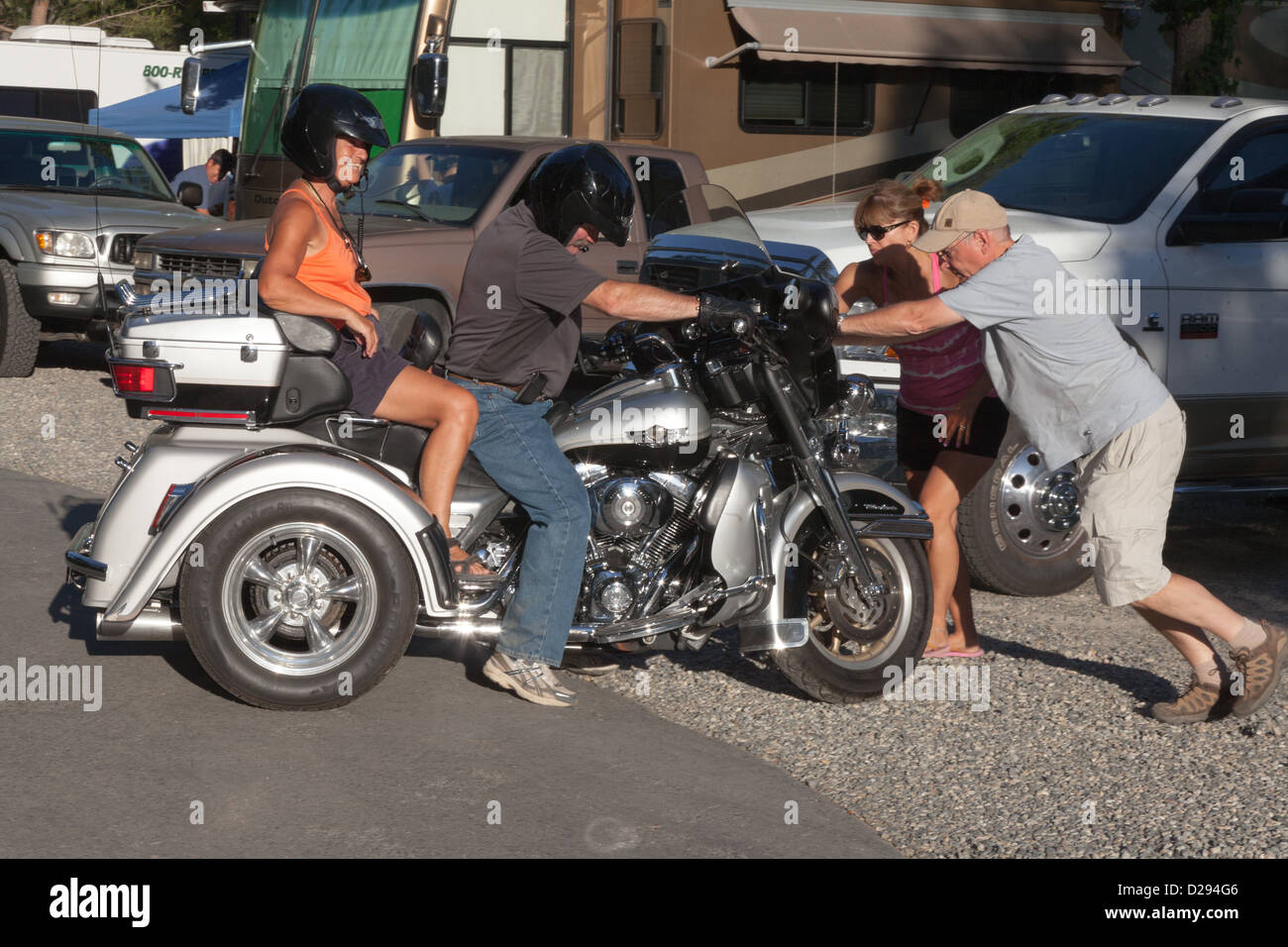
Harley Davidson Trike High Resolution Stock Photography and Images - AlamySo it goes that we begin life pooping and pissing in our pants and we end that way. We move from four-wheel baby strollers and being tucked and strapped into car seats (although not when I was a baby). We stop fouling our diapers and progress to our first Radio Flyer tricycle to a bicycle with training wheels to an actual bicycle. After what feels like a few years, we start leaking again. Around the same time, some of us get the urge to abandon the demands of balancing on two wheels and we buy a $30,000 tricycle. That is a huge red flag, because not long after that comes the four-wheel old fart stroller/Hooveround and being strapped into a wheelchair waiting for a nurse to move us to the crapper and back to bed. I recommend not rushing that chain of events. Stay away from the trike as long as possible.

Nov 30, 2020

Where Could I Go on That?

My wife is worried about me, post-motorcycle ownership. We’ve been together for 53 years and out of 52 those first years I was sans-motorcycle for about five years total. We were young, poor as the servants of church mice, and generally vehicle-less altogether for most of those five years. She still, occasionally, calls me her “motorcycle man.” But I’m not anymore and, likely, won’t ever be again.

On a May weekend this spring, one that was finally seasonably nice, our southeastern Minnesota small town was cursed by the pirates out in their full ear-shattering, trajectory-unstable gory glory (7 motorcycle deaths for the weekend). Even before the coronavirus lock-down began, more motorcyclists had died in 2020 on Minnesota roads than last year, which had the most motorcycle deaths in 24 years. The difference between this year and last is that motorcyclists—responsible riders who do the AGAT thing, can ride competently, and give a damn about their neighbors and communities—are staying off of the roads to avoid becoming a unnecessary load on the already stressed local healthcare systems.

That leaves the highways clear for the bikers and other posers who have none of those socially responsible qualities and couldn’t pass a comprehensive motorcycle license test on a tricycle. Those idiots are falling down and getting run over, riding off of remedial curves over cliffs and into ditches and trees, and even failing to manage competent stops and rolling through stop lights and signs into intersections where they get squashed like bugs. After doing pretty much everything wrong and ending up in a hospital and a wheelchair, the typical biker response is to start whining about “right of way” law enforcement.

Obviously, any complication created by other road users will entangle these idiots, Consistently, the worst drivers/riders/whatever are the goobers on trikes of any sort. The overwhelmingly worst of the trike bunch are on three-wheeled Harleys and the next worst are on three-wheeled Goldwings conversions. The Polaris Slingshot and Can-Am Spyder big spenders are slightly down from that first bunch in overall incompetence and, sometimes, even wear helmets and other gear, but those trike pilots are still are just hopped-up wheelchair trawlers and they generally ride accordingly. There was a perfectly good reason why three-wheeled ATVs were banned in 1988.

When I sold my Yamaha WR250X this spring, the kid who bought the bike commented on a parade of noise-makers going by our house as he loaded up the WR. “My neighbor has one of those Harley trike-things. She had a stroke a couple of years ago and it seems like a good fit for her. She’s pretty brain-damaged.”

“From the mouths of babes,” this 17-year-old pretty much summed up my attitude about three-wheelers and their riders. So, when my wife asked me, “Have you ever thought of one of those things?” My answer was, “Not while I’m still able to think for myself.” After that, who cares?

The reason, of many, for my distain for 3/4 of a cage is “Where could I go on that?” Seriously, what can you do on a three-wheeler that you can’t do on every compact car ever made? Worse, the Slingshot gets 18mpg and the Spyder is in the 30s territory.

Contemplating the current state of decline in both motorcycling and the United States in general, for a brief moment, I thought about Cyril Kornblulth’s The Marching Morons novelette for the zillion-th time since reading that story sometime in the late 50’s:

“The motor started like lighting a blowtorch as big as a silo. Wallowing around in the cushions, Barlow saw through a rear-view mirror a tremendous exhaust filled with brilliant white sparkles.

"Do you like it?" yelled the psychist.

"It's terrific!" Barlow yelled back. "It's—" He was shut up as the car pulled out from the bay into the road with a great voo-ooo-ooom! A gale roared past Barlow's head, though the windows seemed to be closed; the impression of speed was terrific. He located the speedometer on the dashboard and saw it climb past 90, 100, 150, 200.

. . . Watching them, Barlow began to wonder if he knew what a kilometer was, exactly. They seemed to be traveling so slowly, if you ignored the roaring air past your ears and didn't let the speedy lines of the dreamboats fool you. He would have sworn they were really crawling along at twenty-five, with occasional spurts up to thirty. How much was a kilometer, anyway?

We’ve arrived, long before schedule, to Cyril’s predicted future. At least he did ‘t predict flying cars as compensation for being surrounded by the Marching Morons.

Nov 2, 2020

How Do You Know I “Can’t Ride?”

One of the local gangbangers was justifying his noise maker on the grounds of “safety,” and I recommended, as always, that he invest some time in learning how to ride competently. His response was, “How do you know I can’t ride?” A quick look at his social media page had turned up a picture of him on his goober-mobile and it was pretty much what you see in the drawing to the right. So, how do I know he can’t ride?

  1. In this drawing, the “rider”1 is wearing a jacket, boots, and jeans. No helmet, of course. While that isn’t even close to decent protective gear, the real gooberboy’s picture showed him in a wifebeater, lowtop tennis shoes, and a scraggly pony tail. I know he can’t ride because if he could he’d know how fast shit can go bad and how much blood, skin, and mobility he is going to lose when he hits the asphalt.
  2. The bike the dude in the conversation rides is just as disabled as the mechanical junk depicted in this picture. Everything from the feet-forward rolling-gynecologists'-chair riding position to the extended forks to the low ground clearance screams “this is a crash waiting to happen.” Obviously, the rider and the bike are overweight and under-equipped to cope with any emergency. Actions like stopping quickly, swerving to avoid an obstacle, getting up on the pegs to add stability and reduce suspension-load (as if this thing has a suspension), or even turning sharply without running out of ground clearance because of the exhaust parts or hard-mounted foot pegs are all out of this “rider’s” reach because the “design” of the motorcycle is non-functional. I’m not an emergency nurse, but I’d join them in calling this a “murdercycle.” It’s a stage prop, at best, but a completely disabled and incompetent vehicle to the point that it might as well be a trike. You know that “closed course use only” stamp that’s on your illegal exhaust pipe? This vehicle should have “for garage candy use only” written on the tank.
  3. What other clues did I have that led me to assume the character in this story can’t ride? My favorite reason of all, we got into this conversation from one of those “I had to lay’er down” stories. If you know much about me, you know I have no respect for that claim. I don’t care if it is made by some newbie or a motorcycle cop, if you fall down in your attempt to stop, you screwed up. You panicked, screamed, and fell over and tried to sell that as an intentional evasion tactic. Likewise, this goober couldn’t intentionally lay down a motorcycle with help in his garage. Just like the fruitcake in the drawing, he never uses his front brake for ordinary stops, but rides with a finger or three resting on the brake lever and when an emergency happened, he grabbed it and discovered that he had no idea how that brake works. In my character’s situation, that extended fork collapsed with the stress (Surprise!) and his already limited ground clearance vanished and he was instantly metal-on-metal. Then he “laid ‘er down.” Right.
  4. Finally, this ain’t my first rodeo. In my 18 years of teaching MSF courses for the state of Minnesota I taught about 40 of the old ERC (Experienced Rider Course) and a dozen of the renamed version of the same course, the IRC (Intermediate Rider Course). I have suffered the abuse of loud Harley exhausts and spectacular rider incompetence and seen these characters ride straight through obstacle ranges because “my bike can’t do stuff like that” or stop about 20’ beyond the minimum exercise distance because “I’m afraid of the front brake.” There are exceptions, for sure, and they are exceptional. One of the Minnesota Expert Rider instructors is a Minneapolis motorcycle cop and he does amazing things on his huge Harley. Of course, his bike is pretty much bone stock (which makes it the most unusual of all Harley’s on the road). It isn’t loud, it has a functional suspension, and he is a spectacular rider. Otherwise, 99.999% of the time, I can safely assume if you are on a Harley, especially a chopper, you are not a competent rider because you are not riding a competent motorcycle. You might think the stereotype is unfair, but so is life. I love it when someone proves me wrong, but you will be going against the grain when you try.

1 I keep putting “rider” in quotes because I don’t consider these characters in any way in charge of the direction of travel or speed their motorcycle takes. A more accurate description of these characters would be “handlebar streamers.” They are just dangling from the handlebars waiting for a crash to happen after which they’ll whine about how their “right of way” was violated or someone didn’t property sweep the street for debris or some other excuse that no actual motorcyclist would ever claim. When they crash, and they crash a lot, it’s never their fault and someone else is always supposed to get the blame and responsibility.


Jul 13, 2020

Mufflers Are for Pussies?

A few weeks ago, I wondered why it was so hard for Minnesota city and state cops to figure out how to enforce Minnesota’s vehicle noise laws. Minnesota State Statute 169.69 states: "Every motor vehicle shall at all times be equipped with a muffler in good working order which blends the exhaust noise into the overall vehicle noise and is in constant operation to prevent excessive or unusual noise, and no person shall use a muffler cutout, bypass or similar device upon a motor vehicle on a street or highway. The exhaust system shall not emit or produce a sharp popping or crackling sound. Every motor vehicle shall at all times be equipped with such parts and equipment so arranged and kept in such state of repair as to prevent carbon monoxide gas from entering the interior of the vehicle. No person shall have for sale, sell or offer for sale or use on any motor vehicle any muffler that fails to comply with the specifications as required by the commissioner of public safety." This, of course, is a fairly stupid law that was clearly written to satisfy some federal minimum for noise pollution and clearly does nothing to protect residents from semi-grown children who just can’t get enough attention in any positive way. Minnesota is not alone in the “gutless noise laws intended to do nothing” category. Based on this map, I’d say there are 9 states with enforceable laws (which doesn’t mean they enforce them) and the rest are pretty much lawless by design in this regard. 

I made the mistake wondering this on a local “Ask the Chief” city webpage and got a totally bullshit answer from the Chief, “Yes, the State of Minnesota law covers muffler vehicle noise." But he made it clear that it was the job of local residents to, literally, identify and detain lawbreakers and, then, to prove the vehicle violated the law. So, no, there is no actual Minnesota vehicle noise law and please don’t ask again. 

A side-effect of asking this question was that that a bunch of local bikers got downright hysterical about the thought that someone might think their noise-making was illegal and should be fixed. One of those geniuses said, “mufflers are for pussies” as his justification for needing more attention than spoiled 13-year-old girls. 

Someone else replied, “I thought that’s what Harley’s were for?” And things went downhill from there. It is true that actual motorcyclists scoff at the macho posing of the boys and girls on Harleys. It’s hard to pull off macho when you can’t exit a stop sign competently. 

I do, however, think the second guy was right on the mark. Harley and the cruiser genre only have one defining “feature” to brag about: low seat height. In every other area important to actual motorcyclists, cruisers are deficient or defective. They are, to put it politically-incorrectly, “girls’ bikes.” Not women, but girls. Real women don’t ride Harleys and they don’t mess with handicapped motorcycles. 

The rapidly vanishing American motorcycle market seems to be clueless about where American buyers are today. And bikers are doing their best to drive away any likely new riders with IQs into the mid-double-digits and the kind of behavior that puts the lie to “You meet the nicest people on a Honda.” This is from the crowd whose purpose appears to be making as much noise as possible while looking like a sad collection of down-and-out Shriners who either lost their uniforms or couldn’t afford the Knights of Templar suit and the fez. No one with a spec of self-respect would want to join that gang and, apparently, hardly anyone does. 

Way back in 2011, when US motorcycle sales were still not recovering from the Great Recession anywhere near as fast as the rest of the economy, the AMA’s Rob Dingman and the M.I.C. spokesman Peter TerHorst said, “The three biggest problems facing motorcycling today is noise, noise and noise.” That was the last gasp of reality from the AMA. The gangster crowd, who probably don’t amount to a tiny fraction of the AMA membership, scared the AMA “leadership” into abandoning this issue and losing even more members over the next decade. Since disclosures about the organization’s bleeding money in the early part of the last decade, the AMA has been really aggressive about courting members and really reticent about telling members how the “organization” is doing. In this case, I think it’s safe to say that “no news is bad news” and I doubt that I know a single AMA member among the hundreds of motorcyclists I know. Of course, none of my friends ride so badly they need noisemakers to let the world know an incompetent is in the area.

Jul 6, 2020

Socially Responsible Motorcycling? When?

About one third of Minnesotans had been obeying the state’s social distancing rules by the time the rules started going away. Even fewer bother with masks, especially outside of the Twin Cities, and that two-thirds who aren’t taking any more precautions than they did back in January. Of course, they  are constantly whining that the “the rules aren’t working.” Rules, of course, only work when people obey them. Which brings us to motorcyclists.

Thanks to some slimy legislation promoted by Minnesota ABATE in 1982, the minimal contribution Minnesota motorcyclists make to the state’s highway funds comes through gas taxes. Fees collected for motorcycle endorsements pay for motorcycle safety training exclusively, which is mostly wasted money. Minnesota uses the MSF program which has steadfastly refused to subject its training program’s outcome to any sort of evaluation. In fact, MSF instructors are cautioned not to tell “students’ that there is any relationship to the MSF’s training and becoming a safer motorcyclist. Based on my own 18-year experience as an MSF instructor, I believe the training we provided was as close to the absolute minimum possible to hand-hold the least capable riders through the endorsement test. In other words, we put a lot of butts on seats, which is what the MIC/MSF are all about. So, our every-4-year endorsement money pays for a barely-used bureaucracy and the few hundred miles a year the typical Minnesota motorcyclist rides generates a few bucks in gas taxes to pay for the roads we ride’ and crash on, to great taxpayer expense. In 2018,  the estimated economic cost to Minnesota for motorcycle crashes was $1,875,540,500. The numbers aren’t in for 2019’s even higher number of crashes and fatalities, but they will be soon. As of early June, we’re on our way to setting a new state motorcycle fatality record in 2020.

Back in 2013, I compiled a database of miles traveled by collecting odometer readings from Craig’s List ads across the country. One of my readers transferred that to Google Docs format and readers/riders from across the country entered data. Eventually some asshole decided to crash the spreadsheet/database, but by then I had learned that the typical motorcycle gets ridden about 1,400 miles a year with a strong modal average at about 750 miles. Most people who call themselves “bicyclists” beat those road miles by a long ways well into their 70s.

So now that, as a society and thanks to the novel coronavirus, we’re asked to reduce our exposure to each other and to try and reduce the load and risk on our healthcare system what are motorcyclists doing? The usual, anything but something useful. I should rephrase that statement, motorcyclists are doing what they usually, being careful, going AGAT, and maintaining a small social and environmental footprint.

Bikers are the problem. Bikers are out in force, riding in their underwear, protected by magical napkins on their bald heads, making as much noise as possible, and spewing fuel and mayhem where ever they go. Bikers, on the other hand, are proudly members of the two-thirds of Minnesotans who could give a flying damn about anyone else. Their biker “rights” so grossly overwhelm any responsibility they might accept for their actions that they are beginning to attract attention from the public and, sooner or later, legislators.

As of early June, 2020, 29 people have died on motorcycles on Minnesota roads and highways; the majority are single vehicle crashes and the overwhelming majority are the pirate biker crowd. We’re on track to beat or equal the previous 1985 high for the state’s motorcycle deaths. I guess we’re “lucky” that attention has been diverted from our fatalities to Covid-19’s devastation. Bikers aren’t happy with losing that focus, though. In my small town, we have had multiple biker gatherings that are practically begging to be viral hotspots and, when they are, I’m sure we’ll hear all sorts of whining about “government tracking” when the bikers get the blame for spreading Covid-19. In our area, restaurants have been allowed to reopen with outdoor seating and decent spacing, but our local biker bar is flaunting all of that and their customers are dragging tables together and making a show of pretending to be tough boys and girls. From what I’ve seen (and experienced with asthma, bronchitis, and pneumonia) I suspect that tough façade will collapse about the time they can’t breathe. Drowning in your own fluids is the ultimate waterboarding.

Imagine the attitude of overworked and stressed healthcare workers working without adequate PPE, staff, and other resources when some dill-hole in a pirate outfit is wheeled into an emergency room suffering injuries from recreating on a motorcycle. Do you really think people who label bikes “donorcycles,” “murdercycles,” and a collection of other even more graphic derogatory names are going to be happy to risk their lives on people who are too lazy and arrogant to even bother with a helmet? Do you think they should be required to care more than you do? Good luck with that. If your argument is “they knew what they were signing up for,” get ready to hear “right back at you big, bad bikerboy.” At the least, they are going to take special joy in scraping the rocks and asphalt from your road-rashed ass.


This video is of a New York biker gangster funeral procession back in early April. On their website, these characters claim they were “social distancing and being responsible.” You judge.

Mar 9, 2020

Stereotypes and Typical Behavior

A few weeks ago, on a warm Saturday, my hometown was infested with the usual collection of bozos on bikes. Traffic on Old Main Street was jammed up and loud as a 1950’s drag strip. Driving through that section of town is usually miserable on a warm summer afternoon and if I didn’t have business there I would never venture down that street weekends. That day, I had business so I was stuck.

After I finished my Saturday transaction and tried to back out of my parking space, I discovered that another noisy pirate parade was in progress. Since the cops had conveniently found donut shops at the other end of town for their day-long break, the bikers were trawling the street making it almost impossible for anyone with a life to get on with it. After waiting for several minutes for an open space, I found one and backed into my lane. About the time I was straightened up and in forward gear, a pair of nitwits on hippobikes came wobbling down the street in the opposite direction and one of the crossed the center line about 20’ from the front of my pickup. Realizing that a solid object was in his random path of travel, the biker managed to weave back into his lane and barely missed both my left fender and the other half-wit who was no more skilled or in control of his geegaw-disabled vehicle. I caught the raised finger of the first nitwit in my rear view mirror.

Driving toward downtown on Highway 61 (Yeah, that “Highway 61.”), a large full dress ubiquitous black cruiser of some unknown brand passed me on the left. At first, I was impressed that the bike wasn’t obnoxiously loud and that the rider wasn’t dressed in pirate underwear. He was even wearing something resembling a helmet, open face, but not a total toilet bowl. However, he sped past me and the Suburban in front of me, swung into the right lane, and immediately came to a near stop in front of the Suburban before waddling into a filling station; bringing all of the right hand lane traffic to a near stop in the process. It was pure luck, on his part, that he wasn’t rear-ended by the Suburban. Of course, if he had been the SUV driver would have been blamed and more biker crash statistics would be skewed incorrectly away from faulting motorcyclists.

Yesterday, on my way back from the Cities near the UofM, I saw an AGAT biker on some sort of adventure touring bike. It was one of the many “bikes with a beak” and I can’t tell one from the other: coulda been a Triumph Tiger, a newer V-Strom 650 or 1000, a BMW F800GS, or some other wanna be I have yet to meet. The guy was wearing motorcycle gear and I was initially impressed. However, when we came to a stop light, he passed me and the two cars in front of me in the bicycle lane, and jumped the light gambling that no one in the opposite direction would be turning into his path. Again, pure luck that any number of things he couldn’t see or react to didn’t arrive in that intersection when he did.

Because I see so much cruiser/biker incompetence around my hometown, I tend to stereotype “idiot bikers” as characters on cruisers and other hippobikes, but mostly too many of the idiots riding two wheels appear to be mentally deficient with the riding skills of a kid who just came off of the training wheels or a tricycle; brand and species of motorcycle be damned..

The industry is hurting, again, these days. Dealerships are closing, dealers, importers, and manufacturers are reducing their motorcycle inventories. Rider training programs are shrinking to small fractions of their peak years, only a decade ago, and you see even fewer motorcycles on the road outside of occasional pirate parades and stacked up in front of bars. If there were a time when reducing motorcycle access to public roads would be easy, this is fast approaching that moment.

Motorcycle manufacturers, on average, aren’t doing much to slow the regression, either. The average motorcycle is less efficient, fuel-wise, than the average mid-sized car; even SUVs! Toyota’s 2019 RAV4 gets 40mpg, which is as good as all of the liter adventure touring bikes and better than all of the sportbikes over 600cc and as good as most of the 600cc sportbikes. Some cruisers get not-awful economy, but their owners “fix” that with aftermarket exhaust systems and lame attempts at performance enhancements that kill fuel economy and pointlessly multiply the exhaust emissions. Outside of that lame “image” bikers imagine they are sporting, practical reasons for riding a motorcycle are disappearing.

I “retired” from the Minnesota motorcycle safety training program last year (2019), after I reviewed the new, grossly dumbed-down MSF program. It was pretty lame before, but it really became focused on putting butts on seats in the newest iteration. No more “adult education” tactics, now we’re just supposed to be hand-holding prospective motorcyclists through the test so there is practically no way they can fail to get an endorsement. In every class, for the past 18 years, there was always at least one “student” who slipped through the cracks, passed the overly-easy “test,” and got an undeserved and unexpected license. I’d caution them that driving on a closed-course at 15mph was nothing like riding in traffic and that they really needed to keep working on their skills if they were going to survive, but I know those words went in one ear and out the other.

In demonstrations like the ones I described in the first four paragraphs of this article, I see the results of our foolishly easy motorcycle licensing and the incredibly stupid fact that once you have a motorcycle endorsement you have it till you die. All it takes is a few bucks for the endorsement renewal fee every time you reup your license. You can even transfer a Minnesota motorcycle endorsement to a California endorsement for a little money. Crazy! If you think knowing how to wobble down a Minnesota or Wisconsin country road is in any way useful experience on the 405, you are delusional. So on we go, down the path of becoming a piece of motoring history; like horses and buggies and go-carts and street legal ATVs. Yeah, those were all things; long ago. And now they aren’t.

Feb 3, 2020

Book Review: A Craftsman’s Legacy

A Craftsman’s Legacy: Why Working with Our Hands Gives Us Meaning is one more book by someone who left the corporate world for the world of making expensive garage sale bait for the 1% and a few fools who want to “be like rich people.” Like Shop Class as Soulcraft and the rest of the raft of books by people who make incredibly expensive toys, furniture, and “art” for the idle rich, Legacy’s author, Detroit custom cruiser builder and reality television’s Eric Gorges from the show of the same name as the book, attempts to vilify the world we live in and glorify the world the average person never lived in; the Never-Neverland when people made beautiful things for money and ordinary people could afford them. There have been times when a few working people found enough spare time to make beautiful things for themselves, but usually working people just slaved away their days and lived in squalid tenements or on barely-sustenance farms and a few people made beautiful things for the ruling classes. The rest of the working classes lived with hand-me-downs and mass-produced products; just like today.  

Like most of the folks who were inspired to quit their day jobs by Zen and the Art of Motorcycle Maintenance, Gorges makes the ridiculous mistake of thinking that the goofier and less functional a product is, the more artistic it is. For example, the motorcycles he cobbles together are as non-functional and unridable as a three-legged horse. Unlike Persig’s ZaTAoMM reliable and practical Honda CB77 Super Hawk 305, nobody is going to cross the country on one of Gorges’ strung-out cruiser abortions (like the “One [2] One” bike pictured below a few paragraphs). Most likely, whoever bought this ridiculous thing will trailer it anywhere this bike travels. Like the genre’s role model, the Captain America mess that recently sold for $1.2M and could barely be kept inside a highway lane for the filming of Easy Rider, this kind of art(?) does not qualify as a motorcycle. Even Fonda, who barely deserved being called a motorcyclist, admitted that his Captain America creation was so “squirrely” that the motorcycle scenes were simplified to mostly straight line riding. These weird collections of parts and artwork are not real motorcycles, but they are insanely expensive. They might be art, but they aren’t “craftsmanship.”

Too much of Gorges’ handwringing and the “woe  is all of us” bullshit spewed here is of the “nobody does real work anymore” variety. Gorges does not recognize modern engineers and product designers as craftsmen because what they do is so far above the metal-doodling he does that it would be as impossible for him to relate to modern engineering as it would be for Donald Trump to have an intelligent business conversation with Bill Gates or Warren Buffett. People who made swords, hammers, blew glass, and turned pots were the engineers of the 15th Century and back. Today, they are the struggling privatives trying to convince the rest of us that they are keeping skills alive. For what, the post-apocalypse? In the meantime, engineers have moved on for at least two centuries past Gorge’s technology and skill-set. 

A lot of Gorges’ “craftsman” stars and role models unintentionally make the point that almost everyone you know might be an unheralded craftsman/artist. While it is interesting to imagine that these artists who “gave up everything for their art” might be the finest examples of woodworkers, glassblowers, metalworkers, potters, engravers, and painters in the country, the fact is that almost every mid-sized-and-larger community has examples of those same skills in its midst. They might not ever be profiled on television or in a book, but they are out there. People do extraordinary things in their spare time, even people who do boring white or blue collar jobs during their working lives. More to the point, though, is that people make incredible products using their hands, technical skills, and tools Gorges couldn’t imagine. 

I admit that a big part of my lack of enthusiasm for Gorges’ book is his perspective on motorcycles. As far as he is concerned, there are 3 types of motorcycles: “choppers, which have a long front end and skinny wheel; bobbers, which have a short rear fender and stubby front end; and diggers, which are long and low.” I, of course, think any of those bike forms are hillbilly crap that do not deserve a “motorcycle” designation. There is an aspect of A Craftsman’s Legacy that disrespects function and mindlessly worships form. I have no use for that attitude. Some part of my own attitude comes from the fact that I spent a good bit of my life in manufacturing and I know how much actual craftsmanship is required to make reliable, functional products. 

There is a panhandling aspect to Gorges’ craftspeople that really puts me off; like the occupations that survive from begging for tips. Many of these people have chosen a lifestyle that depends on others feeling sorry for them and paying exorbitant prices for items they could find in a Dollar Store. Gorges asks us to “Support these people, this world, and this way of life. Turn your appreciation into some concrete (money).” Like cashiers who point to their tip jar as if they have done something special by pouring coffee into a cup. 

Finally, I firmly believe that everything that requires skill is improved by every generation. You may be one of those age-addled characters who imagines that “good music” stopped being made in 1960, 1970, 1980, or whenever, but you’re wrong. Likewise, most 1970’s era pro basketball players wouldn’t make the team for, even the freakin’ Clippers, today. Michael Jordan would have a hard time playing on a winning team today. It’s true that many people knew how to repair their cars and motorcycles in the 1950’s; because they needed to. A vehicle that lasted 25,000 miles without needing major work in 1950’s was a celebrated rarity. Today, we call any vehicle that fails before 200,000 miles a “lemon.” Modern electric cars are knocking down 300,000 miles without a major repair. 

Today, if I had to go to battle with a 15th Century sword I’d just use it on myself to get it over with efficiently. Any modern weapon would do the job at a safe distance, regardless of how skilled the sword-wielder might be. Vintage “skills” are that because they are no longer state-of-the-art and, as such, are obsolete. If you think someone with a hammer and coal-fired forge can turn out a better steel tool than a modern factory, you’re only fooling yourself. If you don’t think a modern adventure touring motorcycle isn’t as well-crafted as one of Gorge’s hippomobiles, you don’t know what the word “craftsmanship” means. If you think someone cobbling out plodding, non-functional “choppers, bobbers, and diggers” could get a job on a modern factory motorcycle race team doing . . . anything, you are probably the ideal reader for A Craftsman’s Legacy.

Nov 16, 2019

Hardly Riders and Laugh In

More Hardly riders doing the Laugh In tricycle bit. “I hit that [invisible] hole in the road,” sort of like “I had to put ‘er down.” It always means, “I screwed up and fell over totally out of incompetence.” These guys always remind me of the Laugh-In tricycle gag. How can you ride this badly and still take your badass biker posing seriously?

Nov 9, 2019

What Did You Think Was Gonna Happen?

Every weekend, I’m treated to parades of unskilled, noisy bikers wobbling through our small tourist town. Typically, 4-to-20-some bikers will ride, in staggered formation no more than 20’ apart, at 50+mph into town, often rolling through stop lights and signs because most of the riders are incapable of making basic traffic maneuvers: like stopping and starting competently. While the bikers, I’m sure, have images of the rest of us envying their “freedom” and bald domes shining (scroungy ponytails waving) in the sunlight, I am always reminded of herd animals grouping together under the flawed theory of “safety in numbers.”

There is a good evolutionary reason why antelope, gazelles, water buffalo, and cattle pack together in dangerous situations. The “good” part of the reason only applies to the young, fit, and quick. The predators will quickly identify the old and crippled and go for them, rather than waste their precious energy on the hard-to-catch young, fit, and fast. A pack of motorcycles all jammed together in an idiotic “rolling bowling pin” formation is, by default, a herd of old and crippled herbivores.

For decades, whenever we pass bikers in pirate underwear, my wife says, “They’re having fun now.”  What she means, of course, is that those characters are so unaware of how precarious their existence is that they are blissfully unaware of how close they are to death, dismemberment, and general purpose mangling. If “ignorance is bliss,” pirate parade participants are some of the happiest people on the planet.

In the August 2019 issue, ABATE’s Ed Berner wrote “I’m tired of my brothers and sisters dying on the road because drivers are distracted or just don’t give a crap about anyone else.” When 30-40% of fatal motorcycle crashes are single vehicle incidents, you have to question that analysis. Knowing that more than a quarter of motorcycle crash deaths are solely the fault of bikers, you’d be statistically clueless to imagine that the other 60-70% of fatal motorcycle crashes are primarily the fault of cagers.

Mostly, I believe motorcyclists are dying out of disability: drunken driving behavior and a fair amount of their own “distraction” while they wobble down the road. Bikers are pretty much willingly hopping onto suicide machines dulled with  learned helpless syndrome” created by loud exhaust noise that causes mental and physical fatigue, distraction from useless and dangerous pack-formation etiquette, loud sound systems, on-bike cellphone use (hands-free and otherwise), handicapped by the mostly functionally-disabled motorcycles bikers choose to ride, and the general-purpose resistance to obtaining decent riding and defensive driving skills. Complaining that the suicide machines are actually doing the job they were designed to do isn’t any sort of solution.

Until retiring this year, I had been an MSF/MMSC Motorcycle Safety Instructor since 2001. I have taught dozens of what we used to call the  “Experienced Rider Course” (ERC): now more-accurately relabeled the “Intermediate Rider Course” (IRC). Many of those classes were booked by biker clubs, often ABATE chapters. The hallmark of teaching those courses was too often excessive noise and general rider incompetence. Out of all of those courses, I only saw one rider on a big Harley who could actually handle that motorcycle competently and he was a retired motorcycle police officer with a stock exhaust and a mostly-stock motorcycle (He did have some Iron Butt farkles.). All of the other biker characters usually plowed through about half of the IRC exercises as if the cones were merely suggestions. Often, they would just park to the side of the range until the “impossible” exercises were finished.

At the opposite end of Berner’s death-and-destruction tale has been my 50-some-year association with motorcyclists (different folks than “bikers”). Counting the last two decades of hanging out with motorcycle safety instructors and the rest of my life with off-road racers, motorcycle journalists, adventure motorcyclists, motorcycle commuters, and Iron Butt riders, I have not personally known a single person who died riding a motorcycle. I have witnessed three motorcycle deaths in the last 50 years and two of the three were 100% the fault of the motorcyclist and the other was at least 50% due to the incompetence off the motorcyclist. I didn’t know any of those bikers. The riders I’ve worked and hung out with are, at best, entertained by the biker cult and, more likely, disgusted by the whole incompetent macho pirate-parade silliness. Among my friends, you won’t find a single  bike with ape hangers, straight pipes, disabled front brakes, gynecological-exam-position road pegs, handlebar stereo systems, paddle-boards, or useless chromed geegaws. No novelty helmets or bowls, no chaps, no vests, gangster patches, or bandanas. No trikes, either. Those people depend—first, second, and last—on their riding skills, the capabilities of their motorcycles, AGAT, and unwavering focused attention on the road and other road users for their safety; not idiotic and useless legislation, billboards and bumper-stickers, or self-defeating “advocacy groups.”

Like my favorite t-shirt says, “If loud pipes save lives, imagine what learning to ride that thing  could do.”

Sep 2, 2019

It’s Not What You Don’t Know

All Rights Reserved © 2019 Thomas W. Day1

Thanks to old age and bad genetics, I’m stuck on a bicycle so far this summer. Double-vision and myasthenia gravis have pretty much taken me off of the motorcycle for an undetermined period; maybe for the rest of my life. Luckily, my generous and adventurous grandson donated his beat up electric bicycle to my cause this winter and, after repairing all of the damage done to that vehicle that he and city salt in 1 1/2 winters of Minneapolis commuting, I started riding it around my current hometown in January and have put about 750 miles on it, as of July. My wife became interested when she saw how much fun I was having on the eBike and I bought her one for Mother’s Day. She’s almost put 250 miles on the eBike since then. Riding with her today was an experience that made me think of something that might fit the August issue’s editor request for “a women-related article that would fit in with our August women rider issue.”

It’s never fair or realistic to stereotype people for sex, race, formal education, or any other major category we humans use to jump to easy conclusions. However, in my experience there are often some significant differences in men and women, outside of biology, and my experience is all I have to go on.

For example, my wife, like every other woman I know seems to be completely uninterested in how things work. I know a few guys like that, but not many. I realize that my acquaintances and friends are self-selected and I don’t have much in common with men who are disinterested in how things work, but I also don’t run into a lot of men like that. Every woman in my life is exactly like that; “Don’t bother me with how it works, just show me how to use it.” Even something as simple as an electric bicycle, my wife is disinterested in how the Pedal Assist System (PAS), derailleur shifter, battery status, brakes, or even the basic handling characteristics of a bicycle that will easily go 20mph; more than fast enough to create some major road rash. She just wants to know the minimum to get the bike in motion and get on with it. No chance she will ever read the 20-page manual, regardless of what might go wrong or what she might learn about her eBike that would enhance her enjoyment and confidence in riding the thing. I have known exactly two women in my life and career who were significantly different from my wife and her and our women friends.

Not knowing how a motorcycle works is a really limiting deficiency. For one, you’re pretty much stuck going any decent distance with other people; probably men who can fix stuff for you. Motorcycles are solo vehicles, by design, regardless of what the pirate parade nitwits may tell you, and clinging to those rolling bowling pin processions is a formula for ending up dead or wounded. Dead is no big deal, but seriously wounded is freakin’ awful. Another flaw in having to rely on someone else to be your technical resource is that the odds on finding a competent person who will take that job are slim-to-none. For the last 40 years, I have always said that if I ever won the lottery, the first thing I would do would be to hire an IT person for my wife. Likewise, I have found a mechanic to mess with her cars, so I don’t have to look at the neglect and abuse those pitiful vehicles suffer.

When it comes to riding skills, tactics, and techniques, motorcycle brand and model choices, and especially the clothes you wear on a motorcycle, if you are not actively making those choices on your own or, worse, basing those decisions on peer pressure, you are not really a motorcyclist (However, you might be a “biker.”). Peer pressure is for high school kids or worse. Style-over-function in a transportation or life-support equipment decision is just dumb. In my years teaching the MSF Basic and Experienced Rider Courses, I was too often asked questions about these things by people who had already made up their minds from poor advice and ignorant observation. In my touristy hometown, for example, about one-out-of-every-two-dozen bikers are wearing helmets and way fewer are wearing decent protective gear or even boots and gloves. I can tell by their posing that they imagine themselves to be such great riders that crashing is just not going to happen. Having been stuck trying to teach a lot of those exact characters how to make evasive maneuvers, use both brakes, keep their eyes ahead looking for hazards and escape routes, safe distances, and arguing with them about “dangerous helmets” and loud pipes saving lives, I’m here to tell you that those folks suck as motorcyclists. (They are state-of-the-art “bikers,” though.)

So, my suggestion for women who want to become motorcyclists is learn how to ride, learn how to maintain your motorcycle (busted fingernails and all), wear motorcycle gear (not Village People costumes), and remember “It ain’t what you don’t know that hurts you. It’s what you do know that ain’t right.” (Will Rogers) The problem with most of the people who want to give biker-advice is that almost everything they know is wrong.

1This was the first essay I have written for (of all places, Fast Lane Biker Magazine.Check it out. I am, currently, a contributor.

Jul 22, 2019

Running from the Noise Makers

There are tourist towns and there are tourist towns. Red Wing, MN, (my hometown) seems to really want to spend a lot of taxpayer cash attracting out-of-town money, but only a particular type of money. Like Lost Wages in the 90's, Red Wing is pretty much a town full of geezers (mostly retired) who are terrified of change, young people, and bikers. Our cops, especially, follow the national mode of knowing these assholes are gangbangers and domestic terrorists and they keep a long distance. If there is such a thing as a biker who could pass a DWI test on a typical summer weekend, our cops have no idea what that would look like.

We had some friends visit for a weekend recently and when we went looking for an restaurant on one evening we ratcheted from Smokin’ Oak to Kelly’s to Bayside to downtown, finally settling on one of the downtown restaurants that wasn’t surrounded by bikers and loud drunks (not that the two are a different crowd) and their poorly maintained and highly-illegal cruisers. The fact is, you can’t have it both ways; you are either a family-friendly tourist town or a biker-friendly bar stop. The difference between most cruiser exhaust noise and year-round fireworks is usually that the fireworks are quieter and more entertaining. Concentrating on the biker money means that family entertainment money will go elsewhere.

Back in 2007 and, again, in 2013, Stillwater, MN made some political noise about cracking down on illegal motorcycle and 4-wheel exhaust noise and the biker gangbangers made some seriously threatening noise back. About the same time, Hudson, WI’s City Council, reacting to residents’ complaints, had a similar discussion, attracting a collection of Outlaw bikers to a city council meeting, which scared the local cops into hiding for the evening. That effectively caused Hudson to back down from their resident-friendly position. There is a group, Citizens for a Quieter Stillwater, that has tried to keep this issue upfront in Stillwater, but Stillwater police seem to have been terrorized into pretending this isn’t a policing problem. I get that, biker gangs are high on the FBI’s list of domestic terror groups. There are many good reasons to be afraid of them, but that is supposed to be why police get to carry guns and can (and should) arrest dangerous law-breaking people. (I know, if I am dumb enough believe that the characters who mostly want to wear badges and carry guns are willing to risk their 20-years-and-out retirement plan putting themselves at risk to protect and serve the public, you have a bridge and Thomas Jefferson's airplane you want to sell me.)

A few months back, in answering a question about vehicle noise and disturbing the peace, Red Wing’s Chief of Police made it clear that he is familiar with the state noise laws (https://www.pca.state.mn.us/sites/default/files/p-gen6-01.pdf) and how they should be enforced. The reasons those laws are not enforced are both economic and pragmatic. Local bars catering to bikers carry a disproportionate amount of political weight and they don’t care much who brings in money as long as there is lots of it. In Minnesota, motorcycle advocacy groups like ABATE (Always Beer at the Event) advocate against helmet laws, motorcycle safety and pollution inspections, mandatory rider training and licensing, and to whine about increasing penalties for right-of-way violators (unless they are bikers). The state legislator was coerced (or terrified) into passing the “Motorcycle Road Guard” law where a mildly-"trained" doofus is allowed to “stop and control traffic for motorcycle group riders”: one of the dumber ideas from our not-too-bright state legislature. Obviously, a smarter approach would have been to enforce rational pirate parades with police examining all of the vehicles in the parade for legal exhausts and fuel systems and breaking up the parade into normaler, traffic-manageable groups. ABATE does an “Annual Bikerday at the Capitol,” where all the group’s pirates dress up in gangsta outfits intended to scare the crap out of the pseudo-conservative lightweights in the capitol and to keep motorcycle legislation off-discussion. It, so far, has worked. 

The average age of US motorcyclists has been going up 2-3 years every year (>50 as of 2018) and the median income is considerably above the US average: $62,500 in 2018. Safety training programs across the country are reducing the number of classes they offer, for example by more than half in Minnesota from the peak 2003-07 period. Motorcycle dealerships are closing or diversifying into ATVs and boats. The number of licensed motorcyclists drastically exceeds the number of motorcycles with valid license tags, indicating that actual ridership is down substantially (and that a regular demonstration of competence should be part of motorcycle license renewal). That last fact is even more dramatic than it seems when you take into account the fact that many/most active motorcyclists own and ride more than one motorcycle. So, this noise and safety issue could be self-solving as bikers age out of the country’s demographic and motorcycle manufacturers price themselves out of existence.

https://www.ironhorsehelmets.com/if-loud-pipes-save-lives-imagine-what-learning-to-ride-that-thing-could-do-biker-t-shirt/
As for the “loud pipes save lives” hype, as a life-long motorcyclist who taught Minnesota motorcycle safety classes for 17 years, I recommend learning how to ride your motorcycle over passive noise makers. 30-to-40-something-percent of Minnesota fatal motorcycle crashes are single-vehicle incidents and common sense would indicate that at least that number of motorcycle crashes are at least in large part the fault of the motorcyclists. The state doesn’t keep any sort of statistics on loud pipes involved in crashes, but there are a LOT of Harley’s and other cruiser models involved in fatal crashes and the most “custom” Harley is one with no pointless modifications done to the exhaust system. So, the evidence appears to be pretty conclusive that the only reason for loud exhaust systems to flaunt disrespect for laws and authority and common decency and peace and quiet.

Jun 10, 2019

A Motorcyclist Looks at Motorcycles

Red Wing, this time of year, has a lot of pirate traffic. It’s a small town on the Mississippi River with good restaurants and lots of bars, polite and light traffic, wide roads with remedial curves designed for truck traffic, and decent scenery. This is the place for which Harleys and Indians were designed. So, the irritating sound of badly tuned tractor motors (potato-potato-potato and rub-rub-rub) decorates our evenings and weekends most every mild summer day. Our cops, like cops everywhere, can’t tell the real gangbangers on cruisers from the wannabe gangbangers on cruisers. So, they’re afraid of them all, including the dentists and stockbrokers, and let them wobble down our streets in packs of unskilled idiots, just like everywhere. There are days when most locals avoid our favorite restaurants because they’ll be littered with pretend-pirates and all-too-real assholes covered in patches and colors.

I, on the other hand, am either on a bicycle or in a cage (as a passenger or a tentative driver) these days. My eyesight is not getting better, which likely means my motorcycle days are done. So, I find myself at frontage road intersections like this one looking down my blind side (left) at traffic, making my best guess at oncoming vehicle distances and speeds, and planning a right turn into the right-hand lane. As Keanu would ask, “What would you do?” There is a truck in the on-coming left lane, about 1/4 of a mile away on a 55mph four-lane highway and a stop light about 1/4 of a mile down the road from this intersection, so traffic will likely be slowing about the time I'm up to speed and in my lane. I'm turning right, so I should be able to merge into the right lane without any issue, right? What if that truck was a Harley with the usual gearless pirate dangling from the handlebars? What if it were a parade of clueless pirates?

As a life-long (50+ years) motorcyclist and retired motorcycle safety instructor, I have a different take on the “start seeing motorcyclists” bullshit. I know, on average, motorcyclists are the most incompetent people on the road; either on their motorcycles or in their cars. When I see one, two, a half-dozen, or fifty motorcyclists in the lane I am hoping to join or even in another lane, at practically any distance, I am forced to wait for them to pass. Not because I don’t believe I can get into the lane and up to traffic speed in a decent interval, but because I know 99% of the nitwits on two-wheels in my town are totally incompetent (unfortunately that applies to bicyclists, too). Any sort of complication in the road ahead of them will cause insanely inappropriate panic and generally foolish behavior and I might end up with some moron plastered across the back of my pickup. It’s not worth the hassle. So I wait.

I admit that my estimation of the rider’s skill is dramatically guaged against the brand and style of motorcycle. If it’s a cruiser, I automatically assume total incompetence. If I’m wrong, it’s a pleasant surprise; but a rare one. If it’s a sportbike and the rider is geared-up, I assume moderate skills with undetermined judgement. If it’s a sportbike and the rider is helmet-less., bare armed and legged, and perched on the bike like he’s straddling a too-big butt-plug, I’m back to assuming total incompetence with zero judgement capacity. If its a geared-up adventure biker or, even better, a dual-purpose biker I take no special precautions. That one group can generally be trusted to be at least as competent as the rest of traffic. I don’t have the eyesight to pick commuters from joy-riders, but if I did I’d be pretty confident in the commuters’ skill, too; regardless of motorcycle style.

NOTE: If your take on traffic and commuting is, “I don’t ride to work on my motorcycle because everyone else on the road is out to kill me” you are a moron and not even close to being skilled enough to ride a motorcycle on public roads. Welcome to the sad, overwhelming majority of the motorcycle clan. I'm sure you'll be comfortable in whatever bar they are contaminating.

Sad, isn’t it? The people I’ve been associated with for most of my life, musicians and motorcyclists, are pretty much the bottom of the gene pool in most of society’s rankings. Honestly, other than through Minnesota Motorcycle Monthly magazine, my motocross and trials years, and the safety instructor gig, I may have been associated with motorcyclists but I rarely associated with them. I have fewer than a dozen friends (and a brother) who I would consider riding anywhere near. I almost always travel alone and use groups of motorcycles as an indicator of where not to go or be. You can’t really be a musician without being around other musicians, so there is that association that is totally fair.You can be a motorcyclist without knowing a single other motorcyclist. In fact, most likely the fewer motorcyclists you know the more likely it is that you are a competent motorcyclist. Knowing exactly zero "bikers" is always a good sign.

I admit it, I feel "put upon" by being required to babysit these incompetents. Worse, after I give their inabilities lots of safety margin, these idiots assault me with their exhaust noise and pollution and my local cops don't even give them a look. That's injury added to insult added to wasted time. The accommodations our culture makes for bikers so that a few bar owners can optimize their profits at the expense of the rest of society is a red flag of insanity.

May 20, 2019

Taking It Lying Down

All Rights Reserved © 2017 Thomas W. Day

One of the less sane things I wanted to do with my retirement spare time is bicycle. And by that, I mean do some serious distance. I have considered myself a bicyclist since I was about five years old. There have been years when I've done more miles by pedal-power than on either a motorcycle or a cage, but not lately. I hoped to change that before I'm so decrepit that I can't do much more than bitch about the kids trespassing on my lawn, if I ever have a lawn. I have had a fascination with recumbent bicycles since I first saw them in California 40 years ago. I've always wanted to try one, but, like many cool things, they have mostly been priced out of my income bracket. This winter, I kept my eye on a Burley recumbent that seemed to hold it's place in Craig's List without any sign of movement other than a slowly deteriorating price. After I finished wrestling with, hopefully, my last ever complicated state and federal income tax submission, I took the remains of my tax "return" and hunted down the Burley recumbent owner. We came to a price agreement, as the last snow storm of the long 2014 winter started to bury the roads and the seller's hope of convincing me to buy his bike after a test ride. A week later, the snow finally left the streets for "good" and I started learning how to ride my new toy. 

By now, you're probably wondering what the hell this has to do with motorcycling. Hang in there, it's coming. 

recumbent1After 500 miles of getting adjusted to a new riding position, I learned a few new things about a lot of two-wheeled stuff. First, the limitations of riding feet-forward have always put me off on motorcycles. The same position on a bicycle provides similar sorts of restrictions. In fact, the things I couldn't do on my first recumbent probably outnumbered what I got from this riding position by at least 10:1. Thirty years ago, I swapped my road bikes for mountain bikes and have never looked back, until now. Fat tires, a tough frame, and an upright riding position have let me go places I'd have had to walk on a normal bicycle. Many recumbent bikes are even more limited than road bikes. Curb-jumping? Nope. Dirt roads or single-track bike trails? 

Furgetaboutit. 

Quick turns, jumping curbs (in either direction), hill-climbing with anything resembling speed, fast starts, any sort of start on an uphill, or predictable transitions from one surface to another? Nope, on all counts. No more quick jumps on the bike, either. My Burley Limbo recumbent was a solid foot-and-a-half longer than my mountain bike and at least 20 pounds heavier. I didn't  just hop on that bike and go for a quick ride. Because of the length and awkwardness, getting a recumbent out of the garage takes some rearranging, strategic planning, and heavy lifting. A recumbent can be a very restrictive bicycle. Most of my friends were surprised I put up with it.   

If you have to give up all of that freedom and capability what do you get out of a recumbent? Speed on flat land, downhills, or mild uphill grades. That's it, but that is a lot. On relatively flat terrain, recumbent bikes are so superior to traditional bicycles that like all superior technology they have been banned from pretty much all forms of bicycle competition. Recumbents were first banned from UCI (Union Cycliste Internationale) competition right after the first one was invented by Charles Mochet, in 1934. Oddly and symptomatically, the race organization's "reasoning" was that a recumbent wasn't a "bicycle." Bureaucrats have always had problems counting to two competently. In 2005, Tim Brummer won a US national championship on one of his own Lightening Cycles' recumbent bikes and the United States Cycling Federation outlawed them immediately afterwards. You have to love the regressive and conservative nature of racing organizations as they do everything they can to make sure race vehicles don't actually go particularly fast or progress into useful vehicles. Sort of reminds you of our own AMA Racing disorganization or the FIM, doesn't it? If racing bureaucrats don't like recumbents, there has to be something useful in the design. The useful part is lowered wind resistance and some improvement in the efficiency of the pedal stroke. 

recumbent2The other advantage that finally pushed me over the edge of my normal buyer's resistance is comfort. Unlike a motorcycle cruiser, most recumbents have a lawn chair of a seat. No more tiny wedgie triangle cramming its way up my butt. Instead, I have a mesh sling seat that gives me full support from the seat to my upper back. The Burley's rear wheel is suspended, which removed any impact from road surface defects, but cost a lot in uphill pedal efficiency. I can ride my recumbent for hours without any discomfort other than getting tired. No more back or butt aches, no more numb hands. That is no small thing. 

More differing characteristics than I've listed here are discussed in some detail are listed on this link: http://www.biketcba.org/TRICORR/compare.html. However, the stuff I have described all relate to the connection I've made to recumbents and cruisers. There is no real efficiency upside to cruisers, especially since their designers are inclined to build 700+ pound hippobikes with no real thought for fuel efficiency or lowered wind resistance. The only reason for picking a feet-forward, slouched-back cruiser riding position should be comfort. Since every handling quality is sacrificed for this riding position, you better need it. Like my recumbent bicycle, you are not going to turn quickly and confidently, potholes and other road defects are going to connect directly to your back since cruisers usually have laughable suspension designs, and the high bars pretty much eliminate confident braking. You'll be limited to riding on only the best roads (freeways), being a near-stationary target for every texting and coffee slurping distracted driver on the road, and being handicapped by poor visibility and a lousy sight-line thanks to the low seat height. To me, that all seemed like too many sacrifices for a marginal improvement in comfort. 

As for my recumbent bicycle experiment, in the summer of 2016 I gave up on my Burley Limbo thinking I was done with recumbents. In early April of 2017, a friend who is an experienced recumbent touring bicyclist let me ride his bike and I discovered that many of the complaints I had with the Burley were due to the suspension and the steering linkage. I'm about 500 miles into this new bike and, so far, I'm a big fan. It still sucks on uphills but way less and the improvement in steering stability, especially on gravel roads, is dramatic. However, it appears to be a given that this riding position is limited to ideal road conditions and like cruisers not that practical in mixed traffic situations.


Feb 18, 2019

Lots of Laughter from Me

A friend sent me a link to this article, “Why is Harley-Davidson not popular with Millennials?” The article, itself, is just ok. Mostly a lot of twenty-something whining and pontificating about stuff that has been said and written zillions of times before. The cool part of the link I almost missed (Because I am vacationing in the Caribbean and the cruise boat’s wifi is terrible and expensive, so fuck you very much record-cold-setting Minnesota winter.) For a change, the comments section is where the gold is. From Hardly defenders to realists and rational people, the comments are often funny, fun, occasionally enlightening, mind-bogglingly stupid, and entertaining as hell. Occasionally, they are even well-written. Here is a sample, but I recommend you read a few and entertain yourself:

Harleys rarely are disposable, you’ll find old Harleys still being ridden that are over a half century old. Now that longevity.” My all-time favorite bullshit Harley argument. Put 3,000 miles on a bike in 20 years and act amazed that it still gets ridden 5 miles to the local bar twice a year. Or actually ride it and put a half-dozen engines and a zillion dollars in factory-authorized-repairs into the hulk and pretend that is in some way similar to how real motorcycles work and real motorcyclists live.

I customize bikes on a part time basis, and while I do not focus on repairs, a lot of my calls ARE repairs, and most of those repairs ARE Harleys. And the things that go wrong just plain don't go wrong on other bikes; throttle cables snapping in random places, ignition switches burning out while driving, kickstands getting stuck or falling off, a myriad of electrical issues…

Harley owners HATE blacks, hispanics, and middle-eastern ragheads. Harley owners HATE fags, queers, homos, bisexuals, and transgendered. Harley owners HATE Muslims. Want to see a Harley owner completely lose his shit? Just put on your innocent face and ask: ‘No, really, why can’t somebody use the restroom they want to use?’ Then stand back.

Harley-Davidson’s brand is defined by racism, xenophobia and sexism and its riders are older, white and male. Not doing that well so far.”

I keep seeing posts on this question that say Harley is ‘Toxic’ to millenials, or that the brand represents ‘Misogyny.’ those are total bullshit arguments. We all see tons of diversity on the road. We see Black men on tricked out Harley’s as often as we see white men. We have several female riding groups that predominantly ride Harleys. We even have mixed race black/white and White/Hispanic 1% MC’s here. So no, we don’t think the brand itself is ‘Hostile’. Sure, a few old white pricks ride them around, but we don’t associate the bikes with the people who ride them.” Look in the mirror much, kiddo? All you have proven with your micro-analysis of the rare non-white, non-male Harley rarity is that you can always fool some of the people all of the time; no matter what you are selling, regardless of race, sex, creed, or even amount of education.

“. . . the bikes themselves. They are terrible in every way, and I mean that in an objective way. Power, speed, handling, comfort, reliability, price… it is really hard to come up with any category in which Harleys excel. The only thing they excel at is ‘Being American’ which really doesn’t mean anything at all. If the best thing you can say about a brand is where it is based, you are grasping at straws.

If the commenters would pull themselves away from Sons of Anarchy reruns long enough to view reality they would see that very few who ride motorcycles belong to a gang, want to look like they belong to a gang, or have any interest whatsoever in that group. Instead, they would likely see the numerous toy runs and other charity and community betterment events that motorcycle riders participate in - and the fact that the vast majority of the participants are riding Harleys. Yes, there are 3–4% riding Japanese and European bikes, but the motorcycles with the most or biggest toys strapped to them are usually Harleys.” Yep, that’s all it takes to tell yourself that you aren’t an asshole; big toys strapped to a motorcycle while you terrorize and disturb the peace of every town your pack of gangbangers “visit.”

You should read ‘em all. It’s pretty funny stuff and I didn’t even have to think about writing any of it.