Showing posts with label minnesota motorcycle safety center. Show all posts

Sep 6, 2023

Why I Think They Are Wrong

The constant reminder that the “Normalcy Bias” plagues motorcyclists into making fatal and foolish decisions is one of many reasons I decided my Motorcycle Safety Foundation (MSF)/Minnesota Motorcycle Safety Center(MMSC) instructor career was not worth continuing. Years ago (2006), I wrote one of my all-time favorite essays, “Panic Reactions,” where I described a phrase I came to use almost as often as “good job” in my motorcycle safety classes, "Every panic reaction you have on a motorcycle will be wrong." As part of my answer to every question a student might have had would be my constant hunt for “escape routes.” The latest version of the MSF’s Basic Rider Course (BRC) de-emphasizes risk to the point that instructors were reprimanded for talking about things like escape routes. There, of course, is a reason for that: 1) The MSF is owned by the Motorcycle Industry Council (MIC) and their overwhelming incentive is to put butts on seats; 2) The MMSC is funded by motorcycle license endorsements and their overwhelming incentive is to make it easy for anyone in the state to obtain and retain an endorsement. Years ago, I was asked to present a “This I Believe” talk to the Unitarian Universalist society to which my wife and I belonged and what I believe in is that “Incentives Are Everything.” Sadly, I find absolutely no evidence that humans are anything more than a slightly evolved animal and that 99.99…% of human activity can be explained by self-interest and incentives.

I get why the MIC is uninterested in actual motorcycle safety. Like every corporation on the planet today, today’s profits over-ride any future self-interest; you gotta satisfy those “equity investors” first and everything else be damned. The MSF’s mission statement is pretty clear, “MSF is the country's leading safety resource and advocate for motorcyclists. We create world-class education and training systems for riders of every experience level. We raise public awareness of motorcycling to promote a safe riding environment.” “Public awareness” is not motorcycling’s main problem: incompetent motorcyclists is overwhelmingly the biggest problem, illegal noise is second, and a close third is the outright hostility toward the motorcycle gangs that largely represents motorcycling in the public eye. Neither of the two groups I was once associated with have a reason to care about those problems. The state’s civil servants are all old enough that they’ll be long retired before any change happens and the MIC’s executives will be long golden parachuted out when the economics behind US motorcycling finally drops the coffin lid on motorcycles and public roads.

In the past couple of months, I’ve had to listen to at least a dozen motorcyclists and ex-motorcyclists describe their “had to lay ‘er down” stories. Not a one of those fairy tales was even slightly believable. If you can’t competently use your brakes, you sure as hell can’t pull of that stuntman bit, but what you can do is panic, scream, and fall over and, then, make up some bullshit story about how you planned it all and it either worked out or didn’t. At least three of the goobers telling me their sob story were hobbled for life from their motorcycle episode. Even they imagined doing something other than simply and stupidly fucking up and falling down when they crashed and disabled themselves.

Back to the “normalcy bias,” one of my favorite books (and podcasts) is You Are Not So Smart and the chapter on normalcy bias describes people frozen in their seats as a crashed airliner catches fire and burns down around them, while their brains chant “this can’t be happening, everything is normal” until the air is sucked from their lungs and they are fried or blown to pieces. The only way to avoid being trapped by your disbelief is to prepare in advance, to consider the options in a disaster, to look for escape routes, and to think about the steps necessary if escape becomes necessary. Every place you go and everything you do should be accompanied by this process, especially in Crazyville, USA where the NRA has armed every nitwit, fanatic, and pissed-off momma’s-boy incel with enough weapons to empty an auditorium. On the highway, an intelligent motorcyclist knows that bicyclists and pedestrians are the only road users who present a lower threat than a motorcycle and, as such, we’re invisible. The only protection we have are escape routes and a vehicle capable of using them [sorry cruiser and trike guys, you’re likely dead since your invalid bike can barely manage asphalt].

You could argue that riding while constantly worrying about being run over by a distracted, incompetent, and/or angry cager takes all the “fun” out of riding a motorcycle. You could delude yourself into imagining that riding rural highways minimizes those risks. The only real protections you have are your skills, your preparation, and luck. [Never discount luck.] An insurmountable obstacle for me to consider continuing my “safety instructor” career was the organizations’ discounting risk in favor of “more butts on seats.” I love motorcycling and motorcyclists (not bikers, they aren’t the same people) and my life was greatly enhanced by 60 years on a motorcycle, but filling the roster with untrained, unprepared, and unskilled riders is going to kill this form of transportation and I don’t want to be part of that.

The best guess is that motorcycle crashes cost the US economy $16B and the entire US motorcycle industry produces a gross income of about $5.6B in 2022. The damned industry and our idiot licensing systems and godawful training approach produces an income that is not-quite 1/3 of the cost of motorcycling to the nation. In comparison, the automotive industry produces $1.53T in gross income and the cost of automotive/truck crashes is about $340B, or one-fourth the national revenue from cars and trucks. Any half-rational nation would start purging motorcycles from public roads a few minutes after absorbing those numbers. We are closer to half-witted than half-rational, but that just means it will take longer to happen. But it will happen.

Feb 3, 2021

Was It Worth It?

All Rights Reserved © 2013 Thomas W. Day

[As the copyright notice above indicates, I wrote this one in 2013 when I first began to consider the fact that the end of my motorcycling life was approaching. I had just retired from my teaching gig at a music college and my wife and I were planning a retirement vacation trip that might have resulted in our selling off everything except what would have fit into a small camper and going on the road until we could no longer do that. That did not pan out well at all. ;-) I intended for this to be the last entry to my Geezer with A Grudge blog and the odds are good if you're reading this one, I'm dead or incapacitated by age, injury, or both. At the least, I will have sold off my last motorcycle and ended that part of my life. So, this is it. Thanks for reading my thoughts and stories and I wish you all have at least as much fun and luck as I did on two wheels.]

Recently, I spent a fine summer afternoon hanging out with a couple of young friends. One of them is an occasional motorcyclist and the other is not. During a bit of that discussion, we touched on crashes and near-crashes and the odds that getting into serious trouble on a motorcycle are pretty high. Nick, the non-rider, asked, "So, is it worth it? If you are that likely to crash and get hurt, why do it?"

Risk-taking has a bad rap these days, and some of that is for good reason. Bankers, investment brokers, real estate speculators, and the rest of the Vegas gamblers who play with the public's money as if it were a child's toy are a waste of air. They reminded us that hanging out on the edge of sanity is something less than sane. We didn't learn that lesson well enough to accurately apply discipline where it is needed, but we did become more conservative/timid/terrified-of-the-future. That move has been a highlight of failed empires since humans started writing down the steps taken before the barbarians stormed the walls and we all went back to banging the rocks together to make music.

Combine our general decline in courage and intelligence with a brand new phenomena my wife likes to call "old parents" and we're raising a generation of kids who think buying an Android-based smartphone instead of a safe-but-expensive iPhone is risk-taking. These fearful near-geriatric "helicopter parents" are responsible for the collection of pseudo-psychological maladies used to excuse bad manners, poor work ethic, and an education system too terrified to fail even the worst slackers or, even, outright idiots. These low-flying hovering parents think a skinned knee is cause for both medical intervention and systemic overhaul of every playground, school activity, and television program within the 1/4-block territor their child is allowed to free-range. It's also true that the average age of the American parent is increasing and there are some biological reasons why that might not be good news, especially for over-35 men and women. The Genetic Literacy Library summarizes this problem, "As more children are born to older parents, increasing numbers of babies are at higher risk for a range of health problems, many with a genetic basis and possibly resulting from epigenetic changes—functional changes that are generated in the DNA as a product of longevity and environmental interactions." So, we're a nation of declining health and growing conservatism. In other words, we're afraid of everything other than sending other peoples' kids to war. Ideally, other people we don't know. Shades of China, Greece, Rome, Denmark, Spain, England, and every other Empire Gone Bad.

The first part of taking physical risk is physical activity and even the fattest of us knows that physical activity is crucial to good health. The advantages of taking on physical risk is less well known. Freud, that famous couch-potato, sex-deviant, thought that any sort of adventure was evidence of an "innate human death drive." His years of smoking cigars eventually led to cancer of the mouth followed by a successful plea to his own kid for assisted suicide, so his death-drive-drivel was probably just self-diagnosis. More rational psychological studies have found that nature has built in significant biological rewards for risk taking. Endorphins and adrenaline crank out chemicals that give athletes and daredevils a "high" similar to sexual activity. Our hearts speed up and become more efficient, our minds focus, our respiratory system kicks into high gear, and the bio-chemical response to peak moments of excitement can't be matched any other way. Afterwards, we relax and more fully appreciate our everyday life.

Of course, some people get nothing but terror out of almost any kind of risk and they have no way to empathize with any of this. To them, taking physical risks is just crazy and inconceivable. Couple that with all of the characteristics of old parents and it's easy to understand how we "progress' to a conservative state deluded into believing that creating an economically inequitable, unsustainable, always-on-the-edge-of-disaster economy is a rational substitute for actually showing some courage occasionally. This produces stress and stress does not provide the same positive effects as physical risk. They might feel similar to those unused to a physical life, but they aren't.

In the film, Moto 4: The Movie, desert racer Kurt Caselli says, " Do one thing every day that scares you, live your life on the edge. It makes you feel good . . . and alive" Watch him race across the desert, full of life, riding and living on the edge, doing what most of his generation thinks they are doing when they play video games and you will immediately know why we do this crazy thing. In the same movie, WORCS champ Taylor Robert said, "For me, it's my escape to life." For some humans, there is no other way to get this far sideways and getting sideways is absolutely necessary.

My least favorite thing about getting old is the growing fear of getting injured and not being able to recover. It makes me appreciate how the rest of the world spent their whole lives in terror of getting hurt, afraid of taking real chances, worrying about every little thing so they do no big things their entire lives. Life kills us all. Sooner or later, you will be nothing but a memory, if you're lucky. Would you rather be John Glenn, the Marine combat aviator and test pilot who was the first American to orbit the planet or John Glenn, the man who slipped on a bathroom rug and might have spent the rest of his life in a wheelchair or worse from that incident? I know from experience that some pretty boring activities (like working on my house or yard) can result in some awful injuries. So, "I'd rather be shot out of a cannon than squeezed out of a tube." With all of that in mind and a lifetime of injuries from bicycling, contact sports, household chores, motorcycle racing and adventure touring, I can easily say, it was absolutely worth it and still is. Thanks for asking. 

Sep 2, 2019

It’s Not What You Don’t Know

All Rights Reserved © 2019 Thomas W. Day1

Thanks to old age and bad genetics, I’m stuck on a bicycle so far this summer. Double-vision and myasthenia gravis have pretty much taken me off of the motorcycle for an undetermined period; maybe for the rest of my life. Luckily, my generous and adventurous grandson donated his beat up electric bicycle to my cause this winter and, after repairing all of the damage done to that vehicle that he and city salt in 1 1/2 winters of Minneapolis commuting, I started riding it around my current hometown in January and have put about 750 miles on it, as of July. My wife became interested when she saw how much fun I was having on the eBike and I bought her one for Mother’s Day. She’s almost put 250 miles on the eBike since then. Riding with her today was an experience that made me think of something that might fit the August issue’s editor request for “a women-related article that would fit in with our August women rider issue.”

It’s never fair or realistic to stereotype people for sex, race, formal education, or any other major category we humans use to jump to easy conclusions. However, in my experience there are often some significant differences in men and women, outside of biology, and my experience is all I have to go on.

For example, my wife, like every other woman I know seems to be completely uninterested in how things work. I know a few guys like that, but not many. I realize that my acquaintances and friends are self-selected and I don’t have much in common with men who are disinterested in how things work, but I also don’t run into a lot of men like that. Every woman in my life is exactly like that; “Don’t bother me with how it works, just show me how to use it.” Even something as simple as an electric bicycle, my wife is disinterested in how the Pedal Assist System (PAS), derailleur shifter, battery status, brakes, or even the basic handling characteristics of a bicycle that will easily go 20mph; more than fast enough to create some major road rash. She just wants to know the minimum to get the bike in motion and get on with it. No chance she will ever read the 20-page manual, regardless of what might go wrong or what she might learn about her eBike that would enhance her enjoyment and confidence in riding the thing. I have known exactly two women in my life and career who were significantly different from my wife and her and our women friends.

Not knowing how a motorcycle works is a really limiting deficiency. For one, you’re pretty much stuck going any decent distance with other people; probably men who can fix stuff for you. Motorcycles are solo vehicles, by design, regardless of what the pirate parade nitwits may tell you, and clinging to those rolling bowling pin processions is a formula for ending up dead or wounded. Dead is no big deal, but seriously wounded is freakin’ awful. Another flaw in having to rely on someone else to be your technical resource is that the odds on finding a competent person who will take that job are slim-to-none. For the last 40 years, I have always said that if I ever won the lottery, the first thing I would do would be to hire an IT person for my wife. Likewise, I have found a mechanic to mess with her cars, so I don’t have to look at the neglect and abuse those pitiful vehicles suffer.

When it comes to riding skills, tactics, and techniques, motorcycle brand and model choices, and especially the clothes you wear on a motorcycle, if you are not actively making those choices on your own or, worse, basing those decisions on peer pressure, you are not really a motorcyclist (However, you might be a “biker.”). Peer pressure is for high school kids or worse. Style-over-function in a transportation or life-support equipment decision is just dumb. In my years teaching the MSF Basic and Experienced Rider Courses, I was too often asked questions about these things by people who had already made up their minds from poor advice and ignorant observation. In my touristy hometown, for example, about one-out-of-every-two-dozen bikers are wearing helmets and way fewer are wearing decent protective gear or even boots and gloves. I can tell by their posing that they imagine themselves to be such great riders that crashing is just not going to happen. Having been stuck trying to teach a lot of those exact characters how to make evasive maneuvers, use both brakes, keep their eyes ahead looking for hazards and escape routes, safe distances, and arguing with them about “dangerous helmets” and loud pipes saving lives, I’m here to tell you that those folks suck as motorcyclists. (They are state-of-the-art “bikers,” though.)

So, my suggestion for women who want to become motorcyclists is learn how to ride, learn how to maintain your motorcycle (busted fingernails and all), wear motorcycle gear (not Village People costumes), and remember “It ain’t what you don’t know that hurts you. It’s what you do know that ain’t right.” (Will Rogers) The problem with most of the people who want to give biker-advice is that almost everything they know is wrong.

1This was the first essay I have written for (of all places, Fast Lane Biker Magazine.Check it out. I am, currently, a contributor.

Mar 4, 2019

Tell Me How Good You Thought My Riding Was

Ripped from a section of Hitchhiker’s Guide to the Galaxy: Fit the First:

FORD PREFECT:
Well…if we’re lucky it’s just the Vogons come to throw us into space.
ARTHUR DENT:
And if we’re unlucky…?
FORD PREFECT:
If we’re unlucky the Captain might want to read us some of his poetry first.
NARRATOR:
Vogon poetry is, of course, the third worst in the universe. The second worst is that of the Azgoths of Kria. During a recitation by their poet-master, Grunthos the Flatulent, of his poem ‘Ode to a Small Lump Of Green Putty I Found In My Armpit One Midsummer Morning’, four of his audience died of internal haemorrhaging, and the president of the Mid-Galactic Arts Nobbling Council survived by gnawing one of his own legs off. Grunthos was reported to have been “disappointed” by the poem’s reception, and was about to embark on a reading of his twelve - book epic entitled ‘My Favourite Bath-time Gurgles’, when his own major intestine, in a desperate attempt to save humanity, leapt straight up through his neck, and throttled his brain. The very worst poetry of all perished along with its creator, Paula Nancy Millstone Jennings of Greenbridge, in the destruction of the planet Earth. Vogon Poetry is mild by comparison, and when the Vogon Captain began to read, it provoked this reaction from Ford Prefect:
Scene 9: Int. Vogon Spaceship Bridge.
FORD PREFECT:
[Screams]
THE BOOK:
And this from Arthur Dent:
ARTHUR DENT:
[Horrible screams]
VOGON CAPTAIN:
"Oh freddled gruntbuggly…"
ARTHUR DENT:
[Blood-curdling screams]
FORD PREFECT:
[Awful screams]
VOGON CAPTAIN:
"…thy micturations are to me, as purdled gabbleblotchitson lurgid bee."
ARTHUR DENT:
[Ghastly screams]
FORD PREFECT:
[Suffering screams]
VOGON CAPTAIN:
"Groop, I implore thee, my foonting turlingdromes..."
ARTHUR DENT:
[Dreadful screams]
FORD PREFECT:
[ Agonised screams]
VOGON CAPTAIN:
"And hooptiously drangle me with crinkly bindlewurdles, for I will rend thee in the gobberwarts with my blurglecruncheon, see if I don’t!"
ARTHUR DENT:
[Terrible screams]
FORD PREFECT:
[ Horrendous screams]
ARTHUR DENT:
Aghhh. Ahhhhh.
FORD PREFECT:
Ahhhh. Aghhhh.
VOGON CAPTAIN:
So, Earthlings, I present you with a simple choice. I was going to throw you straight out into the empty blackness of space to die horribly and slowly, but there is one way, one simple way, in which you may save yourselves. Now think very carefully… for you hold your very lives in your hands! Now choose: either die in the Vacuum of Space, or -
[Dramatic chord, then several not-so-dramatic chords]
VOGON CAPTAIN:
…tell me how good you thought my poem was.

And that is pretty much what it is often like to be a motorcycle safety instructor when your friends, relatives, and aquaintances ask you to tell them what you think of their motorcycle skills. I would much rather be tossed into the vacuum of space. Most motorcyclists over 40, the majority of motorcyclists I know, are pretty awful and almost none of them know it. They don’t want to hear about it, either. Without getting at least $50/hour there is no chance that I want to be the one to tell them, either.

I didn’t even much enjoy telling strangers that they had no business being on a motorcycle and I did get paid $50 an hour for the privledge and repsonsibility. Damn few people want anything resembling honest when they ask you “Do I look ok in this dress?” or “Does this color make me look fat?” or “All in favor of my decision/idea/self-promotion raise their hands.” Or any number of “let’s pretend I’m able to accept criticism” moments. Most people just want affirmation of their wonderfulness. Most people are not particularly wonderful.

Teaching motorcycle safety classes is a different situation, for the instructors. All of my favorite co-instructors were really quick with evaluations or criticism of both my verbal presentatiuons or my riding demos. They were receptive to my opinion of their performance, too. At least, they pretended to be. Going for a group ride or a track day with a bunch of motorcycle instructors is an exercise in listening to criticism about your riding skills, judgement, and your motorcycle maintenance habits at every stop and, sometimes, on the fly.

I am not complaining. Normally, going for ride in a group of motorcyclists is a weird kind of suicide mission where nobody knows who is going to come back in a box or an ambulance. Watching the characters in most group rides like like observing odd-shaped objects spiriling into a gravity well intended for perfectly round coins. Lots of random motion, nearl collisions, and solid impacts preceded by poor judgement, marginal riding skills, and a misguided belief that gods or nature or Murphy is on our side.

I’m pretty comfortable in the rider-coach group. In fact, as I age out of my motorcycle years I wish I could still have the opportunity to regularly have my riding technique criticized by these people. I have a “test” that I’ll continue to give myself, but that’s not the same as being observed and criticized by riders who have no horse in my riding race. Not only are they competent, realistic riders, but they are my friends and they care (for multiple reasons) that I am doing those exercises correctly and consistently. They are not going to tell me “how good” my riding is if it sucks and if the demos I provide will be poor examples of riding technique. They are going to tell me that I either need to do more work on my demos or, worst case, that I am not good enough to be an instructor. That was a hard thing to give up when I retired from the MMSC this spring. Maybe the hardest thing.

On the other hand, when I watch my friends wobble away from a stop light or wobble to a stop with both feet on the ground dragging on the ground because they don’t trust their ability with a front brake and don’t have the balance to use the rear brake all the way to stopped, I’m supposed to keep my opinions to myself. I’d love to claim that “my training” prevents me from saying something about those riding skills, but it’s really the fact that I am naturally an asshole that makes me say what I think. The only way to avoid blurting out “You Suck!” is just to avoid the whole situation. It is just one more reason why I don’t like riding in a group. In fact, there are about a half-dozen people on the planet that I enjoy traveling with.

So, don’t ask and I won’t tell.

Oct 24, 2018

Biker Reality verses Reality Reality

Some of the words used in this PSA might indicate where the real cause of the crash highligted here came from. In the case of this crash, the car didn't even contact the bike before she went down. Proving that "every panic reaction you will ever have will be wrong." Both the bike and the car were moving to the same lane, parallel to each other, and the car was in no way, as Ms.Katte stated, coming from "out of nowhere." Neither vehicle owned the lane beside the truck and both were equally responsible for anticipating the move of the other.

In the PSA, Katte stated that she was “checking her mirrors, putting my head on a swivel, looking for the vehicles around me” and she missed the vehicle right beside her. Riders need a bigger "swivel" on their heads in that situation. In freeway situations, mirrors are worthless on 99% of the motorcycles we ride. Mine, for example, barely show me what is directly behind me and tell me nothing about a vehicle right beside me. I’ve ridden a CTX1300 and beside the fact that it is far more motorcycle (power, weight, and maneuverablity) than someone with beginner skills can manage, the damn things vibrate so much that the mirrors might as well be blacked out. They are worse than useless.

One point of the PSA was to encourage motorcycle gear use; especially helmets. She was lucky, smart or both to have been wearing a real helmet; even if it was a cheap Chinese brand. A typical Harley rider’s toilet bowl would have been useless in that crash. Her “$35 leather jacket” probably didn’t do much other than save her some skin. Actual armor isn’t cheap, but it works. I know, being the idiot I am I’ve “tested” my Aerostich armor way too many times; fortunately, always off-pavement. 

Oct 22, 2018

Save Me from Myself

I'm always entertained by the fact that so few of the "bikers" in these PSAs don't even make the minimum attempt to protect themselves. The idea that is the 99.999…%’s responsibility to look out for the 0.00001% is pretty hilarious. Good luck with that pipedream.

Oct 8, 2018

Can You Hear Me Out There?

When I taught the MSF program for MMSC, I’d get several questions per class along the lines of “what kind of first bike should I buy?” As you might know from following this blog, I have some strong opinions about that. (“No, you’re kidding?”) Most of the time when I’m giving this sort of advice, I feel like the deaf bluegrass banjo player whacking on a microphone saying, “Can anyone out there hear this thing?” (All bluegrass banjo players are deaf, I know.) It’s almost like teaching when the midterm or final exams get graded and you wonder if you were even in the room when those nitwits came to class. 

Mostly, I’d recommend something small, lightweight, that handles well and my ”students” would act like I’d insulted their intelligence, skill, or something and move on to the other instructor for more “manly advice.” As a habit, I recommend a bike around 250cc and one that weighs close to 300 pounds for daily riding. I’ve said this before in “A Good Beginner’s Bike” and I’ll say it again. And again.

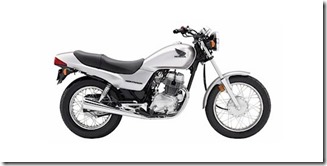
2006_Honda_Nighthawk_250There have been a couple of times, though, when I almost felt like I existed. The first time was in the first couple of years I taught the BRC. Two near-retirement-age physicians took the class, asked the question, and when I suggested they consider the Honda Nighthawk 250’s they were riding in the class. The Honda air-cooled twin is a tough, reliable, lightweight motorcycle that can more than do the job for the kind of around town riding they expected to be doing. A few years later, I was having lunch with a friend in Stillwater when the two doctors came over to our table, reintroduced themselves, and thanked me for the advice. Then, they told me about the trip they’d just returned from to Alaska and British Columbia on their 250s. It was a great story and I wish I remembed it well enough to accurately repeat it here, but I don’t.

Larry's BikeThe second time my advice didn’t die in a vacuum was when my brother asked for the same advice. I had been training on the Suzuki TU250X for a few years at the time and had the opportunity to “test” it on the police driving course at Dakota Technical College earlier that summer. The bike did everything a motorcycle needs to do, plus was fun to ride, gets great fuel economy, has a low seat height, and looks like a 1950’s British bike. Larry bought one and is driving it into the ground in Arizona as I write this. His one complaint was that it didn’t do all that well off-pavement, so I suggested a change in tires. As you can see in the picture above, he took that advice, too. He’s had it for a couple of years and 20,000 miles or so and will probably keep it until he rides it to death.

Likewise, I’m down to one motorcycle and taking my own advice it’s my Yamaha WR250X. Since I sold my V-Strom, I haven’t been riding much but I wasn’t riding much before I sold it. This fall or winter, I plan to rig up a relay so that I can run some electrical crap off of the WR’s battery without draining it when I forget to turn things off. I admit it, I’m addicted to my GPS, heated vest, heated gloves, and charging my computer while I ride on long trips. We’ll see if taking my own advice puts me back on the road and trail.

Sep 1, 2018

Drinking the MSF Kool-Aid

Every two years, the Minnesota MSF program requires instructors to attend a “Professional Development Workshop.” Yes, it is as painful as it sounds. Like a lot of the corporate educational fools in the US, the MSF is a big proponent of “scientific teaching” and that is demonstrated sadly and badly in their instructor “training.” So, in August of 2013, I slogged my way through another of these silly exercises in turning energy into random motion. Every time I go through this experience, I think “Maybe I’m too old for this shit.”

After a momentary period of educational creativity in the early BRC years, the MSF has settled back into its over-bearing, drill sergeant tactics. Instead of talking to students like an instructor, the MSF now tells us just to read the corporate material to our “students”: I suppose that is because we’re too dumb to be teachers and the students are too illiterate to read this crap by themselves? The justification for the “read the cards” harping pretends that the MSF has “scientifically audience tested” the pigeon English in their illiterate 1970’s-era technical writing and that those poorly-written phrases magically turn rookies into Valentino Rossi just by their pure scientific magical-ness. “Keep knees against tank,” “keep feet on ground, not on footrests,” and “at double cones, downshift to 2nd gear, easing out clutch while in straight path” are examples of that genius literature. If I could manage a half-decent Pakistani taxi driver accent, I could deliver their script more authentically. The best I can do is a lousy 1950’s-era Charlie Chan hack-job and that is more offensive than funny. Reading this drivel with a straight face is just embarrassing, so I’m working on the taxi driver bit. So far, I’m more inclined toward the “You talkin’ to me?” sort of taxi driver, though. Reading the cards, without editing on the fly, is awkward and embarrassing. Once you’re involved in trying to fill in the missing pronouns and articles, you might as well paraphrase the whole performance.

Even though we often have a dozen riders with a dozen different skills, temperaments, listening abilities, and mental impairments, the MSF pretends that it’s possible to keep all riders in sight at all times while providing individual instruction to anyone who needs it. “”Never have running motorcycles behind you,” is one of the MSF mantras spoken by those who have never taught a class, paid a lick of attention to struggling students, and possesses an infinite supply of energy. A collection of insane and useless coaching positions are pitched to us as having magical powers in that regard. The fact that most of us see with the eyes in front of our heads rather than our backs appears to be new information to the academic geeks who run the MSF. It is possible that those pencil necks can’t swivel far enough to increase their visual horizon more than a couple of degrees, but most of us can cover a lot of ground from one location just by turning our heads and staying mobile. Go figure.

The chief instructor/trainer-trainer’s catch-all rebuttal is “It’s safer.” Like the conservative’s “think of the children” chickenshit come-back, this is a tough-to-beat argument in a typical classroom situation. It’s not like you can effectively argue against safety. However, like several other sorts of irrational debate tactics, no evidence of that safety improvement is offered or proven. In fact, claiming a tactic is safer without proving that point with statistics is just noise intended to stop discussion. The safety of an instructor’s style, range position, and technique is directly related to how that instructor conducts the class. A “universally perfect position” is an impossibility imagined by someone trying to create a defensible position liability-wise.

Likewise, the argument “If the chief instructor does/says it, it must be right” is about as worthless. The basis for “selecting” chief instructors has turned into accepting anyone who is silly enough to pay to haul his ass to one of the MSF’s training locations and obtain that certification. With that as a basis for selection, it’s a credential no more credible than an inheritance. At one time, our chief instructor was one of the best riders and instructors in our system. Now, the three chief instructors are just three guys who paid more money than the rest of us to do this thing. This is just one more example of failing leadership in all things American. Contrary to popular belief, there is some value in having excellence at the top of an organization

Pulling back from the early days of allowing instructors to find their own style and methods is a mistake, but it’s a popular mistake in the US. Everything known about teachers and teaching has found that instructor autonomy is crucial. All positive education outcomes are derived from creative, inspired, empowered instructors who give a shit about their students. The “read the cards” mantra is a No Child’s Behind Left Untouched holdover that came from the Reagan years’ public education sabotage and it drives good instructors from the system while reinforcing mediocrity. If the reason for recitation instead of teaching is because the MSF is requiring conformity, I’d say that would be a powerful reason for abandoning the MSF program for a state-managed system like Oregon’s. If the reason is liability, I’d say the state needs better lawyers. Reading the cards is something the best instructors do when they are being monitored by our “newspeak chief instructors,” but hardly anyone who knows what they are doing has that habit in an actual course. The upside is that reading the damn things is easy enough to do when we’re pretending to believe in the MSF magic. The downside is that doing that reminds us that we’re supposed to be marionettes, not instructors.

The predictable end result of the MSF’s style of instruction was summed up by this report from someone who took the ERC on a military base, “I also passed the ERC this summer.  The card was good for an insurance discount, and some of the slow speed instruction was valuable.  Other than that, the way this course was taught by the instructors I had was very thin...they did what was in the MSF Rider Card booklets, and that's it.  Mediocre instructors teaching minimal curriculum.  Most of the attendees at my course were military active duty, military retirees, or contractors on military bases all needing the card for two-wheel base access.  It is too bad the military is drinking the MSF Kool-Aid.”

All of this is just another example of the same mismanagement that has driven real work underground in the US. The only talent American management has consistently shown is an ability to make any kind of work as miserable as possible. The average teaching career in the US is eleven years, but even more important is the 25% of beginning teachers who leave the field after four years and the 50% of urban teachers who abandon their careers after five years. The kids aren’t the problem. Management is. About ten years ago (2003), Pat Hahn produced a list of Minnesota MSF instructors with their “length of service” information. I did some Excel sorting on that data and found that the average (mean) instructor career was about three years. There were some significant outliers (15-24 years) in the group, but the overwhelming majority were short-timers. I know more than a few ex-Minnesota MSF instructors and none of them regret quitting. At the time, I wondered how it was possible to make riding the state’s motorcycles for money unpleasant. Now I know.

I know in a couple of ways. For a dozen years, I taught recording engineering and applied acoustics at a private music college. For about eight years, that job was so much fun I would have done it for free. (In fact, I did do a lot of work for nothing other than the pleasure of working with the kids and the school’s great musicians and instructors.) Eventually, the school was overrun by academics and “professional school administrators” and the fun, creativity, and energy was thoroughly sucked from the program. At one time, I thought I would teach at that school until they tossed me out or I died. Now, I’d rather take a bullet than teach another semester. Flipping that kind of commitment takes talent and the one thing American mismanagement has is an incredible ability to make any job as miserable as possible.

I’m writing this in early August 2013 under the assumption that by the time it hits the blog, I’ll either be dead or long out of motorcycle safety training. If not, I’m sure the MSF and the MMSC will make sure that decision is made for me once they read this criticism. It’s hard to imagine that being a big loss. The real problem in motorcycle “safety training” and licensing is that it isn’t serious enough. It’s one thing that 25% of motorcycle fatalities were unlicensed, it’s another that licensing is so easy that people with no ability can fumble through it fairly easily. A real approach to reducing the completely-out-of-line motorcycle fatality and injury numbers would require much tougher motorcycle licensing and a hard-assed approach to unlicensed motorcyclists (confiscate the motorcycle and put the asshole on foot where he/she was stopped along with a big fine). Until that happens, all of this “safety training” malarkey is just part of the sales pitch that is the real MSF objective (after all, the MSF is owned by the Motorcycle Industry Council, a “national trade association representing manufacturers and distributors of motorcycles, scooters, motorcycle/ATV parts and accessories and members of allied trades.” When was the last time you remember a trade organization being restrained in its desire to sell stuff over the safety of its customers? Yeah, that’s what I thought. If it were up to the MIC, motorcycle fatalities would be 90% of total traffic deaths and they’d just suppress the news so that a whole new batch of victims/customers would dive into traffic unaware of the hazards. The MSF is just an attempt to pretend to civic-mindedness while cranking out as many licensed customers as possible. The fact that this organization has forced the states to accept its monopoly on motorcycle safety training is all the evidence anyone should need to know this is a fact.

May 23, 2018

How They Do It

Great Britan has a different take on motorcycle licensing. Until one of our friends, Paul Compton, sent me a link on the British motorcycle license history, I had no idea how different it is: http://www.motuk.com/Motorbike-MOT-history.asp. In comparision, I’m not sure what we have passes for the basic requirement of “a system.”

May 12, 2018

Last One of the Year? Or Ever?

October 7 & 8, 2017, I taught my last MSF Basic Rider Course (I) of the year. This year, in July, I will be "officially 70" (officially, because I’ve called myself “70 years old” since I passed 68 1/2). I’m having a hard time imagining myself teaching kids and middle-aged students motorcycling at that age. 70 is REALLY OLD and I’m feelin’ it. After one of those half-day classes, I can barely move. Six years ago, I was regularly doing doubles but today I wouldn't touch a double with your legs. Guys a lot younger than me say that their day is finished after a morning or afternoon hiking around the BRC range. I’d still be up for the old 2PM to 7PM classes, but we don’t run those anymore: not enough students. Getting up at 5AM to get to a Cities’ range at 7AM isn’t my idea of a fun way to spend a weekend. Early in the season, driving or riding 50 miles in the dark when I'm exhausted and sore is far from my comfort zone.

Teaching motorcycle classes was a terrific income gap-filler when I first left the medical device industry in 2001; before my consulting and repair businesses took off and the college teaching gig became full-time. Yeah, I enjoyed teaching people about motorcycling and getting to ride the state’s motorcycles for money, but it was always close enough to “work” that I wouldn’t have done it without the money. It’s actually a lot of work. In the early years, 2002-2010 or so, I did 20-something courses a summer; pretty much every weekend of my whole summer for a lot of years.

From 2007 to 2011 I made space for at least one several week long trip every season: Alaska in 2007, Nova Scotia in 2008, the Rockies with my grandson in 2009,. North Dakota ghost towns in 2010, the Lake Superior loop with my brother in 2011. I decided on different excitement at the end of 2011: a hip replacement. I made another loop around Superior late that summer, but I put on a lot fewer miles than I usually rack up on that route. I followed that up with a heart attack and a surgery in late 2012. I retired my businesses and from my college instructor gig after the next spring school semester in 2013 and turned a simple RV retirement trip into an extended and miserable VW repair extravaganza. We moved to Red Wing later that year, sold our house in the Cities in early 2014, and . . . that’s about it. The only trip left on my bucket list would be a run down South America’s Pacific Coast Highway. That’s probably not gonna happen.

Since 2014, more than half of my classes scheduled at Red Wing’s site, Southeast Technical College, have cancelled. For the last decade, most of the classes I taught have been at Century College in White Bear, about 50 minutes from our home in Little Canada; but an hour from Red Wing. I have spent a lot of my life arranging my work and home to minimize commuting time and distance (in that order). I’m not going to stop now. I compulsively calculate my actual hourly rate, after 50 years of billing customers for work, and I’m making about $18/hour in real dollars, pre-tax, with the motorcycle classes. Not awful, but certainly not great.

That last 2017 October weekend, I worked with one of my favorite co-instructors: John Wright. If anything could convince me to put in another year or two at this gig, working with John would do it. As always, working with John was in no way like working. I went home sore, a little frustrated with the process and the fact that at least three of the students who "passed" had no business being on a motorcycle, and feeling like I have probably over-extended my use-by-date as an instructor. In early April this year, just like in my first experience with Pat Hahn and the old MSF program, I gave John a volunteer hand with a one-instructor class in Red Wing. After that part-time afternoon on the range, I was almost crippled for a day or so. One of the unexpected benefits of the motorcycle teaching gig has been the people I’ve taught with over the years. The list is long and memorable: motorcyclists and instructors who have not just taught me about motorcycling and teaching, but a whole list of subjects have been explored and appreciated. I feel incredibly lucky that the MMSC opportunity came along when it did; thanks to Pat Hahn and Bill Shaffer for encouraging me to battle through that first mostly-miserable year and the training program. I believe those two friends where hugely responsible for most of the good times that resulted from walking away from my lucrative but miserable medical devices career. If I tried to list all of the instructors I've enjoyed working with, this paragraph would be ridiculous. However, if I didn't mention Greg Pierce and Duane Delperdang, the two program managers who have run the best MNSCU/MMSC program in the state (Century College), I would be sorry for a long while. Not only is the Century program the poster child for a well-run training facility, but those two guys are also a pair of my favorite coaches to work with. Ben Goebel, Mike Jagielski, Jed Duncan, Sev Pearman, and Ken Pierce all make my list of favorite people with whom to spend a weekend standing on hot asphalt for a couple of ten hour day and in the 250+ courses I taught over the years, most of those days were spent with the guys listed in this paragraph.

My first year teaching the MSF program was not that much fun. For a while, that first year, I wouldn’t have bet much on my lasting another season. Since that first year, I’ve worked with several experienced coaches who are not only a lot of fun, but educational, interesting, skilled, and good people. Partially due to location convenience, I ended up teaching mostly at Century College where the program directors have also been coaches.  Working for someone who knows the job, the customers, and the challenges, makes the job a lot more predictable. Oddly, a guy who is no longer with the MMSC program as of a few years ago was the first decent, experienced instructor I worked with: Steve Lane. Steve taught, mostly, at Dakota County Technical College which is often referred to as “the Wild West” by instructors from other locations. Over the years, DCTC became the place for instructors who wanted to make up their own wacky rules and course "design." I quit teaching there more than a decade ago, with once-every-three-or-four-years experimental toe-dip just to see if anything had changed. It’s a little more controlled now, but not consistent enough for my personal liability comfort-levels.

Now, after 16 years, I’m in a similar place as that first year; except I don’t need the money. I don’t like the early morning travel; especially riding or driving in the dark. The work is physically hard on me and has been harder every summer for the last couple of years. I don’t like scheduling my spring and summer weekends seven to eight months in advance; instructor course sign-up occurs in November and December depending on the school where you work. I was in no hurry to make a decision about retiring, but I wanted to as fair as possible to the MMSC program and people who are counting on me. At least until the course sign-up meetings began last winter, I could put the decision off for a while. For that matter, I could just do fill-in work in 2018 and put off the decision until the new BRC 2 kicks in in late 2018. I could have done that, but after evaluating my lack of motorcycling, physical conditioning (especially eyesight), and lack of enthusiasm this spring, I decided to officially retire this month.

Throughout the 2018 season, instructors will be training for that "new" MSF program, the BRC 2, this spring and summer (2018). That is a long two-weekend commitment and I suspect it would be a make-or-break event for me; and lots of other trainers. The rumor was that about half of Wisconsin’s trainers quit during and after their 2015 BRC 2 training (Transitional RiderCoach Prep or TRCP). If history repeats itself, it could be hard to find a Minnesota motorcycle course next year. Finding new coaches is getting tougher because there aren't many younger skilled and experienced motorcyclists and even fewer of those riders are willing to donate the time to become a trainer and put in the work to become a decent coach. It takes a few years to become much of a teacher, if it is ever going to happen for you. Like most professions and human activities, "90% of everything is crap." Once you are a MMSC/MNSCU motorcycle trainer, the state pays something for the semi-annual training requirements, but you have to get past that first long and intense training hurdle on your dime.

Quitting was a tough decision, even with all of the reasons I've listed above. I retired from my college instructor gig 5 years ago and almost all of the friendships I made there have become distant memories. Even though I've continued to teach at Century during the last 4 years, most of my friends there are now only seen in passing and rarely even then. Absence does not "make the heart grow fonder," the more accurate saying is "out of sight, out of mind." But everything changes and so have I and so have you.


Stay safe everyone and thanks for all the fish.

May 1, 2018

What if We Really Cared?

All Rights Reserved © 2017 Thomas W. Day

There is a lot of talk, and little real action, about motorcycle safety improvements. Motorcycles are grossly over-represented in highway death and injury statistics and it will only get worse as cars continue to become safer and less dependent on human drivers. If we really did want to make a serious difference in those statistics and reduce the insanely high cost of all that blood and tears to the non-motorcycling public, what would we have to do?

A lot, I suspect.

After discussions about the possibilities with the Administrator of the Minnesota Motorcycle Safety Program, the owner of an independent motorcycle safety program, and a few MSF instructors, I came to a few conclusions. First, the people involved in the politics of motorcycling (ABATE, the AMA, the MSF/MIC, manufacturers and dealers, safety trainers, DOT bureaucrats at the state and federal level, and motorcyclists themselves) are not incentivized to do ANYTHING that will noticeably improve motorcycle safety. There is more easy money in the status quo than in doing the right thing and in worrying about the future of motorcycling. All of these entities are primarily concerned with putting butts on seats and taking a chunk of money from licensing. In 2010, not a big year for motorcycling, the GAO estimated motorcycle crashes cost the general public about $16B. Not exactly chicken feed. The industry produces about $4.4B in revenue, annually. So, the cost of keeping motorcycles on public roads is about 4X the industry’s economic value to the country. At some point, someone might suggest this is a waste of taxpayer money. In fact, I’m suggesting it right now.
So, my list of things that have to be done to make motorcycling safer, significantly safer, enough safer that motorcycle might be allowed to use public roads in the future, is this:
  • National Helmet Law. I do not know how this isn’t obvious to everyone, but we have a national seat belt law for cars and we simple can’t excuse motorcyclists not taking the minimum safety precaution while we require cagers to belt-up, air-bag-in, and surround themselves in crush-zones and roll-cages. Helmets are a minimum nod to pretending to care about motorcycle safety.
  • National Protective Gear Law. Even more than helmets, I think insurance companies should be allowed to vacate health coverage for riders who have accidents and injuries wearing no reasonable protective gear. At the least, riders should be required to wear decent foot wear, protective jackets, long pants, gloves, eye protection, or self-insure. There is no reason the public needs to assume responsibility for the surgical costs of someone who chooses to ride in flip-flops and a wife-beater.
  • State Emissions and Safety Inspection. Back in the 80's, when I lived in California, every vehicle licensed to be on California's roads had to pass an annual emissions inspection. Part of the inspection was to determine that the intake and exhaust system was bone-stock or equivalent. Anyone who has been anywhere near the usual cruiser suspects knows that those blubbering farm implements drool out as much unburned fuel as they manage to heat up. All that noise and nothing useful to show for it. Loud pipes not only don't save lives, they make millions of enemies for motorcyclists and probably cost a life or two hundred in road rage encounters. Since the fact that motorcyclists are incapable of maintaining safe vehicles has been made apparent by the existence of ape-hangars, chicken strips, missing front brakes, micro-turn signals, and the usual lousy maintenance motorcyclists are often proud of, safety inspections need to be established. Also true for cars and trucks.
  • Mandatory Regular Training. Yeah, I know cagers don’t have to retake the license test every time they re-up their license, but car drivers are in a vehicle that is somewhere around 3,000 –20,000 times safer-per-mile than motorcycles. Even more, cars are consistently getting safer while motorcyclists are a growing portion of highway crashes and mortality. The fact that most states allow a license holder to pay a small premium to add the “M” endorsement to their driver’s license, without any evidence that the endorsee owns or can even ride a motorcycle is flat-out stupid. At the minimum, something like the MSF’s Intermediate Rider Course with a passing score on the test (There is a test? Yes, Georgia there is and it ought to be mandatory.) should be required for that M-endorsement. Of course, I think anyone over 50 should have to retake the written and driving exam for cars and trucks every 5 years or so, too.
  • Tiered Licensing. I’d go with the Eurozone’s 3-tier system, but I’d be really behind something like the Japanese tests and tiers. This is a no-brainer. After teaching beginning MSF classes for 16 years and watching the worst “students” in my classes mount up on the biggest, most cumbersome, hardest to ride cruisers or the most powerful sportbikes after barely passing our minimal “skills test” (or not), I’m convinced that new riders are the last people who should get to choose what they ride without guidance. Yeah, I know that there is a decent argument that requiring serious licensing testing curtails interest in motorcycling, but that's happening with or without. 
Those are my minimum recommendations for changing the direction of an activity and vehicle that appears to be destined to vanish from the transportation system. Otherwise, motorcyclists can look forward to a near future where motorcycles and horses have exactly the same access to public roads (closed street parade permits, only). Why should autonomous vehicles be forced to cope with vehicles and riders who can't manage their own safety? What value does motorcycling bring to a culture that is being asked to foot a $16B annual bill for mere recreational "lifestyle" bullshit? Fix it or lose it, dummies. I'm 70. It doesn't matter to me, either way. I've been on two-wheels since 1952 and with power since 1963 or so. I've had my fun. You, on the other hand, are looking at being forced off of the road in the next decade. Maybe sooner.


Jan 10, 2018

Ironic, Ain't It?

"There’s a new special license plate promoting motorcycle safety available starting today! ABATE of Minnesota designed and sponsored the new motorcycle awareness license plate. The plates cost $10 and there is an annual $10 contribution that will go toward motorcycle safety education and training programs.

Plates are available for purchase at deputy registrar offices: http://ow.ly/D0KB30huk1R"

That bastion of anti-helmet, anti-government, anti-anything that might make motorcycling safer and more responsible, ABATE, convinced the dimwitted Minnesota legislature to create a "Start Seeing Motorcycles" (and Unicorns) special license plate and the character on the plate could not look less like an ABATE member.

Oct 18, 2017

#157 Who Is An Expert Rider?

geezer_squareAll Rights Reserved © 2017 Thomas W. Day

This August, I took advantage of a Minnesota Motorcycle Safety Center (MMSC) Rider Coach invitation to take the program's Expert Rider Course at Century College. Two of my favorite coaches from the Minnesota program, Rich Jackson and Ben Goebel, were the instructors for this class. It was pretty much a no-brainer that if I was going to demonstrate how far from "expert" my riding skills are, this would be the safest place. Both of those guys are so far outside of my skill-set I hesitate to call myself a "motorcyclist" in comparison. Sort of like when someone asks me if I'm a musician, my immediate point of reference is Jeff Beck and my response is, "Hell no." Also, lucky for me, it was a small class, so there wouldn't be many witnesses to tell tales of how many times I rode through an exercise without making the slightest attempt to demonstrate the skills being taught.

ExpertClass5The MMSC offers a variety of classes, beyond the Basic Rider Course (BRC) that many people use to obtain their motorcycle endorsement. For example, the MMSC offers Basic Motorcycle Maintenance, Intermediate Rider Course (IRC), Introduction to Motorcycling Course, Moped Rider Course, the Minnesota Advanced Rider Course and the Expert Rider Course. I've taught the IRC for about 15 years under a variety of names (ERC, BRC II, and the current acronym), but my previous summers' teaching schedules prevented me from taking either the Advanced or Expert courses. This summer, I had a light schedule and I lucked into an open weekend.

ExpertClass3The price ($75 for a one-day, eight-hour range, 9AM-5PM) for either the Advanced or Expert courses is a steal, but the classes aren't offered often and enrollment is limited. There is very little similarity between the IRC and either of these courses. Both the Advanced and Expert classes were designed by Rich Jackson, a Minneapolis Police Department motorcycle officer and MMSC Rider Coach; both courses have some similarities to the training a motorcycle officer receives. The cones are bigger, the exercises are harder, the speeds are higher, and the expectations are elevated. What passes for "a tight, low speed turn" in the other MMSC classes feels pretty roomy compared to the Expert Course obstacles. Likewise, an emergency stop or an offset-weave at 30-40mph is very different than from the 12-15mph BRC or IRC experience. Many of the exercise names are self-descriptive: "40-mph brake-and-escape, instantaneous stops, the Iron Cross, J-turn, slow and 30 mph offset weaves, tight and locked turns in confined spaces." 

The exercises are broken up by "breeze-outs," which are follow-the-leader trips around the college campus; in single-file, side-by-side, or staggered formation. The breeze-outs are an opportunity to experience group ride tactics, hand signals, and the three basic formations for group riding. When Rich introduced a few of the hand signals, mostly for my benefit, I demonstrated my one and only motorcycle group hand signal: a way bye-bye. No one was amused. Rich and Ben are excellent instructors and I wouldn't miss an opportunity to learn from their experiences, but I'm still unconvinced that group motorcycling is a clever idea. Even when the group is being led by actual experts (instead of the usual best-dressed pirate bozos), it still feels to me like rolling bowling pins. I have seen no evidence of safety in numbers when it comes to motorcycles. I'm glad I got the Expert group experience, but I'm still riding solo on my time.

ExpertClass10The breeze-outs are a terrific opportunity to cool off the motorcycles, reduce some of the performance pressure of the class exercises, and get a feel for close-quarters group exercises without the hazards of traffic. There is enough of a hooligan aspect to the breeze-outs to blow off a little steam, too. When else will you get to ride the sidewalks, basketball and tennis courts, and handicap ramps of a college campus without worrying about campus security? Those rides aren't aimless rambles through the park, though. Rich and Ben kept the pace quick enough to require serious lean from the big bikes in the group.

Most of the student and instructor bikes were pretty large, too. There is a 400cc minimum size requirement for either the Advanced or Expert classes and most of the participants in my group exceeded that engine-volume by a few multiples. Unexpectedly, I was really impressed with my fellow "students'" abilities. Of my group, I was clearly the least "expert" in the crowd, but I was the most experienced/oldest. For every rider who claims the DMV's riding test is "impossible" on a "real motorcycle," these guys consistently proved that the DMV's test is a cakewalk for an actual motorcyclist.

In my opinion, this course is really close to what I think should be required every four years to re-up a motorcycle endorsement. Currently, there are about 200,000 more licensed riders than registered motorcycles, just in Minnesota. Far too many people simply pay the extra $13 to add an M-endorsement to their license without being able to demonstrate even the most basic skills. Even better would be a tiered license system that required riders to take and pass a course like this to obtain a license for 500cc or larger motorcycles. If the goal is to reduce motorcycle morbidity and mortality, it's only common sense to require motorcyclists to make a minimal effort to be competent riders.

So, who is this course for? It should be obvious that anyone who intends to participate in group rides belongs in the Advanced Course; at the least. There are a lot of subtleties to riding in a group that most people participating in these rides do not know. Becoming familiar with hand signals, the tactics and complexity and importance of formation riding, and knowing how a group should come to a stop and take off from a parking spot are just the beginning. Doing all of that in a completely supportive and non-threatening situation should be a baseline requirement for anyone wanting to ride safely on public roads in a group. For riders like me who don't feel particularly tested with the IRC's basic exercises, the Advanced and Expert Courses up that game considerably and provide a dose of humility when you see your skills compared with other experienced riders. If the Basic or Intermediate course seemed difficult, this isn't a great fit for you. However, if you put in the time and effort to become comfortable with those fundamentalexercises, setting your sights on these two course for your near future is a practical aspiration. I strongly recommend this course and, particularly, with these two instructors. At the least, you'll spend a day playing around on a motorcycle refining your skills and hanging out with terrific people.

All photos by Catten Ely

Originally published in MMM #187 September 2017

May 23, 2017

Backseat Driving

I just took what will probably be my last MSF instructor training session and got a little more insight into where motorcycle safety training is going, in the process. The “new” (2014) classroom design is a giant step back from the MSF’s earlier attempt at “learner centered” or adult training. While I might suck at the delivery, I’ve always been a big fan of that concept because the alternative leaves me out in the cold as a student. The “education system” I grew up with is often called “the sage on the stage,” which would be one thing if the person on the stage was actually a sage (“a profoundly wise person; a person famed for wisdom. someone venerated for the possession of wisdom, judgment, and experience”), but it will always be difficult to attract that kind of person to western Kansas (where I grew up and experienced my K-12 “education”). Most small-to-mid-sized towns have the same problems, from the intolerant majority segments of the Midwest and Southeast, and most of the country’s underfunded public education system. 

For many years I was too often stuck listening to someone who had put about as much effort into their lecture topic as me, although that person was 20-30 years older and a whole lot lazier. If it hadn’t been for the years I spent in southern California’s university system, I’d have lived my whole life believing that teachers were nothing special. Lucky for me, that didn’t happen. Otherwise, I’d have been so bored with “education” that I’d have given it up after my first junior college semester in 1966.

Becoming one of those “lazier than me” lecturers has never been a goal of mine. In fact, for the first 40 years of my life I had absolutely no interest in being any kind of teacher, although I’d been roped into dealer, technician, and customer training with a couple of my employers for about ten years. I didn’t consider myself to be a teacher and if someone had called me one I’d have laughed at them. My father was a career high school teacher and I spent my first 15 years surrounded by adults who made their living “teaching.” Nothing about that experience provided any inspiration toward that career path.

Some motorcycle instructors claim they teach the MSF program to “give something back to motorcycling.” I don’t get that. 

Motorcycles are a transportation vehicle or a luxury toy. If their primary purpose is to be a “lifestyle” prop and noise-generating irritant, that’s nothing worth the “giving back” effort. After paying my vehicle license and fuel taxes, I don’t feel any compulsion to give back any of my time and energy to Wisconsin, Iowa, Detroit, Japan, or China. Honestly, for at least half of the years I’ve taught the MSF program my primary motivation has been self-preservation. While I do not believe the remedial training we provide or the license testing the state requires does anything significant toward making new or even experienced riders safer or more competent beyond a few weeks post-training, I know that thinking, talking, and demonstrating decent riding techniques make me a safer, smarter, and more competent rider. And I get paid to do it, which brings up my decision to wind down my motorcycle instructor career. This is something I haven’t done for the money for the last 16 years, but wouldn’t do without getting paid for it about 90% of the time.

Over the last five years, I’ve discarded all of the other things I’ve done to make a living that fall into that category. I used to repair professional audio equipment for $175/hour. I wound down that work and business starting in 2012 and by July 2013 all of my customers had been redirected to someone else. I did commercial acoustic consulting and audio forensics, which sometimes paid fantastically and always paid well. I did my last 911 call analysis in late 2011 and completed my last acoustic consulting contracts in early 2012. A decade ago, when someone asked me what I did for a living, I used to say, “I teach rock and roll.” (Nobody wants to hear about the repair or consulting stuff and most people don’t take self-employment seriously; including me.) For more than a decade, teaching music production and technology at MSCM felt exactly like that. After the last couple of uninspiring semesters, there was finally more money than fun in that job. After a minor heart attack in late 2012 I decided I had been there long enough. My last months of teaching came at the end of the spring 2013 semester. I pretty much knew I wasn’t going back, but decided for sure on my 65th birthday that summer. The only thing I do for pay, now, is teach “motorcycle safety” classes a few times a summer. (2015 was the last summer I taught something resembling a full load. Plus, I am still selling off stuff in hopes that we can downsize “bigly” one more time and hit the road full time. Come on by. See anything you like, make an offer!

The “fun” part of teaching motorcycle safety classes was working with and getting to know the students. Even during the Harley/Polaris/Star/hippobike boom days I still had occasional students who made the job worth doing. [For example, two near-retirement medical doctors from Stillwater who took the class, listened to my advice on their first motorcycles, bought a pair of Honda Nighthawk 250’s, and rode them to Alaska and back.] I assisted with my first range portion of the MSF course in 2001 and wrote about freezing my ass off in 2” of slush back then. I went through the training program in 2002 and became an official MSF instructor and taught a boat load of classes that first year of the MSF’s Basic Rider Course. I wrote about that experience in MMM, too. For the next dozen years, I filled most of my summers with basic and experienced rider classes and enjoyed a good bit of that. I got to work with some dedicated, talented, and entertaining instructors (and a few who weren’t any of that) and I met a lot of hopeful prospective motorcyclists.

Over the years, I’ve had lots of conversations about teaching techniques, read a few dozen books about adult education, and have thought and written about teaching everything from computer applications to motorcycle safety and expertise to music, audio recording, and electrical/electronic engineering. One of the many things I’ve learned about teaching is that, like everything, it only works if there is a corrective (negative) feedback loop to provide input that keeps the system on course to achieve the intended outcome(s). There is only one meaningful outcome in motorcycle safety training: reduced mortality/morbidity occurances among “trained motorcyclists.” That is not only something the MSF warns instructors and programs not to expect, it’s not being measured by anyone. Without that critical piece of the puzzle, it seems to me that the effort, time, and money spent on training is wasted. I don’t have a lot of time left, so I’d like to waste as little of it as possible.

Dec 12, 2016

#137 Foot Out, Rider Down

All Rights Reserved © 2014 Thomas W. Day


A friend sent me a note this week, complaining about the godawful scooter and bike skills he witnessed near the UofM. He said, "When I was instructing, a favorite thing to yell at students (and sometimes regular folks) was 'pick up your feet'. For some reason that horrible habit has re-entered the consciousness of people that think they know how to ride. A few days ago I watched a young guy on a scooter (wearing a helmet, with shorts and flip flops) stick his left foot out as he arced through the intersection. This evening I watched a young hipster (flannel shirt, rolled up jeans with lace up boots) on a Sportster leave an intersection making a left turn with his boot out like he was at the Springfield Mile. Just a few blocks later, I watched an overweight middle age guy on some bloated metric cruiser wobbling away from a stop sign with his feet down as he tried to gain momentum and stability. Unfortunately he too was wearing flip flops. At that point I was ready to stick my head out and yell."

I'm not sure what to say about this. His comment was inspired by a rant on the GeezerwithAGrudge.com site, after one of my weekend classes. I had a young man in the class who was convinced he was an experienced off-road motorcyclist. Every turn was accompanied by him sticking out his foot like he was planning on sliding it around a quarter-mile dirt track. There was nothing special about his speed and his steering input was more bicyclist tactic than dirt biker. I repeatedly told him that if he hooked a heel on the asphalt he might be looking at tearing up body parts from an ankle to a knee to a hip.

He kept saying, "it's a dirt biker habit."

I kept saying, "It's really just a bad habit."

So it went for the day. Apparently, so it is going for lots of riders everyday.

Honestly, like cager tailgating and throttle pumping I think it's a byproduct of kids who play video games deluding themselves into thinking they've done something real. When my wife sees someone flying through traffic, crawling up the ass of every car slowing down the fruitcake's progress, she says, "There goes another video game fool." What she means is that kids who grew up playing dumb crap like Grand Theft Auto or Forza Motorsport have been conned into thinking their "competence" in that moronic game translates to their ability as a car driver. Trust me, punk. It doesn't. Likewise, "success" with MXGP - The Official Motocross Video Game has no connection to actually riding a motorcycle off-road. Not one iota of a relationship. None. Nada. Here's where the real difference lives: if you crash your virtual cage or bike, you restart the game and try again. If you crash your real cage or, especially, bike, you might be dead or so mangled you'll wish you were dead. Video games are (wait for it) games. Racing is a sport. The difference is one is played by effortlessly twiddling your fingers while you stuff your face with Cheetos® and the other is one of the most physically demanding sports in the world.

So, just because your virtual "rider" sticks his foot out for every slight change of direction that does not mean real motorcyclists need their feet in the air to turn a motorcycle. That is what the handlebars are for. The tripod method of turning depends on poor traction (so your foot will slide and the rear wheel will spin) and great footwear so your foot and ankle will provide that third leg of stability. Some of the fastest off-road riders reserved sticking a foot out for extreme situations where it was absolutely necessary because of the injury risk involved. Getting a picture of Roger DeCoster sticking a foot out took patience and DeCoster won a Gold Medal at the 1964 International Six Days Trial, was the 1964 Belgian Observed Trials National champ, collected five 500cc Motocross World Championships, and won 36 500cc record-setting Grand Prix races. Putting an unprotected foot out in a low speed, poorly-executed city street turn is just a demonstration of sorry cornering skills.
 
Anyone dumb enough to stick a flip-flop-shod-foot out toward concrete or asphalt deserves to be fitted for a pegleg. I am not exaggerating. That is one of the world's dumbest moves, right along with wearing shorts and a tee-shirt on a motorcycle. Why not ride naked? You might as well. It's not like that teeshirt is going to be any sort of protection when you are sliding down the road. Remember, you're the idiot who needs to poke a foot out to turn a perfectly competent motorcycle at walking speeds. It's not like anyone smart is going to put money on your riding skills. The house odds are that you are going down, hard, sometime soon. When you do, there is going to be a lot of skin left on the road and you will be making some plastic surgeon very happy (and rich) for a very long time; if you live.

This is when someone who loves you should be suggesting you get some training. Most likely, it might be a good time to get your motorcycle license, too. Since 20% of Minnesota's motorcycle fatalities are unlicensed "riders," (If you're not skilled enough to get a license, you're barely a glorified passenger.) it's a safe assumption that lots of those foot-turners are unlicensed and uneducated riders. Even better, if you want to be the kind of rider who really needs to stick a foot out in corners, sell your scooter or street bike, buy a dirt bike, and go racing. Believe it or not, being on a race track is a hell of a lot safer than riding poorly in traffic.

Nov 7, 2016

#134 Changing the Rules, Mixing My Emotions

caveman

All Rights Reserved © 2015 Thomas W. Day

On the last October weekend of the 2014 MMSC training season, I taught a “Seasoned Rider” class (aka Experienced Rider Course, ERC, BRC II, etc.) for a few Polaris company employees. Because the course had some experimental qualities (“There will be a test.”), the course was prepaid to the college regardless of the number of students. Saturday morning was right at freezing and no one was compelled (either by work or because they’d laid down $60) to be there, so only four students showed up. On top of that, due to the lateness in the season and the “test,” the Polaris employees were allowed to ride the course on the state’s 250-and-under motorcycles, instead of bringing their own rides. Due to those points, I was the only guy on the range who rode to the range. The first 3 1/2 hours were identical to the usual course, but it was pretty obvious that we all had a different kind of edge on due to the impending “evaluation” (PC for “test”). The students, because they were in a pass/fail situation and instructors because we’d never conducted a BRC II with a test at the end.

The big exception to this course was the students were offered the choice of riding their own bikes or the state’s. Because it was specially offered to Polaris employees by Polaris and some of them are beginning motorcycle owners and may or may not actually own a motorcycle, it made for an interesting experiment. By design and purpose, the BRC II is intended, I think, to be ridden on the students’ bikes. At least, that’s the way we’ve always done the course as long as I’ve known about it. And, of course, there has not been an evaluation at the end to determine what has been learned in the course during the time I’ve been an instructor. That has not always been the case, though.

I took my first prototype-ERC at Willow Springs Raceway, back in the late 1980’s. It wasn’t called the ERC, as I remember, but I don’t remember what it was called. There was a fair amount of lecture along with the usual emergency stop, obstacle avoidance, turning, and riding technique instruction. There was a short performance test at the end of the course and, as I remember, we were presented with a certificate that could be used for a drivers’ training discount with our insurance companies. The next time I took the course was in Denver, at Bandimere Speedway, the drag racing track. The “range” was a marked-up and coned section of the speedway where the cart racing is today. The course used the same kind of exercises, along with an opportunity to play panic-braking on their big training-wheeled 500 Nighthawk. You could wind up the bike to about 40-50mph and hammer the brakes and the skids kept the Nighthawk from falling over. I don’t think there was a test with that course. The last time I took the course as a student was in Minnesota on the Guidant parking lot in Arden Hills. The parking lot had been oiled earlier that week and employee cars had been sliding into each other at low speeds, morning and evening. I know because I worked there. I usually bicycled to work, so I missed out on the parking lot fun until Saturday at the ERC. The course continued the sliding and crashing the cars had demonstrated earlier in the week. Almost everyone in the class crashed at least once and a lot of chrome and plastic looked worse for the wear. I “anticipated” the emergency swerve exercise because I didn’t think my Yamaha TDM would look better coated in greasy black oil. The next week, another asphalt contractor cleaned and recoated the parking lot, this time with materials that didn’t come from the county oil recycling sludge pit. That’s the history of my student experience with the ERC and it’s ancestors and all of that was on my own motorcycles.

That behind me, I had a little built-in resistance to teaching the course to “experienced riders” on what most of those riders would consider to be “beginner bikes.” The fact is, a lot of experienced riding course students do not ride well enough to be called “experienced.” Maybe that’s the motivation for the recent renaming of those classes as “Basic Rider Course II” or “Seasoned Rider Course.” Another fact I have often expressed is that I think about 90% of Minnesota motorcyclists choose motorcycles that require skill levels far beyond the riders’ capabilities. Unlike ABATE, the AMA (the motorcycle group, not the doctors’ AMA), and the Industry, I believe tiered licensing is just common sense and that our current license testing is a joke. Not a funny joke, but a cruel, sarcastic, vicious joke that costs lives and billions of dollars in death and injury. From observing street riders over half-a-century and training them for a dozen years, I’d estimate about 50% of Minnesota riders should be limited to 250cc-and-under motorcycles, 90% should be limited to 650cc-and-under, and I wouldn’t be surprised if the 10% who are smart, competent, and safe enough to be on 650cc-and-above would probably choose to ride their big bikes on closed courses 90% of the time.

All that baggage under my belt, we started this course with a little apprehension. A lot of my doubts dissolved quickly, though. After the first couple of exercises it became clear that our students were riding a lot more aggressively and testing their skills more confidently than the typical BRC II class. Some of this was because this was a younger-than-typical class, but I have to give a substantial credit to the fact that we all ride small bikes more competently and confidently than large ones. We decided that I’d administer the test, since I’d studied the BRC II test procedure and had a couple of on-line conversations with California MSF instructors who’d done the test in the BRC II’s early years. The BRC II test is more like the DOT’s test. Which means all four sections of the test are performed by each student, more or less non-stop. More concentration is required, along with competence, memory, and attention, all qualities directly related to being safe on the road. Again, this was a small class filled with better-than-typical students, but at the end they all scored well enough to be qualified as MSF instructors.

I thought about this class for several days afterwards. There are some subversive reasons I am inclined to like the whole concept. The test is more important than I’d imagined. We often have old, unskilled, and/or arrogant riders who simply ride through the harder exercises on their abysmal hippobikes, imagining that there is no relationship between low speed closed course exercises and their delusional “real world.” The apehanger crowd that is overrepresented in mortality/morbidity statistics is typical of this character. Handing them a card that indicates successful completion of the course is particularly galling. Mostly what that group achieves is four hours of an out-of-control riding demonstration on an overweight, unmanageable motorcycle that has put the other riders and the instructors at risk. Most of that alcohol-demented bunch would totally blow the BRC II test because they’d forget half of it before they left the gate. If they were allowed to perform the test on a small bike or their own, the result would probably be the same; massive failure. Nearest and dearest to my heart, allowing these intermediate-level riders to do the course on our small motorcycles might encourage some of them to consider, or reconsider, their choice of motorcycle. A tiny percentage of riders might discover that “small is fun” and take that lesson to the street. If that, alone, happened, I’d be all for letting BRC II riders take the class on whatever motorcycle they chose.