Showing posts with label basic rider course. Show all posts

Sep 6, 2023

Why I Think They Are Wrong

The constant reminder that the “Normalcy Bias” plagues motorcyclists into making fatal and foolish decisions is one of many reasons I decided my Motorcycle Safety Foundation (MSF)/Minnesota Motorcycle Safety Center(MMSC) instructor career was not worth continuing. Years ago (2006), I wrote one of my all-time favorite essays, “Panic Reactions,” where I described a phrase I came to use almost as often as “good job” in my motorcycle safety classes, "Every panic reaction you have on a motorcycle will be wrong." As part of my answer to every question a student might have had would be my constant hunt for “escape routes.” The latest version of the MSF’s Basic Rider Course (BRC) de-emphasizes risk to the point that instructors were reprimanded for talking about things like escape routes. There, of course, is a reason for that: 1) The MSF is owned by the Motorcycle Industry Council (MIC) and their overwhelming incentive is to put butts on seats; 2) The MMSC is funded by motorcycle license endorsements and their overwhelming incentive is to make it easy for anyone in the state to obtain and retain an endorsement. Years ago, I was asked to present a “This I Believe” talk to the Unitarian Universalist society to which my wife and I belonged and what I believe in is that “Incentives Are Everything.” Sadly, I find absolutely no evidence that humans are anything more than a slightly evolved animal and that 99.99…% of human activity can be explained by self-interest and incentives.

I get why the MIC is uninterested in actual motorcycle safety. Like every corporation on the planet today, today’s profits over-ride any future self-interest; you gotta satisfy those “equity investors” first and everything else be damned. The MSF’s mission statement is pretty clear, “MSF is the country's leading safety resource and advocate for motorcyclists. We create world-class education and training systems for riders of every experience level. We raise public awareness of motorcycling to promote a safe riding environment.” “Public awareness” is not motorcycling’s main problem: incompetent motorcyclists is overwhelmingly the biggest problem, illegal noise is second, and a close third is the outright hostility toward the motorcycle gangs that largely represents motorcycling in the public eye. Neither of the two groups I was once associated with have a reason to care about those problems. The state’s civil servants are all old enough that they’ll be long retired before any change happens and the MIC’s executives will be long golden parachuted out when the economics behind US motorcycling finally drops the coffin lid on motorcycles and public roads.

In the past couple of months, I’ve had to listen to at least a dozen motorcyclists and ex-motorcyclists describe their “had to lay ‘er down” stories. Not a one of those fairy tales was even slightly believable. If you can’t competently use your brakes, you sure as hell can’t pull of that stuntman bit, but what you can do is panic, scream, and fall over and, then, make up some bullshit story about how you planned it all and it either worked out or didn’t. At least three of the goobers telling me their sob story were hobbled for life from their motorcycle episode. Even they imagined doing something other than simply and stupidly fucking up and falling down when they crashed and disabled themselves.

Back to the “normalcy bias,” one of my favorite books (and podcasts) is You Are Not So Smart and the chapter on normalcy bias describes people frozen in their seats as a crashed airliner catches fire and burns down around them, while their brains chant “this can’t be happening, everything is normal” until the air is sucked from their lungs and they are fried or blown to pieces. The only way to avoid being trapped by your disbelief is to prepare in advance, to consider the options in a disaster, to look for escape routes, and to think about the steps necessary if escape becomes necessary. Every place you go and everything you do should be accompanied by this process, especially in Crazyville, USA where the NRA has armed every nitwit, fanatic, and pissed-off momma’s-boy incel with enough weapons to empty an auditorium. On the highway, an intelligent motorcyclist knows that bicyclists and pedestrians are the only road users who present a lower threat than a motorcycle and, as such, we’re invisible. The only protection we have are escape routes and a vehicle capable of using them [sorry cruiser and trike guys, you’re likely dead since your invalid bike can barely manage asphalt].

You could argue that riding while constantly worrying about being run over by a distracted, incompetent, and/or angry cager takes all the “fun” out of riding a motorcycle. You could delude yourself into imagining that riding rural highways minimizes those risks. The only real protections you have are your skills, your preparation, and luck. [Never discount luck.] An insurmountable obstacle for me to consider continuing my “safety instructor” career was the organizations’ discounting risk in favor of “more butts on seats.” I love motorcycling and motorcyclists (not bikers, they aren’t the same people) and my life was greatly enhanced by 60 years on a motorcycle, but filling the roster with untrained, unprepared, and unskilled riders is going to kill this form of transportation and I don’t want to be part of that.

The best guess is that motorcycle crashes cost the US economy $16B and the entire US motorcycle industry produces a gross income of about $5.6B in 2022. The damned industry and our idiot licensing systems and godawful training approach produces an income that is not-quite 1/3 of the cost of motorcycling to the nation. In comparison, the automotive industry produces $1.53T in gross income and the cost of automotive/truck crashes is about $340B, or one-fourth the national revenue from cars and trucks. Any half-rational nation would start purging motorcycles from public roads a few minutes after absorbing those numbers. We are closer to half-witted than half-rational, but that just means it will take longer to happen. But it will happen.

Oct 8, 2018

Can You Hear Me Out There?

When I taught the MSF program for MMSC, I’d get several questions per class along the lines of “what kind of first bike should I buy?” As you might know from following this blog, I have some strong opinions about that. (“No, you’re kidding?”) Most of the time when I’m giving this sort of advice, I feel like the deaf bluegrass banjo player whacking on a microphone saying, “Can anyone out there hear this thing?” (All bluegrass banjo players are deaf, I know.) It’s almost like teaching when the midterm or final exams get graded and you wonder if you were even in the room when those nitwits came to class. 

Mostly, I’d recommend something small, lightweight, that handles well and my ”students” would act like I’d insulted their intelligence, skill, or something and move on to the other instructor for more “manly advice.” As a habit, I recommend a bike around 250cc and one that weighs close to 300 pounds for daily riding. I’ve said this before in “A Good Beginner’s Bike” and I’ll say it again. And again.

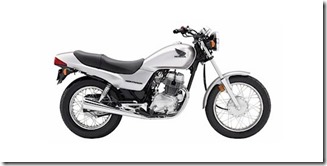
2006_Honda_Nighthawk_250There have been a couple of times, though, when I almost felt like I existed. The first time was in the first couple of years I taught the BRC. Two near-retirement-age physicians took the class, asked the question, and when I suggested they consider the Honda Nighthawk 250’s they were riding in the class. The Honda air-cooled twin is a tough, reliable, lightweight motorcycle that can more than do the job for the kind of around town riding they expected to be doing. A few years later, I was having lunch with a friend in Stillwater when the two doctors came over to our table, reintroduced themselves, and thanked me for the advice. Then, they told me about the trip they’d just returned from to Alaska and British Columbia on their 250s. It was a great story and I wish I remembed it well enough to accurately repeat it here, but I don’t.

Larry's BikeThe second time my advice didn’t die in a vacuum was when my brother asked for the same advice. I had been training on the Suzuki TU250X for a few years at the time and had the opportunity to “test” it on the police driving course at Dakota Technical College earlier that summer. The bike did everything a motorcycle needs to do, plus was fun to ride, gets great fuel economy, has a low seat height, and looks like a 1950’s British bike. Larry bought one and is driving it into the ground in Arizona as I write this. His one complaint was that it didn’t do all that well off-pavement, so I suggested a change in tires. As you can see in the picture above, he took that advice, too. He’s had it for a couple of years and 20,000 miles or so and will probably keep it until he rides it to death.

Likewise, I’m down to one motorcycle and taking my own advice it’s my Yamaha WR250X. Since I sold my V-Strom, I haven’t been riding much but I wasn’t riding much before I sold it. This fall or winter, I plan to rig up a relay so that I can run some electrical crap off of the WR’s battery without draining it when I forget to turn things off. I admit it, I’m addicted to my GPS, heated vest, heated gloves, and charging my computer while I ride on long trips. We’ll see if taking my own advice puts me back on the road and trail.

Sep 1, 2018

Drinking the MSF Kool-Aid

Every two years, the Minnesota MSF program requires instructors to attend a “Professional Development Workshop.” Yes, it is as painful as it sounds. Like a lot of the corporate educational fools in the US, the MSF is a big proponent of “scientific teaching” and that is demonstrated sadly and badly in their instructor “training.” So, in August of 2013, I slogged my way through another of these silly exercises in turning energy into random motion. Every time I go through this experience, I think “Maybe I’m too old for this shit.”

After a momentary period of educational creativity in the early BRC years, the MSF has settled back into its over-bearing, drill sergeant tactics. Instead of talking to students like an instructor, the MSF now tells us just to read the corporate material to our “students”: I suppose that is because we’re too dumb to be teachers and the students are too illiterate to read this crap by themselves? The justification for the “read the cards” harping pretends that the MSF has “scientifically audience tested” the pigeon English in their illiterate 1970’s-era technical writing and that those poorly-written phrases magically turn rookies into Valentino Rossi just by their pure scientific magical-ness. “Keep knees against tank,” “keep feet on ground, not on footrests,” and “at double cones, downshift to 2nd gear, easing out clutch while in straight path” are examples of that genius literature. If I could manage a half-decent Pakistani taxi driver accent, I could deliver their script more authentically. The best I can do is a lousy 1950’s-era Charlie Chan hack-job and that is more offensive than funny. Reading this drivel with a straight face is just embarrassing, so I’m working on the taxi driver bit. So far, I’m more inclined toward the “You talkin’ to me?” sort of taxi driver, though. Reading the cards, without editing on the fly, is awkward and embarrassing. Once you’re involved in trying to fill in the missing pronouns and articles, you might as well paraphrase the whole performance.

Even though we often have a dozen riders with a dozen different skills, temperaments, listening abilities, and mental impairments, the MSF pretends that it’s possible to keep all riders in sight at all times while providing individual instruction to anyone who needs it. “”Never have running motorcycles behind you,” is one of the MSF mantras spoken by those who have never taught a class, paid a lick of attention to struggling students, and possesses an infinite supply of energy. A collection of insane and useless coaching positions are pitched to us as having magical powers in that regard. The fact that most of us see with the eyes in front of our heads rather than our backs appears to be new information to the academic geeks who run the MSF. It is possible that those pencil necks can’t swivel far enough to increase their visual horizon more than a couple of degrees, but most of us can cover a lot of ground from one location just by turning our heads and staying mobile. Go figure.

The chief instructor/trainer-trainer’s catch-all rebuttal is “It’s safer.” Like the conservative’s “think of the children” chickenshit come-back, this is a tough-to-beat argument in a typical classroom situation. It’s not like you can effectively argue against safety. However, like several other sorts of irrational debate tactics, no evidence of that safety improvement is offered or proven. In fact, claiming a tactic is safer without proving that point with statistics is just noise intended to stop discussion. The safety of an instructor’s style, range position, and technique is directly related to how that instructor conducts the class. A “universally perfect position” is an impossibility imagined by someone trying to create a defensible position liability-wise.

Likewise, the argument “If the chief instructor does/says it, it must be right” is about as worthless. The basis for “selecting” chief instructors has turned into accepting anyone who is silly enough to pay to haul his ass to one of the MSF’s training locations and obtain that certification. With that as a basis for selection, it’s a credential no more credible than an inheritance. At one time, our chief instructor was one of the best riders and instructors in our system. Now, the three chief instructors are just three guys who paid more money than the rest of us to do this thing. This is just one more example of failing leadership in all things American. Contrary to popular belief, there is some value in having excellence at the top of an organization

Pulling back from the early days of allowing instructors to find their own style and methods is a mistake, but it’s a popular mistake in the US. Everything known about teachers and teaching has found that instructor autonomy is crucial. All positive education outcomes are derived from creative, inspired, empowered instructors who give a shit about their students. The “read the cards” mantra is a No Child’s Behind Left Untouched holdover that came from the Reagan years’ public education sabotage and it drives good instructors from the system while reinforcing mediocrity. If the reason for recitation instead of teaching is because the MSF is requiring conformity, I’d say that would be a powerful reason for abandoning the MSF program for a state-managed system like Oregon’s. If the reason is liability, I’d say the state needs better lawyers. Reading the cards is something the best instructors do when they are being monitored by our “newspeak chief instructors,” but hardly anyone who knows what they are doing has that habit in an actual course. The upside is that reading the damn things is easy enough to do when we’re pretending to believe in the MSF magic. The downside is that doing that reminds us that we’re supposed to be marionettes, not instructors.

The predictable end result of the MSF’s style of instruction was summed up by this report from someone who took the ERC on a military base, “I also passed the ERC this summer.  The card was good for an insurance discount, and some of the slow speed instruction was valuable.  Other than that, the way this course was taught by the instructors I had was very thin...they did what was in the MSF Rider Card booklets, and that's it.  Mediocre instructors teaching minimal curriculum.  Most of the attendees at my course were military active duty, military retirees, or contractors on military bases all needing the card for two-wheel base access.  It is too bad the military is drinking the MSF Kool-Aid.”

All of this is just another example of the same mismanagement that has driven real work underground in the US. The only talent American management has consistently shown is an ability to make any kind of work as miserable as possible. The average teaching career in the US is eleven years, but even more important is the 25% of beginning teachers who leave the field after four years and the 50% of urban teachers who abandon their careers after five years. The kids aren’t the problem. Management is. About ten years ago (2003), Pat Hahn produced a list of Minnesota MSF instructors with their “length of service” information. I did some Excel sorting on that data and found that the average (mean) instructor career was about three years. There were some significant outliers (15-24 years) in the group, but the overwhelming majority were short-timers. I know more than a few ex-Minnesota MSF instructors and none of them regret quitting. At the time, I wondered how it was possible to make riding the state’s motorcycles for money unpleasant. Now I know.

I know in a couple of ways. For a dozen years, I taught recording engineering and applied acoustics at a private music college. For about eight years, that job was so much fun I would have done it for free. (In fact, I did do a lot of work for nothing other than the pleasure of working with the kids and the school’s great musicians and instructors.) Eventually, the school was overrun by academics and “professional school administrators” and the fun, creativity, and energy was thoroughly sucked from the program. At one time, I thought I would teach at that school until they tossed me out or I died. Now, I’d rather take a bullet than teach another semester. Flipping that kind of commitment takes talent and the one thing American mismanagement has is an incredible ability to make any job as miserable as possible.

I’m writing this in early August 2013 under the assumption that by the time it hits the blog, I’ll either be dead or long out of motorcycle safety training. If not, I’m sure the MSF and the MMSC will make sure that decision is made for me once they read this criticism. It’s hard to imagine that being a big loss. The real problem in motorcycle “safety training” and licensing is that it isn’t serious enough. It’s one thing that 25% of motorcycle fatalities were unlicensed, it’s another that licensing is so easy that people with no ability can fumble through it fairly easily. A real approach to reducing the completely-out-of-line motorcycle fatality and injury numbers would require much tougher motorcycle licensing and a hard-assed approach to unlicensed motorcyclists (confiscate the motorcycle and put the asshole on foot where he/she was stopped along with a big fine). Until that happens, all of this “safety training” malarkey is just part of the sales pitch that is the real MSF objective (after all, the MSF is owned by the Motorcycle Industry Council, a “national trade association representing manufacturers and distributors of motorcycles, scooters, motorcycle/ATV parts and accessories and members of allied trades.” When was the last time you remember a trade organization being restrained in its desire to sell stuff over the safety of its customers? Yeah, that’s what I thought. If it were up to the MIC, motorcycle fatalities would be 90% of total traffic deaths and they’d just suppress the news so that a whole new batch of victims/customers would dive into traffic unaware of the hazards. The MSF is just an attempt to pretend to civic-mindedness while cranking out as many licensed customers as possible. The fact that this organization has forced the states to accept its monopoly on motorcycle safety training is all the evidence anyone should need to know this is a fact.

Jun 17, 2018

It's Never Too Late?

All Rights Reserved © 2008 Thomas W. Day

Keven Cameron's book, Top Dead Center, ends with the following paragraph: "People are clever creatures, but today in our world of specialists we tend to think we need lessons in order to tackle such activities as riding a pony, resetting a circuit breaker, or changing engine oil. This is unfortunate, because it gives people the idea that technology is magic, that there is nothing we non-wizards can discover or do about it. This puts a wall between people and the things they could otherwise understand and therefore enjoy more. The wall takes some climbing, and the ascent is easiest begun in childhood, but it's never too late to begin." There are some things that are only done well by the young or the specially skilled. I, for example, will never dunk a basketball on a regulation court. Being, literally, half-blind, my odds on the race track were limited by my inability to accurately judge distances. None of that kept me from flailing away on a basketball court or from holding down the middle-of-the-motocross-pack. 
 
Since 2001 I've coached MSF Basic and Experienced Rider classes. During the four decades before that, I was often employed to help a variety of people learn how to ride motorcycles, make or record music, write fiction and non-fiction, experiment in electronics and physics, use computers, manufacture electronic and mechanical equipment, and implant medical devices in surgical patients. Sometimes I knew what I was doing when I "taught" those things and sometimes I learned while I went, often just a step ahead of my "students." Regardless of the subject, I was informally schooled, often self-educated, in the subjects I taught. The fact is, the best teachers I've known in my life are rarely formally "educated" and have been driven by their desire to understand how things work rather than inspired by the education system, academic or industrial, to learn their subjects.

Both of my parents had formal education credentials and they both said their formal "Education" classes were the worst taught, most useless classes they took in their long academic careers. My father was a 50-year-veteran high school teacher who taught math and business until he was forced to retire at 73. My step-mother taught individual and group private piano lessons for 30 years and received her MA when she was 66. The skills they used to teach hundreds of students those complicated subjects are not found in any theoretical education textbooks.
not_too_late 
A friend of mine, Scott Jarrett, is one of the most technically accomplished people I know. He deftly avoided the honor of a high school diploma and moved directly past "Go" into a career in music and recording engineering because he was driven to understand and excel at that career. For a while, he and I worked together as instructors at a private college. I learned more about teaching, music, and technology during that period than I had in all of the classes I suffered in my ludicrous 25-year pursuit of a college degree. In his late-fifties, Scott went after new knowledge as passionately as many of us did when we were teenagers. More recently, I watched Scott jump into figuring out how carburetors work, simply because he wanted to understand that part of his new motorcycle. Soon afterward, he became involved in the creation of an on-line education program with the same kind of fearless creativity I have come to expect from him. A few years ago, he designed a multi-faceted music and technology program for a college in Santa Fe, New Mexico.
 
not_too_lateIn 1991, I took a position with a medical device company. My new boss told me, "At your age, this is your last chance to make something of your career." Wilson Greatbatch, the inventor of the implantable pacemaker and the lithium-iodide battery among other things, began a research institute searching for a cure for AIDS when he was 80 years old. Ten years after my "last chance," when I was 54, Mr. Greatbatch told me, "If you are only working for the money, you are wasting your time." A few months later, I quit working for a company that only offered money as compensation for my time. I have not regretted that choice, once, since I abandoned Big Money to do work I didn't hate. Turns out, it wasn't too late for me to switch career directions.

One of the many cool things about an activity like motorcycling is that it is so complicated that you never stop learning about riding and working on these machines. Like lawyers and physicians, we are all "practicing motorcyclists." Only a few will actually ever become skilled in the art. As long as you are curious and interested, you can find something new to learn. I try to do some kind of experiment in every corner I turn, to either reinforce what I know or to see if I can learn something new. Every time I do some basic maintenance on one of my bikes, I read some odd part of the service manual to learn something more about the machine to which I trust my life. The fact that this activity requires some physical capacity inspires me to work on my conditioning, to stay flexible and strong so that I can keep doing it a few more years, is just topping on the cake.
 
Discouraging Boomers and older folks from taking up motorcycling seems like the logical thing to do. Riding is a moderate-to-high risk activity. Getting old means your bones become brittle, your reflexes slow, your eyes deteriorate, you lose strength, and your mind is addled. Positive values of all of those qualities are needed on a motorcycle. Still, you will never be younger than you are today. Life is brief and it should not be boring. I still want to fly a glider, jump out of an airplane, and travel the Pan American Highway to the southern tip of South America. I'm too old to do any of those things, but I hope to do them anyway. It's not too late until the day you die.

PS: June 17th would have been my father’s 100th birthday. He made it to 93, which is more of a longevity accomplishment than I hope to make.


May 17, 2018

Not Dead . . . Yet

So, today was the first day of this season that I actually fired up a bike and took it out for a short ride. Mostly, I rode to a friend’s house in Wisconsin to return some CD’s I’d borrowed a generation ago. I’ve been down with a flu for a couple of weeks and today was the first day since our warm-up two weeks ago I felt good enough to give the bike a try. Red Wing is an easy ride, so no challenges there. The V-Strom needed a new battery and a massive clean-up before I try to sell it this spring, so the WR250X it is.

Without having kept up my flexibility training for a couple of weeks, I almost assumed getting off and on the WR would be a catestrophe. It wasn’t. After dropping the CDs off and blowing smoke at each other for an hour or so, I headed for the old Southeast Tech training course, which I figured would be almost unreadable after two seasons of disuse. Worse, it was coated with a layer of dirt from a destruction project at the back of the school. So, my baseline was tested on several levels. Riding the course was the least of my problems. Finding it was the hardest part. I did just Ok on the figure-eight in the box. I did fine the first pass through on the 135 degree curve and my stopping distance is still excellent. I can’t decide how I did on the swerve. It was a bitch to see until I was right on top of it. I might need to bring some cones with me next time.

My goal was, “So, every March from here out I'm going to go through the old routine but after an hour or so of practice, I'm going to run through every one of the nine BRC exercises and the day I can't do all of them ‘perfectly’ (no cones hit, no lines crossed, fast enough, and clean enough) the bike goes up for sale and I'll fill the space in the garage with a small convertible. I might buy a trials bike, but that will be the end of my street riding days.” I was too wore out for the hour of practice. The flu really kicked the snot out of me and I’m still short of wind. Like I said, I did ok. I’m going to give it a few days and try again. I wasn’t perfect today, but I was good enough to pass the Ridercoach exam.

Apr 21, 2018

Vanishing Slowly

This past few years has steadily seen Minnesota MSF class enrollment diminish, every year. The 2017 program had about 5700 Basic Rider Course (BRC) students enrolled and about 3900 passed, about the same as 2016. In 2012 MMSC trained 7,437 students and 6,754 in 2011, 7,580 in 2010, 8,240 in 2009, 9,543 in 2008, and 8,403 in 2007. The numbers don’t lie, new motorcyclists are in decline. Injuries and fatalities are doing pretty well, though. Seems like every year there is some early warning that fatalities and crashes are up.

Harley is doing some desperate things to attract under-70 buyers (Who cares if they are riders, too?), but there is a ton of used Harleys out there to compete with. Call it a generational shift, if that makes you feel better, but it’s more than that. For starters, the recovery from every recession in my lifetime has been weaker than the previous crash and 2007 was a huge economic hit for almost everyone. Motorcycles, in the USA, are almost purely recreational vehicles with little practical applicaton.

Women-MotorcyclistsWhat’s left of the US industry is targeting women, particularly stupid women, with their “lifestyle imaging” tactics. (It worked for Trump, but we’ll see for how long.) How well it will work for Harley and Polaris remains to be seen, also. It’s not like there is some kind of surge in women riders, taking over from the bucket-list men from a decade SkullKandySBCback. Sadly, many of the women I’ve taught in the MSF program are trying to regain their bar-hopping glory days when they could jump on the back of any Harley and get a “ride home” without much effort. The miles and years have taken their toll and, now, they’re forced to buy their own bike for that ride. I have to wonder if they are hoping a mechanic wants a ride home. Outside of electric bikes, motorcycles are far from low-maintenance transportation. I suspect that most new women riders will sour on the whole experience once their bit of garage candy needs tires, belts or chains, or even an oil change not to mention the high price of all that lost skin the first time they dump a bike at highway speeds. That whole “Sex in the City” thing takes a big hit when you grind off a chunk of your face, ass, or whoknowswhat.

The high fuel costs of the early 2000’s aren’t going to save motorcycling, either. Not only do many cars get better fuel economy than motorcycles, but the cost of EVs and used EVs is dropping fast. Nobody in their right mind would buy a $30,000 motorcycle claiming they are doing it for economy or the environment. The industry is going to have to get 1960's creative, if survival is in the cards. It’s not like motorcycles are going away any time soon, but they sure as hell could end up being as marginalized as horses and horse-drawn carriages. It won’t happen soon, but it might be sooner than you think. Cultural evolution happens inversely porportional with diminishing resources. The rate of human knowedge doubling is now once every 12 months and soon to be much faster. That may not be quick enough to save us from being the cause of the 6th extinction, but it will certainly change the way EVERYTHING works in a big hurry. Motorcycles included.

Aug 9, 2017

Training’s Value?

For the last 16 years, I’ve concluded every motorcycle safety class with a bit about the insurance companies that offer discounts for taking the classes. A couple of weekends ago, I took the MMSC’s MN Expert Rider Course and the lead instructor told us that GEICO, Progressive, and a few other companies offer a discount for every training course a rider takes. This morning, I called GEICO to update their records on me and ask for the additional discount.

What I learned was something completely different from what I’ve been saying for the last 16 years. Not only did I not recieve an additional discount for the Expert Rider Course, but I haven’t even been receiving a discount for being an instructor because I haven’t notified GEICO that my instructor certification had been re-upped in the last couple of years. It turns out that the ONLY people who get a discount credit for “training” are instructors. At least, that’s true with GEICO.

Now, I’m wondering if any insurance companies still give discounts for taking the class? As instructors, we don’t get much feedback on some of the things we’ve been taught to say during the classes. I’ve heard hints from students, especially Intermediate Rider Course students (used to be the “Experienced Rider Course”) that their insurance company didn’t give any sort of discount for the BRC. I’ve checked up on this over the years on the Web, but that information has been inconclusive and contradictory. So, now I’m even more confused than usual.

I did learn that a couple of companies have discontinued motorcycle insurance in various states that do not have helmet laws.

Jun 26, 2017

#148 Creating A Baseline

caveman All Rights Reserved © 2016 Thomas W. Day

In my Geezerdom, I'm always trying to find baselines for measuring my decline. My daughter is fully on-board with my concerns and she's recommended putting black throw rugs around the house because, apparently, old farts will mistake black carpets for bottomless pits and that is a tactic used to keep dementia patients in their rooms. Sooner or later, I'll end up trapped in the bathroom and that will be the winter my wife escorts me to the front door during a sub-zero blizzard and sends me on some sort of grocery store errand.

Like the Minnesota drivers' license "exam," the nation's motorcycle competency test is a low-bar baseline evaluation. While it is true that you don't need to be "perfect" to pass the license exam, you will need to be able to perform every one of those simple skills perfectly to stay alive on the highway and in traffic. Living in tourist town Red Wing provides me with plenty of evidence as to why motorcyclists are thousands of times more likely to die per mile travelled than cagers: most motorcyclists barely contribute more to the direction and speed of their vehicle than do handlebar streamers. It's a Village People clown show out there, folks! Nothing about being able to take a low speed left-hand turn and stop with the front tire in a box is demanding in any way to a competent motorcyclists, regardless of the bike. Nothing about weaving through some widely spaces cones and making a right hand turn should confuse or confound a half-decent motorcyclist. Making a moderately quick stop from 12mph in first gear is not complicated. A 12 mph "swerve" around a huge fake obstacle ought to be second nature. If anything on that test baffles you, either your motorcycle or your skills are totally out-of-whack.

This season was my "decompression and re-evaluate" year for my career as a motorcycle safety instructor. Since 2000, I've taught twelve to thirty basic and intermediate riding classes a year, but this year I signed up for only four and two cancelled. Other than a trip to the Rockies in July, I didn't do much riding this year, either. My usual 12,000 to 20,000 miles a year has withered down to about 3,000 so far this year. I'm retired, so commuting to work is no longer a habit. That accounts for about 6,000 miles a year gone from my Cities' routine. Leaving the 88dBSPL noise level of my old Little Canada/I35E home took away substantial motivation to "get away from the bullshit," too. Most summer mornings, I can sit on the back porch with a cup of coffee watching the hummingbirds and listening to mostly nature. There isn't much that I feel the need to get away from here. If the second half of this summer is much like the last couple of weeks, I might get in more bicycle than motorcycle miles in 2016.

I started this season out like I have every year for the last 15, with a couple hours of practice time on the class range at Southeast Tech. My spring habit since I started teaching safety classes has been to do the usual beginning of the season maintenance stuff, then ride to the range and go through the entire sequence of course exercises until I can do it all comfortably. In Red Wing, after that bit of practice I head south and drop off of the pavement for 100 miles or so of gravel roads and lightweight dirt bike practice and go home. This year, I went through that routine three times before my first Red Wing Basic Rider Class (BRC), which cancelled due to a lack of students, and once more before my first Intermediate Rider Class (IRC) in the Cities. We talked about that a bit in the discussion portion of the IRC and a couple of students said they'd consider adopting my springtime season-tune-up routine and at least one thought it was "way unnecessary."

On the way back home, I thought about the ambivalence or resistance many riders have toward any sort of competence evaluation (something that should be, but isn't, a part of the Intermediate Rider Course). About the time I got to Hastings and into some motorcycle traffic, it became fairly obvious why many motorcyclists would resist a serious competency test and regular skills evaluations. After watching my father's driving skills deteriorate from barely-competent in his prime to life-threatening by his eighties, I have become a firm believer in regular (every 3-5 years) re-licensing skills tests for over-60 drivers who want to cling to their driving privileges. I'd drop that number to 50 and up the testing interval to every two years for motorcyclists. Since motorcycle, car, and truck licensing is mostly about putting butts on seats (selling vehicles) and has little to do with actual highway safety, we all know that won't happen. That resistance to reality and health cost-containment has nothing to do with my life, though.

I have never considered my motorcycles to be an important part of my self-image. I don't name my bikes and I don't identify with any brand's lifestyle bullshit. My motorcycles are transportation first and last. If I'm not using my bikes to go places, I'm not keeping them. The only things I've ever hoarded have been tools and microphones. The microphones are mostly gone with the retirement move and downsizing and I re-evaluate my tool ownership with every declining aging phase. If I haven't used something in the last year, the next step is Craig's List or eBay or the garbage can. Ideally, when I die the only thing my kids will have to worry about in an estate sale is getting rid of a bed, a few dishes, towels, and an empty house. So, like that dementia-test black throwrug, I needed a go/no-go evaluation tool for when it's time to hang up the Aerostich. Lucky for me, I had one already laid out and it was totally familiar: the MSF's BRC course.

I've already said that I consider the BRC to be a lowest-bar standard for the skills needed for riding on the street. However, for my own self-evaluation I need it to be a little more demanding. Likewise, I already had a self-test routine established. I just need to write a scorecard for the test. The first day of the BRC is mostly about introducing a motorcycle to newbies, but exercises 6 (a small 2nd gear oval), 8 (offset weaves), & 9 (quick stop from 2nd gear) demonstrate actual riding skills. Likewise, all but the lane-change and obstacles exercise from the second day's BRC exercises 10-16 are useful evaluations. A more practical obstacle is a reasonably tall curb that I have to navigate from a 45-degree angle, so I added that to my spring warm-up. So, every March from here out I'm going to go through the old routine but after an hour or so of practice, I'm going to run through every one of the nine BRC exercises and the day I can't do all of them "perfectly" (no cones hit, no lines crossed, fast enough, and clean enough) the bike goes up for sale and I'll fill the space in the garage with a small convertible. I might buy a trials bike, but that will be the end of my street riding days.

Of course, your mileage will probably vary. In fact, I'd bet most of the riders I see in Red Wing couldn't pass the Minnesota license test in a dozen tries. If you think that has no correlation to your riding skill or survivability, you are statistically very likely to join the ranks of the "dead wrong."

MMM September 2016


Jul 25, 2013

I Can See the Future

I had this kid in a BRC this weekend (the picture is a link to the video). A big fan of being gearless, wallowing in his self-prescribed-and-never-a-wish-denied ADD, unable to stop, start, or perform any maneuver consistently, and proud of it all. He was a loose cannon all day long and failed the final test, miserably (30 points). However, the slightly nutty rules of under-18 means that he will get the same paperwork as if he had passed the BRC, take that paper to the DMV, pass or fail their test, and if he passes he'll be on the road scaring the crap out of everyone in his path. Until he video records his own crash, like the goofball above.

Everything I have seen in the last 12 years of teaching motorcycle safety classes tells me we need massively more difficult-to-obtain licensing testing and draconian enforcement of laws prohibiting riding without a license; first offense, confiscation of the vehicle, second office, confiscation of the vehicle, and so on. "Ride it, you lose it."

Nov 16, 2011

Speed and Power Kills (or not)?

All Rights Reserved © 2009 Thomas W. Day

A couple of years ago in his "Motorcyclist" column, Keith Code wrote an article titled, "Fast Bikes Save Lives." He argued, that the Hurt Report found that "the average speed of the 900 accidents studied was below 30 mph." He also listed statistics that found that the worst accidents on a California race track were on bikes under 550cc and pointed to another study that found 600cc bikes "were involved in far more major injury accidents" than 1000cc bikes. NHTSA statistics disagree, "Larger motorcycles are figuring more prominently in fatal crashes." The 2006-09 data found that 5% of fatal crashes were on 250cc and under bikes, 43% were on 500cc-1000cc bikes, and 39% were on 1,001-1,500cc motored bikes. (NOTE: The remaining 13% were listed as "unknown.") Since most liter bikes are actually sub-1000cc, I think Code is fudging the facts to fit his premise.

After praising 160mph bikes for their safety characteristics, Code takes a weird turn into a discussion on motorcycle training, claiming that "what statistics have also shown all along is that rider training works." NHTSA, the MSF, and a variety of training organizations actually caution us that statistics don't seem to show any particular advantage, after the initial six months post-training, for trained motorcyclists. Of course, Code wants to claim that track day participants are underrepresented in traffic fatalities, since he runs a track training program. Typically, there are no statistics to prove this statement, that doesn't stop him from stating "riders who have raced or been trained by professionals are even safer." It would be cool if it were true, but I have found no evidence that it is a fact.

I'm not a Code-basher. I actually like Keith's books and his column, but I'm not a Code Kool-Aid drinker, either. In this case, I think his reasoning contains more bias than facts.

First, the argument than "the average speed" of 30mph is proof that speed doesn't kill is a meaningless argument in defense of big motors. A police report of a 30mph crash doesn't tell us if the bike was slowing down, drastically, or winding up with the front wheel waving in the air when the crash occurred. More power means it's a lot easier to get into acceleration trouble and the power won't save you on the way back down the speed ladder. You could also argue that when a bike actually crashes into a more massive obstacle, it is at a dead stop at the moment of impact. How's that for useless data?

Anyone who's attended a regional road race could guess why the 550cc and under crowd get into more serious crashes. Most of the novice racers are on Ninja 500Rs, for starters. There are some absolute rocket racers on 250cc bikes, but most of that crowd are beginners on Ninja 250Rs. Talk about cherry picking your statistical evidence, claiming that novice bikes "cause" novice crashes is a fair stretch even for the math-disabled.

Code doesn't cite references, other than to call his source a "very complete study." I'll take the NHTSA stats over some unidentified study, complete or not.

None of Code's argument really addressed the issue of speed or fast bikes and motorcycle safety. I know that lots of RUBs and Squids think that an ability to rip by cagers at 60mph over the speed limit makes them safer, but I've never owned a bike that was particularly fast and I can get past a truck or cage as quickly as I need to. Most of the characters who make the power-equals-security claim have a nasty history of near-misses, crashes, and or mangled body parts. Squids tend to get into motorcycling with a flash of adrenaline and exit in a fog of morphine. Their long-term participation in motorcycling is mostly dependent on luck, rather than love of "the sport." Too many of the huge twin crowd are a lot more involved in posing and polishing than in actually riding. The number of for-sale 10 year old hippo bikes with less than 20,000 miles on the odometer is depressing. (Their current unsellable status is an encouraging sign, though.) Safety should be described in mile-per-crash terms, not in one-off near crash stories. Until you have at least a 100k miles under your belt, your experiences barely qualify you as a novice.

A dozen years ago, a friend who'd just become a road racer argued that his 650 SV was more bike than he could handle on the track, but that he needed at least a liter rocket for "safe" freeway traffic management. He was and is a faster, smarter, and a far better rider than I'll ever hope to be so I didn't argue the point. I just disagreed. A couple of years later, he told me he'd changed his opinion. He'd sold his big sport bike and replaced it with a much smaller bike because, after a few years on the track, he realized that he might never become skilled enough to over-ride the smaller bike. He learned that he had been substituting riding skill with vehicle power and, in an emergency situation, skill would be a more useful resource.

That has been my opinion all along. Some of my favorite motorcycles have had a lot more frame and suspension than motor and, because of that resource distribution, it is practically impossible to over-ride those bikes with the throttle. With reasonable skill, the motor will not overpower what you can do with the brakes, the handlebars, and a bit of weight redistribution. Add 40hp to the same bike and you have a bloody catastrophe waiting to happen to many excellent riders.

With that in mind, Keith Code and I will have to settle for a respectful disagreement (at least on my end of the argument). Keith is a wonderful rider. I am what I am. From where I sit, fast bikes are dangerous bikes and way beyond the skill level of practically any really good rider. If you are Kenny or Valentino, you can probably deal with insane amounts of power. If you are Joe Typical, anything more than 40hp and 70mph is probably beyond your capabilities on public roads.

Jun 14, 2011

What It Isn't

This month's Geezer column was my 100th, since beginning the first Letter to the Editor/Geezer Debut called What Are We Riding For? in April of 1999. I'm still asking that question, too. As I work through this season, I'm working on my 10th year as a Minnesota MSF instructor, too. That really brings up that original question after a couple weekends teaching both BRC (Basic Rider Course) and ERC (Experienced Rider Courses) that were experiences in the best and the worst in what motorcycles bring out in Americans.

The first ERC was pretty interesting. The first range exercise in the ERC is a large rectangle around the course. It's an attempt to get riders to break their lazy riding habits and use both brakes before the entrance of curves, look and accelerate through the turn, and knowingly counter-steer. After about 5 minutes of watching the cruiser characters use their engines to decelerate and, when that failed, hold on desperately through the corner until they either made the corner (they all did) or crashed into the adjoining BRC class (none did), I stopped the group. After getting them to shut off their racket-makers, I told them they made me feel like the kid in The Sixth Sense. The only thing I could say about their cornering ability was "I see dead people." I went through the procedure for turns again and restarted the exercise. The only people, out of 11 riders, who used their front brakes consistently were a lady on a Buell Blast, a guy on an old Suzuki GS, another guy on a beat up Triumph triple sportbike, a guy on a huge Victory who was a new rider and had taken the BRC the previous weekend, and a guy who was taking the course with his wife riding passenger. The rest either ignored me or wiggled their fingers at their brake lever without actually using the brake.

And so the day went. They got better, but I felt that most of them would return to their old habits within a week or so. No wonder motorcycle training doesn't seem to improve motorcycle crash and fatality statistics.

The BRC was one of the most frustrating in my MSF career. Of 11 "students" (to moderately abuse the word), 5 dropped out or failed. One, who already owned some kind of Sportster, started badly after telling us that she had been riding for several years and ended early the 2nd day by telling us she didn't need to put up with this crap (negotiating tight turns) and would get her license from the Harley folks. In 10 years of teaching MSF classes, only two students have seriously scared me and this woman was Number Two. Every time she came my way, I planned out my fake and my escape route and I had to use those tactics at least a dozen times in the first day. In retrospect, we should have removed her from the class earlier to protect the other students, but I think we were both just trying to survive the day. Even two of our better riders failed the license test and everyone ended the day frustrated.

The next week, I had another ERC with the same coach I worked with on the BRC from Hell. He's a good guy, an excellent rider, and we usually run a fast, efficient class together. This ERC was a totally different kind of people; generally the same style of bikes, same age group, but completely focused on the purpose of the class. Right from the start, these "students" tried to do everything we suggested. I think we could have just handed them the course book and they'd have done pretty well teaching themselves. They politely thanked us for every correction we offered and continued to exponentially get better with every repetition. I felt pretty good about being part of this program at the end, but I have to wonder if the major contribution was made by the practice space and the students. Regardless, I was there to set out the cones and pick 'em up again as the day progressed.

The next BRC was equally different from the previous. This was a young group with the oldest in the class at 44 and the youngest at 15 (the youngest I've ever taught), so it should have been easy and it was. There were two scooter riders in the group and, otherwise, no motorcycling experience among the bunch. We went from basics to some pretty advanced riding demonstrations in four days (counting the classroom) and the whole group passed the license skills test. We even had three perfect scores and a couple of one-pointers. In fact, the cumulative skills test points of all 11 students didn't add up to a failing score for a single student (21 points is a failing score). Again, managing this class was so easy it didn't seem like I was making much of a contribution. My co-coach even mentioned that if every class was this easy it wouldn't be right to accept payment for doing the work.

On the other hand, the two earlier and opposite classes deserved hazard pay. Seriously. You could be killed or maimed standing any where near our Student from Harley Hell. The only skill she demonstrated was an ability to crank on the throttle at exactly the wrong times, every time. I will never forget her swinging her bike in a circle and rolling out-of-control towards another student while I shouted "stop" and she kept saying, "I am stopped." The only thing that kept her from slamming into the other student's bike was me hitting the kill switch. Then she said, "What did you do that for? I was stopped."

When blessed with meeting a motorcyclist like this, I have to wonder if the guy who sold her that shiny new Harley should be prosecuted for attempted murder or given a Medal of Freedom. Know what I mean?

May 16, 2011

Dangerous Profits: Rider Education Goes to The Movies

An interesting and entertaining perspective on the all powerful Motorcycle Safety Foundation and motorcycle safety training:

The one thing that keeps me listening to the critics of the current programs is the MSF's constant reminder that safety training doesn't result in reduced crash or fatality statistics. Explain please?

Feb 28, 2011

MSF with the Geezer

So far, my whole 2011 MSF schedule is with Century College in White Bear. And here it is:

Basic Rider Courses (BRC)

Date

Day

Time

Location

Cost

4/20

Wed

5:30-10:00 PM

E2311

$160

4/23-24

Sat/Sun

8:00 AM-1:00 PM

Range #2

4/30

Thu

5:30-10:00PM

E2311

$160

4/30-5/1

Sat/Sun

2:00-7:00 PM

Range #3

5/23

Mon

9:00AM-1:30PM

E2311

$160

5/24-25

Tue/Wed

9:00AM-12:30PM

Range #3

5/26

Thu

9:00AM-12:00PM

Range #3

5/25

Wed

5:30-10:00PM

E2311

$160

5/28-29

Sat/Sun

8:00AM-1:00PM

Range #1

5/31

Tue

9:00AM-1:30PM

E2311

$160

6/1-2

Wed/Thu

9:00AM-12:30PM

Range #3

6/3

Fri

9:00AM-12:00PM

Range #3

6/1

Wed

5:30-10:00 PM

E2311

$160

6/4-5

Sat/Sun

2:00-7:00 PM

Range #1

6/15

Wed

5:30-10:00 PM

E2311

$160

6/18-19

Sat/Sun

2:00-7:00 PM

Range #1

6/22

Wed

5:30-10:00 PM

E2311

$160

6/25-26

Sat/Sun

2:00-7:00 PM

Range #1

7/13

Wed

5:30-10:00 PM

E2311

$160

7/16-17

Sat/Sun

2:00-7:00 PM

Range #1

Experienced Rider Courses (ERC)

Date

Day

Time

Location

Cost

5/15

Sun

8:00AM-1:00PM

Range #2

$55

College: Century Community College - White Bear Lake - 651-779-3341
Coordinator: Greg Pierce
College Website: www.century.mnscu.edu/cect
MMSC Website: http://www.motorcyclesafety.org/