Showing posts with label future. Show all posts

Apr 21, 2018

Vanishing Slowly

This past few years has steadily seen Minnesota MSF class enrollment diminish, every year. The 2017 program had about 5700 Basic Rider Course (BRC) students enrolled and about 3900 passed, about the same as 2016. In 2012 MMSC trained 7,437 students and 6,754 in 2011, 7,580 in 2010, 8,240 in 2009, 9,543 in 2008, and 8,403 in 2007. The numbers don’t lie, new motorcyclists are in decline. Injuries and fatalities are doing pretty well, though. Seems like every year there is some early warning that fatalities and crashes are up.

Harley is doing some desperate things to attract under-70 buyers (Who cares if they are riders, too?), but there is a ton of used Harleys out there to compete with. Call it a generational shift, if that makes you feel better, but it’s more than that. For starters, the recovery from every recession in my lifetime has been weaker than the previous crash and 2007 was a huge economic hit for almost everyone. Motorcycles, in the USA, are almost purely recreational vehicles with little practical applicaton.

Women-MotorcyclistsWhat’s left of the US industry is targeting women, particularly stupid women, with their “lifestyle imaging” tactics. (It worked for Trump, but we’ll see for how long.) How well it will work for Harley and Polaris remains to be seen, also. It’s not like there is some kind of surge in women riders, taking over from the bucket-list men from a decade SkullKandySBCback. Sadly, many of the women I’ve taught in the MSF program are trying to regain their bar-hopping glory days when they could jump on the back of any Harley and get a “ride home” without much effort. The miles and years have taken their toll and, now, they’re forced to buy their own bike for that ride. I have to wonder if they are hoping a mechanic wants a ride home. Outside of electric bikes, motorcycles are far from low-maintenance transportation. I suspect that most new women riders will sour on the whole experience once their bit of garage candy needs tires, belts or chains, or even an oil change not to mention the high price of all that lost skin the first time they dump a bike at highway speeds. That whole “Sex in the City” thing takes a big hit when you grind off a chunk of your face, ass, or whoknowswhat.

The high fuel costs of the early 2000’s aren’t going to save motorcycling, either. Not only do many cars get better fuel economy than motorcycles, but the cost of EVs and used EVs is dropping fast. Nobody in their right mind would buy a $30,000 motorcycle claiming they are doing it for economy or the environment. The industry is going to have to get 1960's creative, if survival is in the cards. It’s not like motorcycles are going away any time soon, but they sure as hell could end up being as marginalized as horses and horse-drawn carriages. It won’t happen soon, but it might be sooner than you think. Cultural evolution happens inversely porportional with diminishing resources. The rate of human knowedge doubling is now once every 12 months and soon to be much faster. That may not be quick enough to save us from being the cause of the 6th extinction, but it will certainly change the way EVERYTHING works in a big hurry. Motorcycles included.

Mar 28, 2018

A Generation of . . . What?

26LONGMAN7-master675Not long ago, an acquaintance in the motorcycle business said that “Millennials are a bunch of coddled wimps and that’s why they don’t ride motorcycles. It’s too dangerous.” Of course, riding a motorcycle is insanely dangerous, but I see Millennials doing dangerous things all the time; on bicycles, skates and skateboards, skis, a variety of surfing toys, rocks and mountains, boats, and even motorcycles in the X-Games. I don’t think the danger is the issue. There is something else going on here.

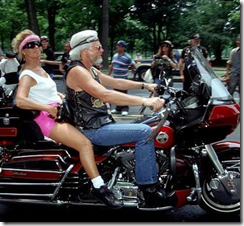
boomersThat is a good thing, too, because my generation has gone bananas. Between the idiocy of handing billionaires billion-dollar sports stadiums paid with taxpayers money and stupid crap like universities handing out football scholarships to 9-year-olds, it’s clear that the “adults” in our society need to grow up. Obviously, the whole Boomers and Bikers silliness was not a sign that my generation had a lick of sense. They parade their senility through towns like Red Wing as if they imagine nobody would ever think about laughing at their pirate outfits and godawful motorcycling skills. But they are very, very wrong. I’ve been hanging out with under-30 kids everywhere from Red Wing to downtown St. Paul to Pacific Coast Highway and they consistently think these folks and the activity/sport they represent are comedic, at best, and despicable on average. For the last thirty years, Boomers and the industry has done their best to make motorcycling look as ridiculous as possible. The reward for all that silliness is the current non-cool status of motorcycling. Add to it the fact that most small cars are more fuel and cost efficient that motorcycles and you have a perfect storm of obsolescence.

An interesting parallel is the music business, at one end electric guitar sales and at the other the old fashioned record labels and music distribution. The Washington Post published an article titled “The Death of the Electric Guitar” that explained a lot of the reasons why the electric guitar may be an old guy’s instrument. This story should sound familiar, Richard Ash, the CEO of Sam Ash, the largest chain of family-owned music stores in the country, said, “Our customers are getting older, and they’re going to be gone soon.” Or how about this fact, “Over the past three years, Gibson’s annual revenue has fallen from $2.1 billion to $1.7 billion, according to data gathered by Music Trades magazine. The company’s 2014 purchase of Philips’s audio division for $135 million led to debt — how much, the company won’t say — and a Moody’s downgrading last year. Fender, which had to abandon a public offering in 2012, has fallen from $675 million in revenue to $545 million. It has cut its debt in recent years, but it remains at $100 million.” Fender’s weird defense of its business model includes the odd statement, “Ukulele sales are exploding.” Ukes were a brief fad, but not a meaningful shift in popular music. Scooter sales were doing pretty well, for a while, but that didn’t mean much for the motorcycle industry, either.

IFPI_global_fullAt the label end of the music music industry, the business has been so deformed from the gatekeeper format of the previous century that “Gotye created his song ‘Somebody That I Used to Know’ in his parents' house near Melbourne, Australia. The self-produced track reached number one on more than 23 national charts and charted inside the top 10 in more than 30 countries around the world. By the end of 2012, the song became the best-selling song of that year with 11.8 million copies sold, ranking it among the best-selling digital singles of all time,” according to an Elite Daily article titled “How One Generation Was Single-Handedly Able to Kill the Music Industry.” Wimps don’t whip international corporations at their own game. These kids have totally changed the damn game. There has been some yip-yap about the music industry “recovery,” but that is a funny term for seven years of stable gross sales with dramatically changing income sources (see the chart above). Sales of physicial media are about a quarter of their 1999 peak while digital distribution, including direct sales, is growing exponentially.

5-Luxurious-Designer-Electric-Bicycles-Bicicletto-electric-bicycle-2-600x388How does all that relate to disappearing motorcycle sales and declining motorcycle use? I’m not sure, but I think there is a connection. The times and the tools are changin’. My grandson has repeatedly said he would get a motorcycle license before he’d be interested in a car. He would, also, rather have an electric motorcycle than a gas-burner. He’s not alone. Since electric motorcycles are barely making a dent in that market, electric bicycles have really stepped up and are crossing the line between bicycles, scooters, and motorcycles; filling every motorcycle niche from vintage to cafe racer to competitive sports with 50-100 mile ranges and 20-to-40-and more-mph top speeds. Like the early years of the motorcycle, there are dozens of electric bicycle brands and you can buy them everywhere from dedicted high-end botique stores like Pedago to low-end offerings from Walmart.

The music business didn’t die. It moved to streaming media, movie and television soundtracks, and on-line digital purchases. Motorcycles won’t die out, but they will change radically. The brand names we recognize today may be as obscure in 20 years as Whippet, Stutz, Red Bug, Nash and Rambler and Nash-Rambler, Packer, and Oldsmobile. At one time there were thousands of auto manufacturers and there have been at least half that many motorcycle brands in the not-so-ancient history. As this electric vehicle revolution plays out, it’s going to be a survival of the fittest environment and there appears to be little evidence that the current brand names are in any way fit; especially the two prominent suck-squeeze-bang-blow US brands. With some luck, minimal incompetence from both Zero’s managment and the US government, and a few changes to motorcycling’s image and purpose, the US could still be a world player in the future market.

Jun 27, 2013

Here It Comes, Smartass

Think auto-piloted vehicles are in the science fiction future? Think again bozo-boy. Your days of “being in control” are numbered.

Think motorcycles are going to be in the traffic mix when these vehicles are on the freeway?

The final statement in this article was, “And if it all goes wrong, Audi Pre Sense will step in to save your bacon. At the sign of potential hazards, you'll see a visual and audible warning. But responding to info from the ESP sensors, like hard braking or skidding, the windows and sun roof will close, while electric motors tighten your seatbelt ready for impact.

There's even a thermal imaging camera with a 24-degree scanning angle, giving your car night sight in the far infrared region (FIR). That's 300 meters in total darkness, and unlike our feeble eyes, it's not affected by the glare of oncoming headlights. In fact, sitting in this autonomous automobile we're beginning to feel like the weakest link.”

Humans have been the weak link in traffic since the freeway system was designed. If we’re not being fuckin’ morons, we’re just not trying.

Jan 30, 2013

My Vehicle Ownership Costs

A while back, blog reader and old man abuser Andy Mckenzie, challenged me regarding my assumptions that motorcycle ownership isn't an economical transportation alternative, relative to cheap car ownership. The chart below describes the results of my careful accounting of my operational costs since I purchased these 3 vehicles. The actual odometer reading \on each vehicle is greater than that listed below, but the only significant variance in the "Miles" spec is on the Ford Escort Wagon which had about 100,000 miles on the odometer when I bought the car. The two bikes weren't even broken-in when I bought them from their original owners (less than 900 miles).


Economy Comparison
between My Cheap Car and My Motorcycles


1998
Ford Escort Wagon
2008 Yamaha WR250X 2004
Suzuki 650 V-Strom
Costs/Mile $0.225 $0.290 $0.172
Cost/Year $1,865 $1,414 $1,114
Miles/Year 8,294 4,882 6,497
Years Owned 9.4 1.9 6.4
Miles 78,053 9,469 41,778
Average Fuel Economy (miles/gallon) 24.4 52.6 50.3
Vehicle Expense $2,700 $3,200 $3,400
Total Fuel Costs $9,437 $531 $2,450
Tires $280 $426 $1,540
Oil Changes $120 $39 $328
Major Repairs $3,572 $0 $0
Minor Repairs $84 $439 $1,056
Taxes and License Fees $517 $253 $310
Insurance $1,468 $410 $956
Farkles $275 $845 $627
Current Resale Value (estimate) $900 $3,400 $3,500
Total Lifetime Costs $17,553 $2,744 $7,166


This is not the data result I expected. For years, because of the cost of drive-line repairs (chains and sprockets) and tires, I've assumed that owning a motorcycle is inherently more expensive than driving a cheap car.  The comments I made on a past blog/rant more than implied that and Mr. Mckenzie called me on it. It's only luck that prevented me from putting money on this claim.This is a discussion and assumption I've shared with the publisher of Minnesota Motorcycle Monthly Magazine, Victor Wanchena, and a disagreement that has continued with the owner/founder of Aerostich, Andy Goldfine, for years. I have, clearly, taken for-granted an erroneous assumption: motorcycles are not an economical transportation option.

The fact that the WR250X is, so far, the most expensive vehicle I currently own means nothing. The bike needed a lot of TLC in the form of returning it to stock after the original owner chopped it to bits in an effort to make his dick appear to be bigger (or whatever motivation it is that causes children and fools to ruin perfectly good engineering in an attempt at proving they're smart). All of the Minor Repair costs on that bike have been the expense of buying stock parts and one chain/sprocket replacement at about 1,200 miles (obviously, the previous owner didn't believe in lubrication). My first set of tires were actual SuperMoto tires and they were expensive and didn't live long. The current tires are dual purpose Korean cheapos and are wearing like iron. I also installed a 3.1 gallon tank, a new seat, a suspension-lowering link, and a rear rack which jacked up the Farkles costs considerably. As usual, I don't expect to get anything back from the Farkle "investment," but it is a one-time expense that will obviously be overwhelmed if the bike holds up and I'm able to put some serious miles on the 250 in the next few years.The more I've worked on the WR250X, the better the fuel economy has become, so it ought to show some serious "improvement" in cost/mile driven by next winter. Since I'm finished Farkle-ing the WR, now the fuel economy will start chipping away at the Cost/Mile figure.

The V-Strom ownership costs are artificially lower than they should be, due to my writing "business." The bike has a lot more Farkle-investment than $627, but I picked up most of those bits as evaluation "samples" so I don't have any money in my aftermarket luggage, chain-oiler, seat, and a bunch of other "improvements." I'm just working this out by what I have invested, not what the stuff might be worth. Most of the V-Strom's Minor Repairs costs have been in chain replacement. The bike has seen at least 12,000 miles of off-pavement travel and that chews up O-ring chains fast, even with an auto-oiler. In fact, if the Escort had seen the same kind of terrain, it might have not survived.

Since the Current Resale Value (estimate) is subtracted from the Total Lifetime Costs and Cost/Mile figures, if I get less than those estimates the numbers will, in the end, reflect that. I might be optimistic on the Escort and WR250X's resale, but from last summer's experience I don't anticipate getting less than $3,500 for the V-Strom whenever I sell it. Those numbers are just estimates, but I don't expect to be particularly surprised or depressed by the final values.

For most of my life, I suspected that car ownership is stupid. The cost of renting a brand new Kia in Portland and driving it to San Francisco this past January and the above data proves that point. I paid about $0.34/mile to lightly use that car for eight days. I would have paid 2/3 of that if I'd have returned the car to Portland. The "convenience" of car ownership is overwhelmed by the cost of the damn things and, since I hate driving them in the best of times, I will happily divest myself of at least one of my cars the day I retire.


Mar 30, 2012

Change is Gonna Come

As I write this, I'm watching "The Revenge of the Electric Car." This is the follow-up, story-wise, to "Who Killed the Electric Car." It's a killer story, one of how Detroit (especially GM, the one-time front-runner of electric car design) got kicked in the ass by Silicon Valley (Tesla Motors), Japan (Toyota, first, followed by everybody making cars in Japan), and Europe (Audi, VW, BMW, Renault). The filmmakers got incredible access to the inside workings of GM, Nissan, Tesla, and Toyota. The story is not about how difficult the technology would be, it wasn't about how hard it would be to convince consumers to make the switch, the story is about how the industry, suddenly, realized the electric car's time had come. In fact, some of the executives realized the time had past and they were catching up to their own customers.

Incredibly unlikeable characters like Bob Lutz, GM's head gangbanger, demonstrated how their leadership imperfections created an industry that collapsed into a smoking heap of history. The inside view of that company and the brief commentary from Congress that disrespected automotive executive capabilities to a pretty realistic level provides a powerful perspective on how a once-great-and-powerful industry became near-obsolete. The Tesla story was pretty amazing, too. He decided to build a high-end, top dollar electric sportscar right at the time the economy crashed into a dying trash bin.

The major motorcycle manufacturers apear to be as clueless as Detroit, when it comes to where electric motorcycles fit into the future. Silicon Valley (Santa Cruz, CA), however, is moving into the future without pause. Zero Motorcycles is making a practical vehicle for a reasonably credible price (about $9k after the 10% federal tax credit for the ZeroS) for an 88mph, 114 miles/charge, $1/charge motorcycle. Zero may not be the eventually winner in this technology race, but they have a shot at it. Harley and Polaris, on the other hand, don't have a clue that there is a race.

Four years ago, I wrote an article called "A Technological Dead End." Apparently, my editors didn't like the column much, because it's still on the waiting list to be chosen or for me to give up on it and put it in this blog. In that article, I wrote about several technologies I've watched that peaked about the time the technologists realized the business was dead. Oil is dead. The peak oil curved topped in 2003 or 2004, even according to uber-conservatives like Dick Cheney. The world is overheating, our air is practically chewable, the world economy is tanking and a lot of that decline and instability is energy-based, and all the wrong people are getting rich in the process.

Oil and the oil economy is dead, we're just to dumb to know it. With it could go motorcycles. On the other hand, it's hard to beat motorcycles for the kind of single-passenger travel most of us do every day.

Jun 8, 2010

Standing in Line

All Rights Reserved © 2007 Thomas W. Day

Here's a brief personality test: you're standing in line at a big-box store, asking for the assistance of a "sales associate." That employee is carrying a telephone which rings in the middle of the conversation and the salesperson says, "I have to take this, excuse me." What do you do?
Here's another scenario: you're zipping down a two-lane highway, having a fine time playing with your two-wheeled vehicle/toy when you come upon a dozen or more bikers in a staggered-line parade. As is typical of this kind of demonstration, they have spaced themselves in a precision "rolling bowling pin" formation that doesn't allow for passing unless you are willing to pass all of them at once or you have the skill/risk-immunity to fit yourself into the small spaces allowed between bikes as you ladder-step your way past the wannabe-Shriners highway obstacle course. What do you do?

I think both of these situations are some kind of Rorschach personality test, but I don't know what the results mean. In the first instance, I would walk away and find another salesperson or a different place to buy what I want to buy. I know that insanely stupid big-box company managers require floor employees to "service everybody, all the time." So, the salesperson is doing his/her job, as directed, by answering the phone and leaving you two twiddle your thumbs while you wait for the telephone conversation to end and hope the phone doesn't ring before you get the information you need. However, anyone who thinks a telephone "virtual customer" is more important than a live, in-store, with cash-in-hand customer is too dumb for my money and time. I don't care where the store CEO's mommy bought his MBA, that's stupid logic.

In the second scenario, if I'm just out for a ride, I look for another road to travel rather than making the monster pass or the precision step-pass. If I'm in a hurry, one or the other passing tactic is the choice. Better yet, I wait for someone in an SUV to pass me, then pass or breakup the bowling pins so that I have a little more space to work with. Regardless, my tolerance for certain kinds of motorcycles and motorcyclists gets reduced, a little more, every time I experience this kind of road arrogance. Eventually, at this rate and if I live long enough, I'll be as pissed off about motorcycle road blocks as the rest of the driving population. For now, I can still see the humor in another demonstration of declining human intelligence.


As an MSF instructor, at the beginning of each season we have the pleasure of attending a sign-up "conference" where we stand in line for several hours, waiting to sign up for the classes we want to teach in the spring, summer, and fall. The line is semi-sorted by instructor senility (using the usual "honor system" that, in these modern United States, works only slightly more effectively than when Germans used "honor" to sort out gas chamber patrons). If an instructor wants to teach more than a couple of classes during the season, he or she will have the pleasure of working through the line several times. Honestly, it's mostly a fair system and, if one hadn't been exposed to the technology advances that have occurred in the last 40 years, it would seem to be "efficient."

Standing in line simply grates against one of my pet peeves. Actually, lines in general, of all sorts, in any situation, drive me nuts.

A decade in Southern California taught me more than I want to know about the "human herding instinct." What finally drove me from the beach, a state with lane-splitting and filtering, year-around motorcycling weather, and friends and family and a great job, were . . . lines. I will walk a mile to avoid a three-person-long line. I will abandon a cart full of groceries that took me an hour to collect if I have to wait in line for more than a few minutes. I will take dead end two lane exits, go off-road (including through alleys, across lawns and golf courses, down or up freeway ditches, and damn near off of a cliff) to avoid having more than a couple of vehicles in front of me. I have changed the destination of vacation trips when I found myself stuck in traffic. I have slept in a tent, my car, buses, and train or airport depots when my hotel reservation required standing in a line of suits waiting for an over-taxed clerk to wrestle with a hotel chain's crappy computer system.

I freakin' hate lines.

Because of this personality weirdness, I rarely see movies in the first release week (I usually wait for Netflix to put the movie in an envelope and mail it to me). I rarely go to concerts or sporting events. I am totally disinterested in popular restaurants. I spend a lot of my daily commute traveling through neighborhood streets rather than more efficient freeways. While politicians see congested freeways as an opportunity to waste more money on asphalt, I see traffic as evidence that I need to send another $100 to Planned Parenthood and ZPG. There are too freakin' many people and, even worse, there are too damn many people between me and where I want to go.

Many motorcyclists and a statistically equal number of motorcycle instructors like to stand in line. What else would you call those lines of hippo-bikes jamming up traffic, violating community noise standards, and stacked in front of bars and restaurants? Gotta be line-lovers. Apparently, a fair number of instructors consider their time in line as "opportunities to network" and "social events." Wow! I either have a way better social and personal life than I thought or I'm lacking in the gene that leads humans to gather in packs, herds, crowds, and lines.

Social scientists who study animal resources have spent a lot of energy determining the square acreage or mileage that a given animal needs to be healthy and sane. An obvious and true result of that study has found that the further up the food chain an animal climbs, the more resources (read space) that animal requires. Hence, predators need a lot more territory than herbivores. Omnivores, like us, fall somewhere between being comfortable in small groups (chimps and baboons) and requiring moderate space or being incredibly solitary and requiring mountains (literally) of space (gorillas and orangutans) for the "elbow room" required to remain sane and healthy.

The top of the food chain, we'd like to think, is occupied by humans. Based on the modern urban experience, we may be as dumb and far down the food chain as Mark Twain suspected (read "The Lowest Animal") because we allow ourselves about as much territory as a hill of oversized ants. Can you think of another animal that tolerates standing in line for a morsel of food? How about sitting in line (in a cage) or standing in line (in a bus or train) for hours to get to a place where we'll stand or sit in place for hours so we can earn enough credit to sit in line (in a cage) to drive to a store where we can stand in line to exchange credit for food? There may be no other animal on earth that passive or unaware of the need for livable conditions. Mr. Clemons was an optimist.

How long do the lines have to get before we realize that overstuffing this planet to standing-room-only is going to reduce worthwhile riding (and living) territory to nothing? Pretty soon, I won't be able to find an alternative Twin Cities route that allows me to escape from the roaring mindless mass of humanity. Then what? Whatever happens, you know that you won't have me to kick around, if you're standing in line. I'll find a nice cave in the mountains to spend my leisure years.

May 7, 2010

Getting Geezerly

All Rights Reserved © 2009 Thomas W. Day

I've noticed a change in my attitude since turning 60. I care less and less about the future of the things that won't affect me. This is fairly significant, since I am sort of notorious among my friends for living as much in the future as the present.

A fair number of my Geezer columns, beginning with the first one from 1999, are about how motorcyclists' anti-social behaviors are likely to affect motorcyclists' access to public roads and parts of cities. It's happened before and it's going to happen more. Even dumps like Daytona are reconsidering the effect motorcycle invasions have on their residents' already miserable quality of life. Lots of lesser "traditional" motorcycle destinations are opting out of the loud pipe, hooligan-behaving, tough-guy-dentist, vandals-took-the-handles secondary effects of going after the motorcycling dollar.

Fortunately for me, I don't go to any of those events or places. Even more fortunate, I live in an insanely conservative country where progress and innovation has been slowed to a crawl and change rarely comes in less than a generation. For example, we're going to be the last industrialized nation to ban lead from manufacturing processes. We are more concerned with the inconvenience manufacturers will experience if they stop pouring that metal into our drinking water than we about poisoning our children. If something that big doesn't get fixed instantly, how long will it take cities to rid themselves of pesky, but rare and insignificant and non-socially-redeeming, motorcyclists? Seriously, even though motorcycles are not in any way part of "smart highway" planning, how many decades will it be before this country moves to that kind of vehicle? In the Land of the Brave we're conservative (timid, afraid of the dark, terrified of change) and we won't do anything rash, innovative, or sensible in a hurry. The oceans may rise up and float our cities away and we'll still be debating who will pay for any technology change.

With that knowledge behind me, I have quit worrying about the future of motorcycling. Whatever happens, won't happen to me. At best, I have maybe 10 years, 15 tops, left to ride. More likely, I'll fall off of a cliff, contract some nasty cancer from my years of industrial chemical exposure, trip over my dog and fall down the stairs, or blow a gasket in any number of clogged vessels or organs. The future of motorcycling is not likely to change in my lifetime. None of my kids have chosen to be motorcyclists and I don't see that as something to worry about. My grandson might become interested, but he probably won't. I've lost the capacity to worry about generations beyond the ones I know personally.

That “freedom” has a cost, though. Recently, a younger, more politically involved friend asked my opinion of helmet laws. For the last 25 years I’ve had a split mind on this issue. On one hand, I’m a fan of Darwin’s selection of the fittest and am all for getting the stupid out of the gene pool. On the other, I’m worried that if too many of the unfit kill themselves on motorcycles their surviving relatives will rise up and campaign against the existence of “murdercycles” on public roads. As I explained that pair of concerns I realized I had passed the point of caring about the second hand. My explanation was blunt, honest, and very politically incorrect. It happened so quickly that it was out of my mouth before I realized what I was saying.

Another friend, a non-helmet wearing friend, was part of the discussion and was obviously offended by my lack of concern for his offspring. That’s the other effect of aging on me; I’m less sensitive (and I was always insensitive) to who I offend. Honestly, I’m less afraid of the consequences. At work, this has resulted in a feeling that I’m “bulletproof” to the politics and backstabbing that goes on in an academic institution. The worst thing that can happen is that I will get fired. If I get fired, I’ll find some other way to occupy my time and pay my bills. I have a good gig, but there are other good gigs.

In personal relationships, I worry less about what will be thought about me and more about saying what I mean to say. Getting old sucks, creaks, hurts, aches, and provides occasional stabbing pain. However, it is sort of liberating. If "the worst" that can happen can only happen for a short duration, how bad can it be? It's not like I'm going to be disabled and suffer through the prime of my years. My prime passed about 30 years ago.

The older I get, the higher my tolerance for pain becomes. Getting out of bed is more painful than crashing a dirt bike was 35 years ago. Bending over, running, squatting, reaching over my head, twisting, and flexing any joint provides a constant reminder that my body is increasingly fragile and rapidly decaying. The choices are: 1) avoid pain by not doing anything or 2) get used to pain and keep doing stuff.

For a while, I'm going to chose to keep doing stuff. If the rest of you choose to screw up motorcycling, I'm not going to worry about it. You can't screw it up fast enough to mess up my time on the road.

Feb 11, 2009

Thinking Bi-Futuristically

The Cycle World International Motorcycle Show is hitting Minneapolis this weekend. Being a media kind of guy, I don't have an excuse not to go and it's usually kind of fun. It's an excuse to bump into old friends, look at the usual suspects of two-wheeled toys, and avoid thinking about five or six more weeks of winter.

Last year, for the second time, I took my grandson to the show and we had a particularly good day of fooling around with mechanical objects. He's 13 this year and will probably be even more interested in motorcycles. None of my kids have been bikers and I don't really expect Wolf to be any different. I think the two-wheeled jones is going to live and die with me. My brother was into it for a while, until a close encounter with a deer demolished his ankle, but he's mostly over it now. My step-brother was a dirt biker and a bragging-rights Harley owner/crasher for a very short time, but he and his son have "grown up" and moved on to big trucks. Like I said, I'm the family's lone two-wheeler and, outside of bicycles, I'm probably going to be the last.

There is some speculation among industry insiders that my family experience is similar to the national trend. As an answer to the often asked question, “Honda has a marketing department?” Honda has dumped the Honda Hoot (apparently, permanently) this year and blamed the economy for the demise. Honda has been making noise about abandoning motorcycles in the US, due to liability issues, since the 1980's economic crash. Yamaha and Kawasaki are about equally enthralled with our low-tech, high maintenance, marginally economic stability marketplace and, if they could find a replacement for the US income, they’d probably dash to it so quickly that there would be a small tornado caused by the vacuum.

I’ve heard off-road distributors describe vanishing youth from those sports and road bike dealers and marketing gurus wonder if street bikes will become a “rich kid’s toy.” The companies who positioned themselves to take advantage of characters who would be willing to spend $30k-$100k on a giant cruiser and now wondering where their customers went. The biggest of the bunch, Harley, is stuck with hundreds of millions of dollars in bad loans after chasing the poor credit risk crowd that is wiping out the housing market. I imagine it won’t be long before we hear that the other companies in this market are suffering similar pains. In the end, the only people who will be buying a $20,000 Polaris Vision will be the guys who handed themselves million dollar bonuses for screwing up their companies and got out before the feds slammed them in jail. That might be a small crowd if those of us who are paying their bills have our way.

Risk is a big topic in the country, too. I’ve listened to several big-time ex-offroad competitors explain why they wouldn’t consider letting their kids ride motorcycles. For a country founded by folks abandoning their homes, history, and security to gamble on a life in “the new world,” we seem to be turning into a caricature of conservative, old-world. Hell, almost every European country is more progressive than the US and if we keep going backwards we’ll get to enjoy hearing China brag about being more contemporary than the United States. Won’t that be fun?

So, I’m going to take in the Motorcycle Show with the thought in mind that I might be the last of a breed, watching obsolete technology fun its course in my lifetime, wondering over what kind of world it will be without risk, adventure, surprise, or even real-world sensations over virtual experiences. Maybe, I’ll even look for something new from the motorcycle industry. That would be a surprise.