Showing posts with label dual sport. Show all posts

Mar 9, 2020

Stereotypes and Typical Behavior

A few weeks ago, on a warm Saturday, my hometown was infested with the usual collection of bozos on bikes. Traffic on Old Main Street was jammed up and loud as a 1950’s drag strip. Driving through that section of town is usually miserable on a warm summer afternoon and if I didn’t have business there I would never venture down that street weekends. That day, I had business so I was stuck.

After I finished my Saturday transaction and tried to back out of my parking space, I discovered that another noisy pirate parade was in progress. Since the cops had conveniently found donut shops at the other end of town for their day-long break, the bikers were trawling the street making it almost impossible for anyone with a life to get on with it. After waiting for several minutes for an open space, I found one and backed into my lane. About the time I was straightened up and in forward gear, a pair of nitwits on hippobikes came wobbling down the street in the opposite direction and one of the crossed the center line about 20’ from the front of my pickup. Realizing that a solid object was in his random path of travel, the biker managed to weave back into his lane and barely missed both my left fender and the other half-wit who was no more skilled or in control of his geegaw-disabled vehicle. I caught the raised finger of the first nitwit in my rear view mirror.

Driving toward downtown on Highway 61 (Yeah, that “Highway 61.”), a large full dress ubiquitous black cruiser of some unknown brand passed me on the left. At first, I was impressed that the bike wasn’t obnoxiously loud and that the rider wasn’t dressed in pirate underwear. He was even wearing something resembling a helmet, open face, but not a total toilet bowl. However, he sped past me and the Suburban in front of me, swung into the right lane, and immediately came to a near stop in front of the Suburban before waddling into a filling station; bringing all of the right hand lane traffic to a near stop in the process. It was pure luck, on his part, that he wasn’t rear-ended by the Suburban. Of course, if he had been the SUV driver would have been blamed and more biker crash statistics would be skewed incorrectly away from faulting motorcyclists.

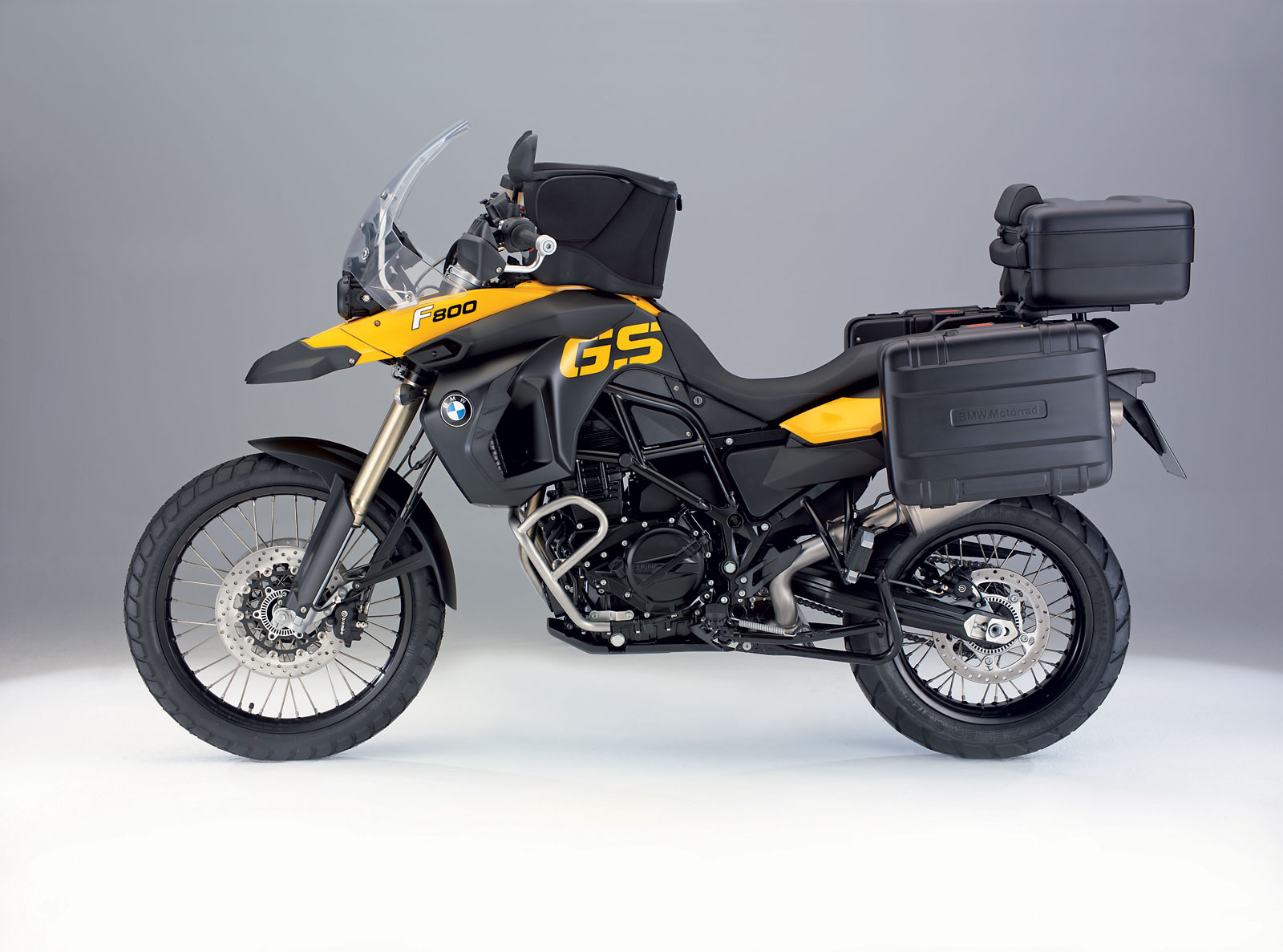
Yesterday, on my way back from the Cities near the UofM, I saw an AGAT biker on some sort of adventure touring bike. It was one of the many “bikes with a beak” and I can’t tell one from the other: coulda been a Triumph Tiger, a newer V-Strom 650 or 1000, a BMW F800GS, or some other wanna be I have yet to meet. The guy was wearing motorcycle gear and I was initially impressed. However, when we came to a stop light, he passed me and the two cars in front of me in the bicycle lane, and jumped the light gambling that no one in the opposite direction would be turning into his path. Again, pure luck that any number of things he couldn’t see or react to didn’t arrive in that intersection when he did.

Because I see so much cruiser/biker incompetence around my hometown, I tend to stereotype “idiot bikers” as characters on cruisers and other hippobikes, but mostly too many of the idiots riding two wheels appear to be mentally deficient with the riding skills of a kid who just came off of the training wheels or a tricycle; brand and species of motorcycle be damned..

The industry is hurting, again, these days. Dealerships are closing, dealers, importers, and manufacturers are reducing their motorcycle inventories. Rider training programs are shrinking to small fractions of their peak years, only a decade ago, and you see even fewer motorcycles on the road outside of occasional pirate parades and stacked up in front of bars. If there were a time when reducing motorcycle access to public roads would be easy, this is fast approaching that moment.

Motorcycle manufacturers, on average, aren’t doing much to slow the regression, either. The average motorcycle is less efficient, fuel-wise, than the average mid-sized car; even SUVs! Toyota’s 2019 RAV4 gets 40mpg, which is as good as all of the liter adventure touring bikes and better than all of the sportbikes over 600cc and as good as most of the 600cc sportbikes. Some cruisers get not-awful economy, but their owners “fix” that with aftermarket exhaust systems and lame attempts at performance enhancements that kill fuel economy and pointlessly multiply the exhaust emissions. Outside of that lame “image” bikers imagine they are sporting, practical reasons for riding a motorcycle are disappearing.

I “retired” from the Minnesota motorcycle safety training program last year (2019), after I reviewed the new, grossly dumbed-down MSF program. It was pretty lame before, but it really became focused on putting butts on seats in the newest iteration. No more “adult education” tactics, now we’re just supposed to be hand-holding prospective motorcyclists through the test so there is practically no way they can fail to get an endorsement. In every class, for the past 18 years, there was always at least one “student” who slipped through the cracks, passed the overly-easy “test,” and got an undeserved and unexpected license. I’d caution them that driving on a closed-course at 15mph was nothing like riding in traffic and that they really needed to keep working on their skills if they were going to survive, but I know those words went in one ear and out the other.

In demonstrations like the ones I described in the first four paragraphs of this article, I see the results of our foolishly easy motorcycle licensing and the incredibly stupid fact that once you have a motorcycle endorsement you have it till you die. All it takes is a few bucks for the endorsement renewal fee every time you reup your license. You can even transfer a Minnesota motorcycle endorsement to a California endorsement for a little money. Crazy! If you think knowing how to wobble down a Minnesota or Wisconsin country road is in any way useful experience on the 405, you are delusional. So on we go, down the path of becoming a piece of motoring history; like horses and buggies and go-carts and street legal ATVs. Yeah, those were all things; long ago. And now they aren’t.

Nov 28, 2019

Seat of the Pants Performance Comparisons

A few years ago, when I was still capable of riding half-quickly and competently off-road, I was riding with a group of Twin Cities Dual Purpose guys north of the Cities. The “route” was a convoluted collection of gravel and paved roads with the occasional single-track and deep sand trail tossed in to provide the illusion of a dual-purpose outing. It might have been one of the first opportunities I had to test my new-to-me WR250X somewhere outside of my daily 6 mile urban commute. It turned out, there was more than just a riding competency and bike capability test available on that ride. One of the other guys had recently bought a used WR250R that had been barely-used and farkled up with a loud “performance” pipe, a Power Commander fuel programmer, a hacked-up air box, and the original owner had removed the AIS and EXUP systems and the “flapper-valve.” Pretty much all of the “performance” weirdness every kid who ever bought a WR might do without any of the nasty riding crap actual motorcyclists would have done first. Both of our bikes had been owned by such children and the WR/R owner had yet to begin the long process of returning the bike to original status and peak overall performance. I got after that immediately and my bike was all the way back to bone stock the day of that ride.

After 30 or 40 miles of the group ride, we all stopped for lunch and the WR/R guy and I compared notes. He was pretty tired of the exhaust noise and wondered if any of the modifications had actually improved the bike’s performance. You might figure, I always assume any “improvements” made by shade tree goobers is a downward evolution. Having been an engineer for most of my career, my appreciation for amateurs is very limited-to-non-existent. We decided that, when the opportunity presented itself we’d “performance test” the bikes on every sort of terrain we’d be riding on for the rest of the day. In our case, “performance testing” mean drag racing the two bikes at every opportunity. Mostly, a drag race eliminates skill from the equation; the outcome is pretty much determined by the bike with the best powerband and peak horsepower. As an unintentional handicap, I was spotting the WR250R about 50 pounds, since that bike’s owner was at least that much lighter than me. He was also a decade younger and a much better, more aggressive rider, for whatever that is worth.

To cut to the chase, the end result was no surprise to me and disappointing to him. On pavement, my WR250X consistently held the advantage. We would start out neck-and-neck, but after 3rd gear my WR/X would begin to pull away until around 70mph when the WR/R began to fall into the distance. On gravel, the results were mixed; pretty much whoever got the best start would end up in front. In deep sand, I got my ass handed to me, mostly based on his skill and my cowardice and, probably, that 17” front wheel that tends to plow into the sand. I was year or two away from having my left hip replaced and, by then, anything that required a firm foot on the ground was out of the question.

So, our shade tree, seat-of-the-pants evaluation of the usual collection of silly “improvements” kids make to the WR/R/X Yamahas was that more is less. You’d hope that doing all of that crap would not have made a 250 slower with an additionally 50 pound load, but it did.

Some of those modifications are, and should be, highly illegal. Yamaha did several things to make the WR/R/X bikes emissions legal, for the US, EU, and Japan. Defeating emissions controls is a federal and state violation and I despise the fact that our states and cops are too lazy and incompetent to enforce emissions violations. In fact, I resent having to pay taxes for cops who don’t care about exhaust noise but pretend to be enforcing the peace (and quiet) of the communities that employ them. Imagining that a low tech sheet metal worker could out-engineer Yamaha is pretty hilarious, at best. The only “tuning” aftermarket pipe manufacturers do is “noise enhancement.” They know you imagine louder being faster and play to that market.

Some of the other “improvements” might actually do something useful, if the entire bike was re-tuned to compensate for the huge change in intake and exhaust pressure curves. However, most goobers are done with their project once they tack on the expensive crap and wouldn’t consider spending another $1,500 on dyno testing and tuning. So, like the 99% dumbasses in The Marching Morons, they mistake noise and an unpredictable and peaky power band for improvement and degrade the motorcycle while wasting money on junk that just irritates the general public, wastes fuel, adds more pollution to the environment, and devalues their motorcycle investment.

The fact is that you can pretty much assume that every dollar you “invest” in aftermarket performance modifications will result in a fifty-cent reduction in the resale value of the motorcycle. You might, occasionally, find a kid who will pay inflated money for a farkled-up mess, but you’ll have to be astoundingly lucky to stumble on to one of those characters who actually has money.

Jun 10, 2019

A Motorcyclist Looks at Motorcycles

Red Wing, this time of year, has a lot of pirate traffic. It’s a small town on the Mississippi River with good restaurants and lots of bars, polite and light traffic, wide roads with remedial curves designed for truck traffic, and decent scenery. This is the place for which Harleys and Indians were designed. So, the irritating sound of badly tuned tractor motors (potato-potato-potato and rub-rub-rub) decorates our evenings and weekends most every mild summer day. Our cops, like cops everywhere, can’t tell the real gangbangers on cruisers from the wannabe gangbangers on cruisers. So, they’re afraid of them all, including the dentists and stockbrokers, and let them wobble down our streets in packs of unskilled idiots, just like everywhere. There are days when most locals avoid our favorite restaurants because they’ll be littered with pretend-pirates and all-too-real assholes covered in patches and colors.

I, on the other hand, am either on a bicycle or in a cage (as a passenger or a tentative driver) these days. My eyesight is not getting better, which likely means my motorcycle days are done. So, I find myself at frontage road intersections like this one looking down my blind side (left) at traffic, making my best guess at oncoming vehicle distances and speeds, and planning a right turn into the right-hand lane. As Keanu would ask, “What would you do?” There is a truck in the on-coming left lane, about 1/4 of a mile away on a 55mph four-lane highway and a stop light about 1/4 of a mile down the road from this intersection, so traffic will likely be slowing about the time I'm up to speed and in my lane. I'm turning right, so I should be able to merge into the right lane without any issue, right? What if that truck was a Harley with the usual gearless pirate dangling from the handlebars? What if it were a parade of clueless pirates?

As a life-long (50+ years) motorcyclist and retired motorcycle safety instructor, I have a different take on the “start seeing motorcyclists” bullshit. I know, on average, motorcyclists are the most incompetent people on the road; either on their motorcycles or in their cars. When I see one, two, a half-dozen, or fifty motorcyclists in the lane I am hoping to join or even in another lane, at practically any distance, I am forced to wait for them to pass. Not because I don’t believe I can get into the lane and up to traffic speed in a decent interval, but because I know 99% of the nitwits on two-wheels in my town are totally incompetent (unfortunately that applies to bicyclists, too). Any sort of complication in the road ahead of them will cause insanely inappropriate panic and generally foolish behavior and I might end up with some moron plastered across the back of my pickup. It’s not worth the hassle. So I wait.

I admit that my estimation of the rider’s skill is dramatically guaged against the brand and style of motorcycle. If it’s a cruiser, I automatically assume total incompetence. If I’m wrong, it’s a pleasant surprise; but a rare one. If it’s a sportbike and the rider is geared-up, I assume moderate skills with undetermined judgement. If it’s a sportbike and the rider is helmet-less., bare armed and legged, and perched on the bike like he’s straddling a too-big butt-plug, I’m back to assuming total incompetence with zero judgement capacity. If its a geared-up adventure biker or, even better, a dual-purpose biker I take no special precautions. That one group can generally be trusted to be at least as competent as the rest of traffic. I don’t have the eyesight to pick commuters from joy-riders, but if I did I’d be pretty confident in the commuters’ skill, too; regardless of motorcycle style.

NOTE: If your take on traffic and commuting is, “I don’t ride to work on my motorcycle because everyone else on the road is out to kill me” you are a moron and not even close to being skilled enough to ride a motorcycle on public roads. Welcome to the sad, overwhelming majority of the motorcycle clan. I'm sure you'll be comfortable in whatever bar they are contaminating.

Sad, isn’t it? The people I’ve been associated with for most of my life, musicians and motorcyclists, are pretty much the bottom of the gene pool in most of society’s rankings. Honestly, other than through Minnesota Motorcycle Monthly magazine, my motocross and trials years, and the safety instructor gig, I may have been associated with motorcyclists but I rarely associated with them. I have fewer than a dozen friends (and a brother) who I would consider riding anywhere near. I almost always travel alone and use groups of motorcycles as an indicator of where not to go or be. You can’t really be a musician without being around other musicians, so there is that association that is totally fair.You can be a motorcyclist without knowing a single other motorcyclist. In fact, most likely the fewer motorcyclists you know the more likely it is that you are a competent motorcyclist. Knowing exactly zero "bikers" is always a good sign.

I admit it, I feel "put upon" by being required to babysit these incompetents. Worse, after I give their inabilities lots of safety margin, these idiots assault me with their exhaust noise and pollution and my local cops don't even give them a look. That's injury added to insult added to wasted time. The accommodations our culture makes for bikers so that a few bar owners can optimize their profits at the expense of the rest of society is a red flag of insanity.

Jun 28, 2017

The Death of DP?

Hard to know, but it’s harder to find people who think off-pavement riding is even interesting, let alone worth risking life, limb, and savings on this kind of adventure. All of the economic reasons listed are valid and likely contributors, but I think the biggest problem is the price of motorcycles vs. competitive means of transportation.

  • HONDA XR650L: $6690
  • KAWASAKI KLR650: $6599
  • SUZUKI DR650S: $6499
  • HUSQVARNA FE501S: $10,599
  • BETA 500RS : $9799
  • KTM 500EXC-F: $10,399
  • BETA 430RS: $9699
  • HUSQVARNA FE350S: 10,399
  • KTM 350EXC-F: $10,199
  • SUZUKI DR-Z400S: $6599
  • HONDA CRF250L: $4999
  • YAMAHA WR250R: $6690
  • YAMAHA XT250: $5190
  • SSR XF250: $2999
  • SUZUKI DR200S: $4499
  • YAMAHA TW200: $4590

Maybe these prices look reasonable to you, but for a kid looking for a recreational vehicle he/she might ride for 3-4 months a year, 3-4 times a week, this is nutty money.

Sep 14, 2015

My Motorcycles: 1974 Rickman 125 ISDT

Learn more about this bike

rickmn3For me, the Rickman 125 was a turning point in motorcycling. It is, 26 years later, one of the two new bikes I've owned. Before and after 1974, I've always bought used. I paid $500 for the Rickman, right out of the box. I did the dealer assembly myself, as part of the price I'd negotiated. The bike was sold as a 1974 model, but I think it was a 1973 that was just relabeled when the '73 inventory carried over. Modern suspensions just started to appear in 1974 and the Rickman was almost instantly obsolete.

On one hand, it was a terrific motorcycle. The Rickman 125 ISDT (International Six Day Trials model) had strong, bulletproof motor and the bike was an artistic example of European design. The chrome-moly, nickel plated frame was an example of the finest workmanship. The quality and beauty of the welding was the best I've ever seen, anywhere.

While the radial head Zundapp motor was a nightmare of false neutrals and monster-Q powerband, the motor had a chrome-plated cylinder and rings. I think the Zundapp 125 would outlast any other motorcycle I've ever heard of, off-road. However, the powerband was so limited that it drove me to disassemble and reassemble the motor dozens of times, hoping to find some miracle that would put me in the front of the pack without having to spend hard-to-come-by money getting there.

In those days, I was earning $3.60 an hour and supporting a family of four on that wage. My average work week was 80 hours and I'd saved spare change for a whole year to scrape up the $500 to buy this bike. Regardless of how unsuited it was for the purpose I intended, it was going to have to work because I had no other choice. I raced the Rickman in the last few cross-country events in the Midwest. I thrashed it through several thousand miles of motocross tracks across Nebraska and northern Kansas, including "the big show"; the Herman, NE track where the nationals and international racers visited on the AMA and and TransAM tour. (My bike actually touched the same dirt as Roger DeCoster, Bob Hannah, and a host of great riders of whom you've probably never heard. I ground the Rickman's gears through a half-dozen enduros, a 24-hour winter endurance race in South Dakota, and, once, an observed trials. I even taught my wife how to ride a motorcycle on the Rickman.

Me 1980 As you can see by the above scan of a nasty old Polaroid, motorcycling was a family sport for my family in those days. No, I didn't ride in that "outfit" (how about those Converse riding "boots"?), but I did a lot of tuning in an enclosed garage that probably could have smoked meat. My passenger is my beautiful daughter, Holly, when she was about three years old. Remembering that exhaust setup, the bike had to have been stone cold for us to be sitting in those positions. That homemade expansion chamber could fry a steak at 2".

rickmn1Don't ask me why I left the speedo on the bike in motocross form, but there it was. I probably had twice as much invested in the add-ons for this bike than I'd spent on the original motorcycle. I pounded out the exhaust myself, finishing it off with one of the original pie-pan SuperTrapp silencers. I'd "blueprinted the intake ports (which made the bike even peakier), tuned the crap out of the Bing carb, and attempted shimming the transmission (which reduced the number of false neutrals available between gears from 4,358 to 12), and invested a thousand hours in the suspension. All in vain. The Rickman was about 50 pounds too heavy, 10 hp too wimpy, and the wide-band ISDT transmission just didn't cut it on the motocross track. I did OK in the half dozen cross-country races I'd managed to locate, but cross-country racing was all but dead in 1974 and enduros bored me stiff.

Toward the end of my racing "career," all of the major damage I did to myself happened on the Rickman. More accurately, those things happened as I was being flung from the Rickman. Broken toes, fingers, ribs, collarbone, and all sorts of burns and road rashes. After 10 years of riding damage-free, I went through a six month period where I couldn't seem to keep the rubber-side down. At age 31, I quit racing while I could still stand mostly erect.

rickman I probably put several thousand hours on the Zundapp motor and, every winter when I tore it down, the rings and cylinder met like-new specs. I sold the bike in 1978, for $125. By then, it was absolutely useless on a race track. Long travel suspensions and watercooled motors had turned the Rickman and most of Europe's motorcycles into ancient history. It was still a beautiful piece of workmanship, though. It was almost like selling a member of the family. I have not been sentimental about selling a motorcycle since the Rickman rolled out of my garage belonging to someone else.

rickmn2

The left picture is of the Rickman in cross-country or enduro dress. Working (mostly) Bosch electrics, a Carl Shipman toolbag on the tank, and, otherwise, the same bike I raced on Nebraska motocross tracks. I'd gear the bike down about 6 teeth (rear sprocket) for motocross, because the top speed was 75mph over broken ground in stock form. The bike was so stable that a good (and light, less than 150 lbs.) rider could wick it up and hang on for miles, WFO.

The last cross-country race I did on the Rickman was in far western Sidney, Nebraska, about 30 miles from the Colorado border. I was blasting the 125 class when the race was called for the mother of all dust storms after the third lap. I looked like a filthy raccoon, when I pulled off my goggles and helmet and my eyes were so sandblasted that I could hardly open them the next day. The dust was so dense that it chewed through the master cylinder on my Mazda's hydraulic clutch on the way back home. We drove almost 400 miles, clutch-less, 100 of that through dust so thick that visibility was barely beyond the nose of our 1973 Mazda RX3 station wagon. The Rickman, however, was doing fine when the race ended.

It took a lazy Nebraskan, who thought air filters were for girly-men, to kill the Rickman. He put in a whole day of riding on the Platte River bed before the power vanished and he walked back home, leaving the Rickman to sink into the sandy river bottom. He even had the gall to call me and complain about the bike, two years after he bought it and 2,000 miles after I'd sold it to him. The bike's frame was a work of welding art. It should have enjoyed a much more honorable demise, but dirt bikes don't often die happily or attractively.

Jun 26, 2015

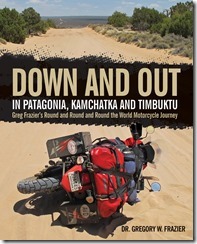
Book Review: Down and Out in Patagonia, Kamchatka, and Timbuktu

downandoutby Dr. Gregory W. Frazier, 2014

All Rights Reserved © 2014 Thomas W. Day

While I've met, talked to, and even sat on a discussion panel with Dr. Frazier, Down and Out introduced me to more things about him and his past and his motorcycling adventures than I knew was available to learn. For one, who knew that Dr. Frazier was a Texas hippie? Not me. If I had, we'd have had completely different post-VBR-session beer drinking events. For two, Dr. Frazier's experiences with Harleys and Indians was a complete surprise to me.

A segment of the Motobooks press release has this to say about Dr. Frazier and his motorcycle history, "The first-ever, first-hand chronicle of Dr. Gregory W. Frazier's never-ending motorcycle ride. A little over 40 years ago, a man named Gregory W. Frazier got on his motorcycle, went for a ride, and never returned. He's still out there, circumnavigating the globe: exploring the jungles of Asia in the winter, trout fishing in Alaska in the summer, and covering all points in between during the rest of the year. He's been shot at by rebels, jailed b y unfriendly authorities, bitten by snakes, run over by Pamplona bulls, and smitten by a product of Adam's rib. He's circled the globe five times and has covered well over one million miles (and counting). During those past four decades, Dr. Frazier has been chronicling and photographing his around-the-world adventures, publishing 13 books on the subject (including one previous title with Motorbooks), the majority of which have been manuals for touring specific locations or general how-to-tour-by-motorcycle books. He has also produced 9 documentary DVDs, but until now, nothing in print has encompassed the entirety of his worldwide motorcycle adventures. . ."

I don't think any readable book could hope to have "encompassed the entirety of his worldwide motorcycle adventures," but this book does a pretty good job of explaining who Dr. Frazier is and where he's been. For $35 list ($26.15 on Amazon.com and $26.25 on Motobooks.com) you can read about Dr. Frazier's early exile from his family due to his motorcycle fixation and mediocre study habits (I never did figure out where the "Dr." comes from.) all the way to his inventive methods of financing his around-the-world adventures and his trip around the world with a handicapped passenger. In between, are his adventures, his motorcycle "education," and a lot more about the man than I've gleaned from his previous books. Fraizer is a complicated combination of humble aware-of-his-Ugly-Americanism tourist and a confident, in-crowd world traveler. He's hard not to like.

In 2010, Frazier retired from round-the-world travelling, which does not mean the same thing for him as it does for mortals, "I’m not done tasting the environments, economies and cultures of the world from atop a motorcycle. There are still plans to attempt reach distance places, as well as to return to some I want to see more of, like Colombia and Brazil in South America, as well as more of Eastern Asia and Africa. I merely plan to quit this foolish squandering of travel funds to transport motorcycles over water. 75% of the earth is water and the increasing costs and bureaucratic hassles associated with transporting motorcycles to the remaining 25% have been seriously cutting into my remaining travel years and project budgets."

Down and Out provides a lot details about the cost and complication of those "projects," but it would require a whole book to fill in the blanks if you are hoping that reading this book will put you in a position to fill Fraizer's shoes. As he says, more than once, he was fortunate to have been bitten by the travel bug at a rare moment when politics, economics, accessibility, and temperament all aligned to allow him to go the places he went relatively safely and inexpensively. Many of those places are unstable and insanely violent today. Even more of those places are specially hostile to Americans (although Fraizer often identified himself as a "Canadian"). So, reading Down and Out has an aspect of a time piece and a history book. Still, brave people are riding motorcycles in remote and hostile places every day and Dr. Gregory Fraizer has been an inspiration to many world travelers. This book will be one more stone in the staircase he has built to put us all on the roads around the world.

Dec 13, 2013

Product Review: Giant Loop Coyote Saddlebag, Dry Bag, & Diablo Tank Bag

All Rights Reserved © 2011 Thomas W. Day

_grandloop
The left side view of the whole caboodle packed and ready for a camping trip to Wisconsin.
After a moto-camping trip to Canada, I realized that my small bike luggage had a few faults. My Motofizz "camping seat bag" (reviewed in August 2008) is a great commuter packer, but it is far from watertight. Four days of rain in the morning and 100F+ muggy afternoons and my gear smelled like a boy's gym and made my skin crawl with bacteria when I went for a "fresh change." My 15 year old Eclipse P-38 saddle bags were pretty leaky when i bought them, but now they provide as much weather protection as a fishing net. It was time to step up to something more serious.

MMM has reviewed Giant Loop gear before (Giant Loop Great Basin Bag and Fandango Tank Bag, Winter 2010 the Giant Loop Saddlebag, June 2008) and  the consensus was always positive. So, I went for the whole shootin' match with the company's new Coyote Saddlebag and Dry Bag and the Diablo Tank Bag. If you've ever used canoe or kayaking dry bags, you're already familiar with the construction materials Giant Loop uses on this series of products. The shell of all three of these bags is made from Giant Loop's Bomb Shell™ “trucker’s tarp.” This is tough, waterproof stuff and the abrasion points at the bottom of the tank bag and the bottom and leading edge of the Coyote Saddlebag are reinforced with 1050 Nylon Ballistic Cordura™. The zippers are heavy duty and, the full length zipper on the Saddlebag and the Diablo are waterproof and protected by storm flaps. The Dry Bag seals up with a side-release buckle, canoe bag-style.
_grand3
The exceptionally hip sleeping bag stuff sack and the Coyote Saddlebag's interior compression bindings.
 
The Coyote Dry Bag neatly straps to either the front or back of the Saddlebag and is big enough for both my sleeping bag and the pad with extra space for camp shoes and light clothing. The Saddlebag is shipped with three really heavy duty "contoured" stuff sacks, including one that is pre-curved to fit  The stuff sacks and the full length zipper makes it possible to get to any of your gear without having to remove the stuff you don't need at the moment.
 
_grand5
The Diablo stuffed with rain gear, wheel lock, flashlight, cold weather gloves, air guage, tools, and camping utensils.
The Diablo has a rear divider for immediate stuff and a water-tight window that you feed from inside the bag through a zipper in the lid's mesh backing. This window setup is making me reconsider my Streetpilot GPS setup for the first time since 2004. You could use any battery-powered GPS protected inside this bag, including a multi-function phone; no need for a motorcycle-specific and over-priced waterproof unit. The bag unzips from the base to allow removal and incredibly easy access to the gas cap. This feature, alone, puts the Diablo in the stratosphere of  "best ever" tank bags. A 4-liter tank bag may seem too small for practical use, but there isn't much of a choice on a small dirt bike or sport bike. 8 1/4" x 12" isn't a lot of real estate, but it's enough for compact gear you need to get to in a hurry while still being able to maneuver your bike without steering-lock restriction.

_grandloop2
The right side view of the small bike Giant Loop Coyote camping rig.
In real-world use, this combination of gear is a giant improvement over my old rig. Packing light, I had a little room to spare after stuffing all of my camping gear and four days of clothing and snacks into the three bags. The first evening out, I was hammered with a monster downpour and my gear and clothing was as dry as when I packed it. I spent one night on a mid-August trip sleeping on a picnic table where I only used the gear stored in the Diablo and the Dry Bag for a short, marginally legal night's sleep. The convenience and access to my stuff, without having to load and unload everything I'd packed, allowed me to spend a night for free and stay off of the road when the hoofed rats came out when a planned campsite was closed due to flooding. 

A deal, for me, with my WR's luggage, is the height and mounting restrictions. I'm old, inflexible, beat up, and short. My WR is young, nimble, and taller than me. My old camping rig often snagged a boot as I swung my leg over the tailbag and was inclined to send me and the bike crashing to the ground at particularly awkward moments. My Wolfman Enduro tankbag pushed my seat room back into the tailbag and saddlebags, which increased the odds that I'd land in a heap when getting on or off of the bike. One reason I ended up mounting the Dry Bag at the front of the Saddlebag is that kept the overall height of the rig low. That mounting position keeps the weight more centered, too.

grandloop
Packing into the bug-infested trails of Wisconsin.
As in any motorcycle packing situation, it's important to keep the weight as low and centered as possible. You want to pack the heavy stuff at the bottom of the Saddlebag and keep the weight evenly distributed. This probably isn't a big deal on a Triumph Thruxton, but on a 275 pound dirt bike, maneuvering through a twisty trail packed weight matters. When that weight is unstable, it's an even bigger deal. The attachment system Giant Loop uses on these three bags is flawlessly stable. It stays in place banging through rough terrain, in high winds and torrential rain, and for long distances.I will admit that the Coyote Saddlebag is a little weird looking, but it is exactly what I needed for my WR's touring rig and, altogether, this setup is better than my wildest dreams for my mini-touring bike..

_grand6_grand7

POSTSCRIPT: I have had my Giant Loop gear for three years, now. There isn't much more to say about the stuff except that is has worn incredibly well, is still water-tight, and the more I use it the more I like it. If you've followed my grumpy career, you know that is saying a lot. The zippers still work and are actually slightly easier to use than they were the day I loaded up the WR and headed out for my first weekend camping trip. Unbelievably, the map window on the Diablo is still crystal clear and it has seen almost 20,000 miles of use and abuse on the WR, including being strapped to the tank all last winter behind our RV. 

I'm not ashamed to admit that the Dry Bag has seen use both on the WR and my V-Strom but in the canoe and kayak. It is an amazing product and has outlived two REI dry bags and survived dozens of canoe trips loaded with boating camping gear.

Nothing I can say will adequately describe how much I like the Coyote Saddlebag. It is simply the ultimate dirt bike camping bag. Nothing else even comes close.

Aug 2, 2013

What is "Dual Sport?"

The next issue of MMM is going to be focused on "dual sport" motorcycles. Turns out, I have no idea what that designation means any more. Among the bikes the editor considers "dual sport" are:
  • BMW F 800 GS/Adventure
  • BMW R 1200 GS/Adventure
  • KTM 990 SM-T Supermoto
  • KTM 990 Adventure Baja
  • KTM 1190 Adventure
  • Moto Guzzi’s Stelvio 1200 NTX
  • Suzuki DL V-Strom 650 Adventure
  • Suzuki DL V-Strom 1000 Adventure
  • Triumph Tiger 800
  • Triumph Tiger 800 XC
  • Triumph Tiger Explorer
  • Yamaha’s XTZ12 Super Tenere
I admit that I'm confused. For one, why isn't the Honda NC700X in this group? It's at least as off-road worthy as everything up there except, maybe, the KTMs. I don't think I've seen a single picture of Scott Jarrett's Honda on New Mexico pavement, so I know it is gravel-capable.  As far as I can see, this whole group of motorcycles is as off-road worthy as modern SUVs. In other words, it's possible but generally a bad idea.

I'm fine with the "adventure touring" genre. Just as SUV is another word for "station wagon," adventure touring means "standard motorcycle with tough looking bags, a plain paint job, and a buttload of farkles." But if the above list is dual purpose, what is the second purpose? Obviously, the main purpose is highway touring with some off-pavement roads. That's only one purpose. Just being able to ride the same roads everyone else can take on their family sedan is not a second purpose. I’m here to tell you that the V-Strom is not a capable single-track motorcycle and it is all but worthless in a hill climb. It is at least as capable as the rest of this list, though.

These guys discovered that four of these hippos were less than nimble off-road:


So, if these bikes are dual sport, what is a Yamaha XT250, WR250R, the Honda CRF250L or XL650L, anything Husky makes, Kawasaki's KLR and KLX bikes, KTM's 690 Enduro, or Suzuki's DRs? Seriously, I'm confused (as usual). I think we may have lost something important in the chase for marketing bullshit.

Jun 29, 2013

What’s Wrong with this Picture?

Look closely at this photo and tell me what is wrong with this picture (and where Waldo is hiding)?
dual-sport-motorcycle
It’s a concept bike, for sure, but exactly the kind of thing one of the so-called American bike manufacturers ought to be building. Unfortunately, as usual, they’ve left it to privateers to do actual engineering work and engineer Jim Carducci gets all of the credit for the Carducci Dual Sport SC3 Adventure. Carducci’s company claims to be “Founded by myself, a mechanical systems design engineer and senior engineering director in the semiconductor industry, with over 32 years of design engineering experience, and my wife with an electrical engineering control systems, SW and operations background, we create and provide innovative and technical solutions. Our designs are patent pending.
“With our professional experience coupled with my 40 years of motorcycling experience and passion for riding, racing, customizing, building, and traveling via motorcycle, have led us to develop dual sport motorcycles. And, we are making them available to you.” Based on this brilliant piece of engineering, design work, and visual excellence, I see no reason to doubt those claims. Of course, it’s still a plodding hippo, but at least it has a purpose. Like the rest of the liter+ “adventure” bikes, it is heavy (475 pounds dry), tall (35.5” seat height), and most likely has limited range (no fuel capacity stated on the company website, but if there are performance mods made to the engine, mileage will suffer). I could whine and moan about what it isn’t for another page, but what it is has to be one of the only cool looking HDs on the road. It will look great on Leno’s garage floor, all polished up and dry as a bone inside to prevent wood floor stains.

Aug 27, 2012

Shaft, Chain, or Belt?

Because one of MMM's contributors recently suffered a catastrophic chain failure on her Versys, a bunch of us got into a conversation about shaft drive vs. chain drive vs. belt drive. My editor, Sev Pearman, is radically in favor of shaft drives over practically everything, especially chains. One of the technical contributors and a recently successful racer, Dave Soderholm, argued for belt drives. I'm old, not easily convinced by emotional arguments, and stuck with the experience of my lifetime, so I'm mostly on the side of chains and have no particular objection (other than cost) to shaft drives and seriously doubt the reliability of belts because Harley uses them and they are only found on cruisers and other toys (like electric bikes).

Here is some of the text from that discussion:

------------------------------------- 
From: Cat on a Kawasaki 
Sent: Sunday, August 19, 2012 6:38 PM 
 Subject: Why my next bike will be shaft driven 

 Sunday ride, nice weather, going to get my nails done then off to a barbecue. Wait, what the hell...? (I watch in my mirror as my chain spins away on the road behind me) This is on 35W southbound, south of the Lake exit and north of the US-10 W exit. ONE vehicle stopped -- ONE!!!? -- a Goldwing rider and his wife. I'm glad they stopped. And I'm /very/ disappointed with the rest of the motorcycling community.

 -------------------------------------------
From:  T.W. Day 

Was it a replacement chain, a new/old chain, or a clip/riveted master link? I've been on bikes since the 60's and I've never had a catastrophic chain or sprocket failure. Obviously, they happen, but drive shafts fail too.  I had a CX500's bevel gear toss a tooth on a trip to SoCal in the 80's. I lucked out and it happened (or jammed) at low speed. I was able to pull the final drive apart, pick out the pieces, and limp back home where I rebuilt the thing. I've had infinitely worse luck (1/0) with drive shaft bikes than chains, when it comes to catastrophic failure. 

Thomas Day 
Minnesota Motorcycle Monthly Magazine 
http://http://mnmotorcycle.com/ 
http://geezerwithagrudge.blogspot.com/ 
thomas@motorbyte.com
 -------------------------------------------
From: Cat on a Kawasaki 

It was a master link on a replacement chain that had about 8000 miles on it. The chain chopped a chunk of aluminum out of the protector-thingie (I have no idea what that part is called), but there weren't any cracks or other damage. Whew! I still don't know why the clip came off. I found the master link in the chain lube goo - it was bent as if it had taken some pretty good pulling stress before it finally gave out.  

 -------------------------------------------
From: "T.W. Day" 

Thanks for the update. That's an interesting failure mechanism. In at least a couple hundred-thousand motorcycle miles, on and off-road, I've never had that happen. I'd be suspicious that the master link clip had been installed improperly, had been reused, or that the master link plate had not been compressed all the way, allowing the clip to sit on the edge of the pin grooves rather than firmly in the grooves. There is a good reason for using riveted master links, but I've never been afraid of the field-repairable style links and haven't had a failure in 40 years of riding. 

I have had three drive shaft bikes; a 1979 CX500 Honda Deluxe and a pair of XTZ550 Yamaha Visions. They were all reliable performers, if a little overweight. There is maintenance to be done to the rear drive and most riders blow it off, sometimes resulting in short drive life. The rear drive oil should be evaluated every time you replace the rear tire and that is a messy, time-consuming process. Some folks recommend changing that oil every time you replace the engine oil. Usually the splines at the end of the drive need to be greased at the same intervals. I know guys who have never changed that oil and lucked into long mileage and I know guys who blew off the maintenance and ended up with $2,000 in driveline repair costs for their lack of effort. I know at least one guy who did all of the maintenance required and still had a rear drive fail at 20k miles. "Maintenance-free" is a marketing delusion, especially if you go anywhere interesting on your motorcycle. 

Rocks are a drive belt killer. A moderately hard fall can bust drive shaft cases. A long ride in a hard rain can completely de-lube a chain and set it up for early failure. You buys your toys and you takes your chances. 

If you've read my stuff, you know I am unaware of this "motorcycle community" of which you speak. Motorcyclists are just people with no more connection to any overall community than the typical American voter. Waving aside (the motorcyclists' equivelant of saying "I'll pray for you" or "I'll hope for the best, assuming I don't have to put out any effort to help you"), I've had as much luck with old and young guys in pickups stopping to offer assistance as I have motorcyclists. For some reason, guys in driving pickups and wearing cowboy hats have been more valuable to me than anyone in or out of a helmet. 

 Mark Lawrence, by the way, is one of my favorite maintenance resources for practically all things motorcycle. His take on drive shave maintenance is worth reading. Mark was way ahead of the curve on the V-Strom 650 and his advice has kept my bike going strong through some tough times and places.

 -------------------------------------------
 From: Soderholm, David 

 Belts are the way to go - strong / light / quiet / clean / lash free / minimal input into suspension..........perfect drive for a street bike. 

 -------------------------------------------
From: T.W. Day 

 I've never had or ridden a belt drive bike. I've always questioned the strength and durability of belts. Of course, nothing I've ever owned has been a committed "street bike." Sooner or later, we're going riding on dirt roads and I suspect that could be a weak "link" for belts. Since a belt is, by design, a continuous loop, doesn't that mean considerable disassembly for replacement? 

 -------------------------------------------
From: Soderholm, David 

That's a good point Thomas, but most belt drives have a very long to life time interval period on replacement. They are also tested for rock and gravel off road during development. They are very tough.......
 -------------------------------------------

From: Sev Pearman

The shaft drive thread 
Pfft Anecdotal evidence 
And all 1800 Goldwings are shaking death traps. I know, cuz the innernets tell me. 

 -------------------------------------------
From: "T.W. Day" 

If "anecdotal evidence" is all we have, it's infinitely more valuable than myth and wishful thinking. The only discouraging word I have about the Tenere is the 42mpg bit. A shaft, one way or the other, is barely a consideration for me. I liked that bike and liked my XTZ550 Visions. If the Tenere came in a 65mpg 550 and at least $4k cheaper, I'd be on it. My point is that shaft drive is a wash, in the long run. And I've had a few of these bikes for long runs. I've never had a single sided shafter, though. That might have some serious advantages, maintenance-wise. The Honda Hawk is one of my favorite machines, concept-wise. I don't know anyone who put big miles on one, though. I know people who have them, I'm just not impressed with 15k miles of use


Does the fact that BMW put a chain on their F800GSe do more than provide "anecdotal evidence?" (I know, the picture was on the internet.) At one of the first Cycle World bike shows I attended in Minnesota, BMW displayed one of their their non-factory Paris Dakar boxers, which was chain drive. I have always wished I'd taken a good picture of that bike. I never seem to have a camera out or an audio recorder running when it really matters. Clearly, I do not belong in the news business. 

Let's face it, it doesn't much matter to people in my socio-economic bracket. There isn't an interesting shaft drive available in my low-ball price range. There is no chance I'm going to own a five-digit motorcycle, ever. There is little chance I'd ever want a drive-shaft cruiser, which might be in my price range but I'm not that old, yet. (I don't plan to live that long, either.) So, if there is a small reliability/price advantage, the initial cost overwhelms the conversation. If that were all there were to it, I'm sure all factory on and off-road race bikes would be belt or shafties. Since they are overwhelmingly chain driven, there is clearly more to it.


 -------------------------------------------
From: Sev Pearman

I don't think that is accurate. Permit me to add this observation

Cruisers and tourers may run belts (a/o shafts) due to fixed FD ratios.  No one cares to adjust it do the FD ratio is fixed. Having said that, BMW & M-G offer a variety of REAR pinion ratios to alter overall ratio

Sport bikes and offroad machines have stayed w chain because it is easy to adjust when gear ratios are changed

If not, a rider would have to stock x different length belts for as many possible FD gear ratios

This is a question of final drive ratio adjustment, not reliability


 I pity the poor salesman who has to sell you any machine 
:•D 

-------------------------------------------
From: T.W. Day

I always buy used from owners, never dealers, at the lowest price I can beat out of the seller, and rarely want anything badly enough to worry about the deal if it falls through. No salesman wastes much time on me because it is, apparently, obvious the moment I walk through the doors than I'm just looking. I bought my first and last new bikes in 1974 and only new car of my life in 1973. "Fool me once, shame on you. Fool me twice, shame on me." I rarely go back for a whipping twice, unless getting my ass kicked at the race track counts. 

Do you have evidence that chains are standard because of the adjustibility or is that opinion?  

I doubt that a lot of gear ratio modifications take place in the Dakar or in enduros and cross country races, Isle of Man, and the rest of the endurance racing world and I suspect that if reliability was a serious issue with chain drives, even road race tuners would find a reasonable way to adjust gear ratios; as you've mentioned BMW and MG do already. I don't think the drive issue is as clear and simple as you appear to believe. I think the racetrack is equivalent to tens of thousands of miles of "normal" use, so if drive shaft systems possessed reasonable power-to-weight and efficiency performance and provided a reliability advantage, we'd be seeing them on the track. 

The fact that belts are practically non-existent outside of the low-performance, maintenance-ignorant cruiser market says a lot to me. I have no objection to drive shaft power transfer, but I'm unconvinced they are the bulletproof, no-maintenance, cost-effective drive line you're hoping they are. 

I'm also unconvinced that encouraging already-barely-conscious riders to buy "let's pretend these are no maintenance" bikes is a good idea. Going over the chain is just a small part of what ought to be good, regular maintenance. It's not difficult to make daily maintenance a reasonably clean activity. It does force us to look at axle bolts and adjustments, and to scan other parts of the bike. It gets us closer to the "Zen" of motorcycle maintenance and that's always a good thing. 

Now, when you get back from 2,500 mile (2,000 off-pavement) North Dakota ghost town tour and can still say, "Time on Victory bikes has made me a believer in belts as well," I'll reconsider. Until then, I'll see your "pfft" (although I'm not sure what means and raise you a couple of "humphs." A few piddling miles around town doesn't convert me to abandoning a system that has only improved dramatically in my lifetime. 

-------------------------------------------

Some of you folks are more experienced, technically more capable, and bigger thinkers than me. What are your thoughts, opinions, and what facts can you bring to this debate table? 

Feb 19, 2012

Can It Do Everything?

One of the guys on the Minnesota Dual Sport sent a mildly dissatisfied note to the group asking if there is any such thing as a "dual sport" motorcycle? I think his point was that there is no such thing as a motorcycle that is great at everything. One of the group's smart guys, Paul Streeter, replied, "Hey, I own more than one Swiss Army knife, too!"

My initial thoughts on the subject were, "I have spent almost 30 years looking for an all purpose bike. In my experience, guys who own lots of bikes generally don't have even one in ready-to-ride-anywhere condition. That's for certain a problem with me. I have a DL and a WRX and a KL250 and the last time I rode the DL (or tried to ride it) I discovered the battery had failed. I can imagine I'll find a reason to ride the V-Strom again, but I'll have to put in a few days of prep work on it to be able to trust it. The KL is just garage mass and has been for a couple of years. When I get the damn thing to start, I'll sell it. The WRX is, currently, my all-purpose DP bike. I use it for commuting around the city, for dirt riding, touring (Lake Superior last summer with my brother on the DL), and I expect to check out the Rockies this summer on the little bike.

"That's just me, though. I don't like owning a lot of stuff. More to the point, I don't like a lot of stuff owning me. Dual sports can do everything, but some things they do aren't done as well as other tools can do them. Swiss Army knives are pretty limited knives, too. Ever try to throw one or fillet a trout? In fact, I'd argue that Swiss Army knives are pretty good at everything they do, except for being knives."

 If I can get my lard ass back down to 180 pounds (even better, 170), I'll have a hard time imagining anything I want to do on a motorcycle being unsuited for the WR250X. It's too small for a passenger, but nobody in my family wants to ride with me anyway; at least as a passenger. It's too slow for road racing, but so am I. With the addition of the Giant Loop Coyote Saddlebag and Diablo Tank Bag, there isn't a one-person travel situation I'll ever be in that will require more storage space.

Still, the WR250X is clearly not the perfect all-purpose motorcycle. It will not cruise at 80+mph; something I have been caught doing in my desperado past. In fact, the WR is most happy cruising at about 60-65mph. The WR's little front wheel doesn't roll over big stuff like a real dirt bike's 21" wheel. With my old, original-issue, withered-up and wimpy left hip, that was a problem because I didn't have the will or strength to get the front wheel far enough into the air to skip a 12" log or jump a ditch. On the other hand, crashing is a much bigger deal to me at 63 than it was at, even, 53, so I may be done with my log-hopping, ditch-leaping days. That all remains to be seen, I suppose. However, that does not diminish the all-purpose-ness of my WR or whatever weapon you deem to be superior.

In all honesty, a 450 or 650cc supermoto or dual purpose bike would be even more multipurpose than my 250. However, you have to be more man than me (expecially than my 29" inseam) to wrestle one of those high-altitude bikes through the woods. I've ridden the KTM 690 and other than the mounting/dismounting issues it is an amazing motorcycle. The KTM 990's 875mm seat height and 192kg are beyond my capacities off-road. The over-$10k price tag for either of those machines is out of my socioeconomic class.

Which brings us to another aspect of dual-purpose-ness; practicality. Not only does a dual-purpose bike have to be affordable (to me/you, not Mitt Romney) but it has to be practical to maintain and affordable to occasionally crash. Because, if you plan to venture off-road, you will crash your dual-purpose toy. This is a perfectly valid Motorcycle Affordability Test:


If your bike, or you, can not pass this test, you have more motorcycle than you can afford and what you own is definitely not dual purpose-ready.

Jul 6, 2011

Failed Another Test

I can't do this with either of my dual sports, so I clearly bought the wrong bikes.