Showing posts with label book review. Show all posts

Dec 30, 2019

Book Review: The Art of Racing in the Rain

I am a habitual reader, a speed reader, and I make up my mind about books fairly quickly in the early pages. Sometimes, when a book appears to have some value but the scene and character-building activity bores me, I kick it into high gear and blow through 50-100 pages almost as fast as I can turn the pages. If I start a book, I almost always finish it, but often more as a physical exercise than from a love of or interest in the literature. Garth Stein’s The Art of Racing in the Rain started off with a bang, with a description of the main character’s canine limitations and impending death and the relationship between Enzo, the dog, and Denny, the dog’s partner in life and the human main character. By the third page you have the Big Picture of almost everything that is going to happen in the book, you just don’t have the details and everything is in the details.

Racing in the Rain is filled with reminders of my motorcycle safety training instructor career and some moments that made me recall my motocross days, too. Some of my favorite quotes follow:

  • “No race was ever won in the first corner but many have been lost there.” Denny Swift
  • “It’s not about a heavier foot. It’s about feel.” Denny
  • “In racing, your car goes where your eyes go.” Denny
  • “The great driver finds a way to keep racing.” Denny
  • “There’s no dishonor in losing a race. There is only dishonor when you don’t race because you’re afraid to lose.” Denny
  • 'The best drivers focus only on the present. Never dwelling on the past, never committing to the future. Reflection must come at a later time.' - Enzo (the dog)
  • 'When I'm in a race car, I'm the creator of my own destiny.” Denny

Eve: How come you go through the turns so much faster than the other cars?

Denny Swift: Well, most drivers are afraid of the rain, because it’s an unpredictable element. They’re forced to react to it. And if they’re reacting at speed, then they’re probably too late, so they should be afraid of it.

Eve: Well, I’m afraid just watching it.

Denny Swift: Yeah, but if you intentionally make the car do something, you don’t have to predict. You control the outcome.

Eve: So you skid the car before it skids itself?

Denny Swift: Yeah. Yeah. When I’m in a race car, I’m the creator of my own destiny. “That which you manifest is before you.” Create your own conditions, and rain is just rain.

  • Enzo: [voice over] In racing, your car goes where your eyes go. A driver who cannot tear his gaze from the wall will inevitably meet that wall. But the driver who looks down the track as he feels his tires break free, that driver will maintain control of his car and his destiny. I realized this was what Denny had done. He had manifested a win because he knew we needed one. Enzo: [voice over] It turned out to be the 1989 Luxembourg Grand Prix in which the Irish driver, Kevin Finnerty York, finished victorious while driving the final twenty laps with only two gears. A true champion can accomplish things a normal person would consider impossible. Denny just needed to remember that. Know who you are on the track with”.

Jul 13, 2017

Feelin’ Lucky, Punk?

Lots of terrific things have happened to me as a result of my association with Minnesota Motorcycle Monthly magazine, but getting to know Kevin Cameron ranks really high on the list. I’ve saved much of the last seven years of correspondence with Keven because, like his Cycle World column, it has been brilliant.

IMG_8409IMG_8410

Jul 17, 2016

Book Review: More Proficient Motorcycling: Mastering the Ride 2nd Edition

If I’d have made it this far, this would have been a doubly fun book to review in life. I met David at the 2013 VBR3 in Duluth and got to speak with him, extensively, about motorcycling, motorcycle training, and other radical ideas. It spawned a whole lot of thought and writing that probably ended when I died. This is an excellent book and a thoughtful analysis of motorcycling. I’m publishing this review on what would have been my 68th birthday. Happy Birthday me!
https://blogger.googleusercontent.com/img/b/R29vZ2xl/AVvXsEgH1ushUdbCfRIGQ4AzVpul1YrymwZxlYeFngaV4Z2wvSHUDNG86cRUz3B0kcqw_YDPN8jSX2WGRRSSGSN7YLM6p8YKRZ0k3Sl6Ogon3aQr5R1ffyT5iVrVymLgnSdVVMADfxPdMA9rwc_z/s1600/Hough+cover.jpg

More Proficient Motorcycling: Mastering the Ride 2nd Edition

by David L. Hough, 2012

All Rights Reserved © 2013 Thomas W. Day

    David Hough and, through his writing for Motorcycle Consumer News, Sound RIDER!, and BMW Owners News has been a strong advocate for motorcycle training and safety for most of his 75 years. Hough was inducted into the AMA's Motorcycle Museum Hall of Fame in 2009. As a motorcycle safety advocate, Hough has won the Motorcycle Safety Foundation's Excellence in Motorcycle Journalism award twice, but he isn't one of the MSF's fans. In fact, in this 220 page book, the MSF is mentioned exactly three times and mostly in an unfavorable light. In 2004, through a short series of MCN articles ("Trouble in Rider Training 1 & 2") Hough championed the argument that the MSF is more committed to selling motorcycles than promoting motorcycle safety and crash and fatality reduction. In 2012, he obviously holds the same positions to be true.  There are numerous references to rider training programs that Hough considers to be worthwhile, but the MSF is not among them. With that as a background, the newest edition of Mastering the Ride takes on many of the issues Hough believes are driving motorcycle fatality statistics into public discussion.
    Hough has some excellent arguments regarding how we ride and how that relates to the frequency that we end up in hospitals and cemeteries. Marketing gurus say "perception is everything" and that goes for motorcycling, too. Several sections of Mastering the Ride are dedicated to discussions of safe following distance, scanning for hazards and escape routes, visibility, and evasive maneuvers. In many piloting, automotive, and motorcycle training programs, this translates to SIPDE (search, identify, predict, decide, and execute). This takes the MSF's SEE (search, evaluate, and execute) to a more functional and detailed level by forcing riders and drivers to think about all of the steps necessary in avoiding catastrophe on the road.
    All of this stuff is about learning how to accurate gauge and react to typical situations with exceptional skill. Since Hough managed to overshoot his own limits at a ride in August 2012 and crashed Lee Park's Triumph in an emergency stopping maneuver, some people might take his advice with a small block of salt. However, most experienced riders know that there are only two kinds of motorcyclists: those who have crashed and those who haven't crashed yet. Hough isn't shy about illustrating this book with pictures of his own off-pavement misadventures and self-deprecating examples of moments when his mental state resulted in (or could have) his sliding down the road shiny-side-down. Crashing is just one possible result from riding a vehicle that doesn't balance itself.
    There are a lot of valuable, but subtle, riding tips that could be missed by a first pass through Mastering the Ride. As an example, in MSF classes, instructors always challenge riders to "look where you want to go," but Hough extends that further by saying "point your nose . . . in the direction you want to go." Using the fighter pilots' tactic of both looking in the intended target direction and keeping your eyes level to force a commitment to a direction change, this hint goes a long ways toward minimizing "target fixation." Just for this tip, I'm glad to have read the book.
    Hough's take on preoccupied drivers is accurate and usually far more politically correct than my own. When he describes the reckless homicide rear end crash that took Anita Zaffke's life in 2009, he doesn't provide more than the first name of the victim or much of a condemnation of the homicidal fingernail-painting driver. In a similar fashion, he refrains from seriously criticizing modern driving skills or in-vehicle distractions. Hough is less politically correct when he describes most US highway law enforcement tactics as being "revenue generating" rather than safety-oriented. Having been hooked by speed traps in some pretty silly locations and even sillier law enforcement legal interpretations, I'm totally on board with Hough in this regard.
    Hough mistakes bicycle habits or newbie fear for skill when he describes using two or three finger-braking as an advanced riding skill. If you watch the extras on the Faster DVD, you'll see that Valentino Rossi often uses all four fingers and I suspect Hough is rethinking his own braking skills after flipping Park's Triumph this past summer. There are times when two finger braking is more than enough, but making that a regular habit is a formula for reduced braking when you really need it and a busted finger or two when the bars slam to the ground in a right turn low-side. His take on advanced braking systems (ABS and linked) seems to be pretty "old guy biased," too.
    Where this book shines is in the street riding strategies. Hough describes a roadway that is in constant flux and a high state of hazard; just like the roads we all ride. His tips for evaluating traffic, turn radii and camber, road surfaces, and other road risks are valuable and expert. There are two appendix entries that the majority of American riders should read: "The Aging Rider" and "Travel." Since the average age of American motorcyclists is moving right along with the Boomer generation, we're all heading toward that moment when we have to consider being too old to ride. Goofy "solutions" like trikes and sidecars aside, it is simply a matter of time for all of us. Hough is close to that point himself and discusses aging and declining skills honestly and factually. His admonition that we all need to ride somewhere on our motorcycles is just good sense. Ride someplace you've always dreamed of visiting. 


Jul 11, 2016

Book Review: Modern Motorcycle Technology: How Every Part of Your Motorcycle Works

modern motorcycle technology

Modern Motorcycle Technology: How Every Part of Your Motorcycle Works

by Massimo Clarke, 2010

All Rights Reserved © 2012 Thomas W. Day
 
    Massimo Clarke is an Italian version of Cycle World's Kevin Cameron. Clarke has several motorcycle books to his name, was the technical editor of Motosprint, and is currently a Director for Assomotoracing. (If you can figure out what this organization does, please explain.) Clarke's grasp of technology is excellent and his ability to quickly describe the function, advantages and disadvantages, and evolution of machines and their parts is why this book is worth reading. The photographs and illustrations, on the other hand, are what make Modern Motorcycle Technology fun to look at and browse through.
    For me, this was not a cover-to-cover read. Instead, I skipped around to read about subjects that interested me at the moment; starting with "Intake and Exhaust." I followed that with going back to the beginning for "Engine Design" and "Structure and Function." While I have a decent basic understanding of internal combustion engine operation, there is no subtlety to what I know. When I'm troubleshooting, "suck, squeeze, bang, and blow" is about all the theory I use to stumble my way through solving engine problems. Clarke's detailed explanation of how the myriad of engine systems work and how the various one, two, three, and four cylinder configurations provide power, reduce vibration and instability, control heat, convert fuel to energy, and how design engineers compensate for the weaknesses of the basic design they have chosen was worth the price of the book. There are useful descriptions of the reliability sacrifices several engine designs make in the hunt for superior performance.
    If you ever wanted to know what manufacturing processes were used for the various parts of your motorcycle, this book is for you. If you're interested in more than surface-level motorcycle metallurgy, fuel system chemistry, and frame and suspension geometry and physics, this book is for you. If you want to know the real effect of exhaust and intake modifications on the design intention of your motorcycle, Clark has a whole chapter just for you. Transmission? Exhaust emissions? Frame geometry? Suspension parts? Wheels and tires? Electronic components? It's all there and with enough detail to provide a decent background on how each of these bike bits works.
    I can't decide if I'm going to keep my copy of Modern Motorcycle Technology in the bathroom/library or in the garage. It's good recreational reading, but it's also detailed enough to be useful as reinforcement to my service and owner's manuals, when I'm stuck troubleshooting some unusual problem. I might need two copies.


Dec 31, 2015

Book Review - Zen and Now

Zen and Now: On the Trail of Robert Pirsig and the Art of Motorcycle Maintenance

ZEN_coverby Mark Richardson, 2008
All Rights Reserved © 2014 Thomas W. Day

    There are a lot of books with Minnesota for scenery and there are a lot of Minnesota authors, but there are only a few books, from anywhere, that change lives. Robert Pirsig's Zen and the Art of Motorcycle Maintenance is, unquestionably, one of those books. Minnesota is prominent in the original Zen and there are more than a few references to our home state in Zen and Now. Pirsig's life began here, both his technical writing and teaching career had roots in his life in Minnesota, and, for a time, he came back to Minnesota to live and write. Richardson follows that path, while creating his own Zen trip on a grossly overloaded 1980's Suzuki dual purpose bike. Richardson starts at the beginning, 458 Otis Avenue in St. Paul, and ends on the street in San Francisco where Chris Pirsig was murdered. For many of Zen and Pirsig's fans, too much of the Art of Motorcycle Maintenance portion of the story ended, sadly, with the author visiting the site of Chris' death and some of the motivation for Pirsig's self-imposed exile.
zen_route
    I stumbled on to Zen and Now looking for something to use as a road map reference to Pirsig's original journey. The map you see at the bottom of this review was what I found and it is one of the few illustrations in Richardson's book. There have been more than a few times in my life when I needed a Zen trip to clear out the crap that naturally clutters the remains of my mind. Lots of reminders have arrived lately to inform me that the capacity to actually follow the Pirsig path is nearly at an end for me. If I'm going to do it, it will have to be soon.
    Richardson was approaching his 42nd birthday when he began his Zen mapped trip. Richardson packed his wife and two sons off for a visit with family in England and began a well-researched retracing of Robert and Chris Pirsig's trip from Minnesota to California about the same time of year as the original journey. It only takes a few pages of Zen and Now to realize you are reading a midlife crisis book. Far too many motorcycle books are about this subject and after Richardson has a drunken, near-carnal moment with a 21-year-old girl he met at a motel in Lemmon, South Dakota I was pretty much tired of Mark Richardson and his story. His self-absorption and arrogance were too damn familiar and uncomfortable, maybe. The trick to writing a travel/self-realization book is exposure. Essentially, you have to pull down your pants, stick your ass out the window, and moon people you might have to face the next day. Richardson did exactly that with this segment and he continues to make himself less perfectly likeable throughout Zen and Now. The point in downgrading himself as a protagonist might have been to illuminate the humanity and complexity of the people he meets along the way. If it was, it worked. If it wasn't, it still worked. A lot of the people Pirsig touched in his book are illuminated and fleshed-out in Zen and Now. Richardson’s timing was excellent. Some of those characters didn’t live much past his last contact with them. He is a sensitive and insightful writer and it would have been a shame not to get to know these people a little better.
    A side "trip" bonus from Zen and Now is the background story of Robert Pirsig and his family. I knew just enough about Chris’ short life to pretty much completely misunderstand the tragedy of his story. Cursed by being identified by fools as “that whiny kid,” Chris and his brother, Ted, had a tough time with adolescence. It is exceptionally sad for me to think that Chris was saddled with that along with his dysfunctional father. I don’t remember ever considering his book character as whiny. I will always think of him as a brave, overwhelmed, loving kid struggling to save and regain his father’s love and life. If you know of a more courageous thing for a kid to do, I probably don’t have the stomach to hear about it.
    Part of Richardson’s purpose in writing Zen and Now was to introduce new readers to an American classic novel and to inspire the rest of us to read it again or to the end for the first time. It worked for me.

Jul 10, 2015

BOOK REVIEW: Shop Class as Soulcraft, An Inquiry into the Value of Work

by Matthew Crawford, 2009

All Rights Reserved © 2009 Thomas W. Day

_shop_1This book could easily have been a lot like most R&R records. It opens with a lot of good stuff in the first pages and Crawford could have been satisfied with being a 20-page wonder. But that isn't the case. Matthew Crawford has thought a lot about Work, the value of doing things rather than having them done, and the effect outsourcing the most basic tasks of invention and maintenance has on the quality of the lives we live.

Crawford isn't just talking about doing real work for the sake of personal satisfaction. "The craftsman has an impoverished fantasy life compared to the ideal consumer' he is more utilitarian and less given to soaring hopes. But he is also more independent." Crawford suggests that people who know how to tighten a bolt, perform precision measurements, or make a useful piece of furniture are less likely to be suckers for a con from a salesperson, marketing schemes, a boss, or politicians.

Shop Class provides Insights on culture and technology on practically every page. One of my favorite bits was the comparison between Yamaha's Harley-copycat ad campaign for the Warrior's collection of Star Custom Accessories ("Life is what you make it. Start making it your own.") and Betty Crocker cake mixes.  General Mills found that the product was more desirable when the "cook" had to add a couple of her own ingredients, providing the satisfaction of pretending to be part of the creative process. Crawford links that to a range of simulated "creative" products such as "Build Your Own Bear" teddy bear stores, Japan and the USA's "customizing" features for cars and motorcycles, and a variety of "creative products" that require nothing more than desire and money to become involved in the "creative process." Convincing consumers that selection options are akin to invention and creativity was a clever marketing tactic, but that doesn't make it real. Shop Class is about the kind of effort it takes to "be the master of your own stuff." Tacking leather and chrome to an existing framework is as far from motorcycle maintenance as playing a video war-game is from battle.

Occasionally, Crawford engages in an academic complexity that limits access to some his best ideas to patient, well-educated readers; not the young people for whom his argument might educate and inspire. Crawford, sometimes, uses complicated language to explain simple concepts but he is at his best when his irritation with consumerism and ignorance overwhelms his academic background and he says what he thinks plainly and with power.

I believe a lot of the media's reviewers completely missed Shop Class's purpose. Crawford is not celebrating menial, physical work over the modern "knowledge worker." He's saying the latter sort of work has no "objective standards" of performance and "is not terribly demanding on the brain, or even requires the active suppression of intelligence." I once had a job where I was supposed to browse through all of the descriptions of medical device product failures and rewrite that text to disguise the failure similarities to prevent FDA from spotting a trend. Cleaning toilets is more satisfying than that kind of "work." Unclogging toilets, wiring homes and businesses, and a variety of skilled labor jobs pay better, even at the entry level, than many clerical "knowledge work" positions. If the work isn't intellectually valuable to the worker, it devolves to Crawford's definition, "Work is toilsome, and necessarily serves someone else's interests. That's why you get paid." 

Crawford argues that society is better served by skilled tradesmen than by docile clerks. This is probably his best message to the few young people who will read Shop Class. From consumerism and marketing tactics to "self-esteem building" education systems to job outsourcing to the decline of our national GNP, Shop Class is full of insights and observations. Crawford is opinionated and unafraid of pissing off a good percentage of the people who might read his book. His opinion of modern American management, for example, is that it is a destructive force that only serves to "push details down and pull credit up" while destroying motivation and creativity in phony "team building" exercises. He saves his most clear (and derisive) writing for when he goes after the management and marketing gurus who promote and worship this kind of self-serving activity. He describes the business-maligned "teamwork" concept, as it applies to modern management techniques as not having a "progressive character" and being amorally dependent on "group dynamics, which are inherently unstable and subject to manipulation." 

As with his beginning, Crawford concludes Shop Class with power, "What defenders of free markets forget that what we really want is free men." If you work on your bike or car, maintain your home, create any kind of art or product from raw materials, and read at a true college-educated level, you'll be reinforced in your activities and your opinions by Shop Class. If you think Mercedes did a cool thing when they removed the oil dipstick from their top-of-the-line luxury cars, you're going to feel a bit picked-on when Crawford explains to you that Mercedes engineers didn't think you were smart enough to deal with "idiot lights."

Shop Class as Soulcraft is the kind of book that could be read a few times over the course of several years and each reading might turn on a new light. Like Zen and the Art of Motorcycle Maintenance, it's an added bonus that Crawford uses motorcycles and motorcyclists to illustrate his key points. There are moments in Shop Class where Crawford makes it clear how he feels about motorcycles and the people who ride them, "People who ride motorcycles have gotten something right, and I want to put myself in the service of it . . . "

Shop Class as Soulcraft is available from RiderWearhouse (www.aerostich.com).

Jun 26, 2015

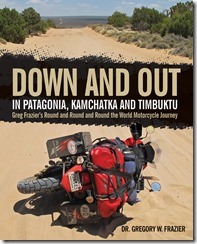
Book Review: Down and Out in Patagonia, Kamchatka, and Timbuktu

downandoutby Dr. Gregory W. Frazier, 2014

All Rights Reserved © 2014 Thomas W. Day

While I've met, talked to, and even sat on a discussion panel with Dr. Frazier, Down and Out introduced me to more things about him and his past and his motorcycling adventures than I knew was available to learn. For one, who knew that Dr. Frazier was a Texas hippie? Not me. If I had, we'd have had completely different post-VBR-session beer drinking events. For two, Dr. Frazier's experiences with Harleys and Indians was a complete surprise to me.

A segment of the Motobooks press release has this to say about Dr. Frazier and his motorcycle history, "The first-ever, first-hand chronicle of Dr. Gregory W. Frazier's never-ending motorcycle ride. A little over 40 years ago, a man named Gregory W. Frazier got on his motorcycle, went for a ride, and never returned. He's still out there, circumnavigating the globe: exploring the jungles of Asia in the winter, trout fishing in Alaska in the summer, and covering all points in between during the rest of the year. He's been shot at by rebels, jailed b y unfriendly authorities, bitten by snakes, run over by Pamplona bulls, and smitten by a product of Adam's rib. He's circled the globe five times and has covered well over one million miles (and counting). During those past four decades, Dr. Frazier has been chronicling and photographing his around-the-world adventures, publishing 13 books on the subject (including one previous title with Motorbooks), the majority of which have been manuals for touring specific locations or general how-to-tour-by-motorcycle books. He has also produced 9 documentary DVDs, but until now, nothing in print has encompassed the entirety of his worldwide motorcycle adventures. . ."

I don't think any readable book could hope to have "encompassed the entirety of his worldwide motorcycle adventures," but this book does a pretty good job of explaining who Dr. Frazier is and where he's been. For $35 list ($26.15 on Amazon.com and $26.25 on Motobooks.com) you can read about Dr. Frazier's early exile from his family due to his motorcycle fixation and mediocre study habits (I never did figure out where the "Dr." comes from.) all the way to his inventive methods of financing his around-the-world adventures and his trip around the world with a handicapped passenger. In between, are his adventures, his motorcycle "education," and a lot more about the man than I've gleaned from his previous books. Fraizer is a complicated combination of humble aware-of-his-Ugly-Americanism tourist and a confident, in-crowd world traveler. He's hard not to like.

In 2010, Frazier retired from round-the-world travelling, which does not mean the same thing for him as it does for mortals, "I’m not done tasting the environments, economies and cultures of the world from atop a motorcycle. There are still plans to attempt reach distance places, as well as to return to some I want to see more of, like Colombia and Brazil in South America, as well as more of Eastern Asia and Africa. I merely plan to quit this foolish squandering of travel funds to transport motorcycles over water. 75% of the earth is water and the increasing costs and bureaucratic hassles associated with transporting motorcycles to the remaining 25% have been seriously cutting into my remaining travel years and project budgets."

Down and Out provides a lot details about the cost and complication of those "projects," but it would require a whole book to fill in the blanks if you are hoping that reading this book will put you in a position to fill Fraizer's shoes. As he says, more than once, he was fortunate to have been bitten by the travel bug at a rare moment when politics, economics, accessibility, and temperament all aligned to allow him to go the places he went relatively safely and inexpensively. Many of those places are unstable and insanely violent today. Even more of those places are specially hostile to Americans (although Fraizer often identified himself as a "Canadian"). So, reading Down and Out has an aspect of a time piece and a history book. Still, brave people are riding motorcycles in remote and hostile places every day and Dr. Gregory Fraizer has been an inspiration to many world travelers. This book will be one more stone in the staircase he has built to put us all on the roads around the world.

Jan 7, 2015

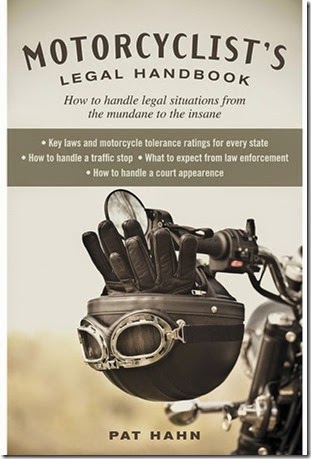
Book Review: Motorcyclists Legal Handbook: How to handle legal situations from the mundane to the insane

by Pat Hahn, 2011
All Rights Reserved © 2012 Thomas W. Day

mlh

    This was a particularly fun book for me to read and review because Pat is a good friend and someone who's opinion and research I trust, almost without question. The book arrived on a Monday and I came home about 9PM to discover it in my mailbox. On the way from the mailbox to the kitchen, I learned something from skimming through its pages. Did you know that the speed "limit" below yellow curve warnings are "advisory" and don't carry the weight of law? Yeah? Well I didn't and either did at least one cop who gave me a warning for blowing off those idiotic, overly-paranoid "suggestions' on an Idaho mountain road.
    Pat takes us through the laws and rules states and individual police apply to riders, most of which are actual laws and some of which are made up on the scene (the "one or both feet down" for a full stop rule, for instance). I'd recommend this as a reference manual for all you Iron Butt'ers.
    There are some statistical anomalies, such as "In the city, the ratio of drivers to law enforcement officers than it is in the sticks." He means in small towns vs. big cities, but when you are really "in the sticks" the ratio is a divide-by-zero equation. In a couple hundred thousand miles of off-pavement road travel, I have yet to see a single law enforcement vehicle doing anything. The "Staying Under the Radar" chapter has excellent information regarding required equipment from state-to-state. The list of things to do to avoid collecting officialdom's interest and things to do when you have attracted their attention is practical, concise, and entertaining. Pat takes us through the whole process of getting a ticket dismissed, reduced, or tossed out of court for a variety of technical and legal reasons. For a guy who has made a lot of his career in government service, Pat is very clear on the court's real purpose, to take your money. This section, "Fighting A Ticket," includes a terrific assortment of phrases and detailed arguments you might use with a cop, a prosecutor, or in court to save your money and driving record. This section, alone, justifies the book's $22 list price.
    The last 115 pages of this 237 page book contains a state-by-state detailed analysis of the states' motorcycle laws, the overall "rideability," and a comprehensive list of the pertinent motorcycle issues for the states (helmet laws, eye protection, insurance, traffic situation rules, etc.). A lot of useful state-specific data is contained in this concise and detailed section. If you consider wearing a head-napkin and ass-less chaps AGAT, it would be valuable to know which states are going to be less impressed with your pancake-lady impersonation. Some states have laws outlawing reasonable experienced motorcyclists' regular practices.
    The Legal Handbook book cleverly points out inconsistencies in state law and downright insanities (called "erratics") that are obvious things to watch out for as a visitor. Wisconsin law, for example, states that exhaust noise can not be louder than OEM equipment. Wisconsin does not honor state reciprocity, which means the state does not guarantee equal treatment of residents and non-residents. Anyone who has been to Wisconsin knows that the percentage of local riders with OEM-quiet exhaust systems is well-under 1%. If Wisconsin ever enforces the exhaust noise law, it will be enforced on non-residents. Colorado, Denver in particular, is downright hostile toward the loud pipes crowd. Colorado also has an assortment of laws punishing coasting (I didn't know that and I lived in Denver for 5 years.). The Legal Handbook gives you a head's up on who is who in the crazy motorcycle law department.
    The Motorcyclists Legal Handbook is a quick read. I went from cover-to-cover in a short afternoon, including reading all of the state analysis. It is both entertaining and enlightening, but it's real value is as a part of interstate travel planning. When you are crossing several state borders, a quick look through these 237 pages could save you time and money. If you happen to be tangled up in the legal system, Motorcyclists Legal Handbook could be the best investment you can make to untangle yourself.

NOTE: Sorry, this book doesn’t qualify for the Geezer Giveaway. I reviewed Pat’s book in 2012 and received an autographed copy with a particularly kind note and I’ll keep this one until I’m dust.


Jul 22, 2014

Book Review: Hell on Wheels, An Illustrated History of Outlaw Motorcycle Clubs

motto by Bill Hayes 2014

hell on wheels
This is the first in the “series” of book giveaway reviews. It’s also going to be a pretty brief, lame review. To be blunt, I have nothing in common with the subject matter. You could claim, like the author and his subjects, that this is a motorcycle and motorcyclists’ book, but it ain’t. This is a lifestyle promotion and I despise the lifestyle it is promoting. This book isn’t even in the territory of the wonderful AMC cable television series of the same name. Considering the cast of “characters,” there was never any hope for that.

Early in this mostly-picture-book, George Christie, ex-Hell’s Angel president of somewhere or another, is quoted, “As I got deeper and deeper into the enthusiasm of the motorcycle, I saw the possibility to fill the void that was left by the military by getting involved with the club.” Enough said. These little boy’s “clubs” are exactly what they look like, weird homophobic in-the-closet gangs of excess males who weren’t properly loved by the mommies and daddies. Christie (who has to be a near relative of New Jersey’s govenator, based on the lameness of his philosophy) continues, “I remember so clearly that the perception people had of me—even those who really knew me—immediately changed as I embraced that lifestyle.” What a surprise, when you dress and smell like a pirate who hasn’t seen land or a shower for months, people make assumptions about who you are. Worse, that old “biker lifestyle” bullshit covers up a lot of degenerate behavior (like the Angels’ monopoly on cocaine sales in the 80’s and their dominance of meth today) as if it were just a matter of appearances. There is a reason these assholes are generally despised and it has nothing to do with motorcycles. It has a lot to do with the reason the FBI categorizes these morons as “domestic terrorists” and racketeers.

The prose between pictures of fat old men in pirate outfits is along the lines of Louis L’Amour’s worst. A lame attempt to balance macho bullshit with god-awful country-western poetry decorates the bold and plain print. I guess you just have to be a fan.

So, who is this book for? If you are a fan of Sons of Anarchy, you might like Hell on Wheels. If you were offended by South Park’s “F-Word,” you might like Hell on Wheels. If you are the character Peter Mayer is singing about in “Brand New Harley,” you are almost certain to cherish Hell on Wheels.

Come Friday evening
I don't shower, I don't shave
And I put my little earring in
And it's time to misbehave
Yes I will clean your teeth on Monday
Or put braces in your mouth
But don't flash 'em at me Sunday, boy
Or I just might knock them out

NOTE:

Remember, the funniest (by my LOL calibration system) comment about this review gets the book.

Feb 14, 2014

Book Review: Zen and the Art of Motorcycle Maintenance: An Inquiry into Values

zencover1

by Robert Pirsig, 1974

All Rights Reserved © 2012 Thomas W. Day

In 2014, Zen (or ZAMM) will celebrate its 40th year in publication. It is one of the best read books in history. Google returns 2 million hits for a search on the book's title. There are dozens of guidebooks for readers: study guides for high school and college students, anniversary editions with introductions and explanations, primers for the less-than-literate, me-too copies, and lots of philosophical analysis. For a book so often despised by academics, ZAMM has inspired an incredible amount of examination and deconstruction.

I have owned a copy of this book since the first year it was published (1974). I have reviewed more than 100 books, several hundred music CDs, and written hundreds of thousands words since I first stumbled upon Zen and, before now, I have never found the confidence or arrogance to write about one of the books that shaped my life. Recently, I found a digital copy of Zen and the Art of Motorcycle Maintenance and was amazed to realize that a popular book published in my lifetime has gone into the public domain. I am probably on my 20th copy of the paperback version of this book, having loaned and lost each of the previous copies I've owned. At the minimum, I've read ZAMM twenty times. For almost forty years, every time I have backpacked into the wilderness or travelled by motorcycle for more than a couple days I have brought a copy of ZAMM for those quiet moments that are the reason I venture into unfamiliar and isolated places. Of the few good things I know, Robert Pirsig and Colin Fletcher (The Complete Walker and many other wonderful foot traveling stories) and John Muir (Keep Your Volkswagen Alive; A Manual of Step-By-Step Procedures for the Compleat Idiot) are responsible for at least 50% of my life's accumulated knowledge.

When someone I respect a lot told me he'd tried and failed to read ZAMM to the end, multiple times, I restarted the self-evaluation experience that always accompanies my exposure to Robert Pirsig's insights; just to see what might make this book difficult to read. When I discovered that all but one novel, Catch 22, from the collection one of the greatest authors of the 20th Century, Joseph Heller, had been purged from my local library system, I felt compelled to write about ZAMM to slow Pirsig's disappearance into the flotsam and jetsam of our trivialized and drug-and-attention-disordered Facebook and Twitter'd world.

When my father discovered my teenage interest in mechanical and electrical concepts, he told me, "Anything you can do for yourself, someone else can do better." When I was a young man, in his "Chautauqua" Pirsig told me, "A motorcycle functions entirely in accordance with the laws of reason, and a study of the art of motorcycle maintenance is really a miniature study of the art of rationality itself." Pirsig's description of the mechanics who botched his bike repair illustrated a world I wanted to avoid, "At 5 P.M. or whenever their eight hours were in, you knew they would cut it off and not have another thought about their work. They were already trying not to have any thoughts about their work on the job. . . They were involved in it (technology and their work) but not in such a way as to care." I knew that the only person who would care about the things I wanted fixed or built was me. Pirsig convinced me that I could learn to do the work.

I grew up in a very religious family and community where "rationality" was avoided whenever possible. I was the family black sheep, green monkey, or whatever label you use to identify and whack the prominent nail. I desperately sought rationality and ZAMM is packed with it from the first to the last page. The confluence of technology, logic, and reason, and the possibility of a career nestled between those concepts was revolutionary. It still is.

Surrounding the practical aspects of ZAMM, Pirsig pursues the concept of "quality." All of us are involved in this search, but many of us are distracted by the sparkly lights advertising uses to convince us that quality is something we can purchase. ZAMM flies against the whole "lifestyle" theory of product marketing. One reason the counter-culture so readily accepted ZAMM is that Pirsig validates the philosophy of questioning authority. From a traditionalist's perspective, Persig's dissection of romantic and rhetoric philosophies was a cold-blooded evaluation of the gaping holes in emotionalism and formal argument. More than a few academics, who live and thrive on emotionalism and rhetoric, fought back from the ramparts of their gloomy institutions while five million of us took refuge in the streets armed with a new way to look for Quality in our lives.

From a hopeful writer's perspective, ZAMM is inspirational. Rejected by a record 121 publishers and selling 5 million copies worldwide, ZAMM is a beacon of hope for authors of all stripes, even though few of us can hope to approach Pirsig's brilliant combination of formal and contemporary style and content. From a life-long student's perspective, Pirsig taught me that in a world full of irrational people, insane cultural garbage, and what seems like universal foolishness, there can be small outposts of rationality and calm. You just have to find them; or make them for yourself. Maybe this is just another version of Dylan Thomas' "Rage, rage against the dying of the light," but ZAMM makes the effort seems more like an attempt to build something than just a rant about death. Pirsig told me, "Trials never end, of course. Unhappiness and misfortune are bound to occur as long as people live, but there is a feeling now, that was not here before, and is not just on the surface of things, but penetrates all the way through: We’ve won it. It’s going to get better now. You can sort of tell these things." I needed to read the book through to that point, multiple times in my life. I did it again, this spring, and I believe it is going to get better now. As it always does.

Feb 7, 2014

Book Review: Bodies in Motion

bodies_in-motion

by Steven L. Thompson, 2008

All Rights Reserved © 2011 Thomas W. Day

This academic look at motorcycles and motorcycling might be the first and only publication issued by Aero Design and Manufacturing (aka Aerostich). Andy Goldfine wrote the forward and it is clear that this piece of research is near and dear to his heart and his company's mission which he described as "motorcycling is a social good--an activity that benefits everyone, not just the rider . . . because even the most mundane riding experience changes the rider in psycho-biological ways which ultimately are beneficial to everyone." Andy and Thompson clearly believe this is true and Bodies in Motion attempts to prove that argument and explain why it's true.

Using sociology, psychology, human and technological history, accelerometers, data collection, statistics, and personal experience, Thompson attempts to document and explain every aspect of why we ride motorcycles and why we ride the specific motorcycles that we chose as individuals. With chapter titles like "Speed in the Genes," "Go Fast, Look good, Feel Great," and "Different Strokes for Different Folks," Thompson dives into our personalities and the "personalities" of our motorcycles. While Bodies is an academic creation, Thompson is not an academic motorcycle voyeur. He has raced motorcycles since the 1960's and has been a competitor at the Isle of Man TT and was a veteran road racer with some success under his belt, a Formula 5000 driver, a former editor of Car and Driver and Cycle World, a pilot, and a PhD candidate. Thompson is also a successful writer who has published several books of fiction and he can generate page-turning text.

Bodies in Motion is not, largely, recreational reading, though. I made it halfway through the book three times before forging to the end. The book was originally proposed as "a social history of motorcycling" for the University of California Press in 1997. By 2001, Thompson's book had turned into something else and he commissioned a bit of Stanford's engineering department to make measurements of "nine iconic motorcycles" in the hopes of explaining why those bikes have been attractive to so many motorcyclists. The end result was a book that the University of California Press turned down and Andy Goldfine picked up. Bodies in Motion is, as Thompson describes the book, something "midway between being a scholarly study and a popular moto-book."

Thompson does  a nice job of blending the academic with the moto-book, though. His analysis of  "high-sensation seekers" vs. the rest of the herd (in the chapter titled "Fast Is Never Fast Enough") was an entertaining chapter. He even comes up with a justification for street racing that didn't piss me off. I'm not convinced that the skill required for street racing is even in the territory of the standard set by real racers, but I can buy the Darwinian argument for racing when an organized track isn't available. His discussion of the motorcycle as "Performance Art" only sort of made sense to me because I am not particularly entertained by shiny motorcycles or the light they reflect.

Thompson has a habit of flipping from an academic viewpoint to the personal and, sometimes, that works well. Sometimes it is irritating or distracting. Aggressive editing to make the writing style more consistent would have improved Bodies considerably. Still, there are lots of interesting ideas and insights into motorcycling, motorcyclists, psychology, biology, and how all of those things come together in the motorcycling experience.

Jul 13, 2013

BOOK REVIEW: Top Dead Center

TDC

by Kevin Cameron, 2007

All Rights Reserved © 2008 Thomas W. Day

Kevin Cameron's first book, The Sportbike Performance Handbook, has been in my library since 1998. Between that first book and his columns and articles in Cycle and Cycle World, much of my motorcycle engineering education has been provided by this one author. Part of the magic of Sportbike Performance Handbook is Kevin's ability to efficiently and clearly write about complicated subjects while making them understandable and interesting. The problem with that first book is the subject, regardless of Cameron's skill, is complicated. 

When I learned Cameron had written Top Dead Center, I put off reading it because I'm still digesting that first book. With a title this mechanically focused, I figured the new book would be an update or enhancement to his original subject. However, while browsing at the RiderWearhouse in Duluth, I picked up Top Dead Center and discovered it was a completely different animal. I was surprised to find that he has written something for anyone with any interest in the physics of motorcycle design or the psyche of the people who race or build these machines. I am not a knowledgeable road racing fan and I know almost nothing about many of the racers and designers highlighted in Top Dead Center.  Regardless of my ignorance, I found myself involved in their stories and enlightened by his analysis of their styles and personalities. Cameron's precise, elegant, insightful approach to crafting words is well-suited to deep analysis of physics, machines, and, particularly, the people who design and ride the machines. Like few other "motorcycle books,” his new book is about many things beyond motorcycles and motorcycle racing.

The book's chapters are broken into segments: "The Racing Life," "Racers," "Moguls, Mavens, and Mechanics," and "Inner Workings" and each chapter holds a collection of articles on the chapter subject. This provides an opportunity for the ADD personality to hop from one essay subject to another, totally wrecking the careful arrangement of stories that Cameron and his editor have selected to create the flow to the book. However, I don't feel guilty for exercising my version of this mental disability. Once I was finished with my initial spasmodic approach, I settled into a cover-to-cover study and re-read the bits I'd skipped to earlier with enhanced comprehension and appreciation.

A good example of the insights Cameron has provided into the mental aspect of riding is the essay Pile with Style, an enlightening look at crashing on the race track that ought to be eye-opening for those of us who are not AGAT (All the Gear, All the Time) fanatics. Consider this quote from Mike Baldwin, "There's a lot you can do to keep from getting hurt after you're down and sliding." Fall from Grace, one of Cameron's most personal pieces describes a crash at the end of a USGP that should make racers and street riders reflect on when “it's safe."

Kevin's descriptions of his experiences as a race team-manager, mechanic, and designer provide insight into his credentials as a motorcycle and racing expert and how he came to know the people who use or create the technology. When Kevin writes about the people who race, manufacturer, tune, or finance the best, fastest motor-vehicles in history, you get to know them almost personally. Cameron is famous for his ability to explain complicated mechanical principles. He deserves special praise for being able to describe the complicated people who use these principles to design and race motorcycles.

At the core, Top Dead Center is a demonstration of Kevin Cameron's ability to tell a good story and to lead us to knowledge we would not attempt to gain on our own. To quote a Cameron quote, "As racer/engineer Albert Gunter once told a young Dick Mann, 'Don't try to beat people with their own methods--they've had them longer than you. Find your own way, something nobody else has.'" Kevin Cameron has found his own way as a writer and all of his readers are better for it. If you have even the slightest interest in motorcycles and racing, Cameron wrote this for you. If you ride, race, or wrench, you'll be better at those things after reading Cameron's collection of essays. If you enjoy the work of a writer in his element and in his prime, Top Dead Center is a book you will often return to for entertainment.

The review copy of this book was provided courtesy of RiderWearhouse (www.aerostich.com).

Jun 22, 2013

Total Control, High Performance Street Riding Techniques, by Lee Parks

total_control

All Rights Reserved © 2001 Thomas W. Day

Originally published in Minnesota Motorcycle Monthly #72 Winter/2004

Off season or on season, I read one or two books about motorcycles or motorcycling every month. They're more interesting than television and I almost always learn something that I can apply to my riding or bike maintenance. The Twist of the Wrist series, for example, are books that I've read and re-read a half-dozen times and I still get something new out of the books every time. Zen and the Art of Motorcycle Maintenance is another book I re-read fairly regularly, especially when I find myself getting mentally lazy and start considering taking my bike to a shop for repairs.

Unexpectedly, Zen and Total Control have a lot in common. Parks manages to make it almost 1/3 of the way into the book before liberal references to various eastern and western philosophies begin to slip into the text. By the time he's out of mechanics and into chapters on "Fear," "Concentration," and "Right Attitude," he's quoting everyone from Zen masters to L. Ron ("I'm not dead yet") Hubbard to Bob (my motorcycling hero) Hannah. Sections on "how do you create a positive road relationship?" may push your credibility buttons a bit too hard, especially in the 22nd Century's "might makes right" atmosphere. So, there may be a chapter or three that rubs you the wrong way.

However, the techniques and practical advice is incredibly detailed and totally useful. With chapters describing every motorcycling activity from suspension setup to riding with a passenger to stocking your garage/workshop with tools and equipment, Parks has done a good job of covering nearly every aspect of motorcycling.

In many ways, this book is a compliment to the Twist of the Wrist series. Where Code uses drawings, diagrams, and theoretical explanations for motorcycle actions and functions, Parks uses pictures, diagrams, and step-by-step descriptions. For instance, in the chapter on cornering, Parks uses 19 pictures in 9 pages to illustrate the right (and wrong) way to make a high performance turn. It's an effective approach and the breakdown of the sequence of events in a turn will provide riders with enough information to practice the technique.

Attempting to detail the details included in this book would result in a 150 page edition of the MMM. Since Parks does a fine job of managing his own descriptions, I'd recommend you read the book and decide what fits your style and what doesn't. At best, this is a great handbook for those wanting to learn a lot more about performance motorcycling. At worst, it's a great winter motorcycle book.

Nov 29, 2012

Book Review: The Carin' Sharin' Chronicles

The Carin' Sharin' Chronicles

by Dave Gurman, 2008

All Rights Reserved © 2012 Thomas W. Day

All of this book's essays were written for the British motorcycle magazine, The Rider's Digest, between the years 2000 and 2002. Dave Gurman is the current editor of that now-exclusively-on-line "magazine" and is a regular contributor to its virtual pages. The poofy title is from Dave's post-bike-courier career (social worker) and an Alexei Sayle comedy routine, which is obscure and British and typical of a lot of this book. If the title led you to believe this is the story of a touchy-feely biker in a hard-assed world, you'll be surprised and disappointed or both. Dave is, however, a nice guy and a few of these stories expose the savage underbelly of a chronically decent person trying to make his way on a less-than-civilized planet.

The language barrier is an obstacle. English is not as shared a language as I expected. For one, they have an allergy to the letter "z." I've had some Brit and Aussie friends and have been exposed to many of the odd words they use to describe ordinary objects and activities, but Gurman is more British than my past experience. In a single sentence, he can use so many unfamiliar words that I am forced to spend more time on Google figuring out what he's said as I do reading the pages of the book. "Totting-up,"  "despatch," "gonadotrophin" (it's probably what you think it is), "Cinquecento," "Vitara," "breaker," and a host of other words I either don't know or don't know used in his context baffled me in "Fatal Attraction," but I still laughed throughout that story. Even Dave's use of the word "football" is confusing. What does David Beckham have to do with football? I thought he was an underwear model or a men's perfume salesman. Come to think of it, I don't understand half of the dialog in a Monty Python skit, but they have always made me laugh.

Carin' Sharin' is a collection of essays, stories, opinion pieces, and what are, essentially, rants from a fellow old guy. A "geezer," in fact. You might expect me to be particularly favorably disposed toward such a man and his words and . . . you'd be right. Dave is a humorous, clever, insightful, sympathetic author and those characteristics shine through in every page of Carin' Sharin'. He might be a too liberal for many modern US pseudo-conservative tastes. If a moderate view of economics, sociology, and humanity is going to upset your tightly-held beliefs, you will be bothered by more than a few of Dave's insights.

Simon Kewer's excellent cartoons might be even more upsetting, since they are rarely politically correct and can even be seen as sexist (gasp!) in the same way Monty Python's routines often disrupted the delicate American sensibilities.

With all that behind us, it's important to remember this is a motorcyclist's book about, mostly, motorcycling. For example, in "You Can Take the M Road . . . ", Dave wraps up the reason motorcyclists search out twists and turns and he describes what kind of people travel by freeway. "The Romans thought they were real clever bastards, what with their baths and straight roads that go on forever; but what good are either of them to a biker? The Welsh have got it better sussed. The looked at the mountains and said, sod knocking that lot down, let's follow the rivers and chip a bit off the edge." In our bums' rush to make the country safe for what will turn out to be the dumbest, most suicidal distribution system in human history, long-haul trucking, we are in the process of paving and straightening every interesting road in the county and doing our bit to leave behind ruins as idiotic as those Roman roads. I will never again ride down a boring highway without thinking of those "real clever bastards" who leveled an interesting countryside in the interests of NAFTA and general stupidity. Dave offers some of the best advice for taking the long, interesting route as opposed to the "time-saving" quick and boring path. "Where do you keep the time you've saved? And when do you get to use it?" Now I feel better about rarely being able to make it to Duluth in less than 250 miles.

A documentary of a few years back provided me with the unpleasant realization that there were people in England's national government who cared more deeply about democracy than in the shambles that remains of Washington D.C. It is equally disquieting to discover that a British motorcycle magazine (Rider's Digest, where all of these essays were originally published) is the place to go to a motorcyclist who is concerned with the future of motorcycling, unimpressed with but sometimes entertained by the hooligan character catered to in modern motorcycle marketing, aware of and inspired by the risk attached to an activity like motorcycling, capable of grasping the value to society provided by risk-takers and adventurers, and philosophical enough to look at motorcyclists as a diverse, entertaining, slightly-insane, sometimes brilliant speck of a broader, more conservative, barely-conscious, mass-marketed culture. Dave may have had the best insight into the reaction we should have had in the US after September 11, 2001, as he put his two cents in with "Terrorvision."

One of Dave's cultural references, Alexei Sayles, summed up a good bit of the message from the Carin' Sharin' Chronicles, "I don't want to be sold a lifestyle. I want to devise my own." Dave wrote, "A biker is someone who rides through choice. Not because it's the most comfortable way to transport a body, but because it can be the most magical way to carry a soul." Dave Gurman has definitely made a good shot at creating an individual lifestyle and he has described it beautifully in this collection of essays; and the boy has soul.

Nov 23, 2012

Book Review: Zen and the Art of Motorcycle Maintenance: An Inquiry into Values

[One more book review that attracted little-to-no interest from my MMM editors.]

by Robert Pirsig, 1974

All Rights Reserved © 2012 Thomas W. Day

In 2014, Zen (or ZAMM) will celebrate its 40th year in publication. It is one of the best read books in history. Google returns 2 million hits for a search on the book's title. There are dozens of guidebooks for readers: study guides for high school and college students, anniversary editions with introductions and explanations, primers for the less-than-literate, me-too copies, and lots of philosophical analysis. For a book so often despised by academics, ZAMM has inspired an incredible amount of examination and deconstruction.

I have owned a copy of this book since the first year it was published (1974). I have reviewed more than 100 books, several hundred music CDs, and written hundreds of thousands words since I first stumbled upon Zen and, before now, I have never found the confidence or arrogance to write about one of the books that shaped my life. Recently, I found a digital copy of Zen and the Art of Motorcycle Maintenance and was amazed to realize that a popular book published in my lifetime has gone into the public domain. I am probably on my 20th copy of the paperback version of this book, having loaned and lost each of the previous copies I've owned. At the minimum, I've read ZAMM twenty times. For almost forty years, every time I have backpacked into the wilderness or travelled by motorcycle for more than a couple days I have brought a copy of ZAMM for those quiet moments that are the reason I venture into unfamiliar and isolated places. Of the few good things I know, Robert Pirsig and Colin Fletcher (The Complete Walker and many other wonderful foot traveling stories) and John Muir (Keep Your Volkswagen Alive; A Manual of Step-By-Step Procedures for the Compleat Idiot) are responsible for at least 50% of my life's accumulated knowledge.

When someone I respect a lot told me he'd tried and failed to read ZAMM to the end, multiple times, I restarted the self-evaluation experience that always accompanies my exposure to Robert Pirsig's insights; just to see what might make this book difficult to read. When I discovered that all but one novel, Catch 22, from the collection one of the greatest authors of the 20th Century, Joseph Heller, had been purged from my local library system, I felt compelled to write about ZAMM to slow Pirsig's disappearance into the flotsam and jetsam of our trivialized and drug-and-attention-disordered Facebook and Twitter'd world.

When my father discovered my teenage interest in mechanical and electrical concepts, he told me, "Anything you can do for yourself, someone else can do better." When I was a young man, in his "Chautauqua" Pirsig told me, "A motorcycle functions entirely in accordance with the laws of reason, and a study of the art of motorcycle maintenance is really a miniature study of the art of rationality itself." Pirsig's description of the mechanics who botched his bike repair illustrated a world I wanted to avoid, "At 5 P.M. or whenever their eight hours were in, you knew they would cut it off and not have another thought about their work. They were already trying not to have any thoughts about their work on the job. . . They were involved in it (technology and their work) but not in such a way as to care." I knew that the only person who would care about the things I wanted fixed or built was me. Pirsig convinced me that I could learn to do the work.

I grew up in a very religious family and community where "rationality" was avoided whenever possible. I was the family black sheep, green monkey, or whatever label you use to identify and whack the prominent nail. I desperately sought rationality and ZAMM is packed with it from the first to the last page. The confluence of technology, logic, and reason, and the possibility of a career nestled between those concepts was revolutionary. It still is.

Surrounding the practical aspects of ZAMM, Pirsig pursues the concept of "quality." All of us are involved in this search, but many of us are distracted by the sparkly lights advertising uses to convince us that quality is something we can purchase. ZAMM flies against the whole "lifestyle" theory of product marketing. One reason the counter-culture so readily accepted ZAMM is that Pirsig validates the philosophy of questioning authority. From a traditionalist's perspective, Persig's dissection of romantic and rhetoric philosophies was a cold-blooded evaluation of the gaping holes in emotionalism and formal argument. More than a few academics, who live and thrive on emotionalism and rhetoric, fought back from the ramparts of their gloomy institutions while five million of us took refuge in the streets armed with a new way to look for Quality in our lives.

From a hopeful writer's perspective, ZAMM is inspirational. Rejected by a record 121 publishers and selling 5 million copies worldwide, ZAMM is a beacon of hope for authors of all stripes, even though few of us can hope to approach Pirsig's brilliant combination of formal and contemporary style and content. From a life-long student's perspective, Pirsig taught me that in a world full of irrational people, insane cultural garbage, and what seems like universal foolishness, there can be small outposts of rationality and calm. You just have to find them; or make them for yourself. Maybe this is just another version of Dylan Thomas' "Rage, rage against the dying of the light," but ZAMM makes the effort seems more like an attempt to build something than just a rant about death. Pirsig told me, "Trials never end, of course. Unhappiness and misfortune are bound to occur as long as people live, but there is a feeling now, that was not here before, and is not just on the surface of things, but penetrates all the way through: We’ve won it. It’s going to get better now. You can sort of tell these things." I needed to read the book through to that point, multiple times in my life. I did it again, this spring, and I believe it is going to get better now. As it always does.

Jul 15, 2012

The Problem with Statistics

I'm reviewing Pat Hahns' new book, Motorcyclists Legal Handbook: How to handle legal situations from the mundane to the insane, for MMM. As always, I ended up with too many words for the magazine publication. As always, I'm dumping the extra verbiage here, because it's something I want to say. Before I go into full rant mode, I want to be clear that this is a useful, well-written book that most of us can use. Like all of Pat's books (except, maybe, Maximum Control: Mastering Your Heavyweight Bike, which is unintentionally hilarious considering the subject and the author who has used my term "hippobike" as often as me), Legal Handbook is practical, helpful, technically excellent, and damn near necessary for anyone who travels interstate. In fact, I'd recommend it as required reading for the IB folks.

Here's my only conflict with the book, and my excess 400 review words: My biggest disagreement with the whole book is about the state "rideability" rating. Rideability is a statistical evaluation of the "ratio of multi-vehicle motorcycle fatalities to single-vehicle motorcycle fatalities," plus the population density and law enforcement density. Pat claims that "a high ratio, such as 75/25, is bad, as it shows in a fatal accident in that state, it is more likely that the rider got hit by another vehicle rather than simply having an accident on his or her own." I disagree with this conclusion on at least two points.

When I first glanced through a few of the states' evaluations, I took that particular ratio completely differently. I would argue that a low ratio, such as 25/75, is bad because it shows that most of the state's bikers may be drunks and incompetents and tend to ride off of the road on their own accord. Plus, simply noting that a crash was a multi-vehicle event doesn't release the motorcyclist from fault for the crash. 

Second, since most Minnesota motorcycle fatalities occur on rural roads and in small towns, I don't put much into population density as a "rideability' evaluator. Having lived in L.A., where I experienced high population density, I apply even less credibility to the density issue as a riding negative. Nebraska has a really high "rideability" rating, but some of the most insane and incompetent drivers I've ever witnessed were in that state. Driver competence is more important than population density.

 I do agree with the inverse connection between rideability and law enforcement population. However, Iowa's 5th place (lower numbers are better) in law enforcement population does not reflect my Iowa experiences. As best I can tell, every third Iowegn is in a police car. I do anything possible to avoid Iowa, even if I'm travelling to Missouri. The whole state is "erratic," to use Pat's term for unusual laws or enforcement. Texas' relatively benign rideability number must reflect the near-absence of motorcycles from the streets and roads of that state. I lived in Dallas and west Texas in the 60's and 70's and the place was hell on wheels for motorcyclists then. My daughter and her family live in Dallas and I visit fairly regularly. I can count on the fingers of one hand the number of motorcyclists I've seen in the time I've been in Texas in the last ten years. In all, I'd have to put minimal value on the book's rideability estimates. Somewhere in the mix, there would have to be a miles-driven/motorcycle crashes value for that kind of evaluation to be useful.

Jul 12, 2012

Motorcycle Magazines & Me

[I wrote this one a long time ago, as you can see by the copy-write date on the header. It's still mostly the way I feel about the leading motorcycle magazines.]


All Rights Reserved © 2008 Thomas W. Day
In looking for product to review, I realized that one of the most arrogant things a writer and a magazine could do is review the competition. Since they don't know we exist, I decided if the cynical Shakespearean adage "discretion is the better part of valor" was catchy enough to gain traction, arrogance and courage might hook up as well. Another motivation for doing this review is that lots of new riders don't know what the rest of us read when we are not reading MMM. With that in mind, I thought it might be sort of a public service to describe our rivals. With that as my guiding light, I decided to do an analysis of the major motorcycle rags. (This is my definition of "major" magazines, your mileage may vary.) There are some pretty good on-line magazines, but I'm not going to look at them on this pass. I decided to list the magazines in order of my opinion of their value, so you'll probably have another bone with which to pick.


#1: Motorcycle Consumer News (www.mcnews.com)
The advantage MCN has over the competition is that this little magazine (practically printed on rag paper) doesn't accept advertising. So, MCN's reviews should be uncontaminated by commercial influences; as if that is possible in corporate America. Sometimes, though, MCN's reviews are the best you will read when the product has serious problems. Unlike the glossy, advertiser-driven rags, MCN writers will occasionally tell you about the things they don't like in a bike, gear, or even the industry.

David Hough's criticism of the MSF's political tactics and training deficiencies, a couple of years ago, was the only voice in the woods. Since the MSF is sponsored by the motorcycle manufacturers and the organization exists to put a happy face on the sad world of motorcycle mortality statistics, the woods were thick. None of the other rags would have touched that subject, but MCN took it on for a series of articles.

Like most of us who review bikes, MCN wastes time describing the technical characteristics of the bikes they review. Anyone who is capable of cutting and pasting data from the manufacturers' press releases can look like a technical wiz by doing this and, since everyone else does it, MCN is wasting precious space in repeating that tactic. Skip the marketing drivel and go straight to the "riding impressions." MCN costs $41/year, so wasting time and space doing what everyone else does for $7/year makes me reconsider my subscription every time they do it. I do, however, hang on to MCN copies until I'm sure I've gleaned all value from each issue.


#2: Cycle World
There is one great thing about every issue of Cycle World, Kevin Cameron. The brilliant author of Sportbike Performance does a technical article, TDC, in which he takes apart yet one more complex idea and re-describes it so that the rest of us have a useful understanding of what is going on inside the mechanical world. Funny thing about CW. In writing this column, I looked all over the house for the magazine and was unable to find a single copy. After working my way through Cameron's column, I rarely spend any time on the rest of the magazine and give it away almost immediately. Kevin is worth the $7/year I spend on CW. No, I am not a Peter Egan fan. Apparently, making that statement alienates lots of local CW readers because Egan is a Wisconsinite and while Minnesotans hate the Packers and successful Minnesotans, we're supposed to love our neighbor motorcycle pundits. I find Egan to be long-winded and a little like listening to Paris Hilton describe her jewelry and makeup.


#3: Motorcyclist
I go hot and cold with Motorcyclist. I, often, love the articles contributed to this rag from outside of their staff. For example, Ed Milich's article, "Field Guide to Common Internet Motorcycle Wackos" was as good as funny motorcycle articles gets; and accurate. The editors of Motorcyclist are thin-skinned, a little reactionary, and highly sensitive to their advertiser's needs/demands. I rarely read the bike reviews or "shoot-outs." Everything is wonderful and you should buy them all is the gist of those puff pieces and I can't afford the time to "read in-between the lines" to sort out what they really thought about the stuff they rode. I can't tell the reviews from the ads and there are pages and pages of ads. Motorcyclist's photo shots cater to the hooligan crowd and that doesn't do much for me, either.

Kenny Roberts mans their "MotoGP Desk," but rag's index is so badly laid out that I usually hear about what he's written from other readers long after I've discarded my copies. Sometimes the mag reminds me of those webpages designed with black text on a dark purple background. Sometimes it's too much work to fight through the format to see what the writers had to say.


#4: Rider Magazine
Rider has vanished into a weird marketing scam (Riders' Club), but it used to be a rider-based, rider-written touring magazine. I have hopes that someday it will return to that standard. I bump into Rider about a half-dozen times a year and in recent years that experience always reminds me of the magazine I used to like, but the current magazine is not it.

Apr 25, 2012

Translating from English

I mentioned a new on-line British motorcycle magazine a few posts back, The Riders Digest. The April issue is one of the more interesting motorcycling reads I've experienced in years. To give you a taste, the editor wrote a politically incorrect intro about going slightly hooligan on his Suzuki scooter and warned his readers to suck it up if that bothered their gentle sensibilities. An incredibly windy dude, who rightly hides behind the stage name "Anarchy 2012," wrote one of the least informative bike reviews ever penned on the Honda NC700X. My own product reviews have been altered forever after beating my way through the deep brush of his opinions and life history to a seriously unsatisfying conclusion.

A white-haired near-geezer, Paul Browne, wrote one of the most concise and interesting diaries about giving up his job in Ireland and running off to tour the Americas with a hot young thing he'd met as a motorcycle salesman. If I were more jealous, I'd have to hunt him down and lecture him about his total lack of personal responsibility and how he is making the rest of us old farts look sedentary and boring. I do not understand a single sentence of his description of where the money came from for this trip. I could read a whole article explaining how "the Irish government had just paid out on a savings scheme that put a little over twenty grand into each of our pockets" and how quitting his job as a bike salesman earned him "a golden handshake that was enough to buy me a new bike." In the States, the only people who get golden handshakes are execs who know where the company keeps the bodies buried. Seriously, I want to understand where this money came from. I fucking want to retire so badly my feet hurt and I can't see anyway it will happen in my lifetime.

The rest of this issue of The Riders' Digest is as unpredictable and varied as all of motorcycle journalism combined. The magazine swings from one end of us to the opposite without a hitch or apology. Michael Moore's Sicko had a couple of scenes that made me despair that, after all our hoolyballo about being the "home of democracy," England was more democratic than the US. TRD has the same effect on me, motorcycle-wise. I seriously hope this magazine catches on and does some serious damage to the current state of motorcycle journalism. The closest thing to TRD that I've seen in the US was the old Dirt Bike Magazine from the Super Hunky-editing days and the best issues of our own rag, MMM. Getting rid of the paper publishing costs takes some of the risk out of possibly alienating sensitive advertisers, but TRD's website and the PDF magazines are terrific and that can't come for free. Here's hoping this new version of an old magazine sets some new standards.

Feb 15, 2012

Revised I-94 Reader

A few days before Xmas, I received a package from the kind and generous folks at Aerostich that contained a motorcycle-themed card and a book, Revised I-94 Reader; Eclectic Stories and Rides. Amazon sells a Kindle-based version of the book for $4 and, I suspect, it is available from Riderwearhouse and old fashioned form. The author, Rand Rasmussen, is a Minnesota guy who commutes big miles for fun and occupation between Fargo and the Twin Cities. He isn't exclusively a freeway rider but he's unashamed of the long miles he puts on Minnesota's east-to-west interstate and in some ways that's a refreshing view of motorcycling's generally accepted disdainful take on freeway riding.

When the book arrived, I was in a poor mind to appreciate the gift. Only a few days away from having the top end of my leg cut off and having had a several-inch titanium railroad spike driven into the hole, my capacities were numbed and dumbed-down. Morphine and I were about to end our unhappy relationship and that would only be replaced with a slightly less miserable fling with oxycodone. My diminished opinion of Rush Limbaugh was lowered several more notches after getting to know his drug of choice. It's obvious why he is so poorly read, neither of those "medications" is conducive to intellectual pursuits. They made me stupid, grumpier than usual, more paranoid than usual, and I suspect even the pain-numbing qualities are overrated.

This week, I picked up the I-94 Reader and passed a brief afternoon with its 64 pages. Rasmussen is not a compelling writer, in my opinion. He overuses the first person perspective, "I had left work . . . I needed to chose between . . . county roads I usually take . . . I reasoned, I would take . . . I was fine for the first ten miles . . . etc." All from one overly long, I-filled paragraph at the beginning of one chapter. There are at least twenty more I's in that paragraph. This only warrants a mention because it became irritating after a few pages. In these days of either no editors in the book stream or working-for-free interns pretending to be editors, we probably have more of this kind of writing to look forward to than less in our futures. The days of Maxwell Perkins are probably over.

However, with that irritant either out of the way or ignored, Rasmussen is often an interesting story teller. He does big miles, "It has been a great riding year for me with nearly 35,000 miles and three Dunlop 491 rear tires to my credit." He is a tough, all-season rider who is neither afraid of sub-freezing weather or night riding. His chapter/stories are often short and to the point and the experiences he describes are personal and sometimes exciting (crazy dangerous). The I-94 Reader is a brief but interesting look into another rider's life and Rand Rasmussen has a lot to say about motorcycling and pushing the boundaries of common sense.