Showing posts with label andy goldfine. Show all posts

Jul 10, 2023

VBR 5 and Me

A while back, Andy Goldfine invited me to be a guest storyteller at the 5th Very Boring Rally (Aerostich’s 40th anniversary). I have had a long, enlightening, and valuable friendship, first with Aerostich, and, after I moved to MN in 1996, with Andy. I bought my first ‘Stich gear in 1983, after moving to California from Minnesota. I wore that suit until I replaced it with a Darien in 2008, not long before I rode my V-Strom to Alaska. Mostly from when I moved to Minnesota, my collection of ‘Stich gear has grown steadily and every product I purchased from the company exceeded my expectations along with the company’s legendary customer service.

I was the first speaker in the VBR5 series and I didn’t have high expectations for a turnout. Andy and his marketing team must have over-hyped me substantially; or the draw of a free lunch overcame a fair number of motorcyclists’ better judgement. We had a nice crowd of about 15 rider/spectators and nobody threw tomatoes or other produce at me. Some disagreements, especially on the AGAT propaganda, but I’m used to that.

The industry has changed a lot since my first experience with a Roadcrafter and US motorcycling is either in serious decline or at a moment of serious change. In 2022, Honda sold 17M+ and a peak of 22M unit/motorcycles in 2018 worldwide, but on 32,000 of those in 2022 were US sales (0.19% of total motorcycle sales). When the US motorcycle market crashed in 2007, the worst year of the US recession only amounted to about a 0.05% drop in world motorcycle sales. The average age of a US motorcyclist has increased nearly one year each year for the past couple of decades. When the Hardly/chopper Boomer boom ends, which will be damned soon, something is going to pop. With the insane public costs of motorcycle crashes “the GAO further found that motorcycle crashes’ total direct measurable costs were approximately $16 billion.” The fact that the total USA motorcycle market had an estimated 2022 revenue of $6.24b USD out to be a total wakeup call for the public who foot the bulk of that $10B in totally unjustified taxpayer expense. If you add up the drunk riders, the unlicensed riders, the reckless riders, the unprotected riders, and the uninsured (medical and/or vehicle) riders, you are looking at a responsibility-free recreational vehicle that is ripe for recreational vehicle status and a public road banishment.

There is, finally, the beginnings of a couple of responsible motorcyclist organizations; since the AMA vacated that for the marketing riches of being nothing more than an industry spokesbabbler. Stupid crap like this Rick Gray side-stepping shuffle-dance (https://www.nonoise.org/resource/trans/highway/motorcycles/ama.htm) is typical of the AMA’s uselessness. However, both Andy’s Ride to Work Day campaign and SMARTER (Skilled Motorcyclist Association–Responsible, Trained, and Educated Riders) are trying to bring motorcycling as a reasonable transportation alternative, along with the responsibilities associated with that privilege, up front and personally. It might be too little, too late but it’s also better late than never time.

Dec 3, 2021

My “Hardest/Fastest/Longest” Ride

I’ve been reading Andy Goldfine’s Aerostich blog since the first entry. This week’s piece was “The Older I Get, the Faster I Wuz” which he ended by asking “Famously, whatever doesn’t kill you hopefully makes you stronger.  What were some of your hardest/fastest/longest rides?”

I’ve had a few hard, long, and moderately fast rides, but my first real street bike trip was probably the longest and hardest of my life. I fully expected to do a search on this blog and find that story to link to my comment’s on Andy’s blog. Somehow, it only sort of got a mention in my review of the Honda CX500 I rode on that trip and another mention (with a trip map) in “Losing the Travel Thing” from 2017. If you thought I was running out of motorcycle stories, you don’t know me very well. I’ve barely touched on my early off-road experiences and mostly grazed over the motorcycle trips and “adventures” that occurred after I moved from California to Denver. Before that period, the only motorcycle writing I did was a couple of short stories and a commuting article for a southern California motorcycle magazine. So, I might start backtracking thanks to Andy’s question.

Like I said in the CX500 review, “I bought my 1980 CX500 Deluxe for $800, cash, from a guy who was suffering the after-effects of divorce and needed the cash in the middle of winter, in Omaha, Nebraska, in 1982.” The bike had less than 500 miles on the odometer, but it had been “decorated” with crash rails and “road pegs,” the foot pegs had been replaced with police-style paddles, and assorted other bits of useless and dangerous chrome. The parts guy at the electronics supply house I frequented bought all of the chrome crap for enough money to finance putting the bike back into stock shape before I left Omaha in late March, 1983 for my new job in California.

Between wrapping up my old job, getting our household stuff ready to ship to California later that spring when the kids were out of school and I had found a place for us, and putting my affairs in some sort of order so I could leave everything behind and get myself organized for my new job, I had no real travel plan sorted out for the 2,000+ miles between Omaha and Costa Mesa, California. After an emotional and stressful goodbye to my family and friends, I fired up the CX and headed south out of Nebraska, hoping to escape before the unpredictably warm spring Nebraska weather turned on me.

My first day out, I pounded about 450 miles between Omaha and Dodge City, Kansas, where I stopped to see my father and step-mother for the evening. The ride between Omaha and Dodge was tough, mostly because I hadn’t been on a bike for a couple of years and I had never been on a fully loaded road bike riding through a 40mph sidewind. My back, neck, and arms were beat to crap by the time I rolled into their driveway. The next day, the weather was so nice I let my father talk me into playing caddy for him while he played a round of golf and I stayed another night. That night that damn wind brought a blizzard, which was just starting to come down and stick when I hit the road early the next day. I’d planned on heading southwest into southern Colorado and northern New Mexico, but by the time I’d put on about 100 miles in that direction, it was obvious that south was the logical escape route.
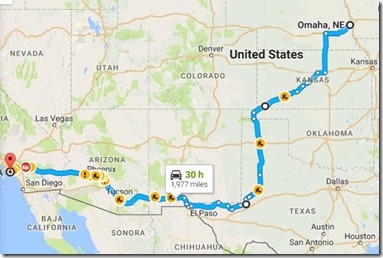
CaliforniaMoveMy next stop was Hereford, Texas, about 300 miles southwest of Dodge. My kids were, sadly, born in Hereford in the early 70’s, something their birth certificates will curse them with for their whole lives, and I had some friends there. First, though, I had to survive the trip. By Guymon, Oklahoma, the snow had turned to ice and the roads were slick and dangerous. I was not even a little prepared for this kind of weather. My rain gear was a bright yellow, rubberized fireman’s suit, which was reasonably waterproof but thermally worthless. In Guymon, I stopped to steal a bunch of grocery store plastic bags that I wrapped my hands and feet in for water-resistance and a little thermal insulation. I stuffed that fireman’s gear with a couple layers of pants and shirts and wore a down vest on top of that. I had to have looked like a yellow Pillsbury Doughboy flying down the highway as fast as I could manage. Semi’s were littering the ditches, after jack-knifing on the iced highway and banging their way through any obstacles between them and the ditch. All of the motels were blacked out due to power failures and full-up even without heat and electricity.

I rolled into a Hereford filling station; frozen, well-into hypothermia, almost delirious from the cold and fatigue. Barely able to move my legs, I half-opened my side-stand, started to lift my right leg over the bike, and they whole mess—bike, gear, and a few pounds of ice stuck to every exposed spot on me and the bike—landed on the ground in a heap. I’d pretty much resigned myself to freezing to death on the spot when a guy in a cowboy had stepped out of his pickup, pulled the bike off of me and onto its side stand, and lifted me off of the ground saying, “Those things get pretty heavy sometimes.” I mumbled something. He asked, “Are you alright?” I mumbled something else and he shook his head and led me into the station where I found a telephone booth (Remember those things?) and found a motel for the night.

After unloading my gear into the motel room, standing in the shower until the hot water was used up, and finding a restaurant where I could get a huge steak dinner, I called a friend who joined me for an after-dinner beer and spent the night recovering from nearly freezing to death. I got up late, loaded up and hit US385 south toward Odessa and, hopefully, out of the ice and cold. I made it about 5 miles when my front wheel started screaming at me. It was pretty obvious that a wheel bearing had failed and I turned back to Hereford where I’d passed a Honda dealership on the way out of town. It turned out that the service department was pretty idle that day, since no rational Texan would be out on a motorcycle in 40F weather, and they got me back on the road in an hour or two. It also turned out that the dealership had been started by two of the guys I worked with when I lived in Hereford a decade earlier. Neither of them were motorcycle guys and they’d spent a small fortune building a new facility, overstaffing it with sales people and understaffing it with service people and had gone bankrupt in a couple years. The guy who owned the place took a great deal of enjoyment telling me about all of that, especially the bits about buying the business for a few cents on the dollar. With new front wheel bearings and some sunlight left, I headed south as fast as I could.

After those first miserable couple of days on the road, sunshine and 50F weather was intoxicating. I mindlessly pounded out the 400 miles between Hereford and El Paso, Texas before realizing that I really wanted to be on the freeway heading straight west, which meant going north (scary thought) to Las Cruces before I could really pound out some miles. Somewhere along the 400 miles between Las Cruces and Tucson, Arizona, I wandered off of the freeway, found a park I remember as “Apache Mounds” and put up my tent for the night.

The next day, I covered the 700 desert miles between my campsite and San Diego, California, hooked up to the 405 and made it another 90 miles to Costa Mesa, California just before dark. The two memories I have of that section of the ride were: 1) discovering that I could lock the CX’s steering and throttle and kick back and relax almost like I was a passenger for a lot of desert miles and 2) pissing off a rough, tough Harley pirate when his big noisy Harley died early on the way up the east side of the Pine Mountain on I8 and my “rice burner” just kept on going while he was stuck at one of the many water barrels at the freeway edge.

I had the idiot idea that my new employer was expecting me when I arrived and discovered that not only was that not true but the place was closed on Saturday and finding an affordable place to stay in Orange County on a weekend was a pipedream. I spent a good bit of time pounding away at motel phone numbers in a phone booth before discovering that I was on my own. I headed south toward some open land that used to be state park territory between Costa Mesa and Laguna Beach and camped for the night on the beach like one of today’s millions of homeless folks do. That night, I also discovered that I’d left my damn billfold in that Costa Mesa phone booth.

The next day, I rolled into QSC Audio Products’ office in Costa Mesa, broke, frustrated and angry, and screwed. At the suggestion of the receptionist, I called the Costa Mesa police and discovered some amazing, decent, sympathetic California had turned my billfold into the police lost-and-found. My money and credit cards were still in the billfold and my life was still on some sort of track. I also still had more than a week of downtime before I was supposed to show up for work for QSC.

First, I hit the 80’s version of Craig’s List, a newspaper called “The Recycler,” found a room-for-rent in a single-family home in Huntington Beach, stowed the stuff I’d been lugging across the country that I didn’t need for a motorcycle trip in my rented room, found a bank for my new life’s financial needs, and hit the PCH for some pressure-free exploration before starting a new life in California. My first stop was Yosemite National Park, 400 miles north, where I explored the hiking trails, fumbled a bit at pretending to be a rock climber, and relaxed for a day in a spectacular campsite, White Wolf. From there, I rode 200 miles to San Francisco and wallowed in a real hippy community that was still sort-of-cool in 1983 and stumbled onto a motel near Golden Gate Park that I’d take advantage of for the next 8 years, every time I was in San Francisco. After a day and a night in San Francisco, I was back on PCH and rode another 200 miles north to Mendocino, California and camped along the Big River just south of town; another location that I’d reused dozens of times while I lived in California.

A couple of days later, I rode 600 miles as close to non-stop as possible back to Huntington Beach and my rented room, unloaded the bike, and settled into my new life as a Californian. A month later, I found a two-bedroom apartment in Huntington Beach for my family, and the solo part of the California adventure was over.

Apr 28, 2021

Maybe Not the End?

Early Wednesday morning, I got an email from Andy Goldfine with the subject line, “certain I am a geezer now.” Andy was mostly commenting on how modern motorcycles are “too pointy” and not cosmetically to his tastes. My reply was that not only are the cosmetically weird looking, but they are too tall and wide, too heavy, insanely powerful, incredibly fuel inefficient, too cluttered, and not particularly fun to ride. I whined that now that my eyesight seems to be somewhat stabilized I’ve been looking for a Suzuki TU250X for the last two-and-a-half years without any luck. Even the state’s MSF program can’t get them and used bikes often list for pretty much what a new bike sells for.

Not an hour from writing that response, my Craig’s List search sent me an email notifying me that a 2012 TU250X was available for $2600 “practically brand new with 700 miles on it and not a scratch on it.” Suddenly, it was put up or shut up time. I emailed the seller, got a little more information, loaded up my ramps and tie-downs, collected my gear and $2600 cash, and with an address somewhere west of Rochester I was headed south just after noon. On the way to the buyer’s location, I thought of all the things I did NOT want to suffer again in a used motorcycle: #1 no damn kids, #2 check for the existence of an air filter, #3 no modified or aftermarket exhaust or intake systems, look at the drive sprocket to be sure it hasn’t been mangled or the countershaft retaining nut, and crash damage. I made a mental list during my hour drive and checked it a dozen times. Any one of those items and I planned on thanking the seller for his time and driving back home without a quibble. I’ve dealt with all of that shit before and I don’t have the patience or tolerance to do it ever again.

Our 2-and-4 wheeled menagerie.
You’ve probably heard the used car salesman line “it was driven by a little old lady only on Sundays to and from church?” This motorcycle was owned by a 60-something Mayo Clinic anesthesiologist who (seriously) only used the TU250X to drive from his house down his very long driveway to get his mail. His “real motorcycle” is a very new Goldwing. There are 700 miles on the TU’s odometer: brand new looking everything and not a scratch on it. It even has a heated vest Quiconnect2 12VDC cable already hooked up for my heated vests. The owner generously let me look for all of the fatal flaws on my list and even helped me push the bike up my ramp on to my pickup. The whole transaction probably took 20 minutes from when I drove into his driveway until I rolled back out on to the street.  

My wife is sort of, let’s say, neutral about my new bike. When myasthenia gravis took away my vision three years ago, she was of two minds: #1 at least I won’t have to worry about you when you are one one of your long motorcycle trips and #2 just when you are getting comfortable with retirement you can’t do the things you love anymore. So, now that the vision thing appears to be under control and the bike I’ve been looking for suddenly appeared, #1 is suddenly back in her life again. The Honda CR-V in the picture at left is her new vehicle (new to us, anyway) as of a couple of weeks ago. She has big plans for us to travel and even “camp” in that little SUV and I know she worries that the motorcycle could put a damper on those dreams. I will try not to disappoint her . . . too severely.

A little while back, I wrote “What Really Signals the End?” That essay mostly moaned about the trauma of making the decision to sell my Aerostich and Giant Loop gear. It was premature. I’ve waffled about putting that stuff up for sale since last fall and it is all still hanging in my closet. I did give away some stuff to friends and had plans on giving away a lot more stuff. But the two Darien suits are still there, my HGC and Shoei helmets are still hanging from the rack, and my beloved Gaerne boots are still in the closet. Hell, I didn’t even get around to putting my barely-used ICON Patrol boots up for sale, although I did try fairly hard to give them to someone locally.

So, we’ll see where this all takes me this summer. I’m old, so all of my systems are on the verge of failing and I’ve already experienced a pretty severe system crash. It won’t break my heart if I can’t pass my own baseline test. I haven’t taught an MSF class in two years and the last time I tried to ride my WR250X through the BRC course I couldn’t see the lines or stay inside the box, thanks to double-vision and myasthenia gravis. So, the first thing I’m going to do, once I get the bike insured, is ride over to the local college parking lot and run myself through that series of exercises. If I don’t ace it, this experiment will come to an abrupt end. Stay tuned.


Aug 22, 2018

VBR 4 and Beyond: Reflections on Now, Then, and the Future

IMG_9466What makes a guy who started the whole textile riding suit business tick? As you’d expect, it’s complicated. Andy Goldfine really only wanted to make Aerostich Roadcrafters; the company’s posterchild product intended to make daily commuting on a motorcycle practical, fun, comfortable, and safe. As he said during a talk at the Very Boring Rally (VBR4), he started the Riderwearhouse retail and mailorder business to be able to support the 3-4 Roadcrafters the company would make each month. Being a retail store businessman was a long ways from a dream Andy had for himself.

vbr4 crowd35 years later, Andy and his company are throwing a party for the people who kept the company alive after every other motorcycle clothing company in the world copied their designs, moved production to the 3rd world, undercut Aerostich’s prices and quality in equal percentages, and out-marketed Aerostich’s Whole Earth Catalog style to a couple of generations of riders who get most of their information from Google searches and make most of their major purchases from Amazon.com. “Word of mouth” has devolved into Yelp and Google reviews by strangers with undeclared motivations and relationships and minimal information of value. If you look closely at the audience for this VBR seminar, you’ll see a lot of bald and/or grey heads, which is pretty much what motorcycling in 2018 resembles: lots of geezers with grudges.

It’s easy to imagine the end of motorcycling. I do it all the time. However, when I was talking to another rider about my first Aerostich I was reminded of the fact that motorcycling looked pretty doomed in 1983 or 84 when I  bought that first Roadcrafter. The California dealers were vanishing. In 1984, there were loads of brand new 1980-1983 motorcycles still on showroom floors. In fact, in late 1983 I talked the owner of a 1982 Yamaha Vision 550 down from his once-reasonable $2200 asking price to $1,000 because the local Yamaha dealer was dumping 1982’s for $1400 and new 1983’s for $1800. Two years later, I bought a like-new 1983 Vision for $1,000 with the same argument. I sold that 2nd Vision in late 1991 in Colorado for $2200 to a guy who drove all the way from California to buy it.  By then, the industry was in yet another motorcycle recession and new Japanese bikes were stagnating on showrooms once again.

It’s easy to imagine the sad current state-of-affairs is a predictor of the future, just like when people imagine current inflated house prices are going to last forever. The only thing experience with the past has taught me is that I am pretty good at guessing when crashes will occur and I suck at predicting bull markets for anything.

People in the industry want to blame Millenials for the current crisis. In Eric Brandt’s article, “Analysts are Wrong about Why Millennials Aren't Buying Harleys,” he wrote, “This all reminds me of a fascinating story Bob Lutz told about the Chrysler Imperial in an interview with Popular Mechanics. ‘That was the source of one of the major arguments Lee Iacocca and I had,’ Lutz said of the Imperial. He said Iacocca showed him the car and asked what he thought. Lutz responded saying it looked ‘aesthetically, 10 years old the day it comes out’ and went on to criticize the vinyl roof, the fake wire wheels, and the opera windows. Shocked, Iacocca responded saying ‘you might not like it because you’re too young, but by the time you’re 65, you’ll like a car like that.’ What Lutz says next applied to the Imperial then and it applies to Harley-Davidson now. ‘I won’t because my generation admires high-end European cars. You like [the Imperial] because when you were 40-years-old, that’s what American luxury cars looked like.’” Harley isn’t the only company to cling to what worked 30 years ago, but there is going to be a hole in one or two generations’ knowledge of what motorcycles “looked like” and someone is going to fill it.

Aerostich’s riding products have changed substantially, while hanging on to the functional concepts that attracted me and thousands of riders to their gear. Their quality standards have only become more refined and stronger over their 35 years of production and invention. There is only one model of what motorcyclists look like and it is the variations on Aerostich’s Roadcrafter and Darien riding suits. In 30 years, if today’s younger riders are wanting to look like motorcyclists from their 20’s and 30’s, they are going to have to be wearing Aerostich gear. Every other brand is a cheap imitation, even if they aren’t cheap.

Here’s hoping Andy and Aerostich will keep doing what they do best as long as they want to be doing it.

Oct 5, 2016

Motorcyclist Gets It Right


Out of the tens of thousands of worthy motorcyclists in the country, Motorcyclist Magazine got it absolutely right this year in declaring Andy Goldfine "Motorcyclist of the Year." Andy and the amazing folks at Aerostich/RiderWearHouse have been making motorcycling safer, easier, more fun, and drier/warmer for 33 years (which means another Very Boring Rally is due in 2 years). Many of us would have been doing something else by now (if we were still alive) if it weren't for Aerostich gear.

Andy has been a friend since I moved to Minnesota and started writing for MMM. Andy's gear has been protecting my body for a whole lot longer.
One of the last pictures of me wearing my ancient (1984) Roadcrafter was in the KLR MMM review way back in 2002. I bought this fine stylish assortment of nylon, zippers, snaps, and cotton bat padding when I first moved to California and discovered that California motorcyclists thought 50F was "too cold" for motorcycling. Since I'd just moved there by motorcycle from Nebraska, my opinion of Californians went down a few notches. Worse, none of the motorcycle shops within easy range of my new home, Huntington Beach, stocked any sort of wet weather riding gear. However, in the back of Cycle or Cycle News (I forget which) I found a picture of a rider in a full-length suit and the ad claimed the suit was "waterproof" or some such thing. Desperate for protection, I ordered the grey/red suit pictured above (the red turned to salmon sometime in the 80's) and I have to give that suit some credit for my Cal State Long Beach bachelor's degree and a ten year California career in professional audio equipment because without that suit, I'd have given up on California a few weeks after being forced to commute by cage.
 
I can't explain why, but this is my favorite picture of me in my
Darien suit circa 2007. It was taken with my old beater Canon
camera by a Montana ranger who told me the story of this
sabotaged dam.
In the late 90's, I met Andy and he immediately dubbed me and my Roadcrafter to be a pair resembling "an overstuffed sausage" (probably the reason the suit had spent the last decade at the bottom of my closet). He sold me a (considerably larger) Darien suit in 2006, before I left for Alaska and a few years later I bought a prototype AD1 jacket and AD1 pants for backup. I've written about both here more than a few times.
 
It's not like there weren't obstacles to overcome. In the Motorcyclist Magazine interview, Andy said, “At first only a handful of riders ‘got it,’ including motojournalists, who were on bikes every day. And even then we were made fun of.” I still get the "going into outerspace?" bullshit whenever I stop near the usual pirate crowd. Usually, when we compare our day's ride (100-150 for them, 400-1,000 for me) the conversation comes to a stuttering end.
 
Google "aerostich roadcrafter crash" and it is impossible to not be impressed by the stories of the skin, bones, and lives saved by Aerostich equipment. There are dozens of Aerostich imitators, but only one company makes gear that you can wear for most of your life and Andy Goldfine founded that company. Even the owners of the imitation gear owe Andy a debt because none of that cheap Chinese-made gear would be here today without Aerostich to copy.
 
Helmets off to you, Andy.

Sep 19, 2016

#127 Dual Purpose Commuting

caveman

All Rights Reserved © 2013 Thomas W. Day

Over a ten year period, I owned four different motorcycles while I lived in southern California: a 1979 Honda CX500, a 1982 Yamaha XTZ550 Vision, a 1986 Kawasaki KLR600, and a 1986 Yamaha XT350. Of the four bikes, the hands-down best daily California commuter was unquestionably the XT350. For four years, I rode my 350 to work from Huntington Beach to Costa Mesa every morning, three to four days a week, to school in Long Beach after every work day, and for 90% of my non-family-related transportation for a total of 68,000 miles. During my last years in California, if I wasn't on the XT, I was on a bicycle (I biked to work almost every day I didn't have college classes). My twenty mile work-to-school commute was via the Pacific Coast Highway, which was dramatically quicker than the 405, thanks to lane-splitting and filtering and no-thanks to the 405's 5mph average rush hour speed. The XT's narrow profile made efficient commuting even more practical as SUVs and other oversized single-passenger vehicles became more popular in the late 80's and the spaces between vehicles shrank considerably.

Since the 80's, so-called "dual purpose" motorcycles have grown (in size and expense) along with the SUV market. It's hard to imagine calling a Super Ten or a BMW 1200GS a "dual purpose" bike, but if you can manage that sort of off-road ride, you probably agree with Emilio Scotto who rode a his "Black Princess," a 1980 Honda GL1100, 457,000 miles through practically every country in the world and claims the Goldwing is the perfect adventure touring bike. Personally, a 900 pound Goldwing would not be my off-road choice and it wouldn't be the bike I'd pick to commute on, either. In a pretty-good world, lane-splitting and filtering would be a common part of urban traffic management and we'd all be saving time, money, energy, and highway maintenance taxes. That's the world in which a real dual purpose bike excels at commuting. With our tall seat height, we can see over and around most other vehicles. The long-travel suspension and spoked wheels allow for almost unlimited escape routes during times of stress. Light weight and nimble handling, a real DP bike can go where panicked cagers fear to roll.

For example, by the early 90's, analog cell phones (as compact as a bunch of bananas) appeared and California drivers became even more distracted. The ability to slide between cars and jump curbs to escape multiple car pile-ups became lifesaving. I'd have been the gooey center in a car sandwich multiple times if I had been on a less nimble motorcycle. Regardless of Minnesota's primitive motorcycle laws, I still split lanes on the freeway when forced to come to an unexpected stop in heavy traffic. I don't even wait for the tire screeching warning that some dimbulb has discovered, too late, that his cell phone was not the most important task of the morning. I just put iron between me and the idiots behind me and merge back into the flow of traffic when it crawls back to life. If a cop wants to give me a ticket for a preventative lifesaving move, I'll spend the time in court defending my right to stay alive. Jumping a curb and hiding in a convenient flower bed is a whole different kind of maneuver, though. That move isn't even an option for sport bikes or cruisers because they don't have the wheels, suspension, or ground clearance. It's not a practical move for a 600 pound "dual purpose" bike, either.

Picture 025I abandoned real DP motorcycles when I moved to Colorado (No, that doesn't make a lick of sense.), but after a few years without a serious dual purpose motorcycle, I bought a 2000 Kawasaki Super Sherpa KL250 with the intention of commuting and touring on the bike. The touring part never happened, but I regularly commuted on the little bike, putting 8,000 miles on the bike in two seasons. It replaced my V-Strom as my regular ride; solely because of the fun factor and 70+mpg in-town efficiency. A couple of years ago, I replaced the Sherpa with my current favorite motorcycle, a Yamaha WR250X. It gets slightly worse mileage (about 60mpg), but it starts easily year-around; thanks to fuel injection. I have a little more than 10,000 miles on the WR and it has done double-duty as a regular commuter and an mid-range adventure touring bike. My old V-Strom is even more lonely than before. In fact, I have ridden it once this year, as of mid-August.

A survey I have been running over the last year found that the average motorcyclist (loosely defined) rides well under 2,000 miles a year. There is no positive correlation between engine size and miles-ridden, either. With that in mind, it's obvious that most of us need nothing more than a 250-500cc motorcycle and the most practical motorcycles every made are dual purpose. For all-around daily use, a motorcycle that can go anywhere, does it efficiently and reliably, and has a decent resale value is hard to beat. Aerostich's Andy Goldfine has a "small and simple equals fun" basic motorcycle rule. Add a versatile suspension, great handling, narrow profile, fuel economy, dependable resale, and a design intended to be treated roughly and you have the perfect commuting motorcycle. Maybe, the perfect universal motorcycle.

Postscript: 
From: Andy Goldfine 
Sent: Friday, June 06, 2014 11:33 PM
To: Tom Day; Day Thomas
Subject: Lightweight touring
Tom - Wonderful MMM column this month.  Thanks for mentioning me.  I learned the "Small and simple equals fun." formulation from an old Steven L. Thompson editorial in Cycle World or Cycle Guide.  


His version was "L + S = MF" which stood for 'Light + Simple = More Fun'.  He deserves full origination credit for this idea as it relates to motorcycling.


I hope we will be able to get together in person some time this summer.


 Andy


Apr 7, 2014

#50 A Witless Battle

http://www.amazon.com/Geezer-with-A-Grudge/dp/B007RPQJ24
All Rights Reserved © 2005 Thomas W. Day

I don’t just write Geezer rants. I write all kinds of crap; short stories, long stories, tech articles, personal letters, e-mail, and (regrettably) letters to editors. I stumbled into this gig with a letter to an editor, in fact. I write even when anyone with good sense would watch TV or play Monopoly. A while back, I was infected by an overwhelming desire to write to the editor of the Ride to Work News, Andy Goldfine.

Like panic reactions, angry impulses, elective surgery, and sexual perversions, “overwhelming desires” should probably be resisted.

Ride to Work had published a collection of letters and articles about how persecuted motorcycles and motorcyclists are on the road and in court. We’re, apparently, a hobby populated by victims and most of the folks who wrote letters to RTW seemed to think motorcycles have been singled out for special neglect by the court system.

I wrote Andy that I didn’t think that was the case. My own experience led me to believe that cars and trucks, in general, are a specially protected “weapon,” regardless of who gets hurt: motorcyclists, pedestrians, bicyclists, non-mobile spectators, or other cagers. As most states’ motor vehicle manslaughter and homicide laws stand, the murder weapon of choice should always be a cage. Kill a kid with a semi-automatic weapon, go to jail for life or get fried. Kill the same kid (and a collection of his family members) with a Hummer or a Cadillac and you might get out of jail in six months. My feeling for the rationale behind these irrational laws is that the public keeps electing drunks and irresponsible/incompetent drivers to public office, There is no way that those characters are going to write laws that are likely to put themselves away for life. So my logic went.

Andy, in one of his articles, contended that motorcycles are a “clear social good” and that caught my attention. In doing my Motorcycling Minnesota cable show, I’ve been working on a series of short articles about motorcycles and motorcyclists’ public image. The put it bluntly, our image isn’t positive, no matter how many Rides for Kids or other benefits motorcyclists do. In fact, many of those benefit rides create as many enemies as friends (or, at least, acquaintances).

Andy’s contention is that motorcycles reduce traffic congestion, pollution, and parking space problems. He argues that motorcycles could reduce fuel consumption, natural resource depletion, and enhance urban transportation options. Mostly, I agree with him. The problem I have with the argument is that, today in the US of A, much of it isn’t true. A large collection of the bikes we choose to ride produce more air and noise pollution and use as much or more fuel than considerably larger cages. The first thing most motorcyclists do to their new bike is dump the EPA-approved exhaust and install a pipe that rattles windows for miles. In the Cities, available parking space isn’t a problem. There are graveyards that experience more traffic than downtown St. Paul and the city counts on parking ticket revenue to fund good bit of the police department.

The reduced congestion argument isn’t going to create a lot of interest with the powers that be in Minnesota urban areas. Minnesota hasn’t even decided if light rail is worth the effort. Reducing congestion is the exact opposite of the Metro Council’s plans. They’d like to transform the Cites and the burbs into a “New L.A.” If the developers and the state government has their way, we’ll be packed, standing-room-only, from the St. Croix to Brainerd.

I think, before any of the socially responsible arguments begin to receive a serious reception, we’re going to be living and driving elbow-to-elbow, buying $6/gallon gas, and breathing air that would choke a Californian. For some reason, Minnesota’s political heavyweights have decided that marketing Minnesota’s quality of life requires sacrificing our quality of life. In the meantime, doing smart things such as reducing pollution and congestion are so far from being on the front burner that they aren’t even being kept warm.

Regardless of which if us is sitting on the perfect side of this debate, Andy makes solidly the most persuasive, literate, and thoughtful presentation; which is what spawned the title of this rant. We passed a few e-mails back and forth and even when it appeared that he agreed with my position, he restated it in such an improved condition that it was no longer something to which I could claim ownership. You’ve heard the expression “a battle of wits against an unarmed man?” That was what I experienced and I realized I was unarmed even before I got into the battle.

MMM Winter 2005-2006

Feb 7, 2014

Book Review: Bodies in Motion

bodies_in-motion

by Steven L. Thompson, 2008

All Rights Reserved © 2011 Thomas W. Day

This academic look at motorcycles and motorcycling might be the first and only publication issued by Aero Design and Manufacturing (aka Aerostich). Andy Goldfine wrote the forward and it is clear that this piece of research is near and dear to his heart and his company's mission which he described as "motorcycling is a social good--an activity that benefits everyone, not just the rider . . . because even the most mundane riding experience changes the rider in psycho-biological ways which ultimately are beneficial to everyone." Andy and Thompson clearly believe this is true and Bodies in Motion attempts to prove that argument and explain why it's true.

Using sociology, psychology, human and technological history, accelerometers, data collection, statistics, and personal experience, Thompson attempts to document and explain every aspect of why we ride motorcycles and why we ride the specific motorcycles that we chose as individuals. With chapter titles like "Speed in the Genes," "Go Fast, Look good, Feel Great," and "Different Strokes for Different Folks," Thompson dives into our personalities and the "personalities" of our motorcycles. While Bodies is an academic creation, Thompson is not an academic motorcycle voyeur. He has raced motorcycles since the 1960's and has been a competitor at the Isle of Man TT and was a veteran road racer with some success under his belt, a Formula 5000 driver, a former editor of Car and Driver and Cycle World, a pilot, and a PhD candidate. Thompson is also a successful writer who has published several books of fiction and he can generate page-turning text.

Bodies in Motion is not, largely, recreational reading, though. I made it halfway through the book three times before forging to the end. The book was originally proposed as "a social history of motorcycling" for the University of California Press in 1997. By 2001, Thompson's book had turned into something else and he commissioned a bit of Stanford's engineering department to make measurements of "nine iconic motorcycles" in the hopes of explaining why those bikes have been attractive to so many motorcyclists. The end result was a book that the University of California Press turned down and Andy Goldfine picked up. Bodies in Motion is, as Thompson describes the book, something "midway between being a scholarly study and a popular moto-book."

Thompson does  a nice job of blending the academic with the moto-book, though. His analysis of  "high-sensation seekers" vs. the rest of the herd (in the chapter titled "Fast Is Never Fast Enough") was an entertaining chapter. He even comes up with a justification for street racing that didn't piss me off. I'm not convinced that the skill required for street racing is even in the territory of the standard set by real racers, but I can buy the Darwinian argument for racing when an organized track isn't available. His discussion of the motorcycle as "Performance Art" only sort of made sense to me because I am not particularly entertained by shiny motorcycles or the light they reflect.

Thompson has a habit of flipping from an academic viewpoint to the personal and, sometimes, that works well. Sometimes it is irritating or distracting. Aggressive editing to make the writing style more consistent would have improved Bodies considerably. Still, there are lots of interesting ideas and insights into motorcycling, motorcyclists, psychology, biology, and how all of those things come together in the motorcycling experience.

Jul 4, 2013

Can't Get More Patriotic Than This

RiderwearHouse/Aerostich are two of the most American things I know of. You should buy something from this great Duluth, Minnesota company and keep America strong (and keep a few jobs in America, while you're at it):

Mar 12, 2013

Fixin' What Ain't Broke

Sometimes I wonder what goes through the heads of the average consumer? Take, for example, cable television. Why the hell would anyone pay a nickel for dozens of channels of "reality" crap, extended sales pitches, recycled network sitcoms, and 1950's programming? What moron doesn't know that all of that crap is free over the air? Originally, cable television was promoted as being commercial free, but today cable station commercials are longer than they are on the networks. What do you get for $85/month: HBO, mind-numbingly repetitive sports, Starz, Showtime, and repeats of the same 4 movies for a week. Since 99% of all movies are worse than reality television, that seems more like a punishment than a reward.

The REVIT Sand 2 Jacket.
Motorcycle gear appears to be going through a similar silly phase. The silly consumer was perfectly portrayed on a recent ADVRider thread when a wannabe wrote, "Aerostich's gear is superb but outdated. Maybe somebody else knows for sure, but most of what they sell appears to be circa 1985 or so. Motorcycle gear has come a long way since the Roadcrafter, Darien, and Combat Touring boots were invented. I'd love to see Aerostich modernize that stuff." Apparently, Aerostich isn't sticking on enough pockets and cupholders for this dude. A knockoff Chinese brand, Rev'IT, appears to have tripped this guy's trigger, which pretty much says all there is to say about his standards: trend over function.

 
The classic Darien Jacket, circa 2013.
Any gear is better than none, of course. Today, even the worst gear that tries to imitate the Aerostich Darien is better than everything except racing leathers from a few years back. And let's face it, everything that looks like a Darien is imitating a Darien. Outside of the canvas stuff from Belstaff, Aerostich pretty much invented modern motorcycle weather-resistant gear. While this douche bag imgaines that the Darien has been locked in 1985, I'm here to tell you that the first generation of this totally original product bears practically no resemblance to the current well-refined and massively practical gear. I owned one of the early versions and while it was state-of-a-brand-new-art, it sucked compared to my current Aerostich gear. For one, Goretex was a ways from being waterproof in 1985.


While I'm a regular maintenance guy, I'm not a fan of fixing things that aren't broke. My day-gig exposes me to a crap-load of people who believe that skill-lessly hacking into functioning gear to "improve" its performance  by mangling specifications and measurable characteristics. As a tech/engineer this whole perspective makes me want to move to my Montana hermit's cave and avoid contact with human beings until the big-asteroid Apocalypse settles the whole issue. The modern Aerostich-knock-offs are laden with silly shit that is more likely to be dangerous than useful. Belts and buckles, for example, are dangerous on a motorcycle. The only person who thinks multiple straps on a jacket is a good idea is someone who has never slid down a gravel road on his ass stuck to a 500 pound motorcycle by a damn bootstrap or belt tangled in some protrusion of the motorcycle. "Slow is smooth, smooth is fast," and smooth is also tangle-free. All those useless pockets make me nervous, too, for a totally different reason. With dozen pockets available to me on my Darien, I'm constantly losing shit; like my keys. I have been known to drive back 100 miles, convinced I'd lost something precious, only to find it in a pocket I use once a decade. Do not tell me I need more pockets. I'm warning you.

After giving me a lecture just like the ADVRider psycho-jabber a few years back, a friend decided to put his money where his mouth lived and bought a few bits of trendy looking made-in-China crap. The stuff lasted about 10,000 miles and two seasons before it bleached out, began to fray everywhere, and began to unravel itself everywhere from the multitude of unnecessary, weather-unresistant pockets to the seams that held the zippers in place. My 6-year-old Darien rig is still as water-resistant, tough, and practical as it was 110,000 miles ago and my new Darien is even tougher, more comfortable, better fitting, and more water-tight. I didn't really need a new suit, but it started with a brain fart and ended with $700 out the door and a 2nd set of riding gear. My excuse would be hi-viz. It would be a better excuse if the pants weren't black.

The Darien armor works. The hip pads and back armor are, I'll admit, expensive and big but I've fallen on my prosthetic ass hard a couple of times and it remains unbent. I've slid down the trail on my butt and back and not only did the Darien hold up but I didn't even get a bruise out of the ordeal. I'm old and I bruise easily. Hell, I break pretty damn easily.

So the gear costs a little extra. No CEO is getting rich from cheap Chinese labor or idiotically designed import laws that encourage companies to create jobs outside of the US. In fact, Andy Goldfine might be the most underpaid executive in American industry. He and his staff are all crazy people who would rather make great motorcycle gear and live in [gulp] the frozenest of all of the frozen woods of Duluth than go the usual route and pay $0.50/day for labor and cut rates on cheap and defective materials. If that bothers you, don't whine to me when your job gets Bain Capital'd into history. You deserve the misery you've asked for.

[Note: Yes I'm pissed off. This one has been boiling in my gut for a while.]

Jul 2, 2012

What's the Opposite of a Grudge?

A couple of weeks ago, I listed ten (just to keep it short) companies, products, and concepts that have earned my long-lasting distrust. During the following week, I ended up at my neighborhood motorcycle accessory store buying replacement summer gloves and discovered that I naturally passed over several brands because of mediocre past experience and immediately picked out a couple of versions from the one brand the store carries that I generally like. From that experience, I decided to list a few of the companies, products, and concepts that I have (probably) unreasonable faith in
  1. icon -- icon is, in fact, the company that provided the motivation for this rant. Some time back, I reviewed a pair of mid-priced icon gloves. Five years later, those gloves are still providing good service. A few years later, I reviewed a pair of icon ventilated pants that I still wear, often. Both products have been reliable, tough, and functional. When I stood in front of that rack of gloves, icon was my only real options, since I've been burned by TourMaster, Alpinestars, and FirstGear. Joe Rocket was an option, but the first pair of gloves I picked up had failing seams, I went for the icon twenty-niner and have been very happy with the choice. Lousy gloves are a memory that sticks with a rider for a long, long time. Good products have the same sticky quality.
  2. Aerostich -- Just mentioning this brand is 'nough said. Aerostich makes great products and I've reviewed so many of them that it would take a page just to list the wonderful products I've bought from the company. Even the products they carry that are manufactured by other people are checked out as thoroughly and supported as consistently as their own stuff. Aerostich/Riderwearhouse is a great American-made company.
  3. Yamaha -- Over the years, I have owned a variety of Yamaha motorcycles and scooters.The first was my wife's MX100 which gave her spectacular service for years before she sold it. She has nothing but fond memories of the bike and out grandson still wears her old bumblebee yellow Yamaha jersey. My first Yamaha street bike was a 1982 XTZ550 Vision that suffered at least 50k miles of LA commuting traffic before I sold it and bought a 1986 Yamaha XT350 that I still regret selling almost a decade later. Along with the XT, I owned a 1983 Vision that moved me from California to Indiana to Colorado and, finally, was sold for a profit to a guy who drove his truck all the way from LA to Denver to pick it up. My 1986 TY350 was and is, likewise, one of my all-time favorite motorcycles along with the pair of 1992 850 TDM's I owned and loved. The current mechanical love of my life is my WR250X, the most fun motorcycle I've ever ridden. The Super Ténéré I reviewed last week joined the list of impressive Yamaha motorcycles I've experienced. I've only owned one Honda, but it was an equally excellent motorcycle. My experience with Suzuki has been less consistent. My two Kawasaki's have been disappointing.  Yamaha has done very well by me and that makes any Yamaha vehicle look a little better than the rest, in my view. 
  4. Dell Computers -- I own four of them: two Latitude 410 laptops, a desktop tower, and the 1012 Netbook I'm working on as I write this. The Latitude 410's were the convincer for me. After wearing out a half-dozen laptops on my motorcycle trips, including two of the grossly misnamed Panasonic Toughbooks, I stumbled on the 410 just before I left for Alaska. 70,000 miles and hundreds of hours later, that first unit is still working. So, I bought another. And another. And . . . Dell's customer service has been exceptional and knowledgeable, on the rare occasion I've needed it. 
  5. Avon Tires - Way back in the 1970's, I was commuting about 60 miles a day in a VW Beetle. The Nebraska roads were poorly maintained, there was often black ice and drifted snow to contend with, and I went through a VW motor about every 60k miles and a set of tires every 15k. A rally driving friend recommended Avon tires and I bought a set. They outlasted the VW's motor and were great on those crappy roads. The whole time I lived in California, all of our cars wore Avons, but I didn't discover Avon motorcycle tires until I put a pair of Distanzias on my V-Strom. After getting 3-5k out of the previous rear tires, I doubled that with the Avons. I don't drive that much these days and my car tires usually dry out and start weather cracking before the treads are 2/3 used. I put pretty much anything that fits on the cage and, sometimes, I go cheap on the bike when city commuting is the primary task. When I'm going long on the bike, I'll go with Avons. I have never been disappointed with an Avon tire.
  6. Chase Harper - Currently, I do not own any of their products. However, I have had several in the past. Their product support (warranty and repairs) is second to none. I owned a pair of Grand Millennium 4000 saddlebags for 30 years and wore them out, twice.  The company not only repaired the bags under warranty both times, but they upgraded the bags to current design standards each time. 
It's a short list, I know. I imagined I'd come up with at least ten companies, but I didn't come close. I've hung on to this post for a couple of weeks, hoping that I'd remember a few more companies on my preferred vendor list. There aren't many to choose from. Forty years ago, a Peavey sales manager explained to my partner why Peavey products were such crap, "Dan, there will never be a pre-CBS (Fender or Harley) Peavey market. We don't want any of our current products having to compete with our older products." Most modern corporations can make that same claim. None of their new stuff will last long enough to leave a memory for the majority of consumers.

An executive I worked with three decades ago once complained that "customer loyalty" is dead. He was the kind of guy who believed that warranties are made to be ignored and all of the inventory of a crappy product should be sold before the product is abandoned. He argued that our customer warranty database was a waste of time and effort, even though we were one of the few companies that stored the data customers filled out on those usually-worthless warranty registration cards. For ten years, I beat back this guy's arguments and we developed a loyal customer base that had high expectations of our company and paid a small premium for our products. A few years later, the company moved production to China, shipped a collection of marginally reliable and under-performing products, and wiped out thirty years of reputation in a few short years. Now, they are one of many equally positioned companies and battle for the lowest cost point, since customers are no longer loyal to the brand.

Customer loyalty is a two-way street. To get it, a company has to be loyal to its customers. Most companies can't even manage to be loyal to the country that provided the resources for their existence, let alone the customers who buy their products. The cost for that disloyalty is that the products become a commodity that can be purchased equally reliably -- or unreliably -- from any vendor. Once you're in that world, the only advantage you can offer is price and that means quality is sacrificed even more and customer loyalty slips away even further.

The high price for maintaining customer loyalty is beyond the capability of most corporate management. In my life, that has been the most obvious thing that is slipping away from US corporations; management with ability. The skills that we have lost and are least likely to regain are intelligent, skilled management with foresight. We can't build stuff because manufacturing management requires the most energy, talent, and commitment. Any lazy idiot can invent fraudulent security "instruments" and sell them to other fools; as long as we're willing to give up on being a nation ruled by law. The few companies that still do business responsibly and are customer-oriented deserve our business more today than ever.