Oct 12, 2022

There Are Tires and There Are Tires

Earlier this spring, a friend rode his Suzuki TU250X from Santa Fe to the west coast and back. On the way back, he got hammered by winds that were almost enough to exhaust that little single-cylinder 250 into a low gear and wore himself out keeping the bike on the road. Yesterday, I did a piddly 50-mile round-trip ride in my local area. On the way back, I experienced 30-40mph side and head winds and re-discovered the joys of skating on a motorcycle. The bike, literally, slides a foot or so across the lane when a big gust hits it strongly. It’s not that different from riding on loose gravel or even a sandy country road, but it’s a little disconcerting and definitely tiring after a few miles. And I wasn’t loaded up with a week’s worth of gear and camping gear, so my experience was a small sub-set of his on the high plains of Idaho. Still, it brought back a lot of memories about motorcycle tire evolution in my lifetime and experience.

When I bought my first street bike, a ‘80 Honda CX500, I got my first taste of getting hammered by the wind when I rode that bike from Omaha to California in 1983 to start a new job. Between Omaha and western Kansas on my first day of the ride, I got my ass kicked by strong winds constantly blowing that oversized, under-powered boat from one side of the highway to the other. Since that bike had barely more than 1,000 miles on the odometer, I’m fairly certain it was still wearing the stock tires when I evacuated the Midwest for California. Probably 4-ply, bias-belted, symmetrically patterned tires like the ones in the Honda ad picture to the left and above. Those tires were consistently awful on waffle-steel bridges, gravel, newly paved roads with loose grit, wet surfaces, and any irregular surface. Not that great on regular surfaces, either. And, of course, the bike was more like a sailing ship than a land vehicle in the wind.    


Not long after arriving in California, I had to reshoe my bike and the first tires I remember making a difference were bias-belted Dunlop Elites. The trick is increased contact patch, irregular grooves in the tire to move water away from the contact patch, and the difference in the ride and stability was revolutionary. Most of the problems I complained about in the above paragraph vanished with the Dunlop shoes. Especially wet surface stability and grated bridges became mostly non-issues. And I stuck with those tires on all of my bikes except the two dual purpose bikes I owned for the next 8 years. The last bike to wear Elites was my XTX550 Yamaha Vision. I moved from California to Indiana to Colorado with that bike and a Yamaha XT350 Enduro.

Not long after moving to Denver (Parker, actually), I stumbled on to a killer deal on an 850 Yamaha TDM and that bike, owned by a doctor who farkled up the bike to the max but rarely rode it, came with Michelin radials. They were, as I remember, tires that I’d considered out of my budget up to then, but I don’t remember what model of tire they were. What I do remember is that the TDM was the most stable, sure-footed motorcycle I had ever ridden at speed on any surface. From that bike on, every motorcycle I’ve owned that could take a tubeless tire got high-end radials: from my TDMs to my SV650 to my V-Strom. And all of those motorcycles and tires convinced me that weight, style, and the rest of the excuses motorcyclists use for “needing” a large, heavy, unwieldy motorcycle are clueless.

But yesterday, back on a small motorcycle with old-fashioned bias belted tires, I was thrown back in time to the bad-old-days when tires were designed intuitively rather than using science and engineering. I have a pair tires in the garage waiting to be installed, but the miser in me wanted to get at least enough use out of the damn 10-year-old OEM Cheng-Shin CS Marquis Chinese junk to satisfy something-or-other waste-wise. Before writing this essay, I hadn’t really looked at the OEM tires. After writing “10-year-old OEM Cheng-Shin CS Marquis” I realized how stupid that argument is. Those tires were installed on the bike to protect the rims in shipping. No rational person would be dumb enough to ride a motorcycle on public roads wearing those sad faux-tires.

Oct 10, 2022

Life Is A Small Window

Yesterday, I did something I haven’t done since sometime in mid-2018, I rode my TU250X about 50 miles from my small town home to the Twin Cities to meet a friend for lunch. I know that seems like a small thing and 5 years ago if someone like me described that as an “event” I’ve have worked hard to politely nod my head in acknowledgement without at least grinning a little. 10 years ago, I’d have laughed. I was/am an asshole, I know, but I did start calling myself a “geezer” (in a monthly publication and in this blog) when I was 50, so it’s not like that is some kind of sudden realization. For the most part, the 120 mile round trip was uneventful, in a good way. The TU is absolutely competent in normal city traffic and I’m still moderately competent, when my eyes are working correctly. My biggest problem yesterday was the fact that I’m definitely a lot more sensitive to light than I was pre-cataract surgery, so I’m stuck wearing glasses inside my full face helmet and face shield when the sun is out. Two sets of lenses puts some stress on my MG (myasthenia gravis) weakened left eye, which made managing double-vision symptoms difficult for a few miles. As soon as the sun went below the horizon and I could dump the glasses I was fine.

MG isn’t a curable disease. It will continue to plague me until it or something else puts me in the dirt. Yesterday was an anomaly from my last 4 years of life and, as such, it was a brief open window of freedom. People like me who have mostly skated through life without many injuries or problems that weren’t self-inflicted naturally forget that this life we enjoy and take for granted won’t last. Sooner rather than later, the window of life that we learn is “normal” when we are young begins to close and, if you are half-aware, you learn to appreciate the moments of fresh air that you still have. Yesterday’s ride was a true moment when that window opened and I was allowed to feel that “I’m not dead yet.”

In fact, riding home as the sun went down, there was a brief moment when the sun going down in a blaze of yellow, orange and red, blue and purple cloud cover on my right was spectacularly balanced by a huge, bright orange full harvest moon rising on my left. That lasted for about 5 miles and 5 minutes of when I rode along the ridge of two valleys before turning east and riding down into the Mississippi River Valley toward home. I got a glimpse of the moon just as I came down the last rise toward my home stretch, but after getting the bike parked, unwrapping myself from my ‘Stich, when I tried to show that natural wonder to my wife it was hidden behind cloud cover. Another brief window of life.

Aug 26, 2022

Fuel Tests

In case you have any confusion about the quality of fuel produced by large amounts of agricultural welfare payments, check out this video on what ethanol does to aluminum and rubber parts:

This is pretty enlightening, too:

And, finally, a motorcycle guy tosses in his several cents:

With all of that said, I have been only marginally careful with my "end of season" fuel. I have used Stabil since the late 80's, anytime my bike is likely to be unridden for more than a few weeks. In my carb days, I often disassembled those damn pieces of plumbing for various reasons, mostly altitude changes. The inside of every one of my bike's carbs were spotless. Seriously, they shined like they'd been polished. The same goes for my snowblowers and lawnmowers. They are the only carbureted motors I own now and I do an inspection at the end of every season. I do try to keep non-ethanol, non-oxygenated fuel in those motors or run them out with Stabil in the last tank before I store them.

Aug 22, 2022

Boiling the Frog

Welcome: The Boiling Frog StoryI had my own special boiled frog moment this week and it reminded me of how easily we settle into to what we’re used to and how quickly we can compromise what we think we “like” or expect from things we use. I’ve been riding my 6-year-old ebike (a late-2016/early-2017 RadPower Rover) since my grandson trashed it badly enough to give it to me in late 2018 in pretty much barely-salvageable condition. He’d commuted in Minneapolis/St. Paul for the year he owned the bike, crashing on the icy roads often, doing little-to-no maintenance, and doing the Millennial thing of ignoring problems until they become insurmountable obstacles. (If I believed in an afterlife, I’d be looking forward to seeing how that characteristic plays out in the long run. I’m still betting on robots over humans.) Over a couple of 2018 winter months, I chased down the non-functional electronic causes, repaired and replaced a lot of obvious mechanical problems and broken parts, and got the bike back to working bit-by-bit. One aspect of getting familiar with a complicated product in that manner is that I sort of reset my expectations as each bit “came on-line.”

Since that initiation, I’ve continued to upgrade the bike and maintain it, sometimes discovering problems that weren’t obvious to a newbie early on. The battery had been particularly abused by sub-zero storage and operating-temperature operation along with crash shocks. When I first started riding the bike, I was using the throttle a lot and, as a result, my range was fairly limited. Over the last 4,000 miles, I’ve learned to use the throttle sparingly and to count on the Pedal Assist System (PAS) to determine most of the bike’s power contribution. A couple of years ago, pre-Covid, I was making 40-50 mile trips on at least a monthly basis. In the last two years, a 20-25 mile trip had become my norm for a long ride, with most days in the 10-15 mile territory. Other than putting the bike chargers on a timer, I don’t do anything special to maintain the batteries.

Last week, Mrs. Day gave her 2019 MiniST a battery "test." We were about 8 miles out when she was stung by a wasp. She's very allergic and, I thought, freaked out, turned around and went full throttle back home and to head for our local clinic. My Rover was already down to 3 bars (from 5 on the battery status indicator) just from riding at PAS2 to that point. Mrs. Day is a minimalist and always rides in PAS3 and 3rd gear on the derailleur. To try to keep her in sight, I kept the Rover in PAS3 and pedaled hard. She was clearly running full throttle (20mph) in full motorcycle mode and she vanished into the distance. I figured she was so freaked out that she wasn't watching the battery status, but I was wrong (again). She still had 4 bars on her battery when she got home. I had been on one bar for the previous 4 miles.

I began to suspect that might need to replace my almost-6-year-old, 5,000 mile battery.

After the big wasp run, I “re-engineered" my grandson's discarded Mini battery bracket to mount on the Rover and, now, I have a newer far more powerful battery on the Rover. The Mini battery, when new, has about 150Wh more capacity than the Rover “dolphin” battery. Over the last few years, my range has been steadily declining and shortening my range to the point that I was pretty much starting to think anything over 25 miles was risky.

I needed to do a LOT of maintenance to the Rover and the cool weather and that battery comparison experience finally motivated me to do it. I cleaned and packed the rear hub bearings and lubed the nylon gears (1st time for that in almost 5,000 miles), cleaned and packed the front bearings, swapped the worn out rear tire for one of the old originals (the front is still ok), installed new brake pads and cleaned and roughed-up the disks, cleaned and lubed the chain and derailleur bearings, repacked the bottom bracket bearings, and generally cleaned and lubricated anything that caught my eye.

For the battery installation, I had to drill mounting holes for two of the 3 battery bracket screws (harder than it sounds because the holes also needed fairly precise countersinking to allow for the Rivnut heads on the bottom side of the battery frame. I installed 45A Quick Connectors in a very tight space between the bracket and wiring entry to make battery replacement fairly simple. Time for a test ride.

It’s probably psychosomatic, but the bike feels way more powerful. That could be real because the internal series resistance of the old battery cells has been increasing, which is the actual cause of battery depletion with age. As I mentioned, the Mini battery has about 150wh more capacity than the original Rover battery and is slightly lighter. I came home, after at least 12 miles of PAS3 operation (a total of 18 miles) and a couple of block-long full power uphill runs with 3 bars remaining (while at power). I think Cannon Falls is back in my range. Over the next several days, I took on tougher rides with more big hills and longer trips. It was obvious that the old battery was on its last legs.

It is also obvious that this is another example of how we become used to what we have and if what we have degrades slowly we won’t notice the degradation until we’re either forced to compare it to something similar or we suffer an outright failure.

Aug 12, 2022

Payback Is A Bitch

I’d been on the road (as a cage passenger, sadly) sans-electronics for a few days and when I came home my email inboxes were filled with the usual crap. I don’t know how people survive with cell phones and the inability to automatically screen callers, texters, and email. I flag practically everything as “spam” and I still ended up with more than 150 pieces of crap in my email accounts after 4 days and, at most, there were a half-dozen things to which I actually want or need to pay attention. And all that is after my spam filter has automatically trashed about 50% of everything sent to me. One of the things that caught my eye was from a local motorcycling (not biker) group. One of the members linked a few pages of the jury decision in the case of a truck driver who crossed into the oncoming lane and killed 7 bikers. WebBikeWorld has some additional information on the case here. where it is noted that “One of the motorcyclists had a BAC nearly double the state's 'too drunk to drive' limit.” The poster speculated that the jury found Volodymyr Zhukovskyy to be innocent because “the jury was filled with idiots. Or the prosecuting attorney was an idiot and didn't present any of this [drug use] information to the jury. Or maybe Westfield Transport is run by the mob and they threatened to harm the family members of the jury?”

Possible. But I have a different theory.

Since the trucking company has bankrupted due to civil payments to families and survivers, I think this case is pretty much done in civil court. It could be the state will bear some liability due to the driver's past history and the fact that he shouldn't have had any sort of commercial license. Somebody else’s problem.

However, I wonder if the real takeaway from this decision is that the jury, like most Americans, are fed up with motorcycles. The general impression of motorcycles and motorcyclists are taken from the unnecessary and arrogant noise, regular well-publicized bad behavior, and the general impression that most motorcyclists are dangerous, sub-human, psychopathic gangbangers. A more successful tactic for the prosecution might have been to spend a lot of time bringing in experts to establish that motorcyclists are sorta (at least closely related to) humans. Hardly has worked pretty hard to create the sub-human image. You'd think/hope there would be some downsides to promoting anarchy, violence, and chaos.

About 20 years ago, I was on the MN Governor's Motorcycle Safety Council. A friend and co-worker, who was also on the Governor's council and was an ABATE officer (most of the council was made up of ABATE gangbanger wannabes) were walking to lunch in downtown St. Paul and talking about motorcyclists' public image. Most of the kids I knew at the school thought motorcycling was for "old people and assholes," but my friend disagreed with that general image.

His disagreement held up until a couple of noisemakers went past us and pretty much everyone on the street said something along the lines of "crash and die assholes." Once exposed to the real world, his take on many of ABATE’s positions changed enough that he quit his club office and took a back row seat in most of ABATE’s key political positions.

So, back to my take on the jury decision: Since police are clearly terrified of bikers and their gangs, maybe the jury just decided legalizing motorcycle highway carnage is the only way to get the bangers off of the street?

For calibration purposes, we got back last night about 9PM after a long vacation return trip (long for us). Went to bed about 11pm and spent the night being noise bombed by nitwits on Hardlys (and other garbage fish) on our un-policed county road well past 2AM. Personally, I keep hoping Amazon will sell a hand-held holographic projector sometime soon. People living in those noise traffic zones could project deer, moose, bears, cops, baby carriages, etc on to the streets in front of the local idiots on blubber-mobiles and entertain themselves watching the goobers try to remember where their brake levers are. My street is decorated all summer long with morons and their unmuffled, 2 hp bikes, and 4 hp sound systems. "If wishes were fishes" there'd be a whole lot of Hardlys buried in half-rotted carp.

A couple of years ago, a friend and I were talking about the herd of anti-vaxing, science-denying goobers who were (and still are) decorating hospitals with their dying breath and crazy conspiracy theories. I’m not a big fan of humans and so my take was “That just seems like the usual price for stupidity.”

His response was, “Being stupid shouldn’t be a death sentence.”

“Dude, that is always the result of being stupid,” I said. In fact, that is exactly how evolution works, it’s the whole point of the Darwin Awards.

Likewise, after 75 years of Hardly’s convincing every white male that looking like an unreconstructed off-on-bail convict on a last binge before a couple of decades behind bars is “manly,” we have a problem. Minnesota has a “road guard” law that allows a moron with a reflective vest and a paddle to stop traffic indiscriminately for any unreasonable amount of time to allow totally useless, law-breaking, and decadent bikers to parade through any street or road in the state. You don’t think that tactic creates animosity? I’d bet it generates enough hate for motorcyclists from at least 50% of the inconvenienced population that you wouldn’t want them on a jury if you wanted that jury to convict anyone of killing a motorcyclist with any kind of weapon. Sit through two of those clown parades and you’ll be running them down yourself.

Jul 25, 2022

Rollin’ Bowling Pins and Wobblin’ Morons

For the last few weeks, I’ve been pretty much stuck on 2-pedaling wheels. My myasthenia gravis and the double-vision symptom are back with a vengeance and I don’t drive more than a few miles on good days and the motorcycle is likely parked until I sell it. Odds are against me that, this time, drugs will suppress my hyperactive immune system and I’ll get my life back. This Sunday, my wife got bored and decided we need to go for a drive somewhere we haven’t been for a long time; Taylor’s Falls, MN; about 75 miles north of our house. That’s a long drive for her and I wouldn’t be much help behind the wheel after the first 40-50 miles, when the double-vision kicks in for the rest of the day.

We got up and out early, mostly to take advantage of my eyesight working, usually, for a couple of hours in the morning. After a stop for breakfast, we made it through Stillwater before that tourist town’s crush began and arrived at the Franconia Sculpture Park before their volunteers even managed to put up a donation bucket. It has been at least 8 years since we visited this terrific multi-acre outdoor gallery and we almost had the place to ourselves until about 11AM. From there, we went to downtown Taylor’s Falls, found a convenient place to park, and walked to the Interstate Glacial Park for a hike along the cliffs of the St. Croix River. Around 1PM, we moved the car to a favorite local drive-in and had lunch. So far, so terrific.

After lunch, traffic was really starting to build up and going back the way we came through town was going to be a long, slow, slog while Minnesotans and other tourists struggled to crawl through the one light in town going either across the river to Wisconsin or back southwest toward the Cities. So, we went another way and wandered through the city to where we could jump the line and head back the way we came, right at the intersection of the light.

About 5 miles down the road toward Stillwater on MN95, in the oncoming northbound lane, were at least 100 blubbering, unburnt fuel-spewing goobers on an assortment of motorcycles heading for the unsuspecting, already overloaded town of Taylors Falls. The intersection of US8 and MN95 (where that one light lives) was already piled up a half-mile or more north on MNwith rural goobers, tourists, bikers, bicyclists, and pedestrians.

When that gaggle of bikers lands at that intersection, it’s save to assume that one of the idiots will be a Minnesota “Road Guard.” The 2012 Guard idiocy is one of the dumbest, most short-sighted, most anti-motorcyclist bills our half-witted legislature has ever created. "Minnesota State Statute 169.06, subdivision 4(f) authorizes motorcycle road guard certificate holders to stop and control traffic for motorcycle group riders. Drivers of vehicles stopped by a flagger may only proceed if instructed by a flagger or police officer." All it takes is $30 and "three hours [of remedial training including] . . . classroom time and practical training at a live intersection near the training site" and you can pretend to be an important asshole stopping all sorts of legitimate traffic to allow a parade of idiots on motorcycles to spew fumes and fuel, to disturb the peace with all sorts of blatantly illegal noises, and demonstrate the usual biker incompetence for as long as it takes for the idiots to waddle indecisively through an intersection.

When those morons in their rolling bowling pin formation landed in Taylors Falls, I’d bet the local psychic temperature went up at least 50oF. The town was already full, so if they stopped anywhere it would be the middle of Bench Street where they could imagine themselves to be the center of adulation while pretty much everyone in town and in any other kid of vehicle fumed and plotted against the next solo motorcyclists they found on the open road. We were glad to be out of town heading in the opposite direction and felt lucky to have avoided the bulk of the incoming disaster. We won’t be going back to Taylors Falls on a weekend anytime soon.

Jul 7, 2022

Better Than A Passport

In 2007, I made what is going to be my one-and-only trip to Alaska by motorcycle. Lots of things went wrong with that trip, mostly because I was burned out, discouraged, frustrated, and clueless about what to do next. My employer, the late-not-particularly-great McNally Smith College of Music (previously the very great Musictech College) had fired my boss, Scott Jarrett, very likely the best thing that ever happened to that school outside of the Director, Michael McKern, who hired both Scott and me and the cream of the school’s technology group. Scott is one of the closest, best friends I’ve ever had. And when he was knifed in the back by a pack of low-life, lucky-beyond-belief academic goobers and the two eponymous nitwits who were doing their best to turn their unearned golden goose into a pile of ashes I was torn between quitting the best job I’d ever had and going my own way or keeping the job and going my own way inside their totally chaotic “organization.” I’d planned the Alaska trip as part of my usual “system” of isolating myself to figure out hard stuff.

As I explained in an earlier essay, my wife had “plans” for how my solo trip would be curated by a friend of hers who was also trying to organize a ride to Alaska. He’d been there several times before, if I remember right, and had an agenda. His agenda and mine had almost nothing in common.

After a series of clusterfucks, incredibly long days that often wore on for more than 1,000 miles, and a decision that I didn’t make that resulted in me being somewhere I didn’t want to be and a crash that prevented me from going where I wanted to go later, I ended up crossing the Copper River by ferry out of Dawson City and riding to the Top of the World border crossing without a US passport (another long story).  As an Alaska tourist site explains it, “The length of the Top of the World Highway is 175 miles/281 km and connects Dawson City in the Yukon to the Alaska Highway at the Tetlin Junction. The Highway is only open from mid-May to mid-October, however, it has been known to close earlier due to snow. Many travelers use the Top of the World Highway when driving between Fairbanks, Alaska and Dawson City, Yukon, which is 398 miles/640 km. The distance from Tok Alaska to Dawson City is 187 miles and the distance from Dawson City to Chicken, Alaska is 106 miles/171 km."

June 10 033The Poker Creek Port of Entry was open when we arrived there on June 10th, but G.W. Bush had changed the rules for Canadian-US travel shortly before my planned departure time and I’d decided to risk it hoping my expedited passport would get to me before I needed it. Worst case, the US wouldn’t let me back in and I’d have to settle for being Canadian. I could live with that. Hell, at the time I was considering taking a teaching job at the Banff School of Fine Arts in the desperate hope of moving to Canada before Bush trashed what was left of the country and economy. So, the threat of not being able to “go home” was pretty weak. In the picture (above) you can see Michael doing the paperwork to cross from Canada to Alaska. When I rolled up to the window, the Border Patrol guy pretty much told me to go back to Canada.

I backed up to where you see me in that picture, hauled out a camp chair, my eBook, and a canteen and granola and proceeded to get set to stay awhile. Mike, now on the other side of the border was perplexed. Worst case, I’d ride back to Dawson, find a campsite (all the hotels were booked for the Dawson City Music Festival), and worry about my next move when I felt better. June 10 034I didn’t have to wait that long. There wasn’t a lot of traffic through that remote crossing and the border guy was curious enough to walk over and talk to me. When he realized I was there for a while, he started asking questions about my passport, where I lived, where I worked, and what the hell I was doing in his place blocking non-existent traffic? While we were talking, a couple of guys came through the border, twice, heading toward Canada and coming back an hour or so later. One of the guys had driven his Hardly off of a cliff and called a buddy to bring his truck and trailer to carry back the remains. I have no idea how they managed to rescue that half-ton hippobike.

So, while we watched the two guys and their load slide down the hill toward Chicken, AK, we continued to talk about my “predicament,” which was more of a problem, I guess, for him than me. At that moment, I hurt badly enough that I would have settled for a nice hole with some dirt tossed over me. My list, discovered several days later when I finally found a doc in Valdez, included several broken ribs, a separated shoulder, and a fractured index-finger metacarpal on my right hand. Pain focuses you mind, though. The stress from my situation was dramatically lower than it had been for the last year or so and I was beginning to put a lot of things in perspective. “Finally,” as Mrs. Day would say.

Growing bored with our stalemate, the border guy got more aggressive/inquisitive in his questions. His last question was “Where were you born?” My answer, “******,” (concealed to protect my personal data) was a godawful eastern Kansas town that I’m sure no self-respecting terrorist would know about or pick for any reason. He waved at the crossing gate, which did not need to be raised for me to get around it, and said something like “Get outta here.”

And I did.

June 10 055Michael was waiting not that far from the crossing and seemed to be relieved that we were still traveling together. I think my wife had somehow made him feel responsible for my welfare. He is that kinda guy. The US side of the Top of the World Highway is/was a mud trail. The Canadian side was a pretty decent gravel and asphalt road. It had been raining for days when we crossed and headed down that 4500-foot section of the mountains and it was slipperier than hell. I saw several trucks and motorcycles sunk to their axles and beyond when they had missed a turn. Usually, there was no stopping to help, either. Either because the road was too narrow, too slick, or the dumbass trucker behind me was intent on tailgating me until he slipped off into a ditch himself, I more often just had to keep going. With my injuries, there wasn’t much I could do to help anyone, anyway.

June 10 056The first stop on the US side is Chicken, AK. There isn’t much to see or do in Chicken, except in my case to borrow a hose and blast off a thick coating of mud and clay from my ‘Stich, boots, and the bike. The rear brake was totaled from being coated by mud, but the disk mostly seemed to be newly “machined” by the abrasive material. So, I put a new set of pads on the rear wheel and cleaned things up as best I could. We had lunch at the Chicken Cafe and headed out toward Glenallen. And Glennallen is where we spent the night in a converted railroad car that had been used as housing for the guys who built the Alaska Pipeline. The next day, Michael headed for the ferry to Juneau and I met up with my son-in-law’s cousin.

Jun 29, 2022

The High Cost of Being Stupid

Figure 1 - The basic graphAbout a year into the pandemic, I was marveling at the anti-vaxers willingness to test their own immune systems often followed by their panicked attempts to jump to the head of the line in healthcare and even begging for a vaccine after being hospitalized and even just before going on a ventilator. My friend said, “Stupidity should not be a death sentence.” And I disagreed. “Stupidity has always been an evolutionary driver behind large scale mortality and morbidity, have you not heard of the Darwin Awards?” “Yeah, that’s true,” he admitted.

In his “The Basic Laws of Stupidity," Carlo M. Cipolla defined a stupid person as “A stupid person is a person who causes losses to another person or to a group of persons while himself deriving no gain and even possibly incurring losses.” Keep that definition in mind as we take another look at loud and illegal exhaust systems.(In the illustration at right, you can see Cipolla’s 4 classifications of human intelligence: Helpless, Intelligent, Bandit, and Stupid. If you follow the link to Cipolla’s article, you can learn a lot more about the characteristics of Stupid.)

Several years ago (2008, to be exact), I foolishly and optimistically wrote a Geezer column for MMM titled “Hearing Damage and Motorcycling.” I had some wild hope that there was a rational way to get motorcyclists to think about how much damage they were doing to themselves while they were irritating everyone else on the planet. I thought this statistic would be an eye-opener, “My generation, the Boomers, is experiencing a higher rate of hearing damage than our parents suffer at their more advanced age and the generation following us is even worse hit by hearing loss. The reason is noise exposure.” Not a chance. When I wrote that article, I owned about $10,000 worth of professional audio test equipment and had access to multiples of that number through my employer (a music school), friends in the audio testing industry, and professional relationships. Nothing I experimented with gave me any significant different data than my own gear. Riding a motorcycle is tough on your hearing, even if you are careful: good quality full-face helmet, high quality ear plugs, and a quiet motorcycle preferably with a decent fairing. Change any of those 3 decisions and you are gambling with your hearing. Once you’ve damaged your hearing, you are unlikely to live long enough for medicine or technology to bring it back.

My wife, for example, is definitely not stupid although she often falls into Cipolla’s “helpless” quadrant. She worked as a professional sculptor for 40-some years, which means she spent a lot of time with a Sawzall and shop grinders. She stubbornly resisted hearing protection for at least 30 years. Today, if she’s watching a movie or television, captions are always on. She misunderstands practically everything said to her, often comically. In any kind of crowd, the conversations around her are worse than meaningless. In the last decade or so she became almost meticulous about wearing hearing protection, the big earmuff things, but it’s too late. It doesn’t hurt to start protecting your hearing anytime, but once there is damage it will only get worse.

I was goofing off in downtown Red Wing yesterday when a pack of biker goobers and a couple of unnecessarily noisy diesel pickups went by. As usual, the noisemakers got the disgusted stare from bystanders that they so desperately crave, but it struck me that as awful as those vehicles sounded at 100’, they were at least 10-20 decibels louder on the bikes or in the truck. The inverse distance law of sound pressure decay masks that one obvious even to the math-disabled. For the motorcyclists, it might even be worse because so much of the exhaust noise that they are so proud of is field-restricted by the road under the noise generator, which means substantially more sound pressure is directed upward toward the rider rather than omnidirectionally toward the intended bystanding victims.

Since I started riding street bikes in 1979 I’ve owned three motorcycles with illegal aftermarket exhaust systems. I bought them used and they came with that crap installed by the original owners: a 1992 Yamaha 850 TDM with a Kerker exhaust and a 1999 Suzuki SV650 with an even noisier Two Brother’s Two-into-One M2-Oval Exhaust System and my beautiful Yamaha WR250X that came with a hacked up stock pipe. The TDM also came with the stock pipe, so I yanked the Kerker, sold it, and bought something useful with the money. The WR and SV’s original owners had tossed the stock pipe, but I found a super-cheap stock pipe on Craig’s List and sold the Two Brothers POS a couple of years later. I just tossed the hacked-up WR pipe. What I learned from those experiences is that all that noise did make me feel like I was going faster than I was (as The Marching Morons author predicted 70 years ago) and that riding either of those otherwise terrific motorcycles more than a couple hundred miles in a day was torture. The fatigue that kind of noise produces is uncomfortable and dangerous.

Which brings me to my point about the connection between illegal, noisy exhaust systems and stupid people. Yes, they are making a statement that they are untouchable by the law; which are often biker gangbangers themselves. Yes, they are irritating everyone they ride anywhere near. However, they are also driving themselves deaf in the process and deserve absolutely no sympathy when that bill comes due. So, in Cipolla’s terms, Stupid bikers are definitely doing lots of damage to the peace and quiet of every place they ride, and even causing some actual physical harm to those close enough for hazardous noise exposure. But bikers are “deriving no gain” from their noisemaking as every statistic on the planet demonstrates that loud bikes receive no safety benefit from their noise and, in fact, those same people are over-represented in crash, morbidity, and mortality statistics and for all of that the bikers are also making themselves deaf in the process.

That, my friends, is stupid.

Jun 25, 2022

I Am Jealous After All

While I was in my backyard working on one of my wife’s godawful honey-do projects, a couple of mostly bald, scroungy pony-tailed, noisy and blatantly incompetent Hardly goobers fell over in the driveway of the abandoned dump next door. For some reason, one of the geezers felt the need to adjust something, probably his truss, in this very large and pretty damn flat driveway and instead of parking he decided to fall over “Laugh-In Tricycle” style. The other Willy Nelson-wanna-be followed his bro into the driveway, bumped into the first downed bike and fell over in the opposite direction with his pony tail dangling well into the outside tire track on our country road. I listened to them bitch and moan and struggle to get out from under their hippobikes and after about ten minutes they were back in Greasy Rider mode and on their way to the nearest bar. Not only did they not look even a little embarrassed during the whole episode, but they kinda had that arrogant, biker-badass scowl on their faces as they wobbled down the road.

I, for one, am jealous. If I were that oblivious to how ridiculous I look, I’d fuckin’ wear a Speedo to the damn grocery store. Nothing else. My wife said if she had that kind of self-confidence she wear a see-thru blouse and a mini-skirt to City Council meetings. These guys really think people are looking at them thinking “Wow! That dude sure is cool!” Trust me, they aren’t especially if they have shout to hear themselves think.

I know bikers think I look like a “fuckin’ spaceman” in my Aerostich gear, but who cares what they think? They are more often bloody grease spots littered all over our country roads and city streets, so their sense of style is mostly a comedy act as best I can tell. But it is hard to top that kind of oblivious confidence.

Apr 29, 2022

A Dog's Life

I began writing this piece on 4/19/2022. I plan to work on it until our close friend, Gypsy dies. It isn’t a journal of those sad days. It is intended to be an obituary of the most amazing non-human life I have ever experienced. Gypsy died on 4/29/2022 at about 12:30PM. In death, as in life, she did her best to be as thoughtful as possible.

This week, as I begin to write this essay, which is very likely to become an obituary, Mrs. Day and I are watching the last days of our 15-year-old best friend, Gypsy, play out. She joined our family, often as the smartest member, a little more than 14 years ago, near Mrs. Day’s birthday in September, 2007. She was a shelter dog and she and a sister had been caged convicts in a puppy mill that the Minneapolis SPCA had raided a few weeks earlier. Gypsy looked like a cross between an Australian Shepherd and a Blue Heeler, so that’s what we described her as her whole life. Her sister appeared to be a classic, black and white spotted Australian Shepherd. Both dogs were being treated well by the adoption agency where Mrs. Day found her and they appeared to be calm, friendly, and intelligent. It could have been a quarter-flip as to which dog we picked, but Mrs. Day really liked the Heeler color and markings. So, we went home with Gypsy (the name Mrs. Day gave her, not the name the shelter had given her). Our previous dog, Puck, who had lived with our daughter’s family for a few years, had died a few days earlier and Mrs. Day was convinced our granddaughter needed a dog to live with. I still hadn’t finished mourning the dog before Puck, a chow mix who had died 5 years earlier. I doubt that I would have ever brought another animal into my life if Mrs. Day weren’t so resolute that we “needed” one.

The ride home was a warning of what the next 15 years would be like. Gypsy whined, shivered, and paced frantically in the back seat of the car all the way home. As soon as the car stopped and she jumped out, she was “normal” again. For at least 15,000 miles of our lives, Gypsy put on that same show every time she was in a moving vehicle of any sort. She was terrible to travel with by vehicle. If we’d have wanted to walk from Minnesota to California, Gypsy would have been all for it.

The first day Gypsy was introduced to our household, she knew she belonged there and did not ever want to leave. We had a cat at the time, Spike. Spike was a neutered male who pretty much thought he owned the house. When we first got him, Puck was already part of our household. Puck accepted that kitten as if they’d known each other their whole lives. Likewise, when Gypsy arrived terrified, shy, and confused. Spike took a good look at her and walked away, back to his usual routine. Until the day Spike took off on us, after about a week living in our camper, they were the closest of animal friends. I am not lying here, but I wouldn’t believe it if you told this story to me: Spike would catch and kill rabbits, squirrels, and other wildlife in our Little Canada backyard and deliver them to Gypsy to devour for the cat’s entertainment. I really wish I’d have taken a picture of that behavior. Spike would just drop the dead animal at Gypsy’s feet and she’d make the prey vanish as if it had never existed. Barely a puff of fur left over, at most. When our most recent cat, Doctor Zogar, came into our family, Gypsy gave that nasty little brat the same kind of generous welcome Spike had given her. Gypsy played with both cats as energetically as if they were all kittens from the same mother, but she was always careful not to hurt them. I can’t say that care was repaid with any sort of kindness by Zogar. (Who I always called “Stinker.”) Zogar regularly spiked Gypsy’s nose and tried for eyes occasionally. I never hit Gypsy in anger, ever, but I batted that damn cat across the room fairly often when he hurt my dog.

Mrs. Day took her for a walk in our Little Canada neighborhood that first afternoon and Gypsy slipped her collar and ran off several blocks from home. Mrs. Day was convinced her $300 “investment” had run off and vanished on the first day, but Gypsy was waiting on the front porch when Mrs. Day came home. For several weeks, Gypsy didn’t want to leave the house and had to be forced out the door into the backyard to relieve herself. If we weren’t quick enough, she had decided the area in front of my office closet was a satisfactory “bathroom.” In a few days, the carpet and floor under the carpet were ruined.

We had a fenced yard, but she was unhappy inside that fence. So, I bought a “wireless fence containment system”: essentially a transmitter with a shock collar. I sent the collar to the lowest shock setting and walked her around the wireless fence perimeter, which I’d marked with flags. She freaked out at the first shock and we only stayed near the border long enough for the collar to beep after that. We did the same routine the next day, without the shock and she had it figured out. From then on, she was the smartest animal any of us had ever known. She marked out exactly the boundaries of her electronic “fence” and patrolled that area like a military guard. She did discover, much later, if she ran through the border and kept running down to the lake shore she’d either escape the shock or it would be brief enough not to be a problem. She rarely did that, though.

In December of 2011, I had a full hip replacement. I was determined to be mobile again in time for the 2012 motorcycle safety training season, which would start in mid-May for me. I had even loftier, less realistic goals for before that deadline and I was slowly failing to meet any of those targets thanks to pain and Minnesota winter. By then, Gypsy was a spectacular Frisbee dog along with several dozen other amazing tricks and behaviors; including being able to jump into my outstretched arms on command, leap head-high (to me) to snag any object out of my hands in a running, flying leap, and jump on to any reasonable object around 5’ high from a standing start. One of my favorites was called “go ‘round.” On that command, Gypsy would run the perimeter of our yard full blast, which was as fast as I have ever seen any animal run. I’d seen something like that in the sheep dog demonstrations at the fair and Renaissance Fairs. My grandson helped teach her the trick by running ahead of her until she figured out the routine. Then, no one alive could have kept up with her let alone lead her. She was the dog I’d dreamed about when I didn’t even know I liked dogs. (I delivered newspapers as a kid and read water meters for the City of Dallas for 3 years. At the end of those experiences, dogs were never high on my list of interests.)

So, as I was struggling with maintaining my rehab discipline I kept up our afternoon walks and tried tossing her the Frisbee. The problem with the Frisbee was that I had initially trained Gypsy to drop the Frisbees at my feet. We would sometimes do a kind of relay toss where I’d flip her a Frisbee 15’-20’ out and she’d return it on the run, drop it at my feet, and keep running in the same direction where I’d toss her another Frisbee. (I wish someone had video recorded us doing those things, but I’m the only person in my family who knows how to use a damn camera.) After the hip surgery, bending over to pickup a Frisbee from the ground was close to impossible. Gypsy figured that out on her own and started handing me the Frisbees about waist-high. That became a huge, incredibly distracting and enjoyable part of my daily physical therapy and, thanks to my dog, I was back walking 11 miles a day and teaching a full schedule of motorcycle classes in early May of 2012. My dog was my best, most dedicated, most sympathetic physical therapist and I can only hope I never need that kind of help again because she won’t be there to take care of me.

If you are one of those unperceptive, species-centric goobers who believes that animals do not have a sense of humor, Gypsy would have laughed in your face and you would have to be a complete fool not to know it. She had a wonderful laugh and a smile that was, literally, ear-to-ear. Her joy in running, jumping, wrestling, and performing her many tricks/behaviors was undeniable. On my worst, darkest depressed moments, Gypsy could make me smile and laugh. As happy as she often made me, I don’t think I ever realized how sad I would be at the end of our life together. As I write this, I feel like my head is overfilling with tears and sorrow. It physically hurts as badly as the worst headache I have ever experienced. I can’t imagine being willing to go through this ever again.

Gypsy had so many tricks (“behaviors” for the politically correct crowd) and she’d taught herself most of them. Speaking of the sense of humor, one of the first things she did was when someone would say “cute face,” she’d cover her face with both paws and act shy. That unmistakable guffaw would often follow that if someone would pet her and talk baby talk at her. She had the most gregarious hand-shake of any animal on the planet. She would raise her right paw even with the top of her head and swing it into your hand to shake. It looked like she was someone almost impossibly happy to meet you. The usual “roll over,” “sit,” “lay down,” “stay,” “speak,” and dozens of other words and actions were almost naturally in her vocabulary. We had to spell words like “walk,” “hike,” “go out,” “outside,” and anything else that might imply going for a walk or she would be whining at the door, looking up at her leash, waiting to go for a walk. Like most dogs of her breed, “heel” was a tough command to obey. She could do it, but she’d much rather take off to the end of her leash and nose about. Early on, she was a plow horse but she learned that obeying “don’t pull” got her a lot more freedom. She also understood “right” and “left” even off of the leash.

While Gypsy might have been the worst traveling companion possible, whining in spectacularly irritating and painful ways non-stop for whatever the length of the car ride, she was the best camp dog imaginable. She was fearlessly protective of Mrs. Day (as seen at left worrying about Mrs. Day on the back of a horse) and kept us aware of everything and everyone who came near our campsites 24-hours/day. She slept at the foot of our camper bed, every night, and always seemed to have one eye open for threats. Once, when she was tried to the bumper of our camper, a coyote had the gall to try and cross the outside edge of our campsite and Gypsy nearly pulled the camper uphill to get at the coyote. The coyote ran away with the knowledge that he’d have been in a fight to the death if Gypsy had gotten loose. People, however, were automatically given a pass unless Mrs. Day seemed nervous. And she was always ready to go for a walk, on a leash or not, and delighted to do it.

She liked everyone and loved many. For most of her life, she was free to roam our backyard and when delivery people came into the yard to drop off packages, she was always quiet and friendly. Many of them came to like leaving packages at our home because they got to visit with Gypsy. Deer, rabbits, and squirrels, not so much. One of my favorite indoor activities was, when I would spot a squirrel attempting to mangle one of my bird feeders, I’d let Gypsy out into the yard and say “squirrel!” She’d dash into the yard, looking for squirrels, and chasing any who were dumb enough to ignore her into the trees, over the fence, or up the hill into the woods. She loved terrorizing squirrels and rabbits and would not tolerate deer or other large wildlife in her yard. Mrs. Day’s hostas will likely be substantially less lush without their guardian.

Her will to live is inspiring. As of today, April 25th, she can’t eat or drink anything without throwing it back up. Her energy is a microscopic fraction of what it was a week ago and she was a shadow of herself then. Every morning, she drags herself out of bed and walks to the back door to be let out. (Yes, she has always been smart enough to know where her home is and did not need a fenced yard or tether until the last couple of weeks.) She is mostly operating on habit, since she isn’t ingesting anything she rarely expels anything. It is very much like she doesn’t want to inconvenience us with the process of her dying. If you are one of those who believe dogs are incapable of love, I can’t imagine what I could say to you. Even when she is on her last legs, she would rather sleep on the floor near Mrs. Day than in a comfortable bed in the living room. She has a bed in the bedroom, too, but in these final days she wasn’t to be closer.

Gypsy died today, 4/29/2022, at about 12:30PM. She had a rough night, mostly waking up and thinking she was alone. She didn’t seem to be in pain. For the 2nd time in the life we’ve known her, she soiled herself last night and when I carried her outside to lie on the deck bench she was still responsive but had no strength at all. She couldn’t even hold her head up and I had to carry her like a baby, supporting her head when I laid her down. We went for our last walk 10 days ago, it that one didn’t last long due to her strength. The day before, we walked almost a mile and she was slow but still moving well at the end of that walk.

Her will to live throughout all of this miserable week was inspiring and humbling. She did not want to give up and we did not feel that we had the right to make that decision for her. She was struggling out of her bed and staggering to the back door to be let out up to Tuesday evening. Wednesday, I carried her out after she was able to get up but couldn’t walk without falling down. We stood in the backyard for a while, listening to birds and night sounds, but she needed to lean on his leg to stay upright. Thursday, she soiled herself and wet the bed overnight. She was conscious most of yesterday and responded to being touched and our voices, but we think she was in a coma most of the day.

Last night, we left her in a bed we’d made for her in the living room but about midnight just as I was going to bed she started whining for the first time in a week (Gypsy whined a lot, that was her “voice” for communication, so the silence over this past week has been weird.) and we laid down beside her. That was what she wanted. I carried her into the bedroom where she had a “bed” and she was fine most of the night, but she woke up twice afraid and I comforted her until she was quiet. I honestly think Mrs. Day’s snoring helped keep her calm for most of the night. Me, not so much.

She seemed to be comfortable on the outside bench and she was there for about 4 hours before I discovered she had kicked off one of the blankets and died. She had been alone for about 5 minutes. I guess she was being considerate to the end.

Life is short, precious, and painful. And if you are as special as our dog, when you go your loved ones will miss you desperately.


Apr 24, 2022

Good Ole' American Quality?

 Mrs. Day watches a lot of streaming television. Today was no exception. We're on a sad death watch for our 15-year-old Aussie dog and that means we're shackled to the house for an undetermined period and that Mrs. Day has a great excuse to spend the day doing art work in front of the television. Being the helpful guy I am, I drop in occasionally to suffer with her. We're both suffering the odor of an old dog on her last legs and I am suffering television. One of the painful moments today was a binge on Seinfeld's "Comedians Getting Coffee" (or something like that). I am not one of "Jerry's Kids" and I usually think he is about as funny as a favorite pet on death's door. His visit with Bill Burr was no exception. 

Jerry is one of those goobers who thinks incompetent engineering that makes a lot of pointless noise is "soulful." That particular program was in a 70s Mustang, which was a particularly pitiful excuse for a machine. While Jerry and Burr were carrying on about subjects they know nothing about, like engineering, I fiddled with one of my dumb retirement hobbies: model vehicles. Mostly, I assemble Tamiya motorcycles, but I've had this damn Revell VW kit in my pile of models-to-be-built for decades and I decided to mess with it this past week.

If you ever wanted to closely examine a good example of why manufacturing in the USA disappeared almost overnight, this kit would be a good place to start. It is, to put it mildly, a piece of shit. The pieces are poorly formed, the extrusion frames are huge compared to the part sizes and often there is more flashing on the parts than there are parts, and the detail is just embarrassingly mediocre. A few weeks ago, I spent a really fun few days assembling a Tamiya RZ350 Kenny Roberts Replica, so my standard of comparison is very recent. After I finish assembling this model, I'll probably just leave it in the box for some poor relative of mine to find after I'm dead. It will not be something I'll ever be proud to show off. 

While I've worked on this model kit, I have been constantly reminded of David Halberstam's book, The Reckoning, a mid-1980s book about the fall of Ford and rise of Nissan. In describing the state of the US auto industry at that time, Halberstam listed the collection of lowered expectations American car buyers had to accept if they were going to "buy American." Things like patterned seat covers that were installed with not interest at all in maintaining some kind of consistency in the pattern direction or plumb line, missing fasteners in visually obvious places, paint jobs that looked as if they'd been applied with a half-empty spray can, and plastic parts like radio knobs and windshield cranks that fall apart on first use. This model reflects all of that kind of lack of concern that 70s American labor was famous for. It is a painful reminder of how quickly power can become weakness. This model was sold in the mid-80s about the same time Halberstam was examining the American auto manufacturing. Revell, of course, is no longer an American company; it's currently based in Bünde, Germany. Like pretty much every manufactured product that requires assembly skill, those skills are found elsewhere today. I bought mine in a model shop's going out of business sale in Colorado in the 90s.

In the 60s and 70s, tech writers like myself often made fun of Japanese translated manuals. Even Robert Pirsig did it in Zen and the Art of Motorcycle Maintenance.  We were wrong. It's hard to tell from the picture at right, but this is the assembly document from the Revell model. You might wonder what's wrong with it, until you tried to assemble the model. Steps 1-6 are about putting together body and suspension parts. Step 7 is about installing the front suspension and the footwell cowling to the "chassis." That suspension piece you see at the fat left of the chassis just appears there like magic, then it disappears in 8-10, and magically reappears in step 20. That is the kind of crap that would make a kid migrate to Japanese models. like the dozens of Tamiya models I have built and never buy another Revell product as long as he lived. Not only was Revell incapable of building a quality model, they couldn't layout a competent assembly manual.

Mar 22, 2022

When Looks Beats Works

I just finished reading an entertaining and informative Kevin Cameron Cycle World article about cooling fins, "The Fascination With Fins." [You might be disappointed to discover there is nothing about Finland in the article.] There is some terrific stuff about how practical engineering and ascetics often combine to make some very artistic mechanical systems. Lots of information about how motorcyclists didn’t take to the look of fan-powered air-cooled motorcycles because the look reminded “motorcyclists of the weak putt-putt engines in lawn mowers and golf carts.” The most important byproduct of air-cooled engines is that the limits to moving heat via air requires that what Kevin calls “Ideological Purity” (the look of air-cooling) also requires engineers put a cap on peak output before the heat fries the motor. Shade tree mechanics have fooled with removing those limits and testing the power-limit assumptions for at least 100 years and scrap and junk yards are full of the results. Liquid cooling just works better. Liquid cooling even works better for high efficiency electric motors (and batteries). As much as I hate plumbing, it’s pretty obvious that it is necessary.

Scanning around the reader comments and a couple other new bike articles was an education in how much humans value appearances over function. For instance this guy who “bought a new [Honda] 500x a few months ago. Love the bike. I would however like a second brake disc, I think this will be a good upgrade. Mine brakes just fine, but they could of course be better. I also think a bike just looks better with twin discs.” It would have never occurred to me that someone would like a front wheel laden with an unnecessary 2nd disk and the associated complications just because “it looks better with twin discs.” I absolutely don’t see the overpowering attraction of symmetry and the fact that a large single disc delivers more stopping power than two small discs. For my money, brakes are generally ugly so the less space given to to lookin’ at them the better.

But I’ve long since realized that what I like to look at and what a whole lot of people like are totally different.

Jan 8, 2022

I Shouda Been A Contender

When I was young, still “made out of rubber and magic,” and full of unfounded confidence in my invulnerability I restarted my motorcycling life with a purchase of a 1971 Kawasaki 350 Big Horn. Motorcycles had been a big, then a small, then a non-existent, and back to big part of my life from when I was 15 until a year before my first kid was born in 1971. I didn’t buy the Big Horn new. It had belonged to an old Texas rancher who imagined that he could easily step down from horses to a motorcycle and discovered that he’d be relegated to a pickup instead. Today, I can relate to his dilemma, but back then I just saw his age-related misfortune as an opportunity. I paid a fraction of new price for a barely used bike and immediately went back to my old off-roading habits.

In those days, Hereford, Texas was a slightly prosperous west Texas ranching and cattle-feeding town with a side order of sugar beets and cotton. Today, it is practically a ghost town. Then, we had Honda, Suzuki, Kawasaki, and Eurotrash dealers, a hill climbing area, a barely-out-of-town motocross track, and hundreds of miles of poorly maintained farm-to-market roads that, often, were barely more than tractor tracks leading as far away as a rider would want to travel on an off-road motorcycle of the day. One of the guys I worked with, a welder named “Charlie,” was a local “bad influence” motocross phenom who rode a 250 Kawasaki piston-port motocrosser and who had found the Big Horn for me. He and I spent a fair number of evenings and weekends banging tanks at the Hereford track and flipping over backwards showing off at the hill climb area. It was all his fault that I almost missed the birth of my daughter, Holly, because he’d signed us both up for a Sunday race in Dalhart the weekend she decided to venture into the world.

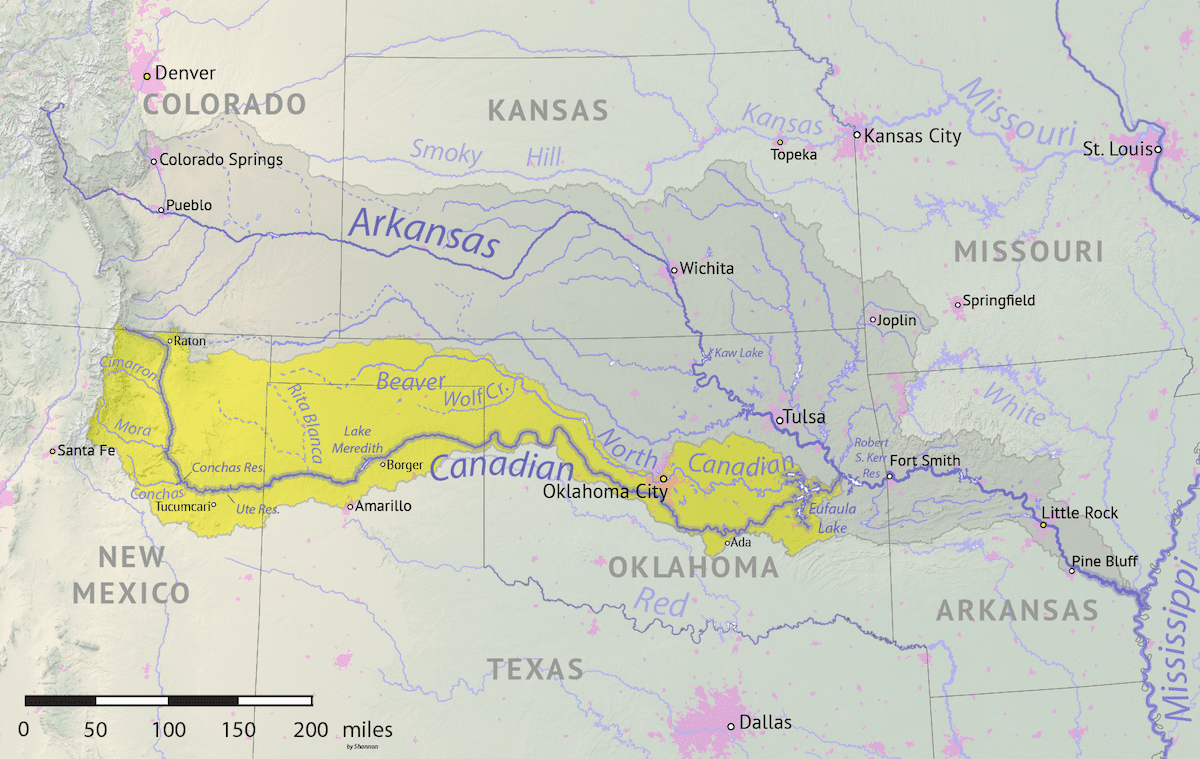
South Canadian River – Las Animas County, CO | San Isabel National ForestSince becoming a father ruined that weekend’s escape, A few weeks late, I signed the two of us up for the end-of-season race, the Canadian River Cross-country. A 120 mile race that started on the west end of Lake Meredith, a pitiful hole that might have been a lake at some time, but was just a big ditch most of the year in the 70s. From there west to New Mexico, the Canadian “River” was a long, wide trench with spotty pools of water, usually surrounded by rocks. I do not remember where exactly the race ended. 1971 was a LONG time ago. I remember my wife was really pissed that, after working a 90 hour week, leaving her home alone with a new baby, I was going to escape all of that bliss for a day and “go racing.” I was probably the least excited-to-be-a-young-father guy on the planet at that moment and her arguments were absolutely valid but unconvincing. Charlie was coming because he had a pickup and a great tool kit, but his interest in Cross-country was so slight that, after the first section, he turned back, loaded up his bike, and drove to the end to wait for me to show up so he could go home and get back to motocross.

I was “determined.” When I lined up with the other open class bikes, maybe 20 of us, it was the first race I’d been in since my rough scramble days on the Harley 250 Sprint. The juices were flowing, I thought i was ready to race and, even, win, and my Big Horn was faster than snot. Heavy as a buffalo, but really powerful for the time. In recent years, I’ve been told that my motorcycles are “unfit for off-road purposes,” and I just laugh at that idea because most of those characters wouldn’t even consider a mess like the Canadian River Cross-Country on a 2022 enduro. My Big Horn was heavy (400+ pounds), barely-suspended with Boge shocks (maybe 3 1/2” of travel) and the stock forks, only made real power (33hp) when the motor was wound up past 4,000 RPM, and ungainly as hell. Every bike I’ve owned from my 125 ISDT to my XT350 to my TDM850 or V-Strom adventure bikes have been far more off-road capable than that Kawasaki so-called “enduro.” In late-1971, I had no idea that there were much better options and if I had been it wouldn’t have mattered because they weren’t available or affordable in West Texas.

The flag fell and off we went. I’d spent some time boning up on the warning flags and less than 10 miles in that education paid off. Just before we entered a tight, blind, hard left in the riverbed, one of those flags fluttered just enough to clue me in that there was a hazard. The hazard turned out to be a substantial pile of rocks that was littered with bikes, bike parts, and riders. I managed to come to a stop before piling into the guy who was in front of me. He didn’t. I paddled through a narrow passage and climb to the other side of the rocks and kept going. From here out, my memories are really clouded.

I know I crashed at least a dozen times in the next 100-some miles. I remember seeing a fair number of bikes and riders stuck in swampy sand, piled into rocks, logs, and each other. I remember, somewhere near the end, smacking my engine case on some rocks, busting the cases, and slowly losing the transmission fluid over the remaining miles. I remember only being able to shift from 1st to 2nd with no neutral or other gears in the last few miles. I remember losing power like crazy and barely motoring past the finish line. Charlie was there waiting for me and we loaded my bike back into his pickup. I remember drinking something, probably beer, on Charlie’s tailgate waiting for the results. I definitely remember a long period of no motorcycle, lots of overtime, and recriminations from my wife, while I reassembled and repaired the damage to my bike from that race.

My big memory, biggest in fact, of that race was discovering that because “only” three open class bikes finished, the organizers decided that they would only trophy to 2nd place, instead of 4th as planned and announced. I guess they wanted to save money on their crappy $5 plastic trophies. I got a fuckin’ ribbon, instead, but my finishing position wasn’t even listed, since I didn’t trophy. I raced motorcycles for another ten years, ending with a series of busted ribs, toes, and fingers. I never again came close to being on the podium. I pointed, in Nebraska, well enough to progress from Novice to Expert in the “Enduro Class,” but that was a quantity-over-quality achievement.

In the 1980s, when my daughter was skateboarding with her soon-to-be-famous boarding friends in Huntington Beach, she used to wear a tee-shirt that said, “I wish I were as fast as my father remembers he was.” I guess that is about as close as I will ever get to a motorcycle trophy.

Dec 27, 2021

Breakin’ ‘Em in or Breakin’ ‘Em Down?

Way back in January of 2007, I bought a brand new, custom-fitted Aerostich Darien suit as part of my prep for an Alaska trip the coming spring. Looking back at the review I wrote in 2008 for that suit, I’m slightly ashamed (only slightly) of my cowardly description of breaking in the suit, “After wearing the Darien suit almost every day for two months, it became much more flexible.” Yeah, that’s not how I broke in my Darien. If you have never owned a new Aerostich suit, you might not believe me when I say their “abrasion-resistant Mil-spec 500 Denier Cordura®" is "stiff as a board," but it pretty much is. I have no idea how they fold those suits into a neat package because that stuff folds about as easily as a refrigerator box.

I had owned a very old Aerostich Roadcrafter before the Darien and I pretty much knew what I was getting into, even if that memory was more than 20 years old. I did ride to work a few times that winter and everything helps, but I’m going to admit to you in this rant how I really broke in my Darien during the winter of 2007. My grandson was about 11 at the time and he spent a lot of his weekends with us at our Little Canada house. Our backyard had a fairly two-tier steep cliff drop-off into Savage Lake and we sledded that hill often, even had large sledding parties when the snow was good enough and the lake was frozen solid. Most of the weekends between January and March that year, my grandson, my wife Elvy, and friends and family would bomb down that hill on sleds, snowboards, cardboard sheets,inner tubes, and I was right there with them in my Aerostich. Just me and that 500 Cordura and the Darien’s armor and the hill. I’d toss myself over the edge and slide on my back, belly and/or sides out on to the ice until that suit was as soft and pliable as it was ever going to be. I did not “wear the Darien” to break it in, I pounded the snot out of it. Not me, the suit. That tough material and terrific back, hip, shoulder, knee, and elbow padding and my helmet, gloves, and boots more than served the purpose of a sled and I got the suit broken in and ready to ride 13,000 miles that spring while having a terrific time being a maniac with my grandson.

In 2012, Icon gave me a really good deal on a pair of their Patrol Boots, which I reviewed for Minnesota Motorcycle Monthly in 2013. I liked the boots quite a bit and wore them often for 2-3 years, but I never really liked either the hassle of latching up the dual adjustable stabilizer straps or getting my bunged up “Haglund’s deformity” heel past the section between the uppers and the inside of the boot. I’m old, I’ve never been particularly flexible, and the weird twisted position I have to get into to latch up the boots is a hassle. So, the boots have mostly sat in my closet ignored and unused for most of the 9 years I’ve owned them. I tried to give them away, but nobody wanted them. This year, my very old, very used Merrell winter boots rotted to pieces. I started looking for replacements, but a good winter boot is easily in the $100 territory and I’m unlikely to live long enough or walk far enough to justify a $100 boot. So, I drug out the Icons and, damn they are excellent winter boots: warm, water resistant, tough, and super comfortable; just not quite broken-in.

Soooooooooooooooo

Remember the Darien break-in tactic? I’m going to abuse the snot out of these boots stomping around in the snow all winter. Next spring, if I survive (something a lot of us are saying in this COVID world), I hope to have them and me broken in enough that I use them on the motorcycle a lot.

Dec 14, 2021

Words and Pictures? Pass

My days of journalism and deadlines and word counts and waiting for invoices to be paid are done. “Rock is dead. Long live rock and roll!” And all that malarkey. The editor for the last online magazine I wrote for, “Fast Lane Biker Delmarva,” regularly asked for “pictures to go with the text.” I tried, honest I did. My editors with Minnesota Motorcycle Monthly wanted the same thing, for almost 20 years. I managed to comply consistently enough with product and motorcycle reviews, but with my column I pretty much failed them regularly.

Why?

I hate taking pictures and I really hate taking pictures of me. I don’t even like looking at pictures of me. 95% of the reason I have a beard is that shaving requires looking in a mirror and mirrors explode into vaporized silicon dioxide when exposed to my face for any period of time. Seriously, I’m not visual and my patience with being asked to mess with images of any sort was never great but is now vanishing. When I was doing the journalism thing, criticism of my pictures usually evoked a “you do it, then” response. Threatening to dock my pay if pictures weren’t included didn’t have much leverage. I’d pay not to have to take a picture, so losing an article assignment because I couldn’t guarantee useful pictures was not much of a price to pay.

My wife is a “visual artist,” but one who is chronically lazy when it comes to learning anything new. In her mind, the book All I Really Need to Know I Learned in Kindergarten pretty much wrapped up her education philosophy. (Except for those idiotic alien invasion Netflix “documentaries she seems infatuated with. Do you know there are morons who call themselves “alienologists?” Seriously. They all look like the Simpson’s Comic Book Guy and the same droning idiot narrates every one of those programs. It is the soundtrack of our basement office.) For more than 50 years, 99.9999% of our family pictures have been taken by me (resentfully) and even the ones that included me were usually taken with that damned self-timer camera function. (I should have never admitted that I know how to do that.) I have taken exactly one picture in my life that I sort of liked and that picture got my camera work more criticism than all of the other crap combined.

Today, while we were walking the dog along Spring Creek, my wife decided she wanted a picture of the creek for our 2021 Xmas card. We haven’t done cards in more than 20 years, but suddenly not only are we doing one but I’m supposed to take pictures and design a card. And for the first time in our 55 years together I said, “Nope. Not doin’ it. You want it, you do it.” I’m laying odds that will be the end of the Xmas card, but if it isn’t I will definitely write something as my contribution.

Dec 3, 2021

My “Hardest/Fastest/Longest” Ride

I’ve been reading Andy Goldfine’s Aerostich blog since the first entry. This week’s piece was “The Older I Get, the Faster I Wuz” which he ended by asking “Famously, whatever doesn’t kill you hopefully makes you stronger.  What were some of your hardest/fastest/longest rides?”

I’ve had a few hard, long, and moderately fast rides, but my first real street bike trip was probably the longest and hardest of my life. I fully expected to do a search on this blog and find that story to link to my comment’s on Andy’s blog. Somehow, it only sort of got a mention in my review of the Honda CX500 I rode on that trip and another mention (with a trip map) in “Losing the Travel Thing” from 2017. If you thought I was running out of motorcycle stories, you don’t know me very well. I’ve barely touched on my early off-road experiences and mostly grazed over the motorcycle trips and “adventures” that occurred after I moved from California to Denver. Before that period, the only motorcycle writing I did was a couple of short stories and a commuting article for a southern California motorcycle magazine. So, I might start backtracking thanks to Andy’s question.

Like I said in the CX500 review, “I bought my 1980 CX500 Deluxe for $800, cash, from a guy who was suffering the after-effects of divorce and needed the cash in the middle of winter, in Omaha, Nebraska, in 1982.” The bike had less than 500 miles on the odometer, but it had been “decorated” with crash rails and “road pegs,” the foot pegs had been replaced with police-style paddles, and assorted other bits of useless and dangerous chrome. The parts guy at the electronics supply house I frequented bought all of the chrome crap for enough money to finance putting the bike back into stock shape before I left Omaha in late March, 1983 for my new job in California.

Between wrapping up my old job, getting our household stuff ready to ship to California later that spring when the kids were out of school and I had found a place for us, and putting my affairs in some sort of order so I could leave everything behind and get myself organized for my new job, I had no real travel plan sorted out for the 2,000+ miles between Omaha and Costa Mesa, California. After an emotional and stressful goodbye to my family and friends, I fired up the CX and headed south out of Nebraska, hoping to escape before the unpredictably warm spring Nebraska weather turned on me.

My first day out, I pounded about 450 miles between Omaha and Dodge City, Kansas, where I stopped to see my father and step-mother for the evening. The ride between Omaha and Dodge was tough, mostly because I hadn’t been on a bike for a couple of years and I had never been on a fully loaded road bike riding through a 40mph sidewind. My back, neck, and arms were beat to crap by the time I rolled into their driveway. The next day, the weather was so nice I let my father talk me into playing caddy for him while he played a round of golf and I stayed another night. That night that damn wind brought a blizzard, which was just starting to come down and stick when I hit the road early the next day. I’d planned on heading southwest into southern Colorado and northern New Mexico, but by the time I’d put on about 100 miles in that direction, it was obvious that south was the logical escape route.
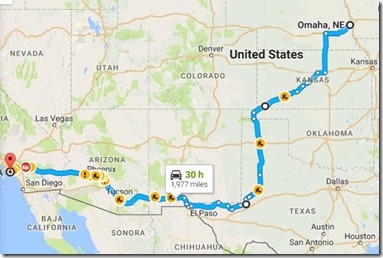
CaliforniaMoveMy next stop was Hereford, Texas, about 300 miles southwest of Dodge. My kids were, sadly, born in Hereford in the early 70’s, something their birth certificates will curse them with for their whole lives, and I had some friends there. First, though, I had to survive the trip. By Guymon, Oklahoma, the snow had turned to ice and the roads were slick and dangerous. I was not even a little prepared for this kind of weather. My rain gear was a bright yellow, rubberized fireman’s suit, which was reasonably waterproof but thermally worthless. In Guymon, I stopped to steal a bunch of grocery store plastic bags that I wrapped my hands and feet in for water-resistance and a little thermal insulation. I stuffed that fireman’s gear with a couple layers of pants and shirts and wore a down vest on top of that. I had to have looked like a yellow Pillsbury Doughboy flying down the highway as fast as I could manage. Semi’s were littering the ditches, after jack-knifing on the iced highway and banging their way through any obstacles between them and the ditch. All of the motels were blacked out due to power failures and full-up even without heat and electricity.

I rolled into a Hereford filling station; frozen, well-into hypothermia, almost delirious from the cold and fatigue. Barely able to move my legs, I half-opened my side-stand, started to lift my right leg over the bike, and they whole mess—bike, gear, and a few pounds of ice stuck to every exposed spot on me and the bike—landed on the ground in a heap. I’d pretty much resigned myself to freezing to death on the spot when a guy in a cowboy had stepped out of his pickup, pulled the bike off of me and onto its side stand, and lifted me off of the ground saying, “Those things get pretty heavy sometimes.” I mumbled something. He asked, “Are you alright?” I mumbled something else and he shook his head and led me into the station where I found a telephone booth (Remember those things?) and found a motel for the night.

After unloading my gear into the motel room, standing in the shower until the hot water was used up, and finding a restaurant where I could get a huge steak dinner, I called a friend who joined me for an after-dinner beer and spent the night recovering from nearly freezing to death. I got up late, loaded up and hit US385 south toward Odessa and, hopefully, out of the ice and cold. I made it about 5 miles when my front wheel started screaming at me. It was pretty obvious that a wheel bearing had failed and I turned back to Hereford where I’d passed a Honda dealership on the way out of town. It turned out that the service department was pretty idle that day, since no rational Texan would be out on a motorcycle in 40F weather, and they got me back on the road in an hour or two. It also turned out that the dealership had been started by two of the guys I worked with when I lived in Hereford a decade earlier. Neither of them were motorcycle guys and they’d spent a small fortune building a new facility, overstaffing it with sales people and understaffing it with service people and had gone bankrupt in a couple years. The guy who owned the place took a great deal of enjoyment telling me about all of that, especially the bits about buying the business for a few cents on the dollar. With new front wheel bearings and some sunlight left, I headed south as fast as I could.

After those first miserable couple of days on the road, sunshine and 50F weather was intoxicating. I mindlessly pounded out the 400 miles between Hereford and El Paso, Texas before realizing that I really wanted to be on the freeway heading straight west, which meant going north (scary thought) to Las Cruces before I could really pound out some miles. Somewhere along the 400 miles between Las Cruces and Tucson, Arizona, I wandered off of the freeway, found a park I remember as “Apache Mounds” and put up my tent for the night.

The next day, I covered the 700 desert miles between my campsite and San Diego, California, hooked up to the 405 and made it another 90 miles to Costa Mesa, California just before dark. The two memories I have of that section of the ride were: 1) discovering that I could lock the CX’s steering and throttle and kick back and relax almost like I was a passenger for a lot of desert miles and 2) pissing off a rough, tough Harley pirate when his big noisy Harley died early on the way up the east side of the Pine Mountain on I8 and my “rice burner” just kept on going while he was stuck at one of the many water barrels at the freeway edge.

I had the idiot idea that my new employer was expecting me when I arrived and discovered that not only was that not true but the place was closed on Saturday and finding an affordable place to stay in Orange County on a weekend was a pipedream. I spent a good bit of time pounding away at motel phone numbers in a phone booth before discovering that I was on my own. I headed south toward some open land that used to be state park territory between Costa Mesa and Laguna Beach and camped for the night on the beach like one of today’s millions of homeless folks do. That night, I also discovered that I’d left my damn billfold in that Costa Mesa phone booth.

The next day, I rolled into QSC Audio Products’ office in Costa Mesa, broke, frustrated and angry, and screwed. At the suggestion of the receptionist, I called the Costa Mesa police and discovered some amazing, decent, sympathetic California had turned my billfold into the police lost-and-found. My money and credit cards were still in the billfold and my life was still on some sort of track. I also still had more than a week of downtime before I was supposed to show up for work for QSC.

First, I hit the 80’s version of Craig’s List, a newspaper called “The Recycler,” found a room-for-rent in a single-family home in Huntington Beach, stowed the stuff I’d been lugging across the country that I didn’t need for a motorcycle trip in my rented room, found a bank for my new life’s financial needs, and hit the PCH for some pressure-free exploration before starting a new life in California. My first stop was Yosemite National Park, 400 miles north, where I explored the hiking trails, fumbled a bit at pretending to be a rock climber, and relaxed for a day in a spectacular campsite, White Wolf. From there, I rode 200 miles to San Francisco and wallowed in a real hippy community that was still sort-of-cool in 1983 and stumbled onto a motel near Golden Gate Park that I’d take advantage of for the next 8 years, every time I was in San Francisco. After a day and a night in San Francisco, I was back on PCH and rode another 200 miles north to Mendocino, California and camped along the Big River just south of town; another location that I’d reused dozens of times while I lived in California.

A couple of days later, I rode 600 miles as close to non-stop as possible back to Huntington Beach and my rented room, unloaded the bike, and settled into my new life as a Californian. A month later, I found a two-bedroom apartment in Huntington Beach for my family, and the solo part of the California adventure was over.