Jul 15, 2014

A Disgusting Appeal for Attention

geezer  It’s true, I’m going into self-promotion mode and I’m doing it with my usual “style.” The blog is about to pass 750,000 lifetime hits and, at this pace, might hit 1,000,000 by the end of the year. I missed commemorating the 500,000 milestone late last year, so I’m compensating.

Since I’m retired, old, lazy, and desperate for attention and a little side income, I’ve decided to actually try to promote this website/blog. However, I am not willing to put actual money into this promotion; at least no noticeable ore regrettable amount of money. Even more disgusting, my promotion is going to be totally self-serving, unscientific, and as alienating as possible. I may not learn from actual smart people, but I figure if I take the tactics of huge, horribly managed, completely incompetent corporations (like Volkswagen and Chrysler and Bank of America) what can go wrong?

So, here’s the promotion.

Very soon, I’m going to start posting occasional book reviews. When the book review goes on line, I’m going to be watching your comments and the comment/commenter that/who makes me laugh the hardest is going to get a copy (the one I reviewed) of the book reviewed in the blog. Because I’m going to be motivated to keep the personal possessions pile small, the decision will come within a week or two (no pressure on me to meet a schedule) after I post the review so that I’m not tempted to put the book on a shelf. To keep this who promotion on the disgusting level with which I generally live and am comfortable, the first book “reviewed” will be a copout: Hell on Wheels: An Illustrated History of Outlaw Motorcycle Clubs. It’s not going to be much of a review, as you might imagine my interest in the subject is . . . non-existent. Really non-existent. The best I could do was a single speed-reading scan of the “text” and brainless quotes and there is nothing in my opinions and observations that any magazine on earth would be willing to print. If I thought my blog were printed, I might not even submit these mindless words to my own blog.

imageRegardless, it’s a free book. I’m paying for the packaging and shipping and the publisher paid for the book. It will be in near-new condition, since I will have been the only person who read the book. The way, in the past or future, you’ll be able to tell that there is a free book involved will be that my brand new, stolen from a professional motto (at right) will be randomly included in the review. There will, I hope, be some other book reviews posted here that won’t include book giveaways because the author sent me a copy and they contain a personal note. So if the smartass “pissing everyone off is a piece of cake” stamp of disapproval is not included, either is the contest. For now, don’t worry about it. I have two more books in the mill that will be of interest to someone: Greg Frazier’s Down and Out in Patagonia, Kamchatka, and Timbuktu and Ian Falloon’s The Art of Ducati. Depending on who gives me what to review, there might be other sorts of products in this promotion in the near future, too.

Bring it on and feel free to be angry, disappointed, disgusted, and/or pissed off at my decisions.

Jul 14, 2014

More Electric News

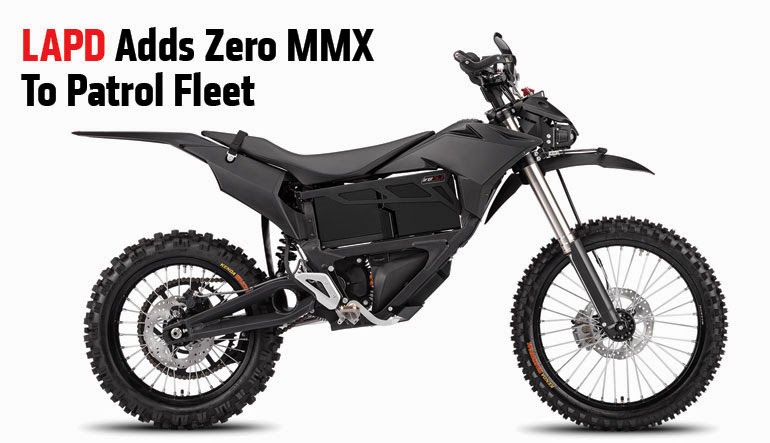
From RideApart: "In a continuous effort to keep Police forces on the cutting edge of technology, the LAPD have recently turned to California based, Zero Cycles, to create a one-off LAPD electric patrol motorcycle.
The Zero MMX police/military motorcycle is a 100% electric cycle that meet all specific military and law enforcement demands. After an extensive and exhaustive testing session the bike performed beyond expectations. Not only for the officers but also for the community. The benefit of adding an all electric drivetrain to a motorcycle is a reduction in noise and maintenance. Not to mention an added benefit of little to no environmental impact.
“'There are major benefits to incorporating these environmentally friendly motorcycles. It costs less than 50 cents to charge compared to using gallons of gas, maintenance is simple, and the community appreciates how quiet they are,' reports Officer Steve Carbajal of the L.A.P.D. Off-Road Unit. 'Most importantly, our officers have an added tactical advantage while on patrol.'
'When you think of a raid on a meth lab or on a mob boss’ hideout, stealth can be your greatest advantage. Police loose the edge when the bad guys hear them coming miles away. A quite, all-terrain vehicle can ensure the baddies aren’t going anywhere fast, should they have a spontaneous need to flee the scene.'"

Yeah! Meth lab raids! I can see the movies spawning off of this in dozens of directions. "Roll Silent, Roll Fast," "Switch-Mode Cops," "They Just Keep on Coming," and . . . you get the picture.

#64 Creating the Wrong Impression

All Rights Reserved © 2006 Thomas W. Day

I had lunch, after a Basic Rider class, with a guy who'd been reading my column for a few years and took the class, partially, on the recommendation he'd found in one of my articles. He couldn't remember which column it was, but he was sure that I'd said something, sometime, about practicing basic skills being a worthwhile activity. Somehow, he ended up in one of my Basic Rider classes and felt the need to let me know about it as we were packing away the bikes at the end of the course. Better yet, he offered to buy me lunch.

While we were waiting for service at a particularly mediocre restaurant, he asked how I'd managed to avoid all of the motorcycling pitfalls I've described in my Geezer columns. Wow! Had he ever read me wrong! I haven't avoided ANYTHING, ever, except education and training before I needed it, experienced advice when I was inexperienced, and wisdom and judgment when it was desperately necessary. If I have any claim to positive personal value, it's that I try hard to make each mistake no more than once and that, somehow, I have lived through doing everything wrong at least once. I've repeated a few mistakes, but I work at keeping the count low.

Take any one of my favorite rant topics and you'll find that I have first hand experience on the other side of the fence. I've never been a member of any motorcycle group more vicious than the AMA, MWTA, or MN-Sportbike.org, but that's about the only motorcycling fault I've avoided. Yeah, I've produced excessive noise (two and four-stroke noise), ridden without a helmet (pre-1969 racing and recreational riding), pissed off landowners and neighbors, ignored and disobeyed laws and common courtesy, and I've even failed to recognize that motorcycles should be a part of daily commuter traffic.

The most embarrassing thing about getting old is recollections of how dumb you were when you were young.

I was an exceptionally dumb kid, with absolutely no adults of similar interests as mentors. When I swung a leg over my first motorcycle, the only people riding in my end of Podunk, western Kansas were my age or younger. In fact, I was lucky to be young near the beginning of the Motorcycle Age. Not at the beginning of motorcycling, because motorcycles arrived a couple of decades before my father was born. Not at the origin of the American motorcycle boom, either, because a tiny fraction of the Greatest Generation invented and financed the slow beginning of American motorcycles after WWII.

Motorcycling took off in the United States when Europe and Japan discovered the vast New World economic utopia in the early 1960s and I was part of that nirvana. My first ride (belonging to my brother) was a 1962 Italian 250, relabeled "Harley Davidson." My second was a 1965 Honda 175. Third was a 185 (or 175) Suzuki that lasted such a short moment that I can't even remember the model or displacement. Fourth, was a 1971 Kawasaki 350 Bighorn. And the list has gone on for almost half a century.

My father was so set against his kids riding motorcycles that he didn't know my brother and I had one until five years later, when I was back in Kansas, married, and beginning something that never quite coalesced into a career. He still disapproves of everything about me and motorcycles. My wife has never tried to convince me that I should consider a more conservative transportation, because she knows it would be a waste of time and energy. I don't react well to guilt tactics and it is, after all, my life; regardless of what the chicken hawks in Washington and St. Paul think. Most of the folks who disapprove of my motorcycling habit are too timid for their opinions to matter much to me, so I roll-on WFO unencumbered by common sense or rational fear. I'm not yet old enough to be conservative.

That's not exactly true. I rode fairly liberally and fearlessly for a long time, until I started getting hurt. I always understood that broken bikes can be fixed, but a busted body might not repair as well and that saved me from a lot of injuries for a long time. About the time I turned 30, I began to get hurt worse than my bikes. I started by tearing a 3", 15-stitch gash in my leg, hooking it on a trials bike shock bolt on my way back down a pile of concrete. I followed that, a few weeks later, with a left foot full of broken toes. After a year of one tore-up thing after another, I broke a bunch of ribs and was out of work for three months. Afterwards, I was infected with a year of irrational fear and experienced a mild version of PTSD, which made me completely worthless on the race track. It didn't keep me off of motorcycles, but it kept me from being competitive or getting much air between my wheels and the ground. Think Will Farrell and NASCAR and you'll have an idea of what I looked like going around a motocross track. That ended my motorcycle racing phase.

Moto-politically, I have been marginally astute. I was in my early-20s when I figured out the link between motorcycle hooliganism and shrinking riding space. Before that, it seemed like we had an infinite area to ride and a right to be there. In Nebraska, for example, we had a thousand miles of "limited access roads" that tied together into an incredible, free, barely-occupied, and unadvertised motorcycle park. Kids on dirt bikes and ATVs managed to piss off the landowners and state park managers by tearing up fences and vandalizing unmonitored grassland until the people who made the rules changed them. Afterwards, the only way to play was to pay. When I moved to California in the early 1980's, I experienced how bad those restrictions could get.

I think it ought to be obvious that a tiny minority exists at the pleasure of the majority, but we humans are not that bright. We confuse rights with privileges and, when we lose our privileges, we whine like Paris Hilton when she pays taxes on her inheritance. It's easy to tell the difference between a privilege and a right, in case you're confused. A "right" is something that is necessary and a "privilege" is a luxury.

People often confuse the two; sort of like confusing "need" and "want." Freedom of expression, the right to be secure against unreasonable search and seizure, the right to a trial, the banishment of cruel and unusual punishment, civil rights, and the rest are critical to civilization, progress, and the pursuit of happiness. The privilege of owning and operating a single-passenger vehicle is dependent on resources, necessity, and cultural convenience. Nobody needs a motorcycle. Nobody needs an SUV. People survived for thousands of years without them and, soon, we may have to figure out how to live without them again. Our society, the world, will roll past this inconvenience as if it were a small bump in a historic road, if these privileges are lost. It's worth keeping that in mind when you stretch your "Loud and Proud" tee-shirt over your belly.

Highway riders are taking the same low road with loud pipes, poor highway manners, and our high accident fatality rates and, I expect, we'll receive the same reward on-road that we earned off-road. If you can't contribute something positive, most likely you'll end up being obsolete in a world of diminishing resources. Evolve or vanish, those are the only choices an individual, a business, a culture, or a species has.

I like to think I've evolved a lot, in my 40-some years of motorcycling. I had a long way to travel and a lot has changed since the 1960s. Oddly, I think I've changed more in the last five years than I had in the previous twenty. Looking back through more than sixty Geezer columns, I can see a lot of my attitudes have shifted since I started publicly writing about motorcycling. In my career, I've suffered the mismanagement and collapse of two substantial companies and as many small businesses. I've learned to identify the signs of impending corporate death. I've watched a lot of personal rights and privileges disappear in my lifetime; it's been a rough sixty years for justice and human rights. All you can do is try to learn from the experiences and, if you care enough, share what you think you've learned with like-minded people. There is nothing positive to be gained in repeating history. Contrary to popular belief, mistakes are not even funny in repetition.

Lunch with the ex-student/new-rider holding a lot less respect for my personal brilliance and a better understanding of how my experience might fool an unsuspecting victim into believing I possess some kind of wisdom. However, he paid for lunch and, in my book, letting someone else grab the bill is always a wise decision.

MMM July 2007

Jul 9, 2014

Your Opinion? Who Cares?

Eric-Bostrom Cycle World e-published a nice interview with Eric Bostrom, Brammo’s main road racing competitor. Eric is clearly sold on Electric Vehicle’s future and anyone who has a clue about world fuel resources would be on board with him. Like most Americans, the comments after this article demonstrates that at least Cycle World’s readers are clueless. I mean embarrassingly, brainlessly, humorously clueless. After reading these brain-farts I think I lost 10 points off of my IQ:

“I have challenged Cycle World a few times to take a real ride, from LA to San Diego and back for example, a ride that could easily happen to many riders in SoCal, and compare the meanest, best of the E-bikes against a 300cc Ninja. I know the price differential will be huge, but drive em side by side for a trip like that, and then report all the details of the experience--not the politically correct version. Just the truth please.

”I already know the result, and that's why Cycle World ignores such a suggestion.” (Wrong. They ignore you because you’re a moron and no one cares what you think.)

“Now, I would like to point out a few flaws in the author's logic. First, he stated that the electric bikes would be easier to ride, because you would not have to use the clutch or shift. Most experienced riders should be at the point where clutching and shifting is pretty much muscle memory, and happens almost instinctively. Yes, a new rider may find the electric somewhat easier, but not much when the rider still needs to learn throttle control, as well as how to brake smoothly, along with smooth steering and paying attention to what is goin on around him.” (You probably believe in multitasking, too. Wrong again, Bonzo. Eliminating the transmission management tasks allows precious mental resources to be retasked to more critical functions. The day a Cycle World reader can find a flaw in Eric Bostrom’s logic will be worth celebrating.)

“now all we have to do is make the battery cheaper, stronger, lighter, and need less charging all the time. something nobody has been able to do yet. simple.” (All engineering tasks are complicated. If we as a society put 1/100th of the effort we waste on extending the ICE lifetime into battery and capacitor development, I might live to see EV turn mainstream. It’s all about focus and resources, something the Koch brothers haven’t redirected the half of our political system that they own toward.)

“I think the choice of electric bikes is a welcome addition to motorcycling. But I don't think replacing ICE bikes with e-bikes is a worthy goal. I would rather stop riding than be forced to ride an e-bike.” (Most likely, the overwhelming majority of society could care less if you stopped breathing, let alone riding. However, the Peak Oil moment is well behind us and the day recreational use of that resource is coming sooner than you think. Get over your “Mommy never loved me” bullshit and imagine a world where motorcycles are not the noisiest thing on the road.)

“Shifting gears and managing a bike's powerband is part of riding technique.... if eliminating facets of riding technique is the goal, ride a train.” (Ever watch MotoGP? Fly by wire eliminated all sorts of riding technique facets. Think you can ride any competitive bike better than Eric Bostrom? Right. Sure you can. Why not go back to suicide clutches, if you think complicating riding is valuable? Bet you miss having to manually add oil to the top end on the fly, too.)

Every sign on the horizon indicates motorcycling is a vanishing activity. Average rider age keeps heading for oblivion. Public opinion is at an all time low. Dealers are dying and consolidating. The only hope two wheeled transportation has for the future is in electrics. If these attitudes are representative of the majority of riders, the MIC can start kissing its ass goodbye.

Jul 7, 2014

#63 Bikes That I Love and You (apparently) Hate

All Rights Reserved © 2006 Thomas W. Day

At the end a workday this summer, I was surprised to see a new bike in our tiny area reserved for motorcycle parking. Even more surprising was that the bike was a 1988 Honda Pacific Coast PC800, one of the most unloved motorcycles ever imported to the United States. Honda tried to hustle us with this bike, off-and-on, between 1988 and 1998. We weren't going for it. Too quiet, too practical, too comfortable, too durable. Too something.

As you have already probably figured out, I like the PC800. I hung out waiting to meet the PC owner for a while. Two other bikers came by while I waited. They both had one or two nasty things to say about the "plastic glob" in our parking lot. When the owner arrived, he was suited (Aerostich), helmeted, and had his keys in hand. He walked purposefully toward his bike, avoiding looking at me, leaning against my bike and evidently looking to make a comment on his ride. I said, "Nice bike." He flinched and quickly swung a leg over, fired up the bike, and rode off. Obviously, he'd had and earful of the kind of comments the other riders make about the PC.

I managed to catch him a few days later, in a better mood. He said he'd made it to the freeway before he realized I'd complimented his bike instead of insulted it. We had a short conversation about his experience with the Pacific Coast and he confirmed my expectations of reliability, mileage, convenience, and comfort. He even said the PC was "a lot of fun to ride, especially long rides." His wife even liked taking trips with him on the PC.

I can't figure the reasoning behind all kinds of human decisions, from politics to music to motorcycles and everything between and outside of those brackets, and I'm at a loss to understand why the average motorcycle commuter wouldn't love the PC800. Unlike most of you, I've wanted a Pacific Coast, as a second bike, from the moment I saw one. Unfortunately, I never seem to own two bikes for long enough to consider multiple motorcycle ownership a practical concept. I have had the opportunity to ride the Honda Pacific Coast a few times and I found a lot to like about the bike. About a decade ago, a friend asked me to transport a PC800 from northern Iowa to central Kansas; and I loved every mile of the trip. It's like a comfortable car without the extraneous wheels. Great storage, smooth and quiet engine, cushy suspension, and it feels much lighter on the highway than you might expect. What's not to like? All that plastic, probably. No noise? The damn comfortable seating and predictable handling? The built-in storage?

A while back, I really pissed off one of our readers and earned a long, heated, rambling, saliva-spraying complaint letter to the editor. (Like that never happened before. Right, Victor?) Most of the reader's complaints were expected and more than a little funny. One of his claims, however, struck on a pet peeve of mine. He claimed that he didn't ride a motorcycle regularly because "a quality, fuel-efficient bike is not cheap." It's probably a taste thing. That reader's tastes are similar to thieves' tastes, since he claimed that his bike "within a month it would certainly by [sic] stolen or vandalized" if he rode it to work. Maybe he works at the wrong kind of drinking establishment? Maybe all that chrome attracts the wrong kind of attention?

I'm obviously out-of-sync with the kind of bikes that scumbags love to steal. For example, in 1994, I bought a nearly-new 1992 Yamaha 850 TDM; reviewers hated that bike, called it "bug eyed" and "gawky." I rode a TDM at a Yamaha Round-Up in 1992 and fell in love. At least as close as I get to loving a bike, anyway. Ok, I fell in "like." As in, "I think I'd like you in my garage."

I cared for that big red bike like it was the coolest guitar I ever owned. I waxed it, put road bags on it, installed new bars, crash rails, hand guards, a tall windshield, and dinky LED turn signals. (That's as tricked out as any street bike I've ever owned. Pitiful, I know.) A few months after buying the bike, my wife and I rode to an Aerosmith concert in Denver. We parked the TDM in the midst of Harleys and other chrome-laden cruisers, in our usual state of turmoil. My wife is not a willing bike passenger and any ride longer than a few hundred feet often turns her into an angry motorcycle protestor. In that state of marital discord, I managed to walk away from the bike with the key not only in the ignition, but with the ignition still on and the headlights blazing and turn signals flashing. Aerosmith audiences are on the far fringes from politically incorrect and, after the concert, there was a rash of stolen stereos, keyed bike paint jobs, snapped antennas. In the motorcycle parking area, bikes were tipped over and a few Harleys had vanished from the lot. The key was still in the TDM's ignition, the battery was drained, but the bike was untouched. I push-started it, came back for my grumpy wife, suffered a little mockery from the rent-a-cops, and rode home. Obviously, my TDM was not on the vandals' or the thieves' radar. I think that's a good thing.

The fact is, there is a plethora of reasonably priced, low-mileage, high efficiency, comfortable, practical motorcycles available. (Yes, El Guappo, I do know what "plethora" means.) Personally, I think the trick is to avoid ownership of things that others covet. I, especially, try to avoid owning things that professional thieves go out of their way to steal. Here are a few of the machines that I think meet the high standard of "a quality, fuel-efficient bike" that are reasonably priced, if "not cheap": Back in the 80s, I owned both the 1982 and the 1983 versions of the Yamaha XTZ550 Vision. How can you not love a water-cooled, drive-shafted bike that gets nearly 60mpg and has a heating system (in the faired 1983 version)? Americans did not love this bike and it was another dealer-discounted bike that took almost three years for Yamaha to move from show rooms. Other than a couple of minor maintenance problems, I rode the hell out of my Visions and got most of my money back when I sold them.

  • I still like the 1988 Honda NT650 Hawk GT. A great experiment in a mid-sized high-tech motorcycle that failed miserably. Clubman racers learned to love the Hawk GT until it was made obsolete by the Suzuki SV in that class, but Honda practically gave them away as door prizes at the dealerships. In Denver, several Honda dealers were still trying to unload brand new 1988 Hawks in 1993. Since the Suzuki SV arrived, used Hawk prices have, again, fallen.

  • I have lusted after the 1988-to-today's Honda XRV 650/750 Africa Twin and the 1989-1996 Yamaha XTZ750 Super Ténéré since the moment they were announced. These beauties are a pair of super-sized dual purpose bikes that never came to the U.S., but I've seen them in bike shows and at the old Steamboat Springs Vintage Bike Days. Once I'd sat on the real thing, my US-wimp Ténéré replica (the TDM) seemed tame and incomplete.

  • 1986-today's Honda Transalp 600/650 versions, but the newest Transalp 650 is unbelievably cool. We don't get many cool bikes in the States, so this bike is just a dream that will probably go unfulfilled. It doesn't come here because Honda thinks we wouldn't buy it in sufficient numbers to justify the EPA qualification process. The 1983(US and the world)-2000(Europe and Japan only) Honda NX650. This bike just kept getting cooler, but we didn't get a second chance at it after the US market imploded and dumbed-down in the mid-80s. For a commuter, this bike is close to perfect: electric-start, extreme suspension, ultra-reliable single-cylinder engine, big enough to travel at highway speeds, small enough to easily find parking anywhere.

  • How can you not love the 1984 Yamaha RZ350 Kenny Roberts Replica? Bumblebee cool, quicker than snot, smells like teenage Castrol (at least what Castrol smelled like when I was young). Kenny was still playing with this little guy, to whip the bootie out of liter bikes and lesser riders on Spain's mountain roads, as recently as five years ago. The original Honda Reflex, the 1986 Honda Reflex, looked like a trials bike, rode like a twitchy dual-purpose bike, got about a zillion miles-per-gallon and could leap medium-sized culverts, climb mountains, and was as reliable as a brick. As usual, Honda couldn't give them away at the dealerships.

  • 1982-83 Honda 500/650 Silverwing, fully loaded with fairing and bags. Whenever some BRC student tells me he/she needs a hippo-bike because he/she might want to "tour," I let 'em know that I crossed the country a few times on my 1981 Honda CX500, which is the undeveloped version of the Silverwing. I froze my ass off, in March moving from Nebraska to California, and put more than 100,000 miles on the bike before I sold it to a friend. We're still friends, too. No surprise, Honda couldn't find many buyers for this bike either.

  • 1988-2005 Honda VTR250, especially the last European VTR250 version that looks like a mini-Ducati Monstro. Look it up, it's an incredibly cool bike, but we don't get it because we're . . . not that smart. The 1988 VTR was Ninja-like and a slow mover for dealers, so Honda quit bringing it here about the time they started getting the cosmetics right. I've owned the 1988 VTRs and I can't say anything bad about it. The mileage was incredible. Sold that one to my brother and he wore it out. Personally, I think the weirdest bike I love is the 1987 Kawasaki 250 Ninja with the white wheels and grasshopper-looking exposed suspension bits and the macho red seat and black body work. I don't like the look, feel, or seating position of the newer 250, but I was really jazzed about the original bike.

Now, I can guess what you're going to say about a lot of these picks of mine, "I'm a forty-year-old, five-foot-six, two-hundred-and-sixty-pound guy and I'd look stupid on any of those bikes." Trust me, with that physical description you'll look hilarious on anything smaller than an over-under-tranny White Industries farm tractor. I know because . . . I know.

Several of my friends say that, in my 25-year-old Aerostich one-piece, I look like a giant gray sausage with salmon trim. Salmon, the color, not the fish. There is no fix for being a hippo, except for getting rid of the hippo-ness. A fat guy on a hippo-bike doesn't look any skinnier than he would on a 50cc scooter. Bikes look cool because they are cool looking, because they have some dedication to function that drives their form to coolness. To my eye, the hippest bikes are so committed to their function that they blow off fashion and trends and charge after the function they've identified without getting tripped up on whatever foolishness the rest of the industry is pursuing.

Economically, it makes more sense for manufacturers to join the pack and follow fashion down the drain of human conformity. Technically, whatever is happening today is already past-tense. Many of the bikes listed above sell for more today than they did when they were on dealers' floors. Some were so far ahead of their time that their time hasn't, apparently, come yet. Or I'm as motorcycle fashion-sense-inhibited as I am devoid of any other fashion sense. Personally, I think the weird non-functional designer bikes are the motorcycling equivalent to the strange Vogue/GQ crap that clothing designers display in Paris. Jeans, loose cotton shirts, Goretex hiking boots, and motorcycles designed for a function are what trips my trigger. Your mileage, apparently, varies.

MMM June 2007

Jul 6, 2014

With the Weapons We Have

One of the telling moments of the second Iraq War was when Donald Rumsfeld was visiting a safe zone in Iraq, pretending to give a shit what the soldiers thought about how the war was going. One of the soldiers asked him something along the lines of “When will we get equipment that is appropriate to fighting this war.” Rumsfeld’s snide reply was, “As you know, you go to war with the Army you have. They're not the Army you might want or wish to have at a later time.” There were two ways to take that comment, both ways are uncomplimentary to the people doing the work; 1) “You guys are what we have to work with, as sorry a lot as you are” or 2) “You’re just going to have to work with the crappy armament we’ve provided because we’re doing this war regardless of the risk” (to you, not me).  Either way, Rumsfeld was basically saying, “Fuck you, kid. We’re here and you’re doing this with the overpriced, no-bid-contract crap Halliburton gives you to work with.”

History is jam-packed with moments like this. Consistently, the losers are usually on the side of Rumsfeld’s position. Sometimes it takes a while, but the imperialist position of “damn the torpedoes, we have more people and torpedoes where those came from” is expensive, inefficient, and eventually leads to a crumbling empire or sudden overthrow and defeat. The alternative view, best expressed by Sun Tzu in The Art of War, is, “One mark of a great soldier is that he fights on his own terms or fights not at all.” From an American perspective, you could say that , since the Revolutionary War, the overwhelming majority of the wars our country has staggered into have disobeyed this axiom and the result has been the decimation of the country’s treasure, thousands of wasted lives, and a steadily declining commitment to liberty and democracy. If you read much history, you’ll note that many great empires have followed this exact path into decline and collapse. It’s a scary scenario.

This, believe it or not, applies to riding a motorcycle. The only advantage a motorcycle has in traffic is flexibility and a kind of nimbleness that allows us to go where most of the traffic can not. Like it or not, the highway is a battleground. Freeways are all out war. Motorcyclists are too often the fools who get caught with a knife in their hand at a gunfight. All of those stories you’ve heard from the Biker Boyz and big bad biker gangbangers about scaring cagers with noise, the biker stare, booting a rear view mirror off, or kicking the snot out of a cager after the biker “had to put ‘er down” are mostly bullshit. A motorcycle is a lousy platform from which to start a fight. In traffic, a motorcycle is absolutely a knife in a gun fight. The only way to “win” is to bring the fight to your terms. Unfortunately, most motorcyclists don’t know enough about riding a motorcycle to know where a motorcycle and motorcyclist’s terms lie.

A quick look at motorcycling history in the 1st world would be useful. The people who mostly picked a motorcycle over a Model T were guys (almost always) who weren’t afraid of getting dirty. The opening moments of On Any Sunday were a montage of people riding their motorcycles where cars could not hope to follow. That is your first hint, if you didn't have a clue in the early stages of this essay. Motorcycles are in their own, best element off of the beaten or paved path. If you want to “defeat” a cell-phone distracted cager who seems hell-bent on squashing you flat, lead him off of the pavement into a ditch. At best, the brainless boob will be stuck there till the HPD and AAA comes to their rescue. At worst, the cager will experience the thrill of rolling his handicapped vehicle and you’ll have the satisfaction of seeing his vehicle disassemble itself in your rear view mirror. That’s called bringing the battle to our terms.

Too many motorcyclists have decided to give in to sloth and inertia and take the battle to their opponent’s field; concrete and asphalt. The most popular style of motorcycle in North America is the cruiser, a totally disabled, barely-street-worthy bike with minimal suspension, a crippled feet-forward riding position, poor handling long wheelbase, and a ground clearance that often high-centers on speed bumps and minor potholes. Defending the existence of these pitiful vehicles is the engineering equivalent of whining that “we fight wars with the army we have,” not an army that can actually defend itself. The lame “defense” these rolling two-wheelchairs offers is “loud pipes save lives.” How’s that working for you, since the majority of highway motorcycle deaths are cruisers and old guys?

Jun 30, 2014

#62 I Lied, So Sue Me

All Rights Reserved © 2006 Thomas W. Day

March through August (2006), I watched a string of DL650 V-Stroms vanish, selling for way beyond my eBay buy-limit. All summer, I'd hoped to find a great deal a long way from home; to justify buying the bike and taking a long trip. September 3rd was my drop-dead, go-back-to-work date. On the last week of August, I won an auction for exactly my top dollar. The bike was in Cincinnati and I had 3 days to work out pickup, transportation (to Ohio), and get my cash sorted out. I took the train to Cincinnati, to met my buyer at the train station and hit the road on my new bike.

"I've never done anything like this on your V- Strom."
Way back (June, 2001) in an early Geezer column, I promised that I'd never buy another bike from a "kid" (anyone younger than 40). I wrote "I've been here before and I will never do anything that dumb again." I lied, but the guy selling my DL650 was an upstanding, respectable, responsible motorcycle dealer. He even sent me a picture of him on his vintage rebuilt 1978 Goldwing with a note, "I've never done anything like this on your V-Strom." If that doesn't make you comfortable with traveling 1,000 miles by train to put your money down and ride off into the night, I don't know what would.

Billy is pointing at his 3rd nipple in the picture. He is a few years younger than 40. In defense of myself, there were a lot of things about Billy's communications that made me feel fairly comfortable with the purchase. He went way out of his way to accommodate my tight schedule. He went to a lot of effort to provide me with a lot of information about the bike, what he knew about its history, and himself. And he reminded me that nobody would buy a "geezer bike" like the DL650 to abuse it, which is probably true. I'm pretty sure there is an insult some where in that comment.

I straggled into Cincinnati's Amtrak station about two hours late. Billy had made it clear to me that he had to be somewhere at 7AM that morning and I didn't unload from the train until a few minutes before seven. He's asleep in the station's parking lot when I called to tell him I'd made it. By the time I collect my baggage and get to the front entrance, Billy has the bike unloaded and ready to ride. He loans me a plate, has the paperwork taken care of, and helps me figure out how to tie on my tank bag. Now, he's really late for his other appointment. Billy returned to his life, leaving me to empty my cardboard luggage into saddlebags, a stuffed duffle on the tail rack, a courier bag, and an overstuffed tank bag.

I brought camping gear, tools, a service manual, and even a patch kit and couple of tubes in case of tire trouble. I may be repeating a mistake, but I'm doing it carefully. Once I get loaded up, I take off for the station's large empty parking lot. Before I hit the road, I want to know something about this new bike. The DL650 has the same motor as my SV, but nothing else is the same. Especially with all the gear I've loaded on the bike, the DL feels more like a big tour bike than a sport bike. I've been on a sport bike for more than six years. It takes a little while in the parking lot before I feel comfortable on the V-Strom.

Once out of town, I checked in with my wife. For some reason, she sounded mildly irritated that I was not going to be home that night. That turned my meandering 2 1/2 day trip into an 800 mile blitz for home. Yeah, I'm whipped. I did get to buy the bike without any argument. More evidence that there is no free lunch.

Once I left Ohio, there wasn't much to see for the next 500 miles. Southern and central Indiana are pancake replicas of Kansas, so is a good bit of Illinois. I've seen Kansas, so, I stayed on the throttle and didn't leave the freeway until Rockford, IL. There, I deviated west toward Galena (one of my new, favorite motorcycle destinations). I took the quick tour of Galena and Grant's home town artifacts, headed toward East Dubuque, and jumped across the border into Wisconsin. I'd decided that I wanted to make it to Prairie du Chen before dark. I hit that mark and moved it out to La Crosse.

I don't usually ride at night, but when I rode out of La Crosse the visibility was excellent. I jumped the border into Minnesota and headed north on Hwy 14 before I realized it wasn't going to get dark as long as I was on the V-Strom. I was enjoying the best lighting I've ridden behind since the days when I strapped 5 Cebies to a 185 Suzuki Enduro for a 24-hour cross-country race. Not just the road, but the ditches and a bit of the countryside was illuminated by the V-Strom's dual lights.

With home in mind, I watched the ditches looking for Bambi and other varmints. Other than failing eyesight, the big reason I try not to be on the road at night is that I'd hate to kill Bambi; and break my neck doing it. Sure enough, about five miles out of Lake City, I spot a cute little deer looking like she wants to commit suicide and I take the opportunity to test the V-Strom's brakes. The road is wet and there is a light drizzle. It doesn't matter. The bike hauls to a stop with plenty of room to spare. I stop on the shoulder and take a moment to enjoy what wasn't even a close call. Bambi isn't satisfied with our uneventful encounter and decides to cross the road while I'm patting myself on the back.

A truck coming the other direction smacks into the deer and you'd be amazed at how much stuff blows out of the back end of a deer when it gets hit by a fast moving vehicle. I was amazed at how much of that crap ended up on me. At the first convenient convenience store, I stopped to hose off. I'd been wearing my rainsuit for the last few hundred miles, so I was mostly protected by the suit. The clerk was pretty upset when I came to the door, smelling and looking like something from a Quentin Tarrantio movie, but I convinced her to let me use a hose at the back of the station. While I was blasting off my suit, a cop showed up. There was quite a pile of deer poop in the blood and guts I'd washed into the lawn. He thought my story was pretty funny and let me go after emptying himself of a few jokes at my expense. He offered to piss on me to "wash" off a spot I'd missed on the back of my suit. Yuk, yuk.

801 miles from when I met Billy in Cincinnati, I made it home in good shape. Between the hose and getting rained on for the last 50 miles of the trip, I was mostly cleaned off; other than having soaked myself in sweat in the rain suit. I considered taking a trip to Duluth and back to rack up 1,000 miles in well under 24 hours, but I couldn't decide how to go about getting confirmation of my trip mileage for the Iron Butt application. So, I watched a movie with my wife and went to bed.

I learned two things on this trip. First, don't make promises you are too weak to keep. Second, don't stop to gloat when you sneak past a catastrophe. When I got home, my wife was surprised that I'd made it back so fast. I was served an angry lecture about trying to read anything from the "tone of my [her] voice" and discovered that I wasn't in trouble until I came home and got into trouble. Yeah, I know, that's three things. I'm pretty sure I'm going to forget one of them, so I'm only giving myself credit for two of the three.

MMM May 2007

Jun 28, 2014

It’s Real, I Hope

From everything I read, it sounds like Harley Davidson’s “Project Livewire” electric motorcycle is the real deal. To quote Vizzini from Princess Bride, “Inconceivable.”

harley electric That word must not mean what I think it means, because not only is The Company hyping the bike all over the corporate webpage, but they are shipping bikes around the country for test rides. Not just media hack test rides, but test rides with real people/riders in 30 cities. I am going to be seriously pissed if the Cities aren’t on the list. I might own a Harley Davidson again, for the second time in 50 years.

Specs are hard to come by, but GizMag got a statement from H-D: “The LiveWire is powered by 3-phase AC electric induction motor, which produces 74 hp (55 kW) and 8000 rpm. Peak torque is 52 lb.ft (70.5 Nm). The bike maxes out at 92 mph (148 km/h) and accelerates from 0-60 mph (100 km/h) in 4 seconds. A full recharge takes around 3.5 hours and its average range so far has been 53 miles (85 km).” Predictably, the Livewire is significantly technologically and performance-wise some distance behind Zero or Brammo bike performance standards. In fact it’s pretty much the bike those pioneers were building 4 years ago, but you have to wonder about where electric bike competition/price/availability will go if the Harley gains some traction. Got my fingers crossed.

Jun 25, 2014

Our Own Worst Enemies


World-wide, motorcycles are their own worst enemies. It’s almost impossible to find an example in this litany of crashes that can be blamed on the cagers. Most of the “victims” are so incompetent it’s hard to imagine them riding a bicycle safely. Again, I want to bring up some statistics the MSF/MIC (same organization, different label) promotes (2011 data): 1) (49%) of all fatal motorcycle crashes were the result of a bike colliding with another vehicle and 51% were single vehicle fatality crashes, 2) 6% of deaths in 2011 were due to a bike being hit from behind, 3) more than 42% (1,998) of motorcyclists were killed in two vehicle crashes,  38% (757) of these were the result of another vehicle turning left in front of the motorcycle that was either going straight, passing or overtaking another vehicle, 35% (1,614) were the direct result of the motorcycle rider speeding.

So, while motorcyclists and motorcycle-promoting organizations like to parade around bullshit “Start Seeing Motorcycles” based distractions, 51% of motorcycle crashes are purely caused by motorcyclist incompetence (and the rare actual unavoidable “accident”). Motorcyclists like to babble about the 49% which actually involves another vehicle, but if 51% of our fatalities are purely and absolutely caused by us, what percentage of the 49% do you really thing are caused by motorcyclists? Statistically, I’d say if more than 25% of the 49% are the cagers’ fault, I’d be amazed. Astounded, even. Disbelieving, even. Spending one tax-paid nickel on warning cagers to watch out for nutty and incompetent motorcyclists is a gross waste of resources as long as our licensing testing is so wimpy, penalties for riding without a license is so minimal (22% of fatal crashers are unlicensed), and motorcyclists’ general behavior is so self-destructive. It clearly makes more sense to simply ban motorcycles from public roads, worldwide. Think about that when you wear your pirate outfit to another Always Beer At the Event drunken brawl.

Jun 24, 2014

Movie Review – Penton: The John Penton Story

john penton
If the opportunity to see this film is as rare in your community as mine, you might have already missed your chance to see it on the big screen. As you can see from the picture, a lot of this film was financed from a Kickstarter.com campaign. A lot of my resistance to art-by-begging has been overcome because of this work. This one movie is so totally deserving of being seen by anyone who has ever put a pair of tires on dirt that I have completely revised my opinion of all things resembling artistic panhandling (which is what Kickerstarter is).
John Penton almost single-handedly drug the USA into off-road competition. The crap we were riding from US, Brits, and other Eurotrash manufacturers was pure pain and misery to ride. You just had to love being off-road to put up with the hardware. Penton’s “ready to race” motorcycles changed everything.
The Bob Hannah interview segments are worth the price of the whole movie. Bob was my second real motorcycle hero, Malcolm Smith was and always will be the first, and he might be the least well-interviewed man in sports history. Because he’s so contained, most dweeb interviewers piss him off and get nothing of value, interest, or entertainment from The Hurricane. The list of people interviewed for this movie is astounding. Literally, it is a who’s who of off-road motorcycling in the world. I am ashamed to admit that I too often thought, “I didn’t know he was still alive” as the cameo segments were introduced. (That included John Penton.) The greats from both sides of the Atlantic ganged up to praise and honor the man who put them all on wheels that went fast, far, and high.
The only negative criticisms I have of Penton The John Penton Story would be because of a bit of the audio editing and an overly-long, seriously silly KTM commercial tacked on to the end of the movie. Intermittently, at the theater I saw the movie, there was a 40-50Hz hum that appeared to randomly contaminate the overall sound. I suspect it was in the film’s audio track, but it could have been some sort of interference caused by the theater’s subwoofer system. Since it was clearly not 60Hz, my suspicion would lie with the film soundtrack.
I would be surprised if KTM didn’t kick in some financing for the movie; hence, the commercial bullshit. KTM isn’t known for being a classy organization (read Ed Youngblood’s -John Penton biography for the whole disgusting story) and this blatant redirection of the subject of the movie to an obvious promotion bit for the current KTM management regime was nothing short of self-promotion and really irritating if you know how badly KTM’s mismanagement treated the Pentons. The whole story of how KTM management turned its back on more than a decade of dedication and hand-holding from the Pentons out of corporate and management greed and arrogance is disgusting. The fact that KTM nearly went bankrupt on its own, afterwards, is pure justice. The Pentons, on the other hand, did just fine with their Hi-Point line (later sold to MSR) and Penton Racing Products businesses is just sweet revenge. The thing that is clear from both Youngblood’s book and the movie is that the KTM engineers and management have/had the same mental diseases that Volkswagen suffers from today; ignorance and arrogance. Their inability to listen to customer complaints and admit to design and manufacturing problems led to their downfall and were what caused the stress and unreasonable pressure Penton lived with while trying to drag KTM into the 20th Century.
Penton MovieSince doing real things with real people has gone out of fashion, movies about people who did those things with amazing people are rare and precious. And by “precious” I mean hard to find, hard to see, and hard to organize. The map at right demonstrates how seldom this movie is currently being scheduled to be shown. The odds are gigantic that it won’t be anywhere near your town. There is a fix, however. As Dirt Rider magazine said, “The movie is being distributed by GATHR Films which is different then most movies. Starting June 20, 2014, anyone can request the film to be screened at a theater in the GATHR network. Once the request is submitted with time, date and place a certain number of tickets must be purchased for the film to actually run. This is a great opportunity for motorcycle stores, dealerships, and companies to host screenings and tell all their clients and/or customers to get involved. For more info on screenings visit pentonmovie.com.” You too could host a Penton off-road extravaganza. It’s not even particularly expensive.

Jun 23, 2014

#61 What Loud Pipes Say

All Rights Reserved © 2005 Thomas W. Day

A teenage girl gets on my morning bus and treks to the back of the bus, loudly jabbering at the girl who got on the bus before her. Every other word is "Iwaslike." She is apparently convinced that the entire bus is interested in her problems with a high school teacher. Bus passengers are barraged with her high volume nonsense, until the bus driver tells her to "shut the hell up." On a train to Chicago, the train makes a stop and picks up a trio of wannabe-executives who find their way to seats, flip open their cell phones and begin loud, moronic "business conversations" with content equivalent to "where are you now" and "dude, I'm on my way but I'm gonna be late."

These incredibly complex messages are delivered, loudly, and over and over, for the next forty minutes until the train disgorges these geek-suited posers a little before we get to Chicago.

I wonder why it is that folks who have nothing interesting to say feel compelled to say that nothing so loudly?

A few summers ago I taught an MSF Basic Rider Course (the BRC); eight women and three men. Incidentally, about half of the bikes that came out of our MSF trailer had mildly-to-severely-damaged exhaust pipes, so several of our new riders had that "loud pipes save lives" thing going for them, right there on the practice range. I wore hearing protection whenever the students were in motion. When all eleven bikes were roaring around the course, the six loud bikes made about as much noise as a single Sportster with an aftermarket bozo-pipe.

In the BRC, we spend a lot of time trying to convince our students to lay off of the brakes in corners. For new riders, this isn't a natural or comfortable thing to do and it takes a lot of nagging to convince newbies to try it. In this particular class, we had six bikes that loudly announces their riders' throttle activities, so we had special "opportunities" to note when our riders were rolling off of the throttle. At the end of the class, one of those students mentioned that she felt picked upon because her bike was so noisy that every throttle-control mistake she made was loudly broadcast to her coaches. She suspected that if she'd have been riding one of the quieter bikes, she might not have received as much attention/criticism/nagging/assistance as she had with her blubbering noisemaker.

She was right. Nothing broadcasts poor technique like advertising it with noise. A while back a news show highlighted the noise motorcycles add to our general noise pollution din. They interviewed a gaggle of bikers and learned that a couple of seriously dorky guys thought that loud bikes "make me look tough." When Mr. Accountant rides through the neighborhood, he imagines that "everybody's lookin' to see who's on that bike." They're lookin' all right. They're lookin' and thinkin' that motorcycles ought to be banned from the planet and that motorcyclists are morons.

There's a different message loud pipes often convey to other motorcyclists. For example, I live on a sharp curve in St. Paul. At least a few dozen times a summer weekend, I get to experience the loud backfiring of poorly maintained big twins as they decelerate all the way through our turn, followed by the even louder potato-splatting of moderate horsepower crawling away from the scene of incompetence. I'm sure these dudes think all that noise implies "NASCAR driver" to local residents, but I happen to live on a block with a half-dozen fairly proficient motorcyclists. To all of us, what we hear is "Bozo hasn't crashed yet. Damn!"

For those of you out there who ride with the passive "protection" of loud pipes, here's something for you to think about. To the average Jill or Joe, you're announcing that you don't care about their hearing, peace of mind, or privacy. To some bikers, you're displaying your uncanny ability to max out your credit card and bury yourself in debt on frivolous purchases. Some folks love any symbol of excessive consumption and pipes and chrome as just another sign of a well-oiled economy doing the supply and demand thing and more proof that "no one ever went broke underestimating the intelligence of the American public."

I have a guard rail all along the front of my property to protect my home from the talents of people who drive without knowledge or skill. Every spring the crash rail gets used by bikers and cagers, when they discover the city's lackadaisical attitude toward sweeping up the post-winter barrels of sand and salt. Every summer, I get to pick up bits of chrome and plastic from vehicles that have discovered the flaws in their cornering technique. The first year we were here, I had to call 911 to come and remove a guy who had planted his leg in between the guard rail and one of the posts, which resulted in a knee that made crunching noises when he moved it.

When we were discussing a particularly awful rider's travels through our neighborhood, my wife described the loud pipe's message as "Look out for me! I'm not very good and I might fall down!" And I promptly fell down laughing. Maybe the noise message works. At least it might work when inanimate objects aren't involved; like curves and barriers, trees, obstacles in the road, and fat old guys lying in the yard.

When you are roaring down the road, scaring small children and making enemies for motorcyclists in general, you're also announcing something to a lot of motorcyclists. It's not "look at me, I'm a badass lawyer/accountant/dentist/burger-flipper." The message is "look out for me! I'm not very good and I might fall down!"

I suppose the rest of us should thank you for the warning. We'll do our bit to avoid you.

MMM April 2007

Jun 19, 2014

Russian Genius


I clearly need to learn more about this vehicle. However, the Russian Taurus 2×2 All-Terrain Motorcycle is pretty amazing. Here's what I "know" at this point:

Features:

Anticipated Price: "DIY kits" ("Anyone having the skills and drill grinder can build yourself ATV," per Google Translate) will be available, about US$1,000
Axels: 2x2
Max Speed: 60 km/hr (37mph)
Transmission: centrifugal clutch-transmission,  gears - 3
Engine: 4 cycle, 5-5.5 hp.
Brakes: brake disc on the intermediate shaft
Max Carrying Capacity: 180 kg. (397 pounds)
Tank Capacity: 3-5l  (0.8-1/3 gallons-US)
Fuel Consumption: 1.2-liters/hour (0.32 gallons/hour)
Wheels: 740 mm. width, 220 mm diameter (29.1", 8.8"?)
Tire Pressure: 0.13 kg/cm. (1.8psi)
Ground Clearance: 370 mm.(14.5")
Max Turning Angle (front fork): 55-degrees
Seat Height: 750 mm. (29.5")
Dry Weight: 47-50 kg. (~110 pounds)
Disassembly Time: 20 seconds to 4 min. (includes two bags in the trunk of the Oka)

Jun 17, 2014

Down, Down, Down

Dirt bike sales are down ~20% and there is little expectation of improvement. One reason is that new equipment is a shadow of the kind of product we used to expect. The industry blames it on rider/customers, “Joe Customer also doesn't fully understand how high-strung a modern four-stroke motor is. They still think it's their dad's old XR and treat it with similar (inadequate) maintenance schedules. For example, pistons need to be changed around 20 hours, but many guys still think they can still get 200 hours on their stock piston. They fail to realize it turns into a live grenade after too many hours in service, and then complain about how expensive it is to rebuild the entire motor when it blows.” Obviously, the number of people who are willing to dump that kind of cash into a toy motorcycle are dwindling as the American middle class disappears. The 1%’ers are busy buying up collector crap, over-priced vintage bikes that they pay a tiny collection of experts to restore and, then, those bikes are ferried around in luxury toy haulers. These people aren’t motorcyclists any more than a Hollywood actress is a diamond miner.

Motorcycle tire sales are down 12.7% in the 1st quarter of 2014. That probably seems like a non-issue, but it means bikes aren’t being ridden, which means the riding season is either shortened by bad weather or . . . there are fewer riders on the road for a ton of possible reasons. The loonies at the MIC wildly speculated that motorcycle miles were up 4.3% last year, 3,028, from the previous year’s 2,903. We know better, though. Any verifiable evidence of motorcycle mileage would produce numbers a lot closer to 50% of the hopeful, delusional cheerleaders from the MIC. These fools have done everything they can to prevent any positive press for motorcycling over the last 30 years. Now, they are reaping the rewards.

Jun 16, 2014

The Geezer Personal Awareness Campaign


#60 Making Decisions and Taking Chances

All Rights Reserved © 2005 Thomas W. Day

We all make decisions. Some of us make life-changing, mission-critical decisions on the spur of the moment, others take months to plan minor events. Marketing folks would like us to be as spontaneous as possible. Every capitalist's favorite consumer is the "impulse buyer," a person who puts as much thought into going into debt for several years as he does when reaching for a roll of toilet paper. I suspect that motorcyclists who make decisions on impulse are "over-represented" in injury and fatality statistics.

One of the dumbest things I've ever heard is the statement that so many crash victims make when explaining why they weren't wearing any protective gear; "if I'd have known I was going to crash, I'd have worn my helmet." On days when I "know I'm going to crash" I don't ride. Some days I feel so accident-prone that I don't go outside at all. On really bad days, I avoid power tools, sharp kitchen implements, skydiving, high voltage, and walking tightropes. Those days are rare, though. I usually take my chances with power tools and electricity and I wear my helmet, gloves, and riding suit when I ride my motorcycle. Someday, I'd like to try skydiving, but I will never have the confidence for tightropes.

As we all know, shit happens and it happens to the nicest, best-prepared and most skilled people. I suppose you could argue that making a decision to put on protective gear is the first step in planning for a crash. Deciding what parts of your body you're going to protect, when your best planning and well-developed skills fail, is just common sense. Only a fool would impulsively make that sort of decision, but there is no shortage of fools on this planet. Mark Twain argued that humans "descended from the higher animals" and an awful lot of motorcyclists would be solid evidence for that argument. If you remove the ability to plan for the future, humans become a pitifully equipped animal.

Let's take two examples of opposite philosophic polarity, Pat the Paranoid and Billy the Brave, and see how their decision making systems work in similar situations. First, Pat starts his day off by checking his tire pressure and doing a quick inspection of his motorcycle's hardware before suiting up for a five mile morning commute to work. After convincing himself that the bike is fit to ride after overnight garage storage and yesterday's forty or fifty miles of commuting and recreational riding, Pat puts on his riding suit, helmet, and gloves. He left the house in riding boots. While he's suiting up, the bike is idling and warming up. Pat not only wears a quality full-face helmet, he wears ear plugs under the helmet to protect his hearing. I told you he was Pat the Paranoid, remember?

Billy the Brave is working off a mild hangover as he wobbles to the backyard, where he hopes he left the bike the last time he rode it home from a group tour of Wisconsin bars. He's in luck. The big twin is leaned against his neighbor's fence. Billy is wearing a tee-shirt, loose-fitting Wellington boots, ragged jeans, sunglasses, and an American flag bandana. A true patriot and a certifiable biker. He untangles the bike from the fence and fires it up. The bike gets as much warm up time as it takes Billy to light up a cigarette. He is on the road in a few seconds.

Billy is an unfortunate stereotype. He could be a Will, a William or, even, a Winifred or Willa. I could have parked Billy's bike in the garage, behind the snowblower and lawnmower. He might have kept it well protected by an old sheet (or an expensive bike tent) to keep off the dust. His bike could be a brand new liter-plus sportbike, or an Electro-Glide, an old beater Kawasaki KZ900, or even a Wing, but it will be larger than his skill warrants, whatever it is. He could be wearing a polo shirt, Dockers, and loafers; or a tank top, cargo shorts, and sandals. Regardless of his socio-economic status, he'd still cover his skull with some kind of kitchen rag, or nothing at all. Really silly fashion statements never go out of style. He might not be hung-over from cheap beer. He might be sweating out umbrella drinks from a late business meeting or designer beer from an after-work singles bar get-together. Pick your stereotype. Whatever Billy rides, he will spend more time cramming stuff into the saddlebags and checking himself out in the mirrors than he will put into safety inspecting his bike.

Pat is less of a stereotype. He commutes every day, which makes him part of an incredibly small minority. He wears motorcycle gear designed for motorcycling. He rides a relatively small displacement, lightweight bike that is maneuverable in traffic. He maintains his bike and has worked hard to develop competent riding skills, including the MSF's Experienced Rider Course and taking advantage of track days offered to street riders at local racing facilities.

Both riders are on similar highways, leaving a few seconds apart, going about the same speed in the same kind of traffic. Billy is taking in the scenery, checking out women in the cars that pass him, and enjoying the feel of wind in his hair. Sparks are flying from the cigarette and Billy is glad he wore the wrap-around glasses because ashes are beginning to build up on the lenses. Because it's cool this morning, Billy tailgates a van to avoid wind-chill. Billy's mirrors are vibrating like bumblebee wings, so he doesn't count on them for useful information. Billy claims that "loud pipes save lives," so he couldn't hear a 747 if it was flying up his butt. From a few years of this lifestyle, Billy is functionally hearing impaired. He is completely isolated in "potato-potato" sound effects when he's in motion. Billy only rides to work when his truck is broken, so he's as familiar with the terrain as any other cager. He hasn't planned on any excitement this morning, so he's not worried, or thinking, about crashing. To Billy, motorcycling is about looking cool and "feeling free."

Pat has practiced tossing his bike into a swerve a few times, when he'd created a little space for himself in the traffic flow, to get a feel for the morning traction and his own awareness and balance. He's tested the feel of his brakes, checked and double-checked the alignment of his mirrors, and never stops listening to the mechanical noises coming from the engine and chassis. Pat reads the traffic to see if there are any obvious crazies to avoid. Pat does what he can to create a little space, at least two seconds in front and behind, so that he can see and be seen and have a little maneuvering space in a crisis. It irritates the coffee-sucking, McFat-chewing, phone-babbling drones to see so much unused space on the road, but it's the least he can do to manage some control of his traveling environment, so he does it. Pat has checked out the exit routes, many times, on this trip. He's thought about the curb and how difficult it would be to jump and what kind of damage his alloy wheels would likely suffer. He's checked out the roadside drainage ditch and how deep and steep that path would be. He knows where the intersections are and works especially hard at building an extra safety margin when he approaches those intersections, knowing that intersections are where most motorcycle-car accidents occur. There is nothing unconscious about Pat's ride to work, but that's one of the things he loves about motorcycling. The combination of intense focus and the excitement of the knowledge of the limited risk he has exposed himself to is an adrenaline boost. To Pat, motorcycling is about controlling his environment and pushing the limits of his ability.

This morning, though, the environment is in control. In a turn, both riders suddenly lose their front tire. In a few microseconds, a peaceful ride to work is packed with a few too many thrills.

Billy freaks when he hears the tire explode and feels the front end wash out and begin sliding toward the ditch. He nails the rear brake, because that is the only brake he ever uses, and the bike instantly starts sliding sideways, he panics and releases the brake; and highsides. Billy's fashion glasses fly off along with one of his boots as he leaves the bike. He is suddenly flying toward the edge of the road and, in the next few thousandths of a second, he begins to "plan" his crash.

Pat's tire blows at the same spot and he, also, thinks about using the brakes. But he controls the panic reaction and puts his trust in his reflexes and training. In avoiding that mistake, he allows the bike to drift to the outside of the corner and slow naturally. Pat has never experienced a front tire failure on the highway, but he's thought about what he'd do if it happened. On it's own, the flat tire will do a pretty decent job of slowing the bike down. Applying the brakes will transfer a lot more weight to the already overloaded front end and reduce the bike's stability, so he gently slows the engine and lets engine compression and the flat tire slow the bike. While the bike is scrubbing off speed, Pat considers his options. Pat is well protected and has the presence of mind to start considering what parts of his body armor will be put into use in the next few seconds. The obvious choice is to try to land on his back and flatten out to increase surface area, reduce impact and speed. A logical choice; since that was the reason his suit designer installed a back protector and added extra abrasion resistance to the backside panels of the suit.

Billy's choices are limited. He's in the air, flying toward an unknown destination at 50mph (or 73 feet per second), and has to decide which part of his body he wants to sacrifice to save the other parts. Reflexively, he chooses his hands as the first point of impact. When his unprotected hands hit the asphalt, skin tears away, then the meat of his palm shreds in the first few feet and he (again, impulsively) reconsiders his decision. The hands contain very sensitive nerve endings, which transmit a lot of pain data in a very short period of time. Billy decides to withdraw his hands from the action. Leaving his unprotected face and torso to absorb the kinetic energy being translated into friction, Billy's shirt and jeans hold up better than his nose and chin, but after a couple of yards, Billy left a body-wide streak of gore on the road before he began to tumble.

The driver in the car behind Billy narrowly misses running over the flying biker, but he hadn't allowed enough of a margin for himself to avoid running over Billy's bike. Now there are two out-of-control vehicles on this section of the highway.

Billy struck his head repeatedly on the pavement during his free fall and deceleration. Before he comes to a stop, he is unconscious and bleeding from dozens of serious injuries. In a few moments, a motorist will use his cell phone to call 911 and several cars will stop to render assistance. Billy's chances for survival aren't good, though. He has sustained broken bones, considerable blood loss, internal injuries, and a concussion. It will be difficult for an ambulance to reach him, through jammed rush hour traffic, before his injuries become fatal.

Pat kept control, more or less, of his bike until it struck the curb at about 20mph. The impact cracked the front wheel and peeled away the tire, which immediately tangled itself between the fork legs and the wheel. Momentum is in control of the bike, since the tire has locked up the front wheel and steering is impossible. On the way down the drainage ditch, Pat decided to abandon ship and he pushed away from the bike. His well-considered three-point landing came unglued when his butt struck a clump of mowed weeds and he flipped face-first into the ditch. The top of his face shield collected about a pound of dirt and scooped it into the helmet. He came to a stop in several inches of ditch water and the dirt in his helmet turned to mud. When he sat up, the mud poured into the collar of his riding suit and made its way to his waist before he regained his senses. His first thought was that he wasn't going to meet the company dress code today.

He was testing his extremities for broken bones when a strong hand grabbed him by the arm and tried to lift him out of the mud. Pat shook off his rescuer and politely explained that believed he was uninjured, but was still in the process of verifying that condition. A few moments later, he struggled out of the ditch, with the unnecessary assistance of a Good Samaritan, and was looking over the damage to his motorcycle. As he peeled out of his riding gear, he provided comedy relief for passing motorists with his mud coated face and clothing. Other than a collection of Russian thistle barbs firmly imbedded in his butt, Pat was unhurt and looking forward to explaining why he was going to be late to work. He wasn't particularly looking forward to spending a weekend finding a replacement front wheel and a new tire.

Neither rider expected to crash that morning. Pat's somewhat paranoid riding routine and protective gear gave him options and control when the crash came. Billy's spontaneous riding style left him completely unprepared for anything outside of ideal conditions. We can argue who was enjoying the ride more, before the crash, but I think it's obvious to even the most radical fashion follower who will be enjoying the rest of the week and who would be struggling to survive the next few hours. Riding is a risk, but it doesn't have to be foolish. You make choices and you accept risk. An aware rider isn't "planning to crash." An aware rider is planning to ride, today and tomorrow.

MMM March 2007

Jun 15, 2014

Preparation Is Everything

Saturday, yesterday, I taught a BRCII (used to be the ERC, Experienced Rider Course). The weather report for Saturday, since last weekend, has been for rain and lower-than-normal temperatures. Friday, the national weather service, Weather.com, and even the local boneheads predicted a 70% chance of rain for Saturday morning. Due to geezer inability to sleep, regardless of exhaustion levels, I was up at 5AM and it was raining steadily, if only a moderate drizzle. By 7AM, when I left for the range, 5 miles away, it was raining slightly harder and the ground and roads were soaked. By 7:30AM, it was raining hard and clouds were rolling in fast. We had some lightening in the distance and the sky looked like the backdrop to “Twister.” I went to bed the night before, falling asleep to Tornado Rampage 2011, so I might have been slightly sensitized regarding crap coming from the sky. Regardless of my own sensitivity, there were no surprises Saturday morning for anyone in Minnesota with any sort of media connection. You had to know it would be wet.

About 1/2 of the class came in jeans, non-water resistant (even perforated) jackets, and fair weather foot and hand protection. (Two didn't show up at all.) At least three of them asked if we could reschedule their class. Of course, I said I didn't have that capacity and told them rescheduling would be up to the "office" and available classes. They all decided to stick it out. By the end, I think several of the group were suffering near-hypothermia. I banked on slightly warmer weather and, in retrospect, should have brought some insulation along with the GoreTex gear. I am not particularly sad that my afternoon class cancelled. When I got home, I spent about an hour in a hot shower trying to bring my core temperature up to normal.

I can not imagine what I’d have felt like if I’d have been dressed for a sunny afternoon. I’m old and all of the students in the course were nearly half my age or even younger. Maybe they rode home in the rain feeling like it had been a day in the park. I can’t help but hope a few of them reconsidered their toilet bowl helmets, their fishing rainsuits, jeans as riding gear, tennis shoes, and gardening gloves. None of that stuff is appropriate for 21st Century motorcycling. We’ve come a long, long ways in weather protection, armor, comfort, and flexibility. My favorite company, Aerostich, is responsible for a lot of that progress, but there are other contributors. 

Our riding season in Minnesota is short enough without allowing moderate weather to trim off even more non-perfect days. One of the things I’d like these MSF courses for more experienced riders to do would be to extend the conversation from the safe territory of the MIC’s industry promotion into a moment of two to consider the future of motorcycling on public roads when the vehicle’s safety record is beyond abysmal. All that macho posing in pirate outfits on offensively loud, 1955 machinery is well-padded by the industry and rider organizations’ shrill complaint anytime society proposes that motorcyclists who don’t care about their own safety should be removed from the public’s responsibility. In other words, “If you don’t care about yourself, why should the rest of us care about you? You crash it unprotected, you come up with the cash to pay for your hospitalization or we’ll have an animal control officer pick up your remains and deposit them someplace cheap. If you want insurance, you can have it if you take reasonable precautions. Otherwise, back to the animal control guys.”

My 10-year-old granddaughter is in a similar stage right now. She’s kind of a rampaging bull in a china closet, flying around the house carelessly knocking things over, throwing temper tantrums and intentionally breaking furniture, appliances, and family valuables, either claiming “I didn’t do it” or “it was an accident” when she’s called on the damage done. Her parents are more forgiving than me, in all respects. Personally, “it was an accident” does nothing for me. You broke it, you own it. I don’t care how you ended up standing over a pile of busted glass, it’s now your problem. Likewise, claiming that life isn’t fair and blaming someone else for the results of your temper tantrum doesn’t go far with me. Again, you broke it, you own it.

Likewise, if motorcycles continue to contribute 14-20% of the nation’s highway fatalities while making a nearly non-existent practical transportation contribution, we broke it ourselves and we’re going to find our favorite vehicle relegated to hobby status any day now. If we are not even willing to think ahead long enough to pick reasonable gear appropriate to the expected weather, what chance do we have of making good decisions about how to improve motorcycle safety enough to justify our existence? If we insist on being identified as hooligans and bandits and outlaws, why would we be surprised to discover society has had all it can stand of our bullshit? Marking people argue that “perception is everything.” Engineers know that “preparation is everything”: plan on the worst, hope for the best. Motorcyclists appear to be incapable of even planning for the expected.

Jun 9, 2014

#59 If You Want "Safe," Ride the Bus

http://www.amazon.com/Geezer-with-A-Grudge/dp/B007RPQJ24
All Rights Reserved © 2006 Thomas W. Day

I had a conversation with a new motorcycle instructor a little while back that has been grating on my mind. Our disagreement--all of my conversations are mostly disagreements--was in the use of the word "safe" and "motorcycling" in the same sentence. I believe part of the attraction to motorcycles is risk. He thinks that is an irrational belief. It seems to me that we've got an irreconcilable viewpoint of human nature. He simply thinks I'm an idiot.

For most of my life a good portion of the people I know have thought of me as a "thrill junky" or simply "nuts." To a mild extent, I think that's true but I know how mildly I'm afflicted with this addiction because I know how radically others have it. I've done some a little climbing, but I've never had the balls to climb the face of El Capitan with or without lines. I've raced bicycles, but I don't imagine myself either able to blast down Pikes Peak without brakes or being surrounded by a pack of road cyclists in a high speed street turn, handlebars and body parts jostling for position at 35mph on tires too skinny to grip to the stickiest surface. I've raced dirt bikes, but Bob Hannah or Jeff Ward or Jeremy McGrath would be hard pressed to call any part of my experience "racing." Risk is a relative thing and my risks were relatively "safe" compared to real risk junkies.

I've just finished reading Michael Lewis' Liar's Poker, a book about investment banking and how money moves through the fingers of real investors. In a chapter called The Art of War, he says "Risk, I had learned was a commodity in itself. Risk could be canned and sold like tomatoes. Different investors place different prices on risk. If you were able, as it were, to buy risk from one investor cheaply and sell it to another investor dearly, you can make money without taking any risk yourself. And this is what we did." Lewis is talking about people who play games with hundreds of millions of dollars. Their own dollars and yours and my dollars. He, and many psychologists, think they do it for the thrill they get from the risk they take. I've got some money in the stock market, but the more money I have the less risk I take with it, completely unlike real investors. When I have a small pile of cash in the bank, I quit working and go riding.

Most of new riders I meet know the reason they want to master two-wheeled transportation is because others will see them as adventurous, skilled, or some such image they've been fed by, usually, Harley's marketing machine. They know this because that's the way they see motorcyclists. A very few, and only recently, want to save some money on fuel and have some fun doing it. A lot of these new riders want to get from Point A (non-riding) to Point Z (their image of an accomplished rider) without dealing with Points B through Y (obtaining the individual skills and dealing with the mental aspect of motorcycling). I think far too many of this group of people are terrified of the risk they are assuming and want to camouflage their terror with distractions; chrome, clothes, and clatter (exhaust noise). Personally, I think any motorcycle instructor who tells beginners that motorcycling is "safe" is doing us all a disservice.

I really don't think our activity is appropriate for everyone. While motorcycle manufacturers would like to sell everyone a motorcycle, I think that's a short-sighted perspective based on too many executive stock options and oversized golden parachutes. Folks inclined to panic under stress don't belong on motorcycles. Combining Attention Deficit Disorders and motorcycling is pretty dumb. Road rage and other personality defects mix poorly in traffic, but especially poorly on a motorcycle. Drug and alcohol consumption is an over-used and usually unsuccessful motorcycle-riding combination. While some argue that safe motorcycling is 90% mental, a considerable collection of physical limitations make motorcycling impractical. Putting a gaggle of poorly-prepared, skills-and-attitude-deficient riders on the road is a formula for tipping the liability-to-benefit ratio toward a point where the general public decides that the positive attributes of motorcycles do not outweigh the negative. If we attract that kind of attention, we're bound to lose the war for access to public roadways.

If you want safe, ride the bus. If you want safer, drive a cage. Because the speeds are lower and the roadway options are greater, bicycling is probably safer, mile per mile, than motorcycling. I'd think we'd all be embarrassed to know that bicyclists put on more miles in the US than do motorcyclists. Balancing on two wheels in the midst of heavy and unskilled traffic, on marginal surfaces, is incredibly risky for the average rider. That probably explains why so few licensed motorcycle riders actually ride motorcycles. One of our readers wrote that because "cagers cut them off and tailgate . . . secure parking is non-existent . . . a quality fuel-efficient bike is not cheap . . ." regular motorcycle transportation isn't worth the trouble; or the risk. I disagree, but motorcycling is an activity I think is worth assuming some risk. Those who chose to polish their garage candy might be excellent investment bankers.

Winter 2006/2007