
In early 2019, Ms. Day and I went on a cruise with some friends to check out the Panama Canal, a few of the Caribbean Islands, Costa Rica, and living like rich people with little-to-no responsibility and more food than we could ever hope to eat; but I gave it (the food) a good try. As it turned out, that was a high point or the tail-end of a long peak. Less than a month after we came home to –20oF Minnesota, a pickup with a frozen and dead battery, and several feet of snow in the driveway, old age landed on me like a Hulk-tossed bus. Driving through the Twin Cities to see a friend’s going-away concert, the world suddenly got really complicated when the single freeway exit lane drifted into two shifting lanes; one over the other, sometimes. I picked the right one, managed to get us off of the freeway, out of traffic and stopped, but that was the beginning of a year of instability and loss.
Over the next eight months, I went from being moderately optimistic about being able to carry on my usual physical activities to wondering how soon I’d end up like my father at the same age. At 75 he was trapped in his house, spending most of his days less than a foot from a big screen television, watching sports and trying to make out what was happening. That was the last 15 years of his life. After years of being an invalid, the culprit was found to be myasthenia gravis (MG), “ a chronic autoimmune, neuromuscular disease that causes weakness in the skeletal muscles,” according to Google and the Mayo Clinic. Supposedly, MG is not hereditary, but my father was diagnosed with MG at about the same age as me now and I’m suspicious of that theory since that’s my problem, too.
Just before the season began in 2019, when it became obvious that I wouldn’t be able to reliably perform many or most of the demonstrations for the MSF courses that I’d been teaching for 18 years, I resigned as a Minnesota state “motorcycle safety instructor.” I put the instructor-bit in quotes, because the state/US training/testing/licensing is now so dumbed-down that it is pointless and exists solely to put butts on seats, regardless of skill or physical ability. It was a good time to quit, the money was good but the mission and purpose was nonexistent.
The previous summer, I sold my beloved and highly personalized 2004 650 V-Strom to a young man who was the perfect next owner. (Usually, I claim not to “love” any inanimate object, but my V-Strom was as close to a trusted friend as any “thing” in my long life.) Just before a 2018 trip to Canada, I’d discovered that my upper body strength was no longer up to the task of manhandling a 450 pound motorcycle. After installing new tires, I was backing the bike into my garage when I let the bike tip slightly away from me and it dropped hard against a retaining wall and the driveway. I was totally unable to slow the fall, let alone save it. I busted as much plastic (and confidence) in that no-speed incident as I did crashing at 60mph on Canada’s Dempster Highway in 2007.
It was a sad wake-up call, a reminder that, at 70, I was on the far end of the rapid downhill side of the “strength and muscle-mass loss with aging” curve. In 2018, I had some hope that I could cling to motorcycling on my 2008 Yamaha WR250X but, by early 2020, MG put an end to that. I didn’t have much faith, in the spring of 2020, that I would ever again be able to competently ride a motorcycle. Double-vision meant that there was no chance could I pass my “baseline” competency test. So, I sold the WR in April and I was motorcycle-less for the first time in 40-some years and remained without a motorcycle for the longest period in almost 60 years.

My substitute bike has been a Radpower Rover eBike that my grandson handed down to me in late 2018, after he pretty much trashed it riding through one long, road salt-saturated Minneapolis winter. Even that bike pushed my competency in low-light situations or when I was tired. “Fortunately,” my MG symptoms are primarily ocular (my left eye involuntarily wanders and closes at inopportune times). The “fortunate” part is that my neurologist has, so far, been able to beat back the symptoms with prednisone and assorted immune system suppressants. But it took a while, more than a year in fact. As of today, I am sort-of-back and have been for a little less than a year.
[A perverted use of the word “fortunately” is something that I’ve heard a lot of in the past 3 years: “If you’re are going to suffer from myasthenia gravis, ocular symptoms are the easiest to treat” and “Fortunately, if you are going to have cancer at your age, thyroid cancer is the one to have” and so on.]
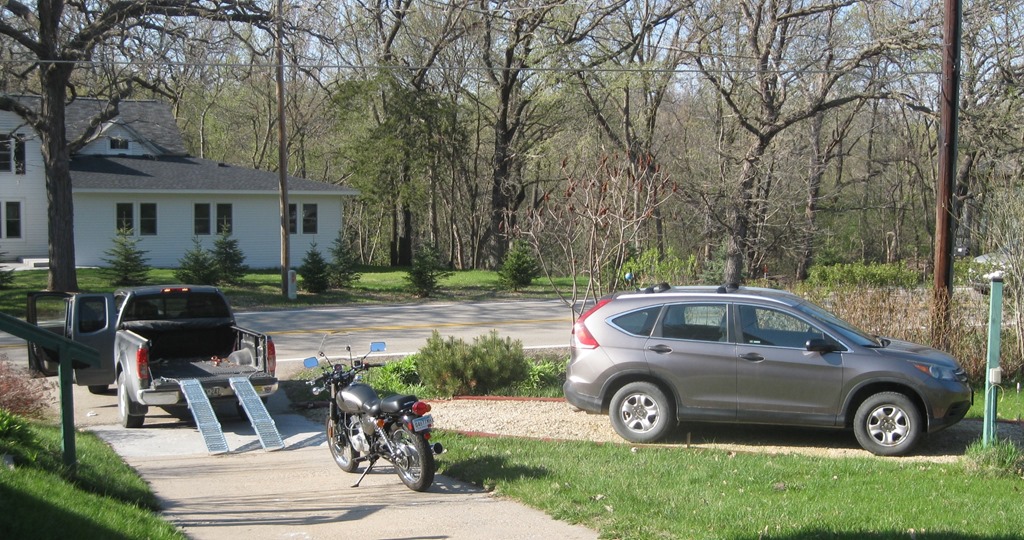 In late April, 2021, a Craig’s List search that I created six years earlier finally produced a hit: a 2012 TU250X for $2600 “practically brand new with 700 miles on it and not a scratch on it” and it was located less than 60 miles from my home. Just a few days earlier I had written a whining blog entry about selling my Aerostich and Giant Loop gear, assuming that I was not going to find a motorcycle to tempt me into testing the road and myself again. Turns out, Trump is right whining does get you what you want, at least, sometimes. I bought the bike, brought it home, immediately started farkeling it up and . . . it sat in the garage unridden for most of last summer. I put almost 2,000 miles on the eBike but barely managed to add another 700 miles to the TU’s odometer by the end of the season in 2021.
Motorcycling was all about transportation for me. I rode to work almost every day for most of 40 years, unless I was driving a company vehicle. There were a lot of Colorado and Minnesota winters where I rode most of the year, too. Fewer toward the end than in the middle, though. After I retired in 2013, I still taught a fair number of motorcycle safety classes and if you don’t ride to your own motorcycle safety classes you’re a fraud, at best. For the first 5 post-retirement years, I took advantage of my location to travel by bike, but the decline in the functional need for both my traveling and commuting started to cut into my motorcycle miles even before MG clobbered me.
Today, I’m 74, overweight but in otherwise fair physical condition, and the last three years feel more like a decade has past. Or more. If you’ve read anything from my GeezerwithAGrudge.com blog, you know I’m hyper-critical of bikers and other marginally-skilled people wobbling through the world on two wheels. That applies to me, too. After this layoff, my physical problems (especially MG), and the fact that I am freakin’ ancient, I am critical and suspicious of my capabilities and skills. My wife is just getting used to me being around the house, after 55 years of marriage to a wandering workaholic, and she’s really not interested in caring for a crippled-up old man who busted himself to bits unnecessarily on a motorcycle. I’m not anxious to become that maimed idiot, either.
At the moment, I have a nice collection of mostly-healed busted bones, torn muscles and ligaments, and scars from head-to-toe and while they often remind me of impending weather changes they don’t keep me from doing stuff. My last significant injuries took a long while to heal and they still bother me more than way worse stuff that happened 20-40 years ago. For most of my life, my planned solution for any sort of fatal illness diagnosis, overwhelming mental illness, or any kind of lingering end-of-life boredom was “buy a faster motorcycle.” Turns out, the problem with that plan is that you need to be able to ride well enough and fast enough for that to be a confident solution. Today, I’m just trying to figure out how to get myself back on the saddle.


