Showing posts with label motocross. Show all posts

Dec 2, 2023

Beware of Bowling

Warning: This story is only as accurate as the author's memory.

I have done a lot of moderately risky things in my life, but I will aways put bowling at the top of the list of scary, risky, painful, dangerous things that I will never do again. This is an old story and I’m sort of amazed that I haven’t told it before, but I did a thorough search of this and the Wordpress blog and didn’t find a single word about it. So, in the late stages of my life and whatever is left of my two-wheel “career,” I am going to explain my terror of all things related to bowling.

It all started when I was just a kid. My father was a pretty decent adult athlete, although I guess he wasn’t much as a kid. Into his late 60s, he played competitive tennis at the Kansas state championship level, bowled consistently in the 230-250 pins territory, had a decent golf handicap, and when he was in his 40s he played basketball well enough to be recruited for the Washington Generals when the Harlem Globetrotters were in town. He was also a high school basketball, football, and tennis coach until he was well into his 60s. From about 5-years-old on a good bit of my life revolved around sports. Usually, thanks to asthma and other physical limitations, sports that I didn’t play particularly well. I never managed to play any of my father’s favorite games well enough to impress him and a couple of them—golf and bowling—were sources of irritation for both of us. Still are. Much later in life, I had a spurt of playing beach basketball in California, but that was a world and a game totally outside of his experience.

Moving forward about a decade and I’m a twenty-something working-class husband and a father of two beautiful daughters, I worked a lot of 80-hour weeks, drove a worn-out 1969 Ford E100 panel van 100,000 miles a year across six Midwestern states without A/C or heat. I was employed by a con artist of a boss who generated a lot of angry and disappointed customers. My only escape from pressure, stress, and confusion was the occasional few hours I was able to spend on my dirt bike.

After a couple of years in small town Nebraska, Mrs. Day, on the other hand, was getting desperate for a social life outside of caring for our two little girls and visiting with other mothers of small children. So, she signed us up for a bowling league, partnering with the only young couple she knew who didn’t have kids. I managed to slither out of the first two league games, claiming (honestly) that I had to work at the other end of the state those evenings. The third match was unavoidable. I couldn’t get out of it because my slimeball boss caved in to my wife’s complaints about her missing-in-action husband and “gave” me the weekend off.

Other than rolling a couple of games with my father and brother during the occasional holiday break visiting my family in Kansas, I had managed to stay away from bowling alleys for a long time. By that point in my life, I had learned that “games of patience” do not play to my strengths. Anything that requires me to do the “zen focus” bullshit when I’m losing is only going to be frustrating. I played and loved basketball well into my 50s because catching up (or staying ahead) requires working harder. Same for racing motorcycles, to catch up or stay ahead you work harder and go faster. Golf and bowling require the player to concentrate on form and geometry and I suck at both. So, that evening at the bowling alley started poorly, with me tossing a couple of gutter balls and barely grazing the end pins in my first couple of frames. Mrs. Day wasn’t much better, but she wasn’t expected to be and our new friends were getting cranky only a few minutes into the evening, which promised to be long, boring, and pointless.

I am an alcohol-lightweight. I have been drunk twice in my life and neither of those episodes had yet occurred. I can easily nurse a portion of a beer or a mixed drink for several boring hours at a party and one drink is usually my limit. About two beers into the bowling evening and I was losing interest in the game and I decided to redefine the fundamentals of bowling. Just rolling the ball down the lane was an insufficient challenge and I started trying to see how far I could heave the ball before it struck wood. I wasn’t going for altitude, just distance, but the ball began to make a fair amount of noise when it landed after I’d suffered through the first game of the three we’d committed to playing. About the time I started to think I was getting the hang of this version of bowling, probably at about the 3-4 beer mark, the bowling alley proprietor asked me to leave. Mrs. Day and her friends were embarrassed. Our new social life came to a screeching end and I don’t think I ever saw the other couple again. In fact. I don’t remember being at all upset at being done with my moment in small town social life.

After the bowling debacle, I still had a weekend off. I had planned the next day, Saturday, for some recreational practice time on the limited-access roads I loved about 20 miles north of our home. I’d loaded up the Rickman the previous evening, strapped a couple of five-gallon cans of premix to the trailer, loaded my privative 1975-style gear into the family station wagon, and headed north for some trail therapy. Sunday was race day and I’d signed up for my usual spot at the back end of the Nebraska State Intermediate class races. And I’d be wrenching for a friend who was actually competitive in the Expert class.

As you might suspect, I was slightly hungover that morning. Having never been even a little hungover, I was clueless as to what that might mean.  The place where I chose to make my stand was in the sandhills about five miles east of Palmer, Nebraska and about the same distance south of the Loup River. Back then, this area had well over 100 miles of limited-access roads tied together in a way that allowed me to ride for hours without ever crossing pavement. And that was my plan for the morning. My excuse for running out on my family on a beautiful Saturday summer morning was that I would be “practicing for Sunday” at the races in Genoa. That was sorta true, but mostly I was getting as much alone-time as possible anyway possible. But I was unwittingly impaired.

I unloaded the bike from the trailer, strapped on my gear, gassed up the bike, and took off heading north toward the Loup River. The first section of the route I’d planned was over some mild hills thoroughly coated with deep, fine dust bowl blow-out sand. I don’t know if I have ever ridden a motorcycle more suited to that kind of riding. The Rickman didn’t have much low-end torque, but once you spun it up over about 4,000 rpm it would sail across the sandhills like a prairie racing catamaran.
 

I had barely got the bike warmed up, less than a few miles from where I’d parked, when I let the bike slide down the side of a sandhill into a tractor rut. Normally, no big deal. Just haul back on the bars, give it some throttle, and sail back up the side of the hill. Hungover, I considered a brand new option: step off of the bike and bail out. I was doing about 50mph at the time and abandoning ship was a freakin’ stupid option. I discovered that immediately. The thing about the next few seconds that has stuck with me for 40 years was a sound I can only describe as “a pound of hamburger thrown hard against a refrigerator door.” Splat!

Some undetermined, but calculatable, period of time later, I awoke imbedded about a foot into soft, hot sand. While I was unconscious, I’d hallucinated that I’d been tossed out of an airplane without a parachute. When I woke up, the dent in the sand, the pain, and the near-desert surroundings fit nicely with that hallucination.

With some effort, the time I’d been unconscious could be mathematically be determined by the flow rate of fuel from my Rickman’s tank overflow hose. When I righted the bike, I discovered I needed to change the petcock to reserve to get the engine started. My guess was that I’d been unconscious for at least 20 minutes. Getting the bike upright was a challenge, I hurt everywhere, but mostly I couldn’t catch my breath. Getting turned around in that deep sand was another challenge. Getting the bike started and moving in the right direction was tough, but easier than the first two hurdles. By the time I made it back to the parking spot, I was having serious problems breathing. I absolutely failed to lift the Rickman’s actual 250+ pounds (216 pounds claimed weightAnimated Smileys Laughing - ClipArt Best) on to the trailer. In frustration, I climbed into the station wagon, reclined the seat, and decided to see if I might feel better after some rest. After a few minutes, I was so seized up and hurting that I couldn’t get back out of the reclined seat. And breathing was harder, not easier.

Sometimes the old adage, “No good deed goes unpunished,” gets proved wrong in spades. Over the past year, I’d put a lot of effort into being friendly and useful to the area’s ranchers. I had helped chase cattle back through downed fences, ridden to the nearest ranch to tell the owners about damaged fences or escape cattle, and always stopped to talk (rather than run away like other dirt bikers usually did) when I met someone working the fence lines bordering the limited-access roads.

As I lay in the car imagining what the odds anyone would find me out on this remote road before I suffocated or starved to death, three actual cowboys rode up (on actual horses) and stopped to talk. I was barely able to say “howdy” and real conversation was beyond my capacity. After a bit, they figured out my predicament, pulled me from the vehicle, loaded up the bike and strapped it down, helped me pull off my boots and gear, turned the car around, and even offered to drive me back home if I couldn’t manage it. [That wasn’t the first or last time I’d be rescued by cowboys or horses.]

Because I was, and probably still am, an arrogant, macho/dumb male, I declined the designated driver offer, gritted my teeth, engaged the clutch, shifted into 2nd (to minimize having to repeat that painful movement), and took off for home. I had to pass through two small towns and about half of our hometown on my way home and braking or shifting quickly identified themselves as painful and impossible tasks. For the first and only time in my life, I desperately hoped a cop would stop me and arrest me, even shoot me and put me out of my misery. But I sailed through both towns and the north end of our hometown at 60mph without a glitch. I think I even blew through two stop signs on the way. The station wagon was a 1973 Mazda RX3 and it would easily do 60 in 2nd gear and start with a little clutch slippage, so I didn’t shift all the way home.

I pulled into our driveway, turned off the key and shuttered to a stop, but I couldn’t get myself out of the car. I blasted the horn until Mrs. Day and our little girls came out to see who and what was causing the racket. They helped me out of the vehicle, into the house, and on to the family room couch. After a bit, I thought a hot bath might help, so I went into our bathroom and ran a tub-full of near-boiling water. And I almost drowned when I discovered I couldn’t keep from sliding into the big old clawfoot tub and going down helplessly. I slept on the couch for the next few weeks because our bedroom was on the impossibly-distant second floor.

When I finally made it to the local doc’s office, an x-ray determined that all 12 of my left-side ribs were broken or cracked. The closest thing to sympathy or assistance I got from my doc was, “That’s what you get for riding a motorcycle.” The injuries put me out of work for more than a month and, thanks to the usual 1970’s small business total lack of any sort of disability or healthcare benefits, about destroyed our family’s economy, . However, I had more than enough vacation time, so at least I got paid for a 40-hour week while I was out of work. A few weeks after I was back to work, I ran into the doc limping around our grocery store, on crutches with his leg in a cast. I sympathized with him by saying, “That’s what you get for playing with those damn skis.”

The long-term effect of the crash, the pain, and the extended recovery time was that for years afterwards when I got into any kind of extreme situation on a motorcycle (a little air, going a bit sideways, skittering along a sandy section of road or track) I PTSD’d myself into going through the worst part of that desert crash and usually found myself parked on the edge of the trail or track sweating and panicking over another crash that had only happened in my mind. It was several years before I could really enjoy offroad riding at any sort of respectable speed and look what that got me.

Nov 9, 2022

Before #1: Geezers on Beemers: (AKA: Steamboat Springs 1997)


All Rights Reserved © 1997 Thomas W. Day

[For the last many years, I’ve said Geezer #1 "What Are We Riding For? (The original, from whence The Geezer came from October 1999" was the first thing I ever wrote for Minnesota Motorcycle Monthly magazine. I wasn’t lying, I was just wrong. I have been working on a Wikipedia entry for the magazine and as part of that I researched as much as I could find about the magazine’s history. In the process, I read through a bunch of old MMMs, sorted my own collection by date, and discovered that in the Winter 1997 M.M.M. #14 issue there was an “On the Road” article. . . by me. This article, in fact. While I absolutely remember the trip, sort of, I absolutely did not remember even knowing about MMM before 1999. Turns out, that was wrong, too. In September 1998, I contributed “Look Ma, No Feet!” an article about the 1998 US Observed Trials event in Duluth. So, now the story I’ve been telling myself and everyone else about my history with MMM is bullshit and I do NOT know what the truth is.

The version that follows is what I submitted. Unlike lots of the stuff I wrote for MMM, this article was edited quite a bit, but I’m too lazy to pick out what was different in the magazine’s version.]

Every year, since I moved out of Colorado, my expedition to the Steamboat Springs Vintage Motorcycle Week gets a little tougher. Last year, I flew to Denver, borrowed a friend’s Honda Hawk, and nearly missed my flight home when my luggage fell off of the Hawk in the middle of traffic on I-70, spreading my belongings and plane ticket all over Colorado. This year, I decided to ride the whole 2,400 miles. Next year, I may try walking.

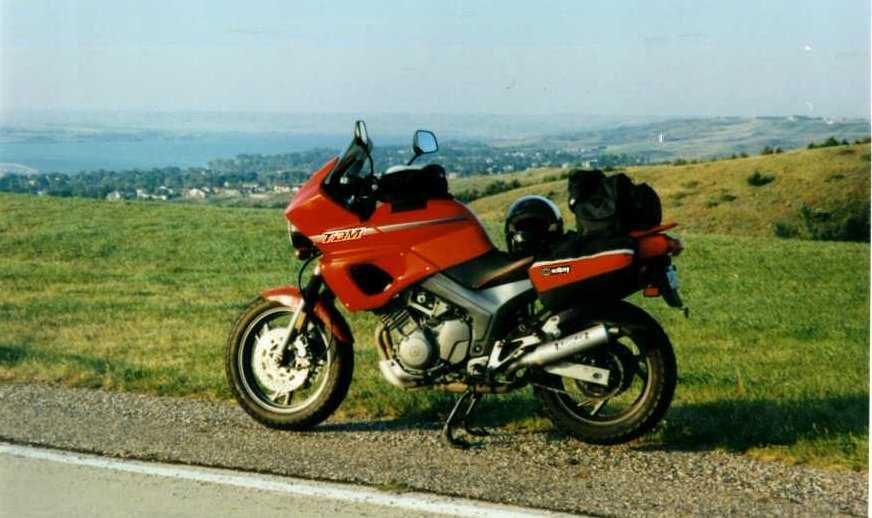
My bike is a ’92 Yamaha TDM, which is a weird cross between a crotch rocket and a dirt bike. It’s probably the closest thing Japan will ever come to importing a Paris-Dakar style bike to the US. Out of some weird allegiance to my dirt biking past, I put dual-purpose tires on the bike this past winter. Because of that strange heritage and hardware, I actually hoped to do some real cross-country touring this trip. Some people do not get wiser as they get older.

Because I had a few days of vacation to burn up, I left for Denver early Sunday morning, September 7th. Steamboat’s Vintage Motorcycle Week was September 10 to the 14th. The start of my planned route was diagonally across Minnesota, via highways 169 and 60, to Sioux City. Early in the day I passed the Mennonite settlement of Mountain Lake, MN, where there is a "phone museum" and other exciting attractions. I’d always thought of Mennonites as hardworking, honest types, but this place had to be their equivalent of a Florida swamp real estate scam. There is no no mountain and no lake, as far as I could see, anywhere near Mountain Lake. I have a new sort of respect for Mennonites.

I stopped in Heron Lake for my first fuel stop. I discovered, by drenching my bike and feet in gas, that the fuel shutoff was defective. With the helmet and ear plugs in place, I nearly dumped two gallons of gas on the ground before I noticed I was creating a Super Fund site. From here out, I did my trip documentation after filling the tank. It didn’t surprise the lady at the counter though. She said, "that side don’t register, this side does," when I told her about the screwed up pump. I kept an eye on the mirror, as I left town, half hoping for a mushroom cloud to compensate me for the wasted fuel.

Just south of Worthington, I tailed a yuppie in a Range Rover who showed no fear of Iowa’s CHP. He got me through that mind-numbing state in record time. I stopped at an interstate rest stop in Iowa where an old lady with a highway department uniform told me "I used to be in the bidnez worl’, that’s why I’m workin’ here." I thought she meant the business world ruined her life, but she was just working for the exercise. Go figure. Just south of Sioux City, I hooked up to highway 77 and to some even less regularly maintained roads.

I used to live in north eastern Nebraska and I mistakenly thought that gave me some ability to pick my way across the state. I ended up on a newly graveled road, about 10 miles north of North Bend, that was terminated by a large crane and a missing section of road. When I stopped to look at the construction damage, my wheels sunk past the rims. My next short cut took me though about 5 miles of really deep gravel and sand. By the time I escaped that desert riding experience, my front fender had a 3" hole pecked into the back side and my chain picked up about an inch of slack.

After relocating asphalt, I picked up 30 at North Bend and headed west. I failed the "will to live" test and stopped for a hamburger in Columbus, NE (Actually, I figured that ought to be the safest place in the US for a beef-eater, after that city’s most recent 15 minutes of fame.) Making up for lost time, I stuck with 30 to Grand Island and jumped to I-80. By the time I got to Gothenburg, NE; 630 miles from home, I was wiped out. I stayed in a truckers’ motel that night and set the alarm for a 5:00AM takeoff.

Poor road maintenance almost bit me in the butt this morning. I had a low rear tire and thought I’d developed an oil leak when I stopped in Julesburg, CO. The tire was low, but OK. I washed the engine and discovered the oil leak was just chain lube that was heating up and dripping off of the engine cases. I promised my self I would watch my oil level and temp gauge carefully for the rest of that leg of the trip, just in case. I managed to hold to that promise all the way to Denver, about 120 miles. Later in the trip, my failure to extend this pledge to the whole journey would haunt me.

By noon Monday, 372 miles later, I was in Denver. You can’t see the mountains until you are about 55 miles from the city. Mountain cloud cover suddenly becomes mountains and the air seems cooler and fresher. The last 50 miles into Denver seem to go quickly and the horizon’s view is terrific.

When I stopped, my butt hurt. My kidneys were falling out in chunks. My bike needed about 10 hours of serious maintenance. Being the high tech, serious maintenance guy I am, I lubed and re-tensioned the chain, put duct tape over the hole in the fender, washed the bike, checked for loose hardware, washed my laundry, and hung out in a bar until Wednesday morning.

Six of us left my friend’s home for Steamboat Wednesday at about 8:30AM. We were probably the weirdest collection of motorcycles on the highway that morning: a Yamaha TDM (mine), two Honda new Magnas, a ’78 Kawasaki Scepter, and an ’83 Yamaha Venture. After a few miles, we strung out across the highway in a several mile long "touring pattern."

We intended to get to Steamboat by noon so we could catch a little of the dirt track speedway racing in Hayden that afternoon. We’ve made that plan five years in a row. Like the other years, this year we didn’t get to Steamboat until 1:30PM, our trip schedule was sabotaged by several coffee, fuel, and meal beaks. Some of the group, including me, thought the lodge’s hot tub looked more interesting than another 100 miles on the bikes. Those who stayed watched the clouds cruise the mountain tops and drank beer. Those who left got to Hayden just as the last of the racers were leaving and got caught in a short rain storm on the way back. I try to make each of my millions of mistakes only once.

The next day, I went to town by myself because none of my group was all that hip on the trials event. This is the sport with which I ended my 15 year off-road competition career. In fact, the years defined as the end of "vintage" were state-of-the-art just before I quit trying to luck into a trophy. Every once in a while, Steamboat makes me reconsider my constant fear of knee injuries and I think about buying a Bultaco Sherpa T or a Yamaha TY and doing a little cherry-picking. Steamboat’s vintage traps are almost all easy enough that a good rider could zero out on a street bike.

This is also the day where the "geezers on Beemers" sub-title for Steamboat really becomes appropriate. There seem to be an incredible number of retired executives, military officers, and other non-working class types doing the vintage-bike gypsy tour. They live in 40’ luxury campers and tow bike-trailer/work-shops that make my garage look puny and unequipped. A few of them even have trophy wives in tow. Since most of these guys are pretty near my age and I don’t have any of that stuff, I try not to make too many comparisons or I’ll get discouraged.

I really get a kick out of seeing how many ancient bikes have been modified for trials. I didn’t even know BSA or Greeves made a 125 or that anyone was riding trials pre-WWII before my first trip to Steamboat. This is like a dirty, live-action museum with some dirty, active museum caretakers riding the exhibits. It rained a little about 10:00AM, just enough to send me back to the bike for my jacket. As soon as I had two arms full of stuff to carry, the weather got hot and I spent the rest of the morning sweating and grinding dirt into all of my body parts. I don’t know who won, probably some geezer with a collection of Beemers and a Yamaha TY in like-new condition.

Friday is vintage motocross day. Another of my favorite events. Again, I was up and out before the rest of the group. I spent the early morning walking through the pits, taking pictures, listening to experts talk about the history of various, long-dead motorcycle manufacturers. It’s still hard for me to reconcile Rickman, Bultaco, Ossa, Norton, BSA, and the rest of the deceased as being not only dead, but long dead. Seeing these bikes back in their prime, sometimes much better than prime, is a lot of retrospective fun.

Speaking of dead-ends, three other TDM’ers showed up for Steamboat. We belong to an Internet mail-list for our bike and some of us have been writing each other for a couple of years without ever putting faces to names. I recognized a couple of the guys by their bikes. Yamaha orphaned the TDM after importing it to the U.S. for two years (1992-93). Most of us have done a lot of little things to personalize our bikes and it was fun getting to see the mods I’d been reading about. Everyone got a good laugh of the state of my front fender and the general condition of my bike compared to those whose owners, intelligently, avoid dirt roads. We experienced our "fifteen minutes of fame" when another biker recognized us as "those guys who met on the Internet." We took pictures, talked for a couple hours, and headed in four directions for the rest of the weekend.

The actual races are almost anticlimactic. It’s always a kick watching Dick Mann win. He was a Baja hero of mine when I was a kid. He’s still heroic at sixty-something. Dave Lindeman, a Denver fireman, put on a good show in the Open Twin Expert class, dueling and beating Rick Doughty’s zillion dollar Rickman/BSA on a cobbled up Yamaha XL650.

But lots of the actual races are pretty boring. There are wads of timid, over-forty wannabes who barely turn their bikes on in the straights and come to a lethargic near-stop at every corner. The race to the first turn is often more humorous than exciting. Everyone is so concerned with avoiding contact and a crash-and-burn that they barely make it to the turn, let alone work for a decent position on the other side. In the bulk of the races, there is rarely more than two half-decent racers. The other two dozen geriatric cases are nothing more than track obstacles when the fast guys start lapping them. The upside, for me, is that I regularly get pumped about buying an Elsinore and stealing a trophy. The downside is after making a couple of deep knee squats, I remember why the majority of the riders are going so slow. Getting old is hell. The body can’t even remember how to do what the brain told it to do.

Fairly late in the afternoon, the races are over. We cruise the streets of Steamboat, looking at bikes we will never own. This really is a BMW convention. I doubt there is a bike BMW ever made that isn’t represented here. Seems like there are more Harleys this year, too. Maybe that’s why the local paper doesn’t have a single word about the events. In years past, I could read about what I’d seen the previous day in the local rag. Not this year. There must be several thousand bikers in town and the only mention of motorcycles was when a local biker got smacked by local cager. It’s not like this is a pack of Outlaws, tearing up the bars and defiling local women. A pair of women, climbing out of a Jeep Cherokee on their way to lunch, asked one of my buddies if we were a "biker gang." He told them, "Yeah, after our nap, we’re gonna take this town apart!" That’s about the speed of everyone at Steamboat. Sedate. Old. Mostly intent on finding a good restaurant and a decent hotel. I guess we still found a way to scare them.

I didn’t cruise much Friday night. We really did find a great place to stay and I headed back, well before dark, to sit in the hot tub and watch the clouds and the mountains flare and fade in a crimson tinted sundown lightshow. Beer, a good book, a hot tub, and tired, old aching joints really go well together. If a local female stripped herself and jumped into my hot tub, I might have defiled her but I’d have more likely been pissed that she got my book wet. I bought my beer at the Clark Store, so I didn’t even have a chance to think about trashing a bar. I’m a pretty poor excuse for a biker, I guess.

Saturday is vintage road racing and the first opportunity we have to look at the concourse. We buy pit passes, which are $20, and head for the pits. I’m not much of a connoisseur of street bikes. In fact, I never paid any attention to street bikes at all until I’d been riding and racing for almost 15 years. I still don’t really know one cruiser or crotch-rocket from another. I don’t much care about cars either. But there are some really neat, loud noises coming from the pits and one of my friends has a great time describing all the bikes to me. I lecture on the dirt bike days, he does the street day.

About two hours into Saturday, I got bored. This is a terrible thing for a "reporter" to admit, but I’d have rather been riding than watching. When I fell asleep and lost track of where the rest of my group had gone, I decided it was time for me to hit the road. I’d planned on leaving that day, anyway, and it seemed like the time to do it. I wandered around the course for another hour, trying to find everyone, with no luck. I stuck a note on a friend’s seat and started getting ready for the long ride back to Minnesota.

Sunday is the modern road race. I have been going to Steamboat for 6 years and I’ve never stayed for the modern road race. My justification for leaving early is that I can watch modern crotch rocketing any weekend during the summer and I never do. Why blow a good day of riding watching someone else have a good day of riding? Like all the years past, I left on Saturday and missed the really fast guys. They’d just discourage me, anyway.

The real reason I wanted to leave early was that I wanted the extra riding time so I could go back the long way, through Wyoming and South Dakota. I retraced my trip into Steamboat back over Rabbit Ears Pass. About 30 miles east of Steamboat, I turned north on Colorado 14. This is one of the prettiest roads I’ve traveled in Colorado. It’s a neat combination of mountain plains and ranch land. The road isn’t particularly twisty, but it does curve its way through a beautiful section of the Rockies. The road is well maintained and completely unoccupied by cage or cop. I made good time to Walden, where I picked up 127 and continued north to Laramie, WY.

The scenery doesn’t stop when you leave Colorado. Good roads and great views all the way to Laramie, where I copped out and took the freeway (I80). After 300 miles of awesome two lanes, I80 was a complete bummer. But I stuck to it to Cheyenne, where I swapped freeways and took I25 north to Wheatland. I spent the night in Wheatland, at another truck stop. Leaving Steamboat early allowed me to knock off 250 unproductive (destination-wise) miles before I seriously head for home.

The actual route I took from Wheatland to Deadwood is up for discussion. I know I stayed on I25 for a few more miles to Wyoming 160. I know I swapped off of 160 to 270, because I had breakfast in Lusk, WY. I’m not sure I stuck with 270 all the way to Lusk, though. A good portion of that trip was on dirt roads. I mostly used the sun as a compass and tried to keep going north at every intersection. I popped out of the last section of dirt road on highway 85, just a few miles south of Lusk. I had been on reserve for about 30 miles when I filled up in Lusk. I’d like to tell you 270 to Lusk is a terrific road, well worth traveling, because it is. I’d like to tell you that I strongly recommend this route for the scenery and adventure, because I really enjoyed that aspect of the trip. The fact is, this is a route that requires a great suspension. The road (the real road, not the dirt road) is heavily traveled by farm equipment and is pretty rough. The TDM ate it up, but a crotch rocket or cruiser would deliver a severe pounding. You decide.

Leaving Lusk, I forgot to reinsert my ear plugs. Good thing. I heard several nasty noises and pulled over for a maintenance stop. You’ll probably notice that I haven’t mentioned maintenance since just before I pulled into Denver. I hadn’t done much since then. Another brain fart. The older you get, the more of them you’ll have. I discovered the front fender had a new hole, this one on the front, from poor tire-to-fender clearance and flung gravel. I pealed away pieces that were touching the tire and "fixed" that problem. I also discovered my chain was really wearing out fast, probably due to the off-road portions of the trip. It was actually hanging up at spots as they passed over the countershaft sprocket. I bought a can of WD40 and thoroughly cleaned the chain. I lubricated the chain and made some more promises to myself regarding maintenance.

The next section of the trip was sort of frightening, considering the condition of my bike. There is next to nothing between Lusk and Deadwood, 140 miles of nothing. There are some towns listed on the map, but they are barely bumps in the road. Some of them aren’t even that. But I took this route because I was bored with the trip across Nebraska and Iowa, so I figured it was worth continuing. Not that I had much of a choice.

Wyoming is a great state. I suppose every state has a motto. Nebraska blabs about some mystical "good life" that no visitor or resident has seen any sign of. Iowa yaks about "liberties" and "rights" and parks a cop on every road to make sure no one ever even dreams about freedom. Colorado’s "nothing without providence" is totally meaningless. But Wyoming is the "big country" and you don’t have to look far to find real cowboys just like the one on their license plate. Some of those cowboys drive farm trucks on highway 85. I only saw four vehicles on the road between Lusk and the South Dakota boarder. All of them were doing 90+ mph and they all waved when they went by me. I would have stayed with them, but I wanted to live through this section of the trip with chain intact. There is nothing, in any other part of this country, like the concept of "safe and reasonable" as a speed limit. It almost makes me feel like an American. Out there, Mamma Government is in short supply and nobody misses her.

The weather totally cooperated. From the beginning of this day until I hit the plains, just west of Wall, SD, the sky was clear, the temperature was in the low 70’s, and the wind was nonexistent. South Dakota’s Black Hills are a national treasure. South of Deadwood, 85 winds through the hills like the best Rocky Mountain highway. There are miles of twisty, narrow highway that parallels beautiful streams and cuts through wooded valleys and farm land. I could take a summer long vacation, traveling the roads of the Black Hills, and never grow even a little tired of it.

I made it to Deadwood in one piece. Stopped for gas, lubed the chain, washed the windshield, checked the tires, and thoroughly inspected the bike. Then I walked to the Deadwood Historical Society museum and wasted an hour looking at the coolest of western history. There are Harleys all over Deadwood. It’s only a few miles from Sturgis, which must account for all the heavy iron.

I still hadn’t eaten when I left Deadwood. I was making, and having, such good time that I couldn’t convince myself to waste any of the day in a restaurant. Slightly north of Deadwood, I struck interstate and there I stayed until Minnesota. Once you pass Wall, the home of Wall Drug, there isn’t much to say about South Dakota. Every diddly-butt town has some kind of tourist trap. None of them are worth stopping for. It’s not just that there’s nothing to see in those towns, there’s nothing to see in that part of South Dakota. It’s just miles and miles of flat, boring plains. Most of the state’s rest stops are "out of order," probably to force travelers to waste time and money in the state’s tourist traps. I stopped for gas at Wall, Chamberlain, and Sioux Falls. There isn’t much more to say about the space between any of those cities.

The wind was killer, once I passed Wall. It was 50+mph and I felt like I was making the world’s longest right turn. 420 miles of right turn. I wanted to make Sioux Falls by nightfall, but I was forced to take a stretch break every 50 miles. My arms, back, and butt were going numb and the road never seemed to end. I swear that some of the mileage signs increased the distance to Sioux Falls as I drove east.

The only break in the monotony comes a few miles before Chamberlain, SD. The Missouri River valley almost instantly changes the scenery. It takes you from flat, barren plains to green rolling hills in only a few miles. The river is awesome, especially after 200 miles of desolation. It’s as wide as a lake and as blue as an ocean. Unfortunately, 10 miles east of Chamberlain, I’m back in a windy desert. That evening, 650 miles from where I left that morning, I pulled into Sioux Falls and headed for a Super 8.

The next morning, I tried to sight-see in Sioux Falls but failed to find any interesting sights. I left town at about nine and headed for home. I repeated the original leg of the trip by exiting I90 at Worthington and take 60 to 169, through Mankato, and on to the Twin Cities.

I got home a little after noon. I popped the cap on a beer, filled up the hot tub, and fell asleep dreaming about high mountain passes, unlimited speed limits in Wyoming, and gorgeous snaky roads in the Black Hills. I woke up, sweating, later that night when the dream turned to wind blasted, straight and boring South Dakota interstate dotted with hundreds of Iowa Highway Patrol cars.


Jan 8, 2022

I Shouda Been A Contender

When I was young, still “made out of rubber and magic,” and full of unfounded confidence in my invulnerability I restarted my motorcycling life with a purchase of a 1971 Kawasaki 350 Big Horn. Motorcycles had been a big, then a small, then a non-existent, and back to big part of my life from when I was 15 until a year before my first kid was born in 1971. I didn’t buy the Big Horn new. It had belonged to an old Texas rancher who imagined that he could easily step down from horses to a motorcycle and discovered that he’d be relegated to a pickup instead. Today, I can relate to his dilemma, but back then I just saw his age-related misfortune as an opportunity. I paid a fraction of new price for a barely used bike and immediately went back to my old off-roading habits.

In those days, Hereford, Texas was a slightly prosperous west Texas ranching and cattle-feeding town with a side order of sugar beets and cotton. Today, it is practically a ghost town. Then, we had Honda, Suzuki, Kawasaki, and Eurotrash dealers, a hill climbing area, a barely-out-of-town motocross track, and hundreds of miles of poorly maintained farm-to-market roads that, often, were barely more than tractor tracks leading as far away as a rider would want to travel on an off-road motorcycle of the day. One of the guys I worked with, a welder named “Charlie,” was a local “bad influence” motocross phenom who rode a 250 Kawasaki piston-port motocrosser and who had found the Big Horn for me. He and I spent a fair number of evenings and weekends banging tanks at the Hereford track and flipping over backwards showing off at the hill climb area. It was all his fault that I almost missed the birth of my daughter, Holly, because he’d signed us both up for a Sunday race in Dalhart the weekend she decided to venture into the world.

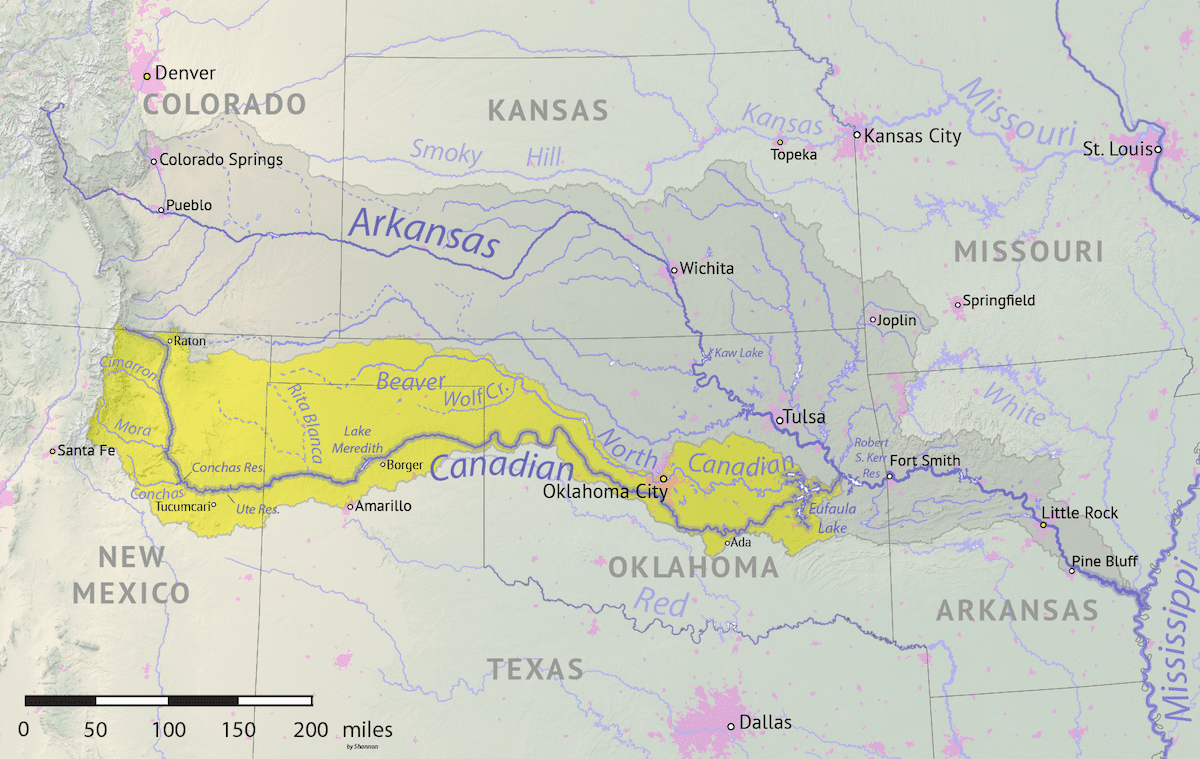
South Canadian River – Las Animas County, CO | San Isabel National ForestSince becoming a father ruined that weekend’s escape, A few weeks late, I signed the two of us up for the end-of-season race, the Canadian River Cross-country. A 120 mile race that started on the west end of Lake Meredith, a pitiful hole that might have been a lake at some time, but was just a big ditch most of the year in the 70s. From there west to New Mexico, the Canadian “River” was a long, wide trench with spotty pools of water, usually surrounded by rocks. I do not remember where exactly the race ended. 1971 was a LONG time ago. I remember my wife was really pissed that, after working a 90 hour week, leaving her home alone with a new baby, I was going to escape all of that bliss for a day and “go racing.” I was probably the least excited-to-be-a-young-father guy on the planet at that moment and her arguments were absolutely valid but unconvincing. Charlie was coming because he had a pickup and a great tool kit, but his interest in Cross-country was so slight that, after the first section, he turned back, loaded up his bike, and drove to the end to wait for me to show up so he could go home and get back to motocross.

I was “determined.” When I lined up with the other open class bikes, maybe 20 of us, it was the first race I’d been in since my rough scramble days on the Harley 250 Sprint. The juices were flowing, I thought i was ready to race and, even, win, and my Big Horn was faster than snot. Heavy as a buffalo, but really powerful for the time. In recent years, I’ve been told that my motorcycles are “unfit for off-road purposes,” and I just laugh at that idea because most of those characters wouldn’t even consider a mess like the Canadian River Cross-Country on a 2022 enduro. My Big Horn was heavy (400+ pounds), barely-suspended with Boge shocks (maybe 3 1/2” of travel) and the stock forks, only made real power (33hp) when the motor was wound up past 4,000 RPM, and ungainly as hell. Every bike I’ve owned from my 125 ISDT to my XT350 to my TDM850 or V-Strom adventure bikes have been far more off-road capable than that Kawasaki so-called “enduro.” In late-1971, I had no idea that there were much better options and if I had been it wouldn’t have mattered because they weren’t available or affordable in West Texas.

The flag fell and off we went. I’d spent some time boning up on the warning flags and less than 10 miles in that education paid off. Just before we entered a tight, blind, hard left in the riverbed, one of those flags fluttered just enough to clue me in that there was a hazard. The hazard turned out to be a substantial pile of rocks that was littered with bikes, bike parts, and riders. I managed to come to a stop before piling into the guy who was in front of me. He didn’t. I paddled through a narrow passage and climb to the other side of the rocks and kept going. From here out, my memories are really clouded.

I know I crashed at least a dozen times in the next 100-some miles. I remember seeing a fair number of bikes and riders stuck in swampy sand, piled into rocks, logs, and each other. I remember, somewhere near the end, smacking my engine case on some rocks, busting the cases, and slowly losing the transmission fluid over the remaining miles. I remember only being able to shift from 1st to 2nd with no neutral or other gears in the last few miles. I remember losing power like crazy and barely motoring past the finish line. Charlie was there waiting for me and we loaded my bike back into his pickup. I remember drinking something, probably beer, on Charlie’s tailgate waiting for the results. I definitely remember a long period of no motorcycle, lots of overtime, and recriminations from my wife, while I reassembled and repaired the damage to my bike from that race.

My big memory, biggest in fact, of that race was discovering that because “only” three open class bikes finished, the organizers decided that they would only trophy to 2nd place, instead of 4th as planned and announced. I guess they wanted to save money on their crappy $5 plastic trophies. I got a fuckin’ ribbon, instead, but my finishing position wasn’t even listed, since I didn’t trophy. I raced motorcycles for another ten years, ending with a series of busted ribs, toes, and fingers. I never again came close to being on the podium. I pointed, in Nebraska, well enough to progress from Novice to Expert in the “Enduro Class,” but that was a quantity-over-quality achievement.

In the 1980s, when my daughter was skateboarding with her soon-to-be-famous boarding friends in Huntington Beach, she used to wear a tee-shirt that said, “I wish I were as fast as my father remembers he was.” I guess that is about as close as I will ever get to a motorcycle trophy.

May 7, 2020

RIP: Marty Smith

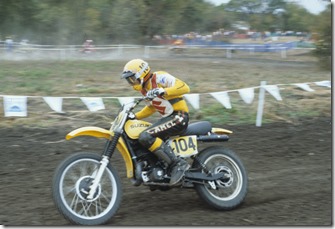
At the tail end of what passed for a “motocross career,” I rode 125 support class at the Herman, NE track in 1978 or ‘79. As usual, I ended up in the middle of the pack. No bad luck, no bike failure (I was riding a friend’s RM125 that he and I had spent a week prepping), just not nearly enough talent to be anywhere else but in the middle of the pack. My friend’s one-year-newer RM125 put him in the top 5, not high enough to trophy, but high enough to make him feel good about himself. I was happy not to have crashed and to have managed to pass a couple of guys; and get passed by a few including getting lapped in a 20 minute moto by the winner.

A real upside to being there was getting to hang out in the pits for the main events. We amateurs were pretty much relegated to a section of the pits, to keep us out of the way for the pros, but we were close enough to talk to some of the racers and mechanics and watch the real guys do their jobs. One of those guys was “Mighty Mouse,” Marty Smith. Marty and his wife, Nancy, were killed in a dune buggy crash not far from their home in the California desert this past Monday. Marty was 63, which really makes me feel old because I remember him being a “kid” when I was in my late-20s and early-30s.

This picture is how I will always remember Marty. He was always a serious looking guy before the race and had a big grin on his face afterwards; even when he didn’t win. The year I saw him upclose was the year Bob Hannah started winning . . . everything. It was very much like the changing of the guard. Marty’s style was like the European TransAM guys we’d been seeing for the past decade, wiping up the US guys on our own tracks and hauling off the trophies and prize money. Bob changed all that and within a few years, the Euro-riders quit coming to the US because they were working for free.

Dec 26, 2018

Face-Planting Across the Ages

350bhornIt was spring 1971 and I was well on my way into parenthood at 23 years old, a trade school dropout, living in Hereford, Texas and working 80-90 hours a week at $3.25 an hour servicing the electronic scales on cattle feed trucks. What a life! One of my new friends at my new job turned me on to a deal on a 1970 Kawasaki F5 Bighorn 350. It didn’t take long and, if I wasn’t stuck behind the wheel of the company Chevy C10 pickup blasting my way from one feedlot to the next, I was on that motorcycle. It was my first 2-stroke and the first bike I seriously tried to prep for off-road racing. 28 raging horses with a rotary valve fueled motor, a 5-speed transmission, electronic ignition, aluminum wheels, Hatta forks (at least 3” of travel), lime green paint job, and . . . lights. I don’t think Kawasaki advertised the weight. Maybe metric weights and measures numbers don’t get that big. If it was less than 400 pounds, wet, I’d be astounded.

70s helmetMy last gasps of freedom before becoming a father and really needing to rack up overtime at work would be two races: the Canadian River Cross-Country Race and a state series motocross in Dalhart, Texas. The Canadian River race was first and I was “preparing” for that race by blasting across the Texas plains on some friend’s property every spare evening could get away from work. Helmets were optional at most Midwestern 60’s motorcycle events and I had one, a gold metal flake open face unit just like the one in the picture at left. But I often took it off when I got where I was going because riding off road was “so much safer than being on the highway.” Everybody knows that, right? It, honestly, wasn’t much of a helmet and the only reason I owned it was because the rancher who sold me the motorcycle included the helmet. When I arrived at the field where I often practiced riding fast, I would sometimes take off the helmet and stick it on a fence post to be picked up when I got back from playing racer. 

One weekend afternoon, I snuck out of work and rode my Kawasaki to the practice field and for whatever reason I popped the gate loop, rode through the gate, reattached the loop, and headed into the field with my helmet still on my head. I rode around the field for a long while and after I tired of going fast, spinning around in dirt-bomb circles, and racing down the dry creek bed on the property, I decided to practice jumping big rocks. The Canadian River race was notorious for having rock piles that had to be either ridden over or you had to drag your bike across the rocks or take the long way up the river bank and back down, hoping you didn’t miss a check point in the process. Some of those river banks were a long trip up, around, and back down. If you could do it, hopping over the rocks trials-style was the way to go and I needed a lot of practice if I would be able to use that tactic in the race. 

The Bighorn’s 350 motor was an unpredictable bitch. You never really knew what would happen when you opened up the throttle. Plus or minus a hundred rpm at 3,000 rpm would be the difference between flipping over backwards or charging full speed ahead without enough torque to clear a dime under the front wheel. Hopping logs and rocks on that bike required a lot of clutch and throttle work. I was having a pretty good day working on the technique when I suddenly wasn’t. I’d been working a fairly large pointy rock from several angles when I got the full speed ahead torque-less response and slammed my front tire solidly into the rock, launching me over the bars head-first into the rock, flipping over that and landing on my back in a pile of goatheads. I remember hearing something that sounded like gunshot just before the lights went out. 

The day I wake up and can’t remember where I am or who I am will be sponsored by the many times I’ve been concussed in my life. This was one of those times. 

I don’t know how long I lay on my back in the goatheads, but it was long enough that when I decided to rejoin the west Texas population of humanoids my shirt was covered in blood. I managed to get to my feet, pull the Bighorn upright and swing a leg over it, and sit there semi-balanced for a bit longer until I remembered where I was and how to get out of there. By that time, my lime green gas tank was blood red. I was really losing a lot of blood and I didn’t know where it was coming from. I rode back to the gate, did the unloop and relooping thing, and rode to my friends’ house. I think I was hoping for a hose to clean myself and the bike off and a bandage for my lip. By then, I had figured out that I’d punched a hose clamp bolt (from the toolbag on my crossbar) through my upper lip. I could feel the wind on my teeth while I rode, even though my mouth was closed. It didn’t hurt much, yet, but I suspect it would soon. 

I got to their house and, luckily for me, they were home. I freaked them out a good bit; looking like someone had taken an axe to my face. One of the couple was a nurse and she quickly realized that my face needed stiches and she did them right there in their kitchen. Six stiches, I think. While she was stiching up my face, he took a hose to the bike and my gear. About the time the nurse was applying iodine to her handiwork, he came into the kitchen with my helmet in his hands. “Was this from today?”: He pointed to a triangular-shaped hole in the center of the very top of my helmet. 

“Nope. That’s something new.” 

We loaded my bike into his pickup and drove out to where I was fooling around when I crashed into the rock and there was a lot of gold metal flake paint on the point of that rock. I must have been launched headfirst into the largest spearhead in Texas. It was a crappy helmet, but it wasn’t crappy enough to let that rock get through to my skull. That was the first time a helmet saved my life. 

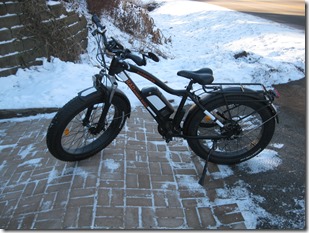
IMG_9575 Page forward to December 2018. I’m 70 and the only big moment in life I’m anticipating is my next bowel movement. No kids on the way and no demanding, unrewarding, dangerous as hell job to worry about. My grandson gave me his fairly worn-out eBike earlier this winter and I just got it back on the road. 

I bought a new winter helmet, since my usual bicycle helmet is colder than wearing nothing and isn’t really much protection. When the mailman delivered the new helmet, I had a bunch of normal errands to do and a bike ride on a 38oF December day seemed like the perfect excuse to go for a ride. I put on about 12 miles bombing around town and enjoying both the ride and my new much warmer gear (including some Bar Mitts I picked up at Red Wing Bicycle while I was downtown). Just to put some more miles on the battery and see what kind of range the bike had hauling my lard ass around town, I headed out the Cannon River Trail toward the Anderson Center at the west edge of town. I came to the gate that blocks all traffic except fat tire bikes (like mine), cross-country skiers, and hikers and scooted between the bars on to the trail. 

IMG_9591I made it about 30’ on the partially melted slush and the front tire zipped out from under me and dumped me face-first into the road. The slush was soft and slippery, but didn’t provide any buffer between me and the asphalt path. If you look at the middle of the front of the helmet, you’ll see the nice new dent I put in my nice new helmet on its first day on my head. Once again, I was knocked punchy for a few moments, but not unconscious this time. 

IMG_9589Once again, I punched a hole through my lip, but this time it was with a tooth. Once again, I coated my coat, pants, and bike with blood, but the hole was normal and self-healed after a couple of hours. Weirdly, it leaked saliva all over my lip for a couple of days, but it didn’t swell up all that much and while it pretty much squashed any whistling I might have wanted to do it wasn’t that limiting otherwise. No serious kissing, please. I might have been able to whistle through the hole before it closed up, but I didn’t think to try. Too late now. 

I wouldn’t have been out there on the snow if I hadn’t had the helmet, but I’d have been out there sometime this winter. You just have to ride snow sometime if you are going to live in Minnesota and be a biker. Once again, a helmet kept me from bashing my tiny brain out.

Oct 31, 2017

I’m Not Him, But . . .

A few years back, Sev Pearman and I took a trip toward Duluth for a day of off-road riding at Nemadji State Forest trails. I was pretty off-road rusty, from years of living in the Twin Cities and daily commuting and I was about six months away from having my left hip replaced. So, I wasn’t on my game and my left leg didn’t do me much good when I stuck it out in a corner. The day was close to perfect and the trails were wet and a little slick from recent rains and a fairly wet early summer. We spent a lot of the day sideways. I spent a moment lying in a puddle of mud with my WR spinning way a few feet, while I laughed at the miscalculation that had put me in the mud. Sev was concerned that the old fart had hurt himself and was impressively concerned for my health. Or he thought I’d had a heart attack and died. Either way, Sev proved himself to be a good friend and a solid person to ride with.

GoDecosterWhile I was righting myself and the bike, Sev commented on how much time I spent sideways and how rarely I bothered to stand on the bike. Today, I was listening to Adventure Rider Radio and a conversation/commercial for some brand of footpegs and the jock made a big deal out of how off-road riding means “never using the seat.” I’m too old for that silly shit. The fastest rider of my generation, Roger DeCoster spent at least as much time in the seat as he did on the pegs and RogerDeCosterRoger won five world championships and competed at the highest level from 1966 to 1980. I first saw DeCoster ride at the Herman, Nebraska TransAM in the 1970’s. The track at Herman was seriously rough and most of the US riders were on the pegs everywhere but in the sharpest corners. DeCoster looked like he was out for a Sunday ride around the neighborhood. There were a couple of monster hillclimbs terminating in even bigger jumps and Roger was on the pegs when he landed from those jumps. Otherwise, he was seated and on the gas hard enough that he lapped 3/4 of the pack by the end of the motos.

RogerDeCoster1977I’m not any fraction of the rider Roger DeCoster was or is, but I learned a lot from watching him ride. It wouldn’t be the first or the last time watching a worldclass athlete changed my tactics, style, or attitude. DeCoster absolutely changed how I thought about a 20 minute moto, though (although his races were 40 minutes +1 lap). I worked a lot harder at going a lot slower before I saw Roger DeCoster in person. Afterwards, I worked harder at being smoother and using less energy and, as a result, I was a good bit faster. One of the things I learned was that standing isn’t always the best riding position, even on rough terrain (even with a 1970’s suspension).

After I gave up trying to be fast, I bought a trials bike and spent a few years plonking around rocks, creek beds, and logs. Standing is the status quo in trials and the seats on that style of motorcycle aren’t worth squat. Obviously, there aren’t a lot of places where sitting on a trials section makes sense and I spent a lot of hours on the pegs. It’s not like I don’t know how to ride standing up, I’m still considerably better at low speed maneuvers on the pegs than on the seat. I'm still inclined to think Mr. DeCoster’s off-road racing style makes more sense than the “always be on the pegs” philosophy.

Sep 8, 2017

Minnesota's Off-Road Gem

All Rights Reserved © 2017 Thomas W. Day

I'm out of my depth here. I specialize in criticism, picking apart the flaws I observe in products and services, and general purpose griping about stuff in general. So, after a long, hot July afternoon at the Spring Creek Motocross Park, I don't have a thing to complain about; at least as far as the park itself and the races are concerned.

Since we moved to Minnesota in 1996, my summers have been jammed with work, travel, and play; pretty much in that order. One of the events I have consistently missed because of overbooking and poor planning has been the Spring Creek AMA Pro National outdoor motocross round. This year, purely by luck, I had nothing planned for that weekend and I kept it empty, once I discovered that happy accident.

Millville 6Once I started planning to spend a day in Millville's main attraction, I realized that the last time I was at a real outdoor motocross was in the late 70's or early 80's. I was lucky enough to see a few of the 70's Trans-AMA rounds with Roger DeCoster and crew, the 1976 AMA season and Bob "Hurricane" Hannah's first national championship season, and a half-dozen AMA national races every year until I moved to California. The year Spring Creek MX Park opened, in 1983, I arrived in southern California just in time to read about the end of the great motocross parks: Saddleback, Elsinore Raceway, Carlsbad, Corona, El Toro, Hopetown, Indian Dunes, Ontario Speedway, and Orange County International; all absorbed by the vast urban and suburban California housing explosion of the 80's. There was still outdoor motocross to see in California, but it required a hundred-plus mile trek through the city and desert. At the same time, stadium-cross was gearing up and I got large doses of an extreme version of the sport at Anaheim Stadium and the Los Angeles Coliseum. Even better, I could convince friends to come with me to those places. Getting beach dwellers to drive to Riverside is harder than teaching a cat to swim. A decade or two later, Denver and Minneapolis stadium-cross was a big step down from the L.A. experience, so my motocross spectating interests dwindled away. After moving to Minnesota in 1996, every year when the Spring Creek pro national round came around, I thought, "I should go." This year, Saturday, July 22, 2017, I made it to Millville.

Millville 1Dirt Rider magazine provides a solid blow-by-blow wrap-up of the race results (Check out http://www.dirtrider.com/spring-creek-motocross-results-2017#page-4.) and I don't have anything to add to that. I didn't attend the races as "press," so my access was no different than yours. I paid my $10 parking and $45 general entry fee. I hauled a chair, a big umbrella, lots of water, and a backpack full of electronics and camera gear, so I drove my pickup to the races. Motorcycle parking is free and right by the entrance gate, just like you'd expect from a real motorcycle event organization. I wouldn't be surprised if there were a thousand motorcycles in that area. The "overflow parking" for cagers is about a half-mile from the park entrance and I was glad I dressed for a hiking experience. The park's camping area is another parking lot a little closer to the track and I have to say I was unimpressed with motocross fans' camping etiquette. Saturday afternoon, the campsite smelled like a bunch of the campers were dumping their black water tanks on the ground. Out in the overflow parking lot, a disappointing number of young men were dumping trash into piles and setting fire to their garbage between the parked cars. Apparently, if you can't be a motorcyclist the next best thing is to behave like a drunk and brainless hooligan.

Milville 5The Spring Creek track and spectator grounds are amazing. On Saturday, it was practically a small town in itself. The variety of food available during the national event was diet-busting. The event organization was totally professional. Even the security guards were friendly and helpful. The ticket area was organized and well-run and and if you wanted to get through the lines fast, you brought cash.

Going to these races was a lot like stepping back in time to the glory days of Southern California's CMC, except for the politically-correct Midwestern electric guitar version of the Star Spangled Banner and the weirdest pre-race Road Warrior-style prayer I've ever heard. If this were a CMC event, the between-race entertainment would be a Van Halen-style band (or the actual Van Halen band) and the motorcycles would provide respite from the sound system volume. The track's PA system is adequate for between race dialog, but is pretty much buried by the 4-stroke snarl of 40 race bikes. However, the track also has a simulcast on the 107.9MHz FM radio band and if you bring a radio and some in-ear phones you can follow the jocks' conversation during the races.

Millville 2There is no one spot from where you can see all of the action on the track: the course is just too long and convoluted for anything short of a hovering blimp for an overall view. However, there are dozens of great spots to setup a shade tent or large umbrella. Most the good spectating spots are within a reasonable hike to a beer garden, food, and a porta-can. Speaking of hiking, thanks to the giant culvert-underpasses, you can hike the entire perimeter of the course. There are stairs to assist those of us who aren't mountaineers up or down the cliff known as "Mount Martin."

The track itself is a little bit of everything; from deep sand to loamy only-in-Minnesota knee-deep topsoil to hard-packed whoops on the way to the finish line. Every stereotypical bit of motocross topology is there, too: killer whoops, even bigger jumps, ruts and berms deep enough stop non-super human riders, a giant hill climb (Mount Martin) and a banzai run back down the same hill with a hairpin at the bottom, more deep sand, and another steep hillclimb and downhill, before the whoop-filled drag race to the finish line.

I've been raving about the Millville park to anyone who will listen since I got back. At least one friend, who raced at Spring Creek back in the early 80's, and I are going back for the end of the regional Millville Super Series season. I can't say enough good things about my day at the park. I'm not familiar with the warm glow of satisfaction, but I could get used to it. The organization that puts on the Spring Creek national races could consult with every other motorcycle event group in the state and improve every one of them.

Aug 14, 2017

#152 The Little League Dad Society

All Rights Reserved © 2016 Thomas W. Day

We've all witnessed the "little league dad" syndrome and some of us have suffered that arrogant, egotistical, under-achieving fellow personally. Some of us have even been stuck with little league dads and moms. Way back in 2014 (I Hate Racing #155 April 2014), I made my personal take on watching little kids on motorcycles pretty clear, "When a stadium motocross is broken up (too often literally) with a bunch of 8-year-olds plodding around a motocross track, smashing into each other and the track obstacles, I have to be somewhere else. I can't watch." Even worse, when I end up following a dad on his bike and his kid dangling from the back--feet a few inches from reaching the passenger pegs, in minimal clothing, and an ill-fitting helmet--I have to find another route to where I'm going. I've seen dead and mangled adults and I don't like it much, but I can deal with it. I'd just as soon live my whole life without ever seeing a dead and/or mangled little kid. I'm afraid I'd never be able to get that image out of my mind. I saw a dirt bike foot-peg-gutted high school kid, 40 years ago, and I'm still stuck with that image as if it happened last week.

I wonder how many parents have digested the real message behind the Will Smith movie, Concussion, or the book it is based on, Mark Fainaru-Wada and Steve Fainaru's League of Denial? As one of the doctors in the book said, "We're exposing more than 1 million kids to early-onset brain damage, and we don't know yet how to prevent it." Well, we know there are a lot more than "1 million kids" exposed to this because he's just talking about football. Between baseball, hockey, soccer, motorcycle racing, and a culture that tells kids they can knock each other around like punching bags without consequence, almost half of our kids are exposed to early-onset brain damage (resulting in chronic traumatic encephalopathy or CTE) on a regular basis. Another sports-related concussion researcher said, "If only 10 percent of mothers in American begin to conceive of football as a dangerous game, that is the end of football." Obviously, the possibility that 10% of American mothers don't "conceive of football as a dangerous game" pretty much proves that there are a lot of clueless mothers out there. Anyone who has played football for more than one afternoon knows it's a dangerous game. However, until recently we didn't know how dangerous. CTE has been found in the brains of 18 to 21 year old football players and the leading neurological researchers are now recommending that "kids under the age of 14 should not play collision sports as they are currently played. We believe they should not be playing tackle football." Likewise, it's pretty obvious that kids under the age of 14 should not be racing motorcycles. It's a well-known fact that when you're racing off road, "if you're not crashing you're not riding."

Peter Lenz, center, poses with mechanic Will Eikenberry, Dylan Code, Misti Hurst, and Keith Code. Lenz died at Indianapolis Motor Speedway.
Of course, this is an issue where following the money gets to core of the problem. Danger is why we like these high risk sports: football (394,350 injuries in 2012 with an average of 12 deaths per year for the past 25 years), soccer (172,470 injuries in 2012), baseball and softball (119,810 and 58,210 injuries in 2012), basketball (389,610 injuries in 2012), hockey, volleyball (43,190 injuries in 2012), wrestling (40,750 injuries in 2012), gymnastics (28,300 injuries in 2012), field and track (24,910 injuries in 2012), and motocross and road racing (for which there are no reliable statistics). Hell, we've even figured out how to make cheerleading dangerous (37,770 injuries in 2012). And there is a lot of money to be made (the NFL's 2014 revenue was $7.24B) exposing young athletes to death, disability, and damage to their long term mental health. However, we're just getting started with learning about brain damage and the fact that 76 or 79 studied NFL player brains found evidence of CTE hasn't sunk; especially NFL players and their families. Regardless, you would have to be delusional to imagine that motorcycle racing doesn't have these problems. The sad case of ex-NASCAR racer Fred Lorenzen is probably the first shot fired in motorsports and I suspect there is a lot of hidden damage out there in race cars, motorcycles, and every other contact sport. Now that (a few) doctors know what to look for, a lot more cases will be popping up.

The big sea change here isn't that we are surprised that long term consequences result from injuries. We expect knee, hand and arm, shoulder, and even internal injuries from motorcycle racing that will hamper the ex-racer later in life. Racing is dangerous, get over yourself, right? My hip replacement was due, according to my orthopedic surgeon, to "use and abuse" and genetic factors. Racing and riding off-road motorcycles would be major contributors to that use and abuse. I wasn't surprised and I haven't once looked back and wished I'd not ridden motorcycles when I was young and made out of "rubber and magic." The big change in attitude should come from the knowledge that "getting your bell rung" can have long term consequences to your mental health: resulting in CTE which is "essentially pugilistica dementia (boxer's dementia)" with side orders of memory loss, confusion, impaired judgment, impulse control problems, aggression, depression, anxiety, Parkinsonism, suicide, and progressive dementia. If you know your kid is being exposed to chemicals that could result in those symptoms would you keep him or her in that environment?

We use, semi-rationally, to justify risk is the associated reward. Those of us who chose to ride motorcycles, with some understanding of the risk we're accepting, have a collection of rewards that we believe makes the risk acceptable. The problem with this new knowledge is that the information is being aggressively repressed by the people who make the most money from these sports. In the case of football, the NFL has done everything possible (like Big Tobacco) to squash research and evidence that head trauma can lead to long-term cognitive problems. By "everything" I mean everything from creating bogus "research" to ridiculing researchers in public media to suing people for slander. I suppose murder hasn't been on the table, but you never know. Currently, their big argument has been that it's not "certain" that head banging is the cause of CTE. Since we're not absolutely positive that whacking on a kid's skull causes CTE, we don't have to stop it. Drug and chemical companies have used that bullshit argument for being able to continue polluting water, air, food, medicine, and the entire planet for a century. A more rational society would require the polluters to prove they aren't doing harm before they are allowed to do whatever godawful thing they want to do, but humans are mostly irrational. Maybe we're all brain damaged and it's too late to make any difference for the species?

In the meantime, I think parents should seriously reconsider the risk their children are taking for whatever weird cause they've used to justify putting a little kid on a motorcycle and putting that kid on a race track. Ten years ago, you could excuse this behavior with "it's not a problem, he'll shake it off and be ok tomorrow." Today, the evidence is good that not only will that headache and loss of memory stay around a while but it might become a whole lot worse in 30-40 years.

 MMM #183 May 2017

Jan 5, 2017

Bikes I've Owned and Loved (a lot or a little): 1975-1980 Suzuki RM 125(s)


1976_RM125A_Aussales-1_1200Over the last 30 years I’ve tended to forget about the small collection of RM’s I owned, raced and rode, and maintained. Mostly, it has been because my “ownership” was often dubious. On my old Geezer with A Grudge webpage, I didn’t list my association with the RM125 at all. I simply forgot about the bike in context with anything other than being a racer’s mechanic for half a decade. Contrary to what you might have expected from me there was no ill-will involved. I didn’t hate the RM125, as I did the Kawasaki KLR600 or the Suzuki TL250. I just never thought of them as “mine.” Maybe they weren’t.

I was wrenching for a kid who worked for me at our day job and who was regularly in contention for the Nebraska 125 Expert (A) Class state championship. For about 3 years, we spent almost every weekend together; him racing A class 125 and me in B or Enduro class and working on his bikes. Mostly I raced my Rickman 125 because it was my regular ride and it was mine. Mike had a deal with a local Suzuki dealership for super cheap bikes and below dealer cost parts. He went through a lot of parts, including engines, frames, suspension bits, wheels, etc. In fact, I occasionally had enough spares to build a spare bike or two. A couple of those bikes ended up under me when I was a B Class rider. I’m not sure who, officially, owned them. I know I sold at least one of them when I cashed out of my off-road bikes in 1981.

My impression of the RM, especially after the Yamaha Monocross bikes showed up at local tracks, was that the bike was light, powerful, and grossly under-suspended and the frame was way too flexible to be stable. I still remember riding behind one of Yamaha’s guys at a moto in Genoa, NE watching the YZ track through the ruts and over the busted terrain almost like the track were paved while I was being slung from one side of the course to the other by every large and small obstacle because the RM’s frame and suspension practically worked against each other and me.

Also, unlike the YZ’s, Suzuki’s philosophy with the RM motor was that the engine parts should break in quickly rather than last a long time. I knew winning racers in Nebraska who went two seasons on a motor, piston, and rings. Our Suzukis needed new rings every 3 motos, new pistons every third ring replacements, and 2-4 cylinders every season. If money, time, or energy made us decide to put off a ring change, Mike would always lose power toward the end of that 4th race and either ride desperately to hang on to his position or not even have enough engine left to be able to ride desperately.

If it weren’t for most of the cost being someone else’s money, we’d have dumped the Suzukis after about 1976. None of the RM cost came out of my pocket. For a lot of that period, I was still selling Ossas out of my garage shop/dealership and if I could have afforded to race what I sold I would have. I loved the Ossa Phantom 125 and it kicked the RM’s ass every time Mike and I practiced with either one of us on the Phantom. I never took a Phantom to the track though and most of my customers were play racers and didn’t put the bikes to much of a test. So, I don’t really consider the RMs to be something I either owned or loved.

Oct 12, 2015

My Motorcycles: 1975-76 OSSA dirt bikes


For two years in the mid-70's, I ran a microscopic dirt bike shop out of my garage, code name "Dirt Shop." My wife hated the name because she was constantly receiving packages at our home addressed to the Dirt Shop.  She thought the UPS guy might think the name reflected on her housekeeping. I didn't see the problem. We had two insanely active little girls, a house full of toys (the kids' and mine), and my wife is a sculptor and artist. My day job was servicing mobile electronic scales in cattle feedlots and grain mills. There was never a shortage of dirt in our household.

ossa_logo  I, mostly, fixed other guy's bikes to earn enough extra cash to support my own habit. On occasion, I found a sucker/customer for a line of Spanish motorcycles, OSSA, for which I had a wholesale deal from the Kansas City distributor. Most of the likely OSSA riders lived in Omaha or Lincoln, where there was already an OSSA dealer, but most dealerships actually needed to make money to maintain inventory. I found a few customers out in the sticks who would take that inventory off of the big city dealers' hands.  I didn't expect much out of my "dealership." I just wanted to get to fool with cool, new bikes and spend as little money as possible for the privilege.

I snagged the two pictures above from the net. Sorry, I lost the original links and haven't been able to reproduce the search since, so I can't give proper credit for the pictures. These are the two bikes I sold and enjoyed the most. I sold a couple, each, of the 125 and 250 Phantom motocrossers, a pair of Mick Andrews Replica Plonker trials bikes, and one 250 Pioneer enduro. I really thought I was doing my customers a favor, at the time. There was still some residual anti-Japanese Euro-arrogance still left in dirt biking and OSSA's were good, general purpose dirt bikes. The Phantoms were moderate suspension technology (canted and moved slightly forward) and a great rider could still hang in with the front of the pack. The Plonkers were not so easy to sell. They were under-powered, heavy, and hard to maintain. The Amal carbs were a detriment to all of the OSSA bikes, but the Plonker suffered the most from that primitive and unreliable hardware.  And trials was a sport that never caught on in the States.  The Pioneer was a really pointless motorcycle.  It wasn't a competitive hard-core enduro bike and it was not reliable enough to be considered a useful dual purpose bike.  To this day, I don't know why anyone would buy one.  But someone did.

ossphantom I rode almost every bike I sold, at least a few miles, before I found a buyer. Except for the 250 Phantoms, I usually had a bite before I placed my order but no money down. So, I got to play with the bikes like they were my own, because they were, until a buyer with cash appeared. I especially loved the Phantom 125, but never found the motivation to own one myself. The worst I ever did on an OSSA deal was break-even, including shipping, interest, and my setup labor. I thought that was as good as I could expect, considering the sloppy circumstances under which I operated.

I'm afraid that I probably left the Central Nebraska area and dirt biking about the time my customers were due to need serious dealer support. I moved about 120 miles from where my shop had been and, over the course of the next three months, sold my own dirt bikes and stopped attending events. I have no idea what became of the bikes I sold. I know that OSSA bit the dust not that many years later, leaving some resentment among the few riders who'd stuck it out over the years. I still see OSSA fanatics and bikes at the vintage events, so I guess they didn't all explode into Hollywood flames when I abandoned ship.  I don't think anyone buying a bike out of my one car garage, behind my obviously low-income house, could have seriously thought I was FDIC insured.  On the other hand, nobody ever went broke underestimating the American consumer. 

That was a weird period in motorcycle history. The Boomers were at their peak, physically and culturally. We were riding a lot of motorcycles back then, on and off-road. Unless you've been to a 1970s event, it's hard to imagine how popular, well-attended, and disorganized those events were. It was the beginning of the end for an aspect of individual freedom in the United States, mostly due to overpopulation. A half-dozen years later, the boom crashed. We quit buying, riding, and caring about motorcycles, especially off-road motorcycles in the quantities that manufacturers enjoyed during those years. The world shed itself of a dozen motorcycle manufacturers and Japan ended up owning what was left of the market.

Ossa was a crappy company with non-existent customer or dealer support, but their bikes were interesting, competitive, and distinctive. Parts were hard to come by, bikes were delivered in non-functional condition, but there was something cool about being a dealer, even at the marginal level I experienced. Uncrating a new motorcycle, with an expectant customer either calling every couple of hours or breathing down my neck, is a lot of fun.