Showing posts with label 10 favorite. Show all posts

Jun 26, 2015

Book Review: Down and Out in Patagonia, Kamchatka, and Timbuktu

downandoutby Dr. Gregory W. Frazier, 2014

All Rights Reserved © 2014 Thomas W. Day

While I've met, talked to, and even sat on a discussion panel with Dr. Frazier, Down and Out introduced me to more things about him and his past and his motorcycling adventures than I knew was available to learn. For one, who knew that Dr. Frazier was a Texas hippie? Not me. If I had, we'd have had completely different post-VBR-session beer drinking events. For two, Dr. Frazier's experiences with Harleys and Indians was a complete surprise to me.

A segment of the Motobooks press release has this to say about Dr. Frazier and his motorcycle history, "The first-ever, first-hand chronicle of Dr. Gregory W. Frazier's never-ending motorcycle ride. A little over 40 years ago, a man named Gregory W. Frazier got on his motorcycle, went for a ride, and never returned. He's still out there, circumnavigating the globe: exploring the jungles of Asia in the winter, trout fishing in Alaska in the summer, and covering all points in between during the rest of the year. He's been shot at by rebels, jailed b y unfriendly authorities, bitten by snakes, run over by Pamplona bulls, and smitten by a product of Adam's rib. He's circled the globe five times and has covered well over one million miles (and counting). During those past four decades, Dr. Frazier has been chronicling and photographing his around-the-world adventures, publishing 13 books on the subject (including one previous title with Motorbooks), the majority of which have been manuals for touring specific locations or general how-to-tour-by-motorcycle books. He has also produced 9 documentary DVDs, but until now, nothing in print has encompassed the entirety of his worldwide motorcycle adventures. . ."

I don't think any readable book could hope to have "encompassed the entirety of his worldwide motorcycle adventures," but this book does a pretty good job of explaining who Dr. Frazier is and where he's been. For $35 list ($26.15 on Amazon.com and $26.25 on Motobooks.com) you can read about Dr. Frazier's early exile from his family due to his motorcycle fixation and mediocre study habits (I never did figure out where the "Dr." comes from.) all the way to his inventive methods of financing his around-the-world adventures and his trip around the world with a handicapped passenger. In between, are his adventures, his motorcycle "education," and a lot more about the man than I've gleaned from his previous books. Fraizer is a complicated combination of humble aware-of-his-Ugly-Americanism tourist and a confident, in-crowd world traveler. He's hard not to like.

In 2010, Frazier retired from round-the-world travelling, which does not mean the same thing for him as it does for mortals, "I’m not done tasting the environments, economies and cultures of the world from atop a motorcycle. There are still plans to attempt reach distance places, as well as to return to some I want to see more of, like Colombia and Brazil in South America, as well as more of Eastern Asia and Africa. I merely plan to quit this foolish squandering of travel funds to transport motorcycles over water. 75% of the earth is water and the increasing costs and bureaucratic hassles associated with transporting motorcycles to the remaining 25% have been seriously cutting into my remaining travel years and project budgets."

Down and Out provides a lot details about the cost and complication of those "projects," but it would require a whole book to fill in the blanks if you are hoping that reading this book will put you in a position to fill Fraizer's shoes. As he says, more than once, he was fortunate to have been bitten by the travel bug at a rare moment when politics, economics, accessibility, and temperament all aligned to allow him to go the places he went relatively safely and inexpensively. Many of those places are unstable and insanely violent today. Even more of those places are specially hostile to Americans (although Fraizer often identified himself as a "Canadian"). So, reading Down and Out has an aspect of a time piece and a history book. Still, brave people are riding motorcycles in remote and hostile places every day and Dr. Gregory Fraizer has been an inspiration to many world travelers. This book will be one more stone in the staircase he has built to put us all on the roads around the world.

Jul 2, 2012

What's the Opposite of a Grudge?

A couple of weeks ago, I listed ten (just to keep it short) companies, products, and concepts that have earned my long-lasting distrust. During the following week, I ended up at my neighborhood motorcycle accessory store buying replacement summer gloves and discovered that I naturally passed over several brands because of mediocre past experience and immediately picked out a couple of versions from the one brand the store carries that I generally like. From that experience, I decided to list a few of the companies, products, and concepts that I have (probably) unreasonable faith in
  1. icon -- icon is, in fact, the company that provided the motivation for this rant. Some time back, I reviewed a pair of mid-priced icon gloves. Five years later, those gloves are still providing good service. A few years later, I reviewed a pair of icon ventilated pants that I still wear, often. Both products have been reliable, tough, and functional. When I stood in front of that rack of gloves, icon was my only real options, since I've been burned by TourMaster, Alpinestars, and FirstGear. Joe Rocket was an option, but the first pair of gloves I picked up had failing seams, I went for the icon twenty-niner and have been very happy with the choice. Lousy gloves are a memory that sticks with a rider for a long, long time. Good products have the same sticky quality.
  2. Aerostich -- Just mentioning this brand is 'nough said. Aerostich makes great products and I've reviewed so many of them that it would take a page just to list the wonderful products I've bought from the company. Even the products they carry that are manufactured by other people are checked out as thoroughly and supported as consistently as their own stuff. Aerostich/Riderwearhouse is a great American-made company.
  3. Yamaha -- Over the years, I have owned a variety of Yamaha motorcycles and scooters.The first was my wife's MX100 which gave her spectacular service for years before she sold it. She has nothing but fond memories of the bike and out grandson still wears her old bumblebee yellow Yamaha jersey. My first Yamaha street bike was a 1982 XTZ550 Vision that suffered at least 50k miles of LA commuting traffic before I sold it and bought a 1986 Yamaha XT350 that I still regret selling almost a decade later. Along with the XT, I owned a 1983 Vision that moved me from California to Indiana to Colorado and, finally, was sold for a profit to a guy who drove his truck all the way from LA to Denver to pick it up. My 1986 TY350 was and is, likewise, one of my all-time favorite motorcycles along with the pair of 1992 850 TDM's I owned and loved. The current mechanical love of my life is my WR250X, the most fun motorcycle I've ever ridden. The Super Ténéré I reviewed last week joined the list of impressive Yamaha motorcycles I've experienced. I've only owned one Honda, but it was an equally excellent motorcycle. My experience with Suzuki has been less consistent. My two Kawasaki's have been disappointing.  Yamaha has done very well by me and that makes any Yamaha vehicle look a little better than the rest, in my view. 
  4. Dell Computers -- I own four of them: two Latitude 410 laptops, a desktop tower, and the 1012 Netbook I'm working on as I write this. The Latitude 410's were the convincer for me. After wearing out a half-dozen laptops on my motorcycle trips, including two of the grossly misnamed Panasonic Toughbooks, I stumbled on the 410 just before I left for Alaska. 70,000 miles and hundreds of hours later, that first unit is still working. So, I bought another. And another. And . . . Dell's customer service has been exceptional and knowledgeable, on the rare occasion I've needed it. 
  5. Avon Tires - Way back in the 1970's, I was commuting about 60 miles a day in a VW Beetle. The Nebraska roads were poorly maintained, there was often black ice and drifted snow to contend with, and I went through a VW motor about every 60k miles and a set of tires every 15k. A rally driving friend recommended Avon tires and I bought a set. They outlasted the VW's motor and were great on those crappy roads. The whole time I lived in California, all of our cars wore Avons, but I didn't discover Avon motorcycle tires until I put a pair of Distanzias on my V-Strom. After getting 3-5k out of the previous rear tires, I doubled that with the Avons. I don't drive that much these days and my car tires usually dry out and start weather cracking before the treads are 2/3 used. I put pretty much anything that fits on the cage and, sometimes, I go cheap on the bike when city commuting is the primary task. When I'm going long on the bike, I'll go with Avons. I have never been disappointed with an Avon tire.
  6. Chase Harper - Currently, I do not own any of their products. However, I have had several in the past. Their product support (warranty and repairs) is second to none. I owned a pair of Grand Millennium 4000 saddlebags for 30 years and wore them out, twice.  The company not only repaired the bags under warranty both times, but they upgraded the bags to current design standards each time. 
It's a short list, I know. I imagined I'd come up with at least ten companies, but I didn't come close. I've hung on to this post for a couple of weeks, hoping that I'd remember a few more companies on my preferred vendor list. There aren't many to choose from. Forty years ago, a Peavey sales manager explained to my partner why Peavey products were such crap, "Dan, there will never be a pre-CBS (Fender or Harley) Peavey market. We don't want any of our current products having to compete with our older products." Most modern corporations can make that same claim. None of their new stuff will last long enough to leave a memory for the majority of consumers.

An executive I worked with three decades ago once complained that "customer loyalty" is dead. He was the kind of guy who believed that warranties are made to be ignored and all of the inventory of a crappy product should be sold before the product is abandoned. He argued that our customer warranty database was a waste of time and effort, even though we were one of the few companies that stored the data customers filled out on those usually-worthless warranty registration cards. For ten years, I beat back this guy's arguments and we developed a loyal customer base that had high expectations of our company and paid a small premium for our products. A few years later, the company moved production to China, shipped a collection of marginally reliable and under-performing products, and wiped out thirty years of reputation in a few short years. Now, they are one of many equally positioned companies and battle for the lowest cost point, since customers are no longer loyal to the brand.

Customer loyalty is a two-way street. To get it, a company has to be loyal to its customers. Most companies can't even manage to be loyal to the country that provided the resources for their existence, let alone the customers who buy their products. The cost for that disloyalty is that the products become a commodity that can be purchased equally reliably -- or unreliably -- from any vendor. Once you're in that world, the only advantage you can offer is price and that means quality is sacrificed even more and customer loyalty slips away even further.

The high price for maintaining customer loyalty is beyond the capability of most corporate management. In my life, that has been the most obvious thing that is slipping away from US corporations; management with ability. The skills that we have lost and are least likely to regain are intelligent, skilled management with foresight. We can't build stuff because manufacturing management requires the most energy, talent, and commitment. Any lazy idiot can invent fraudulent security "instruments" and sell them to other fools; as long as we're willing to give up on being a nation ruled by law. The few companies that still do business responsibly and are customer-oriented deserve our business more today than ever.

Dec 13, 2010

My Top Ten Bike List #10:

This is it, my last pick of ten. So far, my list includes the following 9:
  1. 1988 Honda NT650 Hawk
  2. All versions of the Montesa Cota trials bike
  3. All models of the Honda Transalp XL600V
  4. Yamaha's SRX Series (250, 400, and 600cc)
  5. 1992 Yamaha 850 TDM
  6. 1977 Yamaha IT175D
  7. BMW R 80GS Paris-Dakar Special
  8. Honda EXP-2
  9. Yamaha XT350
This is a pretty complete list, from me, and I'm running out of motorcycles to add to the group. You'd think someone as old as me would be at the other end of the spectrum; with more favorite toys than room to list them. Sorry to disappoint. Most of the motorcycles I really would have loved to love have been unavailable in the US and I've only had the opportunity to drool at the idea through magazine articles. One thing I've discovered through experience is that long distance love is usually misplaced. Things look better from a distance than up close. So, I'm tempted to say "I'm done at 9."

That wouldn't be fair. In fact, I own one of my 10 favorites and it could be my last motorcycle. This affair started with the first edition, the 1999 Suzuki SV650, which I rode for almost 50k trouble-free miles before trading it for the newer, more multipurpose, fuel-injected version, the 2004 V-Strom. In fact, if you look at the picture of my SV you'll notice that it was heading toward becoming a V-Strom before I sold it. Now, approaching 50k miles on the V-Strom, I'm as happy with the DL650 as I was when I saw the first version of this motorcycle at the Cycle World Motorcycle Show in 2004.

I've already posted dozens of pictures of this bike and my adventures on it on this blog, so doing it again is probably idiotic. But he's a rare shot of the bike in clean condition. If you want to see a few more, go here. Or check out the June 2009 North Dakota Tour blog entries or the August 2008 Nova Scotia tour stuff. Eventually, I hope to do something with my 2007 Alaska pictures and video, but that might be a lost cause. The V-Strom has taken me places I've always wanted to experience. Five guys on V-Strom 650's toured from the tip of Venezuela to Prudhoe Bay, Alaska and, other than damage caused by hitting a British Colombian moose at speed, all 5 bikes and guys made the trip without incident.

The V-Strom 650 is everything I expect and almost everything want in a touring motorcycle. It gets reasonable mileage (43-58mpg, depending on conditions and speed). The stock suspension is almost dirt-capable. The motor is tough, starts easily and reliably at any temperature or altitude, and fairly easy to maintain. The brakes are powerful, reliable, and predictable. It's comfortable for long miles. The V-Strom is capable of mounting luggage that will hold all of my stuff and has room for my grandson or my wife. It handles well on freeways and limited-access dirt roads. The top speed is faster than I need to go and all-day cruising speed is anything between 55 and 95. The headlights are the best I've ever experienced. The stock exhaust system is stainless steel and quiet as a cage.

So, without any question I put this bike on my top-ten list. Some of the other bikes may fall off of the list, but the V-Strom will be there for a long time. It would be disloyal to do otherwise.

Aug 13, 2009

My Top Ten Bike List #9: Yamaha XT350

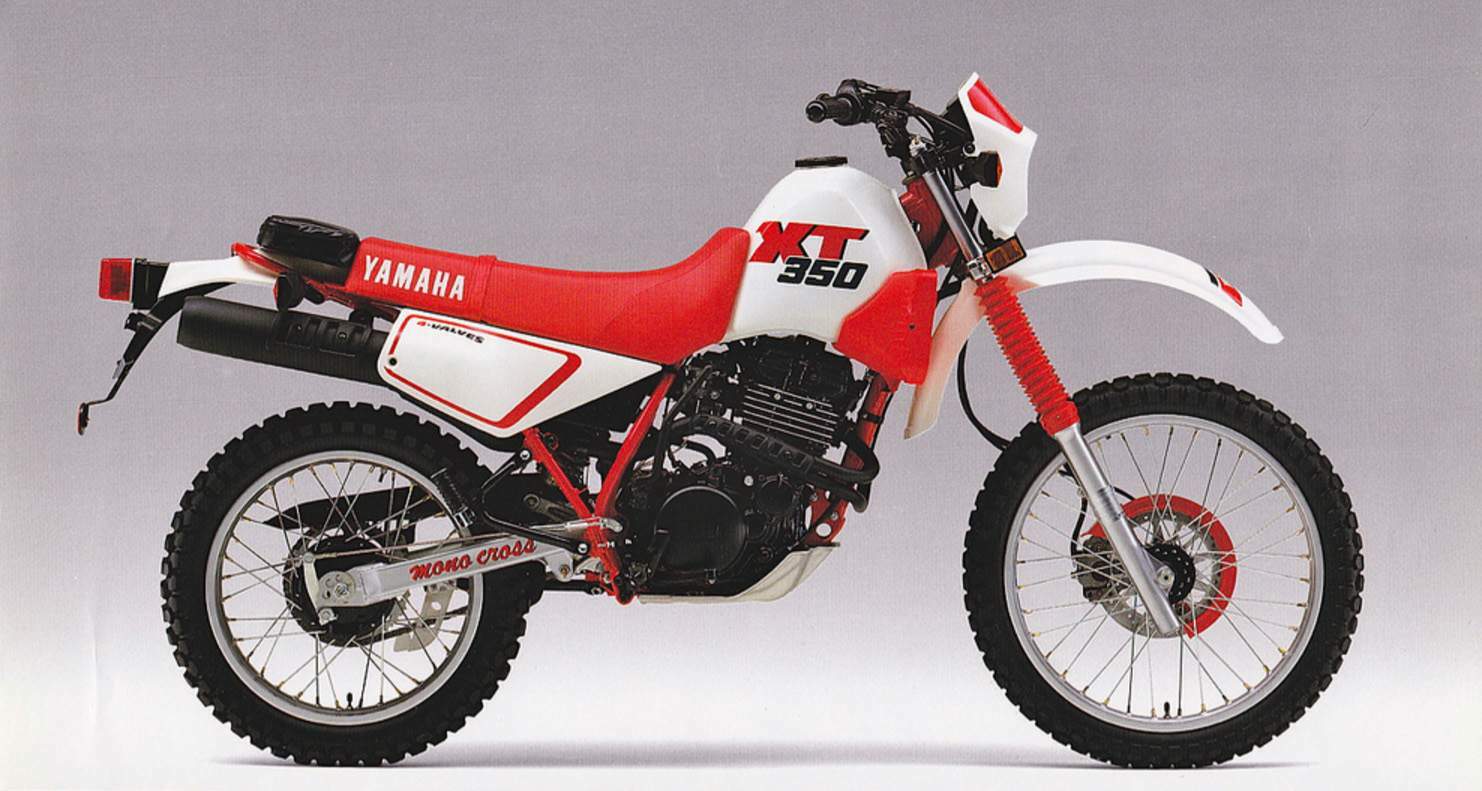
https://www.motorcyclespecs.co.za/Gallery%20%20A/Yamaha%20XT350-87.jpgNow we are getting down to it. The first 8 picks in this list of ten were easy. The last two will be hard, mostly because they are the last two. Once I've made this choice, I only have one pick left and I'm done. No more flexibility. No going back. I'm on record until the record disappears. I'm, of course, tempted to pick something really flaky, like a 1979 Rokon Scout, one of the ugliest, most practical off-road vehicles ever made. But it really isn't one of my favorites. It would be cool if it was, but it isn't. This is hard. I might not have ten favorite bikes. What do I do then?

Aw hell, I know one of the last two has to be the most reliable, fun, versatile, comfortable, useful, easy to service motorcycles I've ever owned; the Yamaha XT350. For many, this will seem like a boring, predictable, common pick for a "favorite motorcycle." You're right. Of all the bikes I've owned and sold, my 1986 XT350 is really the only bike I wish I'd never sold and the only bike I ever owned that I'd like to have back.
From 1981 until 2000, Yamaha made this little enduro over and over again. Sometimes, it got a new paint job, usually it was white and red or white and blue. It's a brick of a bike and it handles well on and off road.

I bought my 1986 XT350 in 1989. I had two years left to get my degree and escape from California. That meant I would be commuting via side streets between Huntington Beach and via PCH to Long Beach 5-7 days a week. The 405 was not an option because it had long since become a parking lot. Commuting via PCH means that you are either splitting lanes during rush periods or you are parked. It also means that you might find yourself squashed between a dozen cars in one of California's famous multi-car pile-ups. Riding a little 350cc enduro meant I could escape traffic easily finding room to split lanes and I could escape being squashed by jumping curbs and hiding from the multi-car events sitting on a sidewalk or in someone's flower bed. I did both, often.

I put 35,000 miles on my XT between 1989 and 1995, when I decided, foolishly, to sell it. My life was overly busy during those last couple of years and I couldn't seem to find the time to get the jetting right for Denver's mile high atmosphere. My bike was dead on for the California beach, but always too rich in Denver. Today, it would be a snap for me to figure out that simple problem, but in 1995 I was so disconnected that I couldn't have fixed a toaster. Bad timing, bad thinking, and a bad decision. I've watched for another XT for more than a decade, but people don't sell those things. It took me four years to snag one in LA. In Minnesota, I probably won't live long enough to get lucky again.

This is a mildly emotional pick. The XT saved my ass dozens of times. It took me places I wanted and needed to go. I burned about a thimble of gas every zillion miles. It always started on the first kick. I have nothing but good memories for that motorcycle.

Here's the rest of the list, with only one bike left to pick:

  1. 1988 Honda NT650 Hawk
  2. All versions of the Montesa Cota trials bike
  3. All models of the Honda Transalp XL600V
  4. Yamaha's SRX Series (250, 400, & 600cc)
  5. 1992 Yamaha 850 TDM
  6. 1977 Yamaha IT175D
  7. BMW R 80GS Paris-Dakar Special
  8. Honda EXP-2

Aug 6, 2009

My Top Ten Bike List #8: Honda EXP-2

My #8 favorite is so similar to my #7 that some of you probably think I'm slipping past senile into retarded. Could be, however, to me the two are radically different. For one, the Honda EXP-2 is made of unobtainium.

Back in 2003, Honda was set to storm the off-road world with a 2-stroke that did everything 2-strokes supposedly can't do. Sure, the 400cc single made big power, 54hp with 58 ft/pounds of torque, but it did it with scarce emissions and terrific fuel economy; two characteristics unknown to 2-strokes. The links at the bottom of this article take you to places where a lot more information is held. These guys even got to ride the EXP-2, something I'll never do.

You can find the specs on Motorcycle.com's Quick Take: Honda EXP-2 and Honda EXP-2: The Return of Two Strokes? Their stories only makes me jealous that I don't have serious connections to the world of motorcycle development. This was one cool motorcycle that could have meant a radical change in motorcycle technology. In 2002, Honda won the under-500cc class and the Experimental class and came in 5th overall at Granda-Dakar. The bike made the same torque and nearly the same horsepower as the 780cc 4-stroke twin Honda had been racing, but was 118 pounds lighter.

In 1998, Honda anticipated this would be a production bike by 2000. In 2003, it was on its last legs even while Honda was promoting the technology to magazines and events. Then . . . poof! It was gone. Mostly, I love the bike because the leading-edge technolgy Honda was working on. Too much of motorcycle engineering is about yesterday's styles and technology that's long been applied to cages and lawn tractors (fuel injection , electronic ignitions, electric motors for example). The EXP-2 was an attempt to do something first in a motorcycle motor. I can't remember the last time that happened.
Here's the rest of the list, so far:
  1. 1988 Honda NT650 Hawk
  2. All versions of the Montesa Cota trials bike
  3. All models of the Honda Transalp XL600V
  4. Yamaha's SRX Series (250, 400, & 600cc)
  5. 1992 Yamaha 850 TDM
  6. 1977 Yamaha IT175D
  7. BMW R 80GS Paris-Dakar Special

My Top Ten Bike List #7: BMW R 80GS Paris-Dakar Special

If any vehicle ever "proved" that "beauty is in the eye of the beholder," I think the 1980 BMW R 80GS Dakar is the evidence. To me, everything about this motorcycle screams "ride me somewhere nobody else can go!" I'm not exaggerating when I say that this bike is my standard for motorcycle style and beauty. Yeah, I said it, "beauty." I love the wayt this bike looks. If I could ever afford one, I might swear off owning any other motorcycle ever again. To my eye, no street-legal poroduction bike even comes close to being cooler than the R80 G/S Paris-Dakar Special.

The incredibly basic air-cooled, twin-cylinder horizontally opposed Boxer four-stroke is the epitome of "basic." The motor is a pushrod-lifted, 2-valves-per-cylinder, moderate-compression (9.3:1), fuel-insentive, kick and electric-start 55hp picture of simplicity. BMW bent over backwards to make this motorcycle field-servicable and the field they intended it for can be any place you find yourself stranded.

This 355 pound (160kg) bike is suspended by a pair of Maico forks with 10.6" (270mm) of travel and canted Bielstein shocks providing 6.7" (170mm) of rear wheel movement. The frame provided nearly 10" of ground clearance, which meant a seat height of almost 34" ( a problem for shrimps like me). The small front disk and rear drum brakes are pretty pedestrian by today's super-disk standards, but they worked; wet and dry.

One of my personal heroes, Gaston Rahier, won Paris-Dakar in '84 and '85 on a BMW-prepared version of this bike and the company sold an autograph model called the "Paris-Dakar Special" for several years afterwards. The 80G/S is my favorite of the lot. Part of my bias is that the 80G/S is the only "enduro" BMW ever made that is close enough to the ground to allow me to swing a stubby leg over the seat and reach the ground afterwards.

You could say that it's unrealistic for me to call this a favorite, since I've ownly ridden the bike once in my life and that was a ride that was about as far from a serious dual-purpose test as anyone can imagine. Hell, it didn't even have a full 8.8 gallon fuel tank, so I didn't have the whole "experience" of trying to hoist the real weight of this bike even on my city ride.

I can't argue with or help you there. I have loved the way this bike looks and the way it works since the day I saw a California neighbor pull into his driveway with a pair of used Paris-Dakar Specials strapped to the back of his pickup. With more than a little envy, I will never forget his having found the two 80's for sale in the California desert for exactly the same price ($1600) that I had paid for my crappy used Kawasaki KLR600 that same week. After a year of farkeling my KLR, it wasn't even a fraction as tough, useful, or cool looking as his regularly desert-abused BMWs.

Many of the specs for the Paris-Dakar Special are here: http://www.motorcyclespecs.co.za/model/bmw/bmw_r80gs_paris.htm.

Specs are nice, but this bike simply felt competent from the moment I rode it out of my neighbor's driveway and headed down PCH toward Laguna. If I hadn't been married with children, I might have kept going to Mexico and never returned. My neighbor could have consoled himself over the loss by confiscating my KLR. Sucker.

Here's the rest of my 10 Favorites list:

  1. 1988 Honda NT650 Hawk
  2. All versions of the Montesa Cota trials bike
  3. All models of the Honda Transalp XL600V
  4. Yamaha's SRX Series (250, 400, & 600cc)
  5. 1992 Yamaha 850 TDM
  6. 1977 Yamaha IT175D

Jun 10, 2009

My Top Ten Bike List #6: 1977 Yamaha IT175D

This list has been a while in construction, mostly because I'm procrastinating. So far, I've listed:

1988 Honda NT650 Hawk
All versions of the Montesa Cota trials bike

All models of the Honda Transalp XL600V
Yamaha's SRX Series (250, 400, & 600cc)
1992 Yamaha 850 TDM


And I'm half-way done. The list is in no particular order, so don't try to invent significance from the fact that I started with a street bike and have ended, so far, with another street bike. Most of the bikes I've loved over the years have been dirt bikes and regardless of how this list plays out, that will always be true. The older I get, the less in love I'm falling with specific motorcycles and the more I look at two-wheels as transportation rather than something more emotional. That means I'm having to drag up those old emotional attachments and apply some kind of value to those memories. Laugh, you damn kids! Wait 'till you're ancient and barely getting around without the help of Jack Daniels and an afternoon nap.

Anyway, number six: the 1977 Yamaha IT175D. This bike was the first motorcycle I'd ridden that I could wheelie easily and long. Don't ask me why, I couldn't explain it to save your life. The IT175D is a lightweight, two-stroke, reed-valved, mono-shocked, six-speed, drum-braked, dual purpose from the days when a bike like this might end up with a license plate in many states (such as Nebraska). No turnsignals, no electric start (no battery), no horn, and I don't remember if it had a brake light, but I suspect it did not.

The ride ripped. Of course, I was still riding a 1974 Rickman 125 when I test rode the IT175, so my opinion was moderated by the mediocre bike I regularly rode. However, the motor was way cool, once you got it off of idle. Maybe the first 1,000 rpm was a little mundane, but the next 10,000 wound up and got the bike moving incredibly quickly. The suspension, by today's standards, was pretty old fashioned but it was amazing in 1977.

Today, I admit the IT looks pretty mundane, but in 1977 I thought the all blue, uber-functional cosemetics were totally hip. Everything about this bike says, "Take me somewhere dirty and let me go fast." My firs ride on the IT was outside of Hastings, Nebraska when a dealer foolishly let me take the bike out for an afternoon under the crazy assumption that because I had a job in 1977 (unlike most everyone in Nebraska that year) I might buy a motorcycle. There was no chance that I would cough up the one-thousand-something it would have required to buy that bike brand new in 1977, but I didn't have the heart to tell the dealer that because. . . he wouldn't have given the bike to play with if he'd have known.

Anyway, I headed out of town via residential streets until I hit a dirt road borded by a nice wide ditch. Once I dropped into the ditch, I started playing with the throttle and discovered I could do a long, balanced wheelie in 2nd gear. I did that for a while until I actually got bored doing something that I'd never been able to do before. So, I shifted to 3rd and kept going. I must have burned up a 1/4 tank doing ditch wheelies. I don't want you to think this bike, all by itself, taught me how to wheelie. I could consistently pull the wheel up and get over large and small objects comfortably on everything from my Rickman ISDT to my godawful Suzuki RL250 trials bike. However, I couldn't think of a reason to do long, obstacle-free exhibition wheelies, so I never bothered to do them. Until the IT175 test ride. That bike pulled the front wheel up and kept it up so easily that I became infatuated with wheelies for part of an afternoon.

After the wheelie experiment, I ended up at a local motocross practice track and took advantage of the IT's monoshock suspension and low weight to turn times close to what I could have managed on the Suzuki RM125 I usually rode at the track. The IT was a lot more fun, though. The extra horsepower on a similar frame made for bigger berm busting, consistently double-jumped whoops, and less time on the pegs as the monoshock sucked up the ripples on the straights and the impact of landings after jumps.

Everything about the IT175 said, "Buy me." I would have if I could have. My long-term allergy of short term credit was all that kept me from putting my name on a dotted line. If I'd have become an IT175 owner, I'd have riddend a lot more enduros, figured out adventuring touring a lot sooner, and I'd have probably hurt myself going over backwards showing off my new wheelie technique.

--

Jul 24, 2008

My Top Ten Bike List #5: Yamaha 850 TDM

One of my favorite bikes, ever, happens to be one I owned, twice: the 1992 Yamaha 850 TDM.


This bike had everything I ever wanted in a motorcycle, almost. I've written about it before, on my home website: http://home.comcast.net/~twday60/850tdm.htm. So, there isn't a lot of point in restating words from my past.

When the TDM first arrived in the US, practically every bike rag said ugly things about the bike's appearance. They called it "bug-eyed," "ungainly," and "a collection of assorted spare parts." 15 years later, every Italian manufacturer is making a bike that owes most of it's lineage to the Yamaha TDM and it doesn't seem to bother anyone that these bikes could easily be mistaken for the TDM. Yamaha didn't give up on the TDM, they still sell a version of the bike in Europe and Japan. However, they gave up on the US market in 1993 and we haven't seen anything as interesting from Yamaha TDM 850 since.

One of the cool side-advantages of picking the TDM is that I get to include it's relatives: the Super Tenere' and the TRX 850-900. Both of these near relations are Europe-only releases, so like the majority of the coolness that the TDM represents (years 1994-present), the US wasn't cool enough to be part of the show. Regardless, I think the XTZ 750-900cc Super Tenere' is one of the hippest DP bikes ever made and the TRX is a prototype of the kind of all around standards/sport bikes that Europe would be copying for the next two decades.

Jul 12, 2008

My Top Ten Bike List #4: Yamaha SRX Series (250, 400, & 600)

I'm pretty sure I'll hear that I should be embarassed about this selection: Yamaha's SRX Series (250, 400, & 600cc) .

The 1988 600cc version is pictured on this page, but I love 'em all. Probably, knowing my state of motorcycle perversion, I loved the 250 the most. The single-cylinder, balance-shaft-smoothed, single overhead cam motor has a kind of mid-tech simplicity that really tripped my trigger. The two stage carbs (like the XT dirt bikes of that period) was a bit of high (for the time) tech engineering that added bandwidth and performance to the SRX bikes. The sturdy but lightweight metalic-painted steel frame and cool looking alloy wheels created a striking, functional bike that has yet to be beaten for trick-ness. I'd buy one today if I could find one. In fact, when I was unemployed a few years back, a 600 SRX showed up on Craig's List and I went after it as if I actually had money. I still regret that someone beat me to it.

Yamaha made the SRX models from 1985 until 1997, but the 400 barely appeared in the US and the 250 was only bootlegged here. The 600 was available (and ignored by the buying US public) from '85 to '89, sort of. The dealers I knew had '86 bikes until '89 and relabeled them if they bothered to try to move them at all.

The specs are underwhelming:

Detailed Specifications:
ENGINE
Type: 4-Stroke, SOHC, 4-valve, Single Cylinder
Displacement: 595 cc
Bore and Stroke: 94.0 x 84.0 mm
Compression Ratio: 8.5:1
Maximum Torque: 34 ft·lbf @ 5500 rpm
Maximum HP: 40 hp (30 kW) @ 5700 rpm
Carburetion: 2KY27PV
Oil Capacity: 2.5 Quarts
Transmission: 5 Speed

CHASSIS:
Overall Length: 82.1 inches
Overall Width: 27.8 inches
Overall Height: 41.5 inches
Wheelbase: 54.5 inches
Ground Clearance: 5.7 inches
Seat Height: 30.3 inches
Dry Weight: 329 lb.
Wet Weight: 375 lb.
Fuel Capacity: 4 Gal.

But the bike outperformed the sum of its parts. Anyone who owned one expected a fortune in exchange for a title. The SRX6 sold for $2495 list in 1988, but if you can find one for less than $3k today, you are scoring a big one.

May 2, 2008

My Top Ten Bike List #3: Honda Transalp XL600V


Since I first saw a Transalp, in 1987, this bike was high on my list of all time favorites. The Transalp didn't last long in the US, but it's alive and well in the rest of the world. More evidence that we're too dumb to reproduce in the US. The photo on the right is the 2008 model. This, of course, is zillions of times cooler than the coolest bike imported into the US.

The XL600V was a 450 pound, V-twin, 4-stroke, with a semi-Paris-to-Dakar styling that was ahead of its time. It wasn't fast, it didn't have a monster suspension, it wasn't flashy. It was just a solid, reliable, easy to ride bike that could carry you across the country, deserts, mountains, and lousy roads without worry. Every once in a while, a used Transalp appears on the want ads and it always vanishes faster than free money.

Feb 25, 2008

My Top Ten Bike List #2: Montesa Cota Trials

#2 on the list is all of the versions of the Montesa Cota trials bike. Every one ever made. I think they are among the most beautiful vehicles ever designed by anyone.


I first ran into this bike in the mid-1970s and was blown away by the bike. It looked, worked, and rode like a dream. The Cota made everyone a better rider, even untalented, uncoordinated, balance-disabled clunkers like me. I was selling Ossa Mick Andrew's Plonker replicas at the time, but the Cota was a far better bike. The 125, in particular, was the best beginner bike of the time.

When Honda bought into Montesa, the best just got better. World champs, Dougie Lampkin and Takahisa Fujinami dominated the world round for a decade on Cotas. Personally, one of my favorite moments in my writing life came when I lucked into interviewing an old hero from the boom days of US trials, during the 1970's. I'm still not clear on what lured Martin Belair from Southern California to Minnesota, but I will always be grateful for the opportunity to talk at length with Martin about motorcycles, great trials riders, his own experience near the top of the US game, and everything between and around those subjects. Martin was the US distributor for Honda Montesa, until Honda decided the US market was too small, too unpredictable, and unprofitable for Montesa and discontinued importing their trials bikes into our country. When that dried up for Martin, he packed up his family and returned to sunny California where he occasionally sends me a "glad I'm not there" email bragging about the perfect weather and his distain for down-filled clothing. Martin rebelled against the Minnesota funny hat fashion statement and managed to spend every winter in short baggy pants, regardless of frostbite and practical sense.

My Top Ten Bike List #1: Honda NT650 Hawk


After seeing the Ten Best Designs article in MCN this month, I decided to post my own, one-at-a-time. This list is not necessarily in order of preference. I'm just listing my favorite bikes, by design, as I think of them.

My first pick is the 1988 Honda NT650 Hawk. Ahead of its time, the NT650 had a super cool dual spar aluminum frame frame and single-sided swingarm and was advanced for 1988 and is pretty far ahead of most sportbikes today. If there was one, the downside was the mild-mannered twin-cylinder motor. Honda over-estimated the public's ability to deal with future-think. The bike bombed. In 1992, Honda was still trying to unload 1988 models.
Regardless of the marketplace, I think this was one of the most fun-to-ride bikes ever. A friend owned one and every time I visited him I borrowed this bike. The thing most obvious about the NT650 was that the frame, brakes, and handling were way above the motor's capability to get the rider into trouble. It is a great ride, especially when corners are so tight that the lack of a 110+ mph speed motor doesn't seem an inconvenience.