Showing posts with label personality. Show all posts

Jul 20, 2024

My Pace, My Path, My Objectives

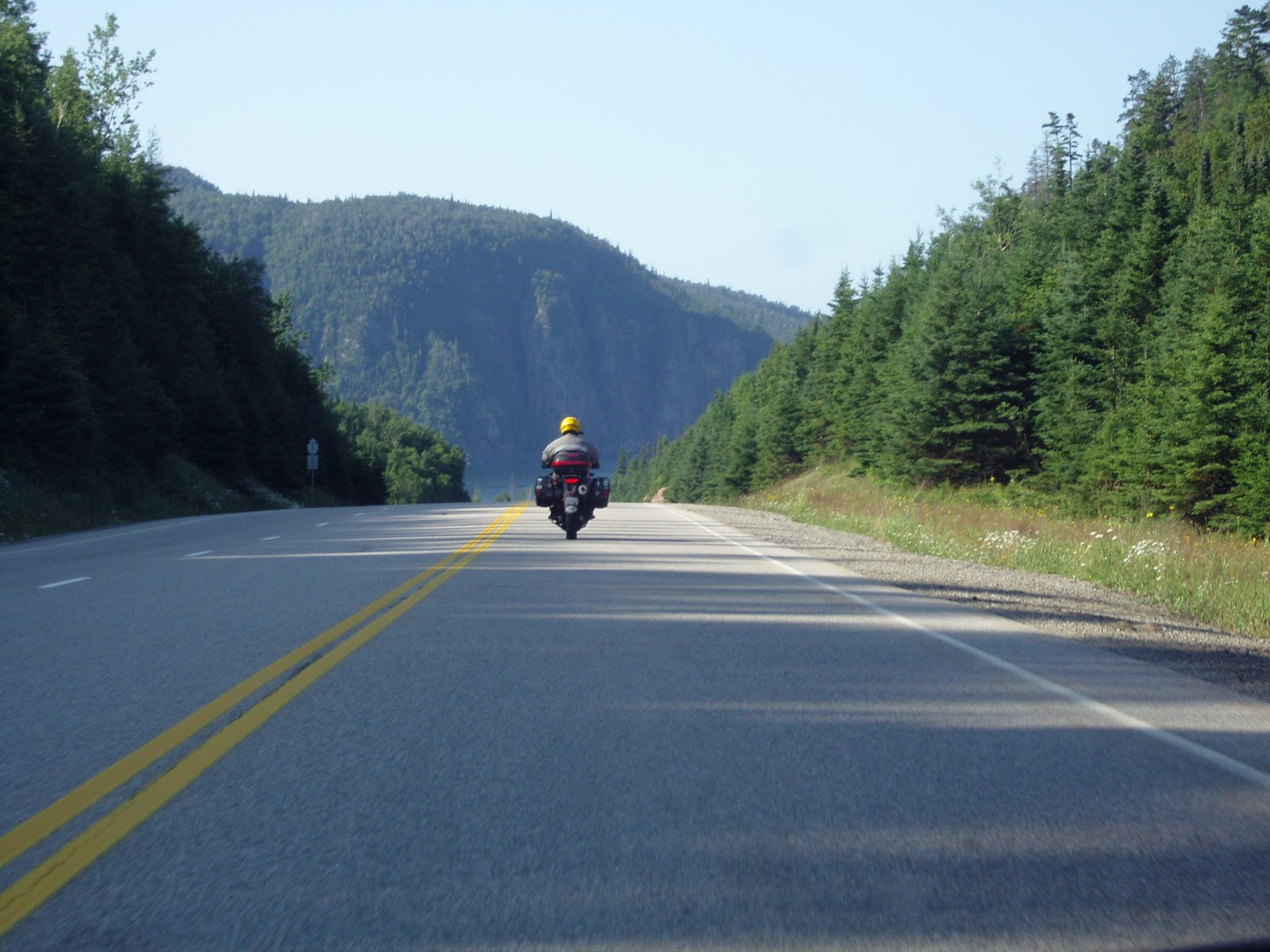
For more than 60 years, the ONLY time I have been in total control of what I’m doing, how fast I’m doing it, and why I’m doing it have been on a motorcycle. I came from a fairly large (5 brats and two semi-adult parents) family and I was the oldest and designated babysitter, cook and bottle-washer, and the official family black sheep. When I abandoned my father’s nuthouse the summer I turned 16, I went from that over-complicated situation to even crazier 1960’s rock-and-roll bands, marriage at 19, and the next 40 years of occupational and parental over-stimulus non-stop; unless I was on a motorcycle.

Other that a few trips with close friends and one decidedly wrong start to the trip of a lifetime with someone Ms. Day had picked to babysit me and one anniversary trip with Ms. Day and a small portion of my 2008 Nova Scotia Canadian tour, I have always traveled alone by motorcycle. Even when I have been on a ride with a friend, my preferred plan is to designate a general time and specific place to meet at the end of the day and for each of us to find our own way to that location at our own pace.

For almost all of my 76 years I have been the poster boy for failing at “to thine own self be true” because I had no idea who I was. In the early 80s, in a “Career Planning” class at OCC, I took the Myers-Briggs Personality Test. Say what you will about how obsolete that test is, but when I received my dot-matrix printout of my personality results (INTP) it was all I could do to keep from crying during the class. It was the first time in my 35-years that I felt anyone actually “knew” me and that “someone” was an 8-bit, IBM mini-computer.

I am not just “a little” INTP, either. Those measurement bars were pinned to the far end of each characteristic. The intended outcome of that test was for us to plow through a 4” thick book of occupations and find jobs that were suitable for our personality types. INTPs are fairly rare (not in a good way) and, at that time, that giant book of occupations recommended only four occupations. Not helpful, especially for me since “engineer” was not one of the four and I had been making a living as an electronic engineer for a dozen years by 1984.

Worse, everything about being a 1950s kid ruled against the “I” characteristic in my personality type. When I grew up, in the age of How to Win Friends and Influence People, “introversion” is old psych-jargon for homosexual or worse. Giving in to my natural inclinations was the fast route to unemployment and social stigma. So, for the next 40 years I ignored the “I” and concentrated on making the best of “NTP” (my Intuitive, Thinking, and Prospecting traits). And that, occupationally, worked for me right up to when I retired, mostly. It kept me employed, anyway.

For my family and friends, however, ignoring my introversion meant that i spent a lot of my “off-camera” time suffering from an “introvert hangover”: “a metaphorical state of emotional and mental exhaustion. It occurs when an introvert has spent an extended period interacting socially, leaving them drained and depleted.” “Drained and depleted” enough that I would rather risk being bitten by a rattlesnake backpacking alone in the Texas desert or left injured and stranded anywhere from Baja, Mexico to Alaska to the empty backroads of Newfoundland and New Brunswick to Montana or Wyoming’s empty, abandoned wastelands than talk to one more person, no matter how much I loved them. And that is where motorcycles came into my life in a dominant way from around 1969 until a few years ago.

I had been backpacking the wilderness of every place I’d lived, from Kansas when I was a kid to California when my daughters were teenagers, but backpacking usually required a lot of prep time and energy and, often, I didn’t have those resources in any quantity. At the most hectic period of my life, when we lived in California and our daughters were teenagers, I would often have to escape for a weekend or a day or two more and my trip “planning” involved stuffing camping gear into saddlebags along with a couple changes of clothing and flipping a quarter while I sat on my motorcycle to decide if I was traveling north or south out of Huntington Beach: often as far as well into Baja, Mexico or right up to the Canadian border on PCH. Sometimes, I’d make the same trip (with the same planning) in my ‘73 Toyota Hilux with a kayak tied to the rack and a bed full of scuba gear. (“Fuck a lot of ‘dive buddy’ crap, I need to go where nobody else ever goes.”)

If you peruse this blog, you’ll see “reports” of my solo travels that cross about 50 years of my life. I have never had a job that didn’t generate substantial “introvert hangovers” and busting out of my life alone and mostly directionless has been the cure until I retired in 2013. When I retired, two friends gave me copies (one paperback and one eBook) of Quiet: The Power of Introverts in a World That Can't Stop Talking, And I thought, “Why the fuck do you guys think I need a book about introverts?” Seriously. After being trapped in a screwed-up VW camper for several months in a New Mexico campground waiting for parts, information, or shop time I started to read the book. By the time I had that crap VW Eurovan back in running condition and we’d relaxed into our original driving and camping

In 2018, myasthenia gravis put an end to that hangover cure, but being retired also diminished the requirement. It got a lot worse before it started to get better and, assuming it wouldn’t get enough better to matter, I sold my beloved 2004 Suzuki V-Strom and my even more precious Yamaha WR250X. Thinking that the worst was past, I gambled on a Suzuki TU250X in late 2019, but it didn’t get better as the eyesight problems were soon replaced with hands that refuse to function usefully or reliably and riding skills that had deteriorated to the point of no return.

Bicycling, my primary transportation for as many Minnesota months as I can stand it, is not the same.

Jul 4, 2011

Puttin' Off Order

Last winter, too many things happened at once and I missed the moment; the garage cleaning moment. Since then, nothing has gone right in my favorite room of the house. Work stuff, personal stuff, family stuff, hoarding tendencies, and general laziness kept me from performing a ritual that has kept my life semi-ordered for decades; scrubbing the garage before winter. Once I missed that window, everything has gone downhill. Finally, this weekend, I have no MSF classes to teach (looks like the rest of the summer's schedule might cancel out on me) and no freelance deadlines to meet. So, I'm out of excuses.

The problem is I've lived here too long. My natural hoarding instincts are overwhelming my disciplined mid-tech transient practicality. All of my life, I've moved every 2-5 years. Before moving into my current home, the longest I'd ever lived anywhere was the 7 years my family lived in a dinky Huntington Beach apartment. Since I was working 80-90 hour weeks, going to school nights and weekends, and managing two small businesses during that period, it's hard for me to consider the actual time spent in that California beach apartment as being more than a blip in my life. But I've lived in my current home for 14 years and the collected crap is starting to become overwhelming. My wife collects girl-stuff and most of the house is crammed with that crap. I collect guy stuff and the garage and my basement shop and the attic studio are stuffed with that crap. In the garage, I have squirreled away parts for all of the cars and motorcycles I've owned in the last decade, service manuals for the same vehicles, tools for a wood shop, toys and kid-projects that my grandson started and gave up on, acetylene welding stuff, bicycles and assorted maintenance bits for bikes, an idiotic collection of electronic components for audio products I will probably never design, mountains of acoustic treatment materials for recording studios I will probably never build, construction materials that may (or may not) end up being used on the house, and dozens of yard and gardening tools for a yard that could suck up my whole life.

It's a really big garage, but it can shrink up dramatically if I can't find the guts to toss out the stuff I will never get around to using. When I bought the house, the previous owner had stuffed the garage front-to-back and eight feet high with all sorts of crap. He had a tunnel carved in the junk to allow access to his huge television dish antenna. Most of the residue of his existence is gone from the garage now.

I used to love moving because moving forced me to make those kinds of decisions. I don't mess around when I move, either. In the last four decades, I've moved from Kansas to south Texas to Kansas to west Texas (again) to Nebraska to California to Indiana to Colorado to Minnesota. My moving motto is "when in doubt, throw it out." I don't, however, apply that philosophy to cleaning up my crap-filled garage. I use more of a "when in doubt, stuff it in the rafters" policy. The rafters are about to collapse and crush me flat. Some decisions will have to be made.

The first things to go are the kid stuff. My grandson has progressed from a sweet, energetic, fun little guy who used to direct me in building everything from robots to rockets to the usual sort of sullen teenager who is pissed off at everything I do. That makes emptying out the unfinished kid projects an easy assignment. I set the kid stuff on the curb with a "FREE!" sign and it all vanished in a few hours. It's not like I'd ever mess with model rockets or stop-motion animation on my own time and having that rocket stuff in the garage is a fire hazard.

Next goes the unfinished construction project materials. I will probably never roof a house, so all the scrap roofing materials hits the curb and instantly vanishes. I'm not adding a door to another room in this house, so the interior door that's been sitting in the rafters since we bought this house hits the curb and disappears. Likewise, the louvered closet doors, the baseboard electric heating elements, and the unused wall-to-wall carpeting left by the previous owner. All set out on the curb and all claimed in less than an hour. I'm on a roll.

Electronic parts and project cases hit the trash. I disassembled my wooden saw horses and chopped them up for materials. I have cool folding metal ones and don't ever use the old style horsies. Flammable construction materials practically fling themselves into the burn box for the wood stove. I can almost see my metal work bench and the wooden bench has been cleared since morning.

As I toss crap, I inventory the non-crap possessions and put them up on Craig's List and eBay while I organize. By 5PM Saturday, I've sold almost $200 worth of idle crap. I also have the Kawasaki Sherpa up on the jack ready to strip down to the frame and rebuild with the original stock parts. By Sunday night, the KL250 will also be on Craig's List. Once, I'd thought Wolfe and I would be doing some off-road riding together this summer, but he's made it clear that isn't in the works so I'm clearing the garage space for something useful (or just for the luxury of free space). I can always find another dirt bike if it turns out I need one. That's another transient motto of mine, "if I ever need it again, I can buy it again." Two spare helmets are on Craig's List and so is the cruise control I never installed on the V-Strom because I couldn't convince myself I could tolerate the control's added clutter under the tank.

While I'm tossing stuff and selling stuff, I'm fixing stuff, too. That's why cleaning the garage takes so long. If I find a repair part I've been looking for, I stop cleaning and do the repair so I won't lose the part again. Tomorrow, I'm installing the throttle for the electric scooter and, if it works, that damn thing hits Craig's List, too. Another dumb idea that got a lot of playtime, initially, and ended up taking up space afterwards.

Ten hours later, the garage is clean and civilized. Both work tables are clear, the work area is wide open, the kid stuff gone, a giant curb-load of stuff has been claimed by the neighborhood collectors, and a bunch of boxes are going to be part of our Fourth of July celebration as starter material in the fire pit.  Mission accomplished. Now I'm afraid to start anything in the garage because I'll mess up my new order.

May 3, 2011

My Alaska Adventure

All Rights Reserved © 2008 Thomas W. Day

When I was a kid, growing up in flat-as-a-pancake and boring as television western Kansas, I led a kind of Walter Mitty life. On the surface, I was a normal kid. I went to school during the week, went to movies and church on Sunday, played sports, threw a paper route and had part-time jobs, and tried to act normal. Under the surface, I read science fiction and adventure books, listened to jazz records, and planned my escape. My two favorite writers were Mark Twain and Jack London. My two favorite escape destinations were California and Alaska. I lived in California for almost a decade and discovered that frontier had been overpopulated long before I got there. Alaska is different.
I read about Twain and London's adventures in the wilderness and among men who risked their lives for a chance at doing something unusual and imagined myself living that kind of life as soon as I ran away from Kansas. I imagined myself saddling up a couple of horses and taking off for some remote part of Canada or Alaska, never to be seen again. The phrase, "this isn't Kansas anymore, Toto" held nothing but positive connotations for me. I couldn't wait to get as far from the Midwest as I could travel. Life didn't turn out the way I'd imagined and I've spent most of my life near the center of this country, including a dozen years in Minnesota. Now that my kids are grown and on their own and I'm in pretty good shape, financially, and in reasonable shape, physically, some of that old wanderlust returned to itch at me.
Three years ago, my 60th birthday was on the horizon and a collection of unrelated events jumpstarted my interest in traveling to Alaska. I began to seriously plan an extended trip to Alaska in the spring and summer of 2007. "Extended," for me, meant more than two weeks. I've been employed since I was 14, so two week vacations have been the limit of my adventures for more than 45 years. I planned to take 30 days to ride to Alaska and back. I mapped a route through northern Minnesota, North Dakota and Montana, up through Alberta, nicking British Columbia, into Alaska. I'd hoped to hit every significant historical and natural high point in the Alaska before I headed back down through British Columbia into Washington. I had a fairly extensive route planned for my return, too. There was a lot of wiggle room in my plan, because I'm usually pretty spontaneous once I get on the road, but I had a specific set of goals in mind for my first real adventure.
Then my wife stepped in and starting maneuvering some "security" into my plans. She, apparently, decided that I'm too old and fragile to do something like this on my own, so she recruited a work friend, Michael, to ride with me. She and I had dozens of conversations about how this wasn't going to happen, but I lost. "Conversation" is the word wives use for "argument" and "agreement" is the word they use for "I won."
For 50-some years, I have done almost every cool thing in my life on my own. I backpack alone, scuba dive alone, bicycle alone, and I dislike riding in a group, even for short distances. A "group" is two or more people. Having someone else along on my first month-long trip was a major concession for me. "Concession" is the word I use for "losing."
Michael and I met once, in January, as part of my wife's plot to get me to take on a co-rider. My wife introduced us. Michael asked when I wanted to leave. I said, "the first of June."
He said, "That's too early, it will be cold."
I said, "That's when I'm going."
He said, "Huh."
He rightly seemed to think I was far too stupid to ride with, if I thought Alaska in June was a good idea. I figured that ended that and went back to planning my trip. In May, my wife mentioned that Michael had put in for his vacation days and had been given the time off from work.
I said, "Huh?"
She had, apparently, continued recruiting him for the trip all through the winter and he'd decided that June was good enough for him. Now I had a co-rider, so I began to rationalize how this might turn out to be a good thing. By mid-May, I'd almost convinced myself a traveling companion would be less uncomfortable than a sharp stick in the eye. I figured we could start off together and, if it didn't work out, we could go our own ways. We'd both been on long solo motorcycle trips and we'd proven we could do it alone. That's the ointment I used on myself to keep from giving up on the trip altogether.
We had one more meeting, a week or so before June 1, and I discovered that Michael had his own route planned and it was a lot different from mine. I assumed we'd be going our own ways a lot sooner than I expected. You know what "assume" means, I assume.
Due to two cases of Midwestern Guilt and both of our well-evolved desire-to-get-along genes, it took us ten days to split up. The first 3,500 miles of my trip plan were scrapped for a route that Michael picked and one that only included a few hundred miles of my plan. I'd waited more than 50 years to make this trip. Some of Michael's plan was better than mine, but I'd have rather gone where I wanted to go. We went north, mid-Montana, into Saskatchewan instead of making the crossing at Glacier National Park where I’d planned to exit the US. We attempted to ride the Dempster Highway to Inuvik, where I crashed, separated a shoulder, cracked a collection of ribs, bruised a kidney, busted a bone in my right hand, and gravel-rash’d my bike and luggage. The Dempster had not been on my route plan, but I'd hoped to make a run at the Dalton Highway to Deadhorse. 

In Glennallen, Alaska after a day of rest and maintenance, I was sort of back on track; although I was off schedule and busted up. Michael and I shook hands and began two different adventures. He needed to get back home for work. I needed to get used to being on my own with my mending injuries. I arrived at the base of the Dalton Highway, just north of Fairbanks, where it took me an hour of staring at the road to accept the fact that I was too beat up to take on 1,000 miles of dirt road. As I turned south to explore more of Alaska and Canada, I also realized that I was completely in charge of where I’d go next. The next 6,500 miles and 18 days were some of the best moments of my life, let alone on a motorcycle. Nothing beats being by yourself, in the middle of nowhere, knowing that you are in control of everything that happens in your life at that moment.

So, if my wife ever tries to recruit you into going on a motorcycle trip with me, she's working on her own agenda, not mine. If she tells you I'm old, feeble, incompetent and suicidal, she's probably right. If she tells you that I need someone to take care of me in the wilderness, she's still probably right. If she says I want someone to ride with, she means she wants someone to ride with me. She is working from the purest of motivations. However, she is also working with poorly socialized material; me.

I'm as likely to want company on the road as I am to want you to slide your foot into my airport bathroom stall. I'll call you if I want company, otherwise, I'll be on the road; alone and enjoying my solitude.

Jun 8, 2010

Standing in Line

All Rights Reserved © 2007 Thomas W. Day

Here's a brief personality test: you're standing in line at a big-box store, asking for the assistance of a "sales associate." That employee is carrying a telephone which rings in the middle of the conversation and the salesperson says, "I have to take this, excuse me." What do you do?
Here's another scenario: you're zipping down a two-lane highway, having a fine time playing with your two-wheeled vehicle/toy when you come upon a dozen or more bikers in a staggered-line parade. As is typical of this kind of demonstration, they have spaced themselves in a precision "rolling bowling pin" formation that doesn't allow for passing unless you are willing to pass all of them at once or you have the skill/risk-immunity to fit yourself into the small spaces allowed between bikes as you ladder-step your way past the wannabe-Shriners highway obstacle course. What do you do?

I think both of these situations are some kind of Rorschach personality test, but I don't know what the results mean. In the first instance, I would walk away and find another salesperson or a different place to buy what I want to buy. I know that insanely stupid big-box company managers require floor employees to "service everybody, all the time." So, the salesperson is doing his/her job, as directed, by answering the phone and leaving you two twiddle your thumbs while you wait for the telephone conversation to end and hope the phone doesn't ring before you get the information you need. However, anyone who thinks a telephone "virtual customer" is more important than a live, in-store, with cash-in-hand customer is too dumb for my money and time. I don't care where the store CEO's mommy bought his MBA, that's stupid logic.

In the second scenario, if I'm just out for a ride, I look for another road to travel rather than making the monster pass or the precision step-pass. If I'm in a hurry, one or the other passing tactic is the choice. Better yet, I wait for someone in an SUV to pass me, then pass or breakup the bowling pins so that I have a little more space to work with. Regardless, my tolerance for certain kinds of motorcycles and motorcyclists gets reduced, a little more, every time I experience this kind of road arrogance. Eventually, at this rate and if I live long enough, I'll be as pissed off about motorcycle road blocks as the rest of the driving population. For now, I can still see the humor in another demonstration of declining human intelligence.


As an MSF instructor, at the beginning of each season we have the pleasure of attending a sign-up "conference" where we stand in line for several hours, waiting to sign up for the classes we want to teach in the spring, summer, and fall. The line is semi-sorted by instructor senility (using the usual "honor system" that, in these modern United States, works only slightly more effectively than when Germans used "honor" to sort out gas chamber patrons). If an instructor wants to teach more than a couple of classes during the season, he or she will have the pleasure of working through the line several times. Honestly, it's mostly a fair system and, if one hadn't been exposed to the technology advances that have occurred in the last 40 years, it would seem to be "efficient."

Standing in line simply grates against one of my pet peeves. Actually, lines in general, of all sorts, in any situation, drive me nuts.

A decade in Southern California taught me more than I want to know about the "human herding instinct." What finally drove me from the beach, a state with lane-splitting and filtering, year-around motorcycling weather, and friends and family and a great job, were . . . lines. I will walk a mile to avoid a three-person-long line. I will abandon a cart full of groceries that took me an hour to collect if I have to wait in line for more than a few minutes. I will take dead end two lane exits, go off-road (including through alleys, across lawns and golf courses, down or up freeway ditches, and damn near off of a cliff) to avoid having more than a couple of vehicles in front of me. I have changed the destination of vacation trips when I found myself stuck in traffic. I have slept in a tent, my car, buses, and train or airport depots when my hotel reservation required standing in a line of suits waiting for an over-taxed clerk to wrestle with a hotel chain's crappy computer system.

I freakin' hate lines.

Because of this personality weirdness, I rarely see movies in the first release week (I usually wait for Netflix to put the movie in an envelope and mail it to me). I rarely go to concerts or sporting events. I am totally disinterested in popular restaurants. I spend a lot of my daily commute traveling through neighborhood streets rather than more efficient freeways. While politicians see congested freeways as an opportunity to waste more money on asphalt, I see traffic as evidence that I need to send another $100 to Planned Parenthood and ZPG. There are too freakin' many people and, even worse, there are too damn many people between me and where I want to go.

Many motorcyclists and a statistically equal number of motorcycle instructors like to stand in line. What else would you call those lines of hippo-bikes jamming up traffic, violating community noise standards, and stacked in front of bars and restaurants? Gotta be line-lovers. Apparently, a fair number of instructors consider their time in line as "opportunities to network" and "social events." Wow! I either have a way better social and personal life than I thought or I'm lacking in the gene that leads humans to gather in packs, herds, crowds, and lines.

Social scientists who study animal resources have spent a lot of energy determining the square acreage or mileage that a given animal needs to be healthy and sane. An obvious and true result of that study has found that the further up the food chain an animal climbs, the more resources (read space) that animal requires. Hence, predators need a lot more territory than herbivores. Omnivores, like us, fall somewhere between being comfortable in small groups (chimps and baboons) and requiring moderate space or being incredibly solitary and requiring mountains (literally) of space (gorillas and orangutans) for the "elbow room" required to remain sane and healthy.

The top of the food chain, we'd like to think, is occupied by humans. Based on the modern urban experience, we may be as dumb and far down the food chain as Mark Twain suspected (read "The Lowest Animal") because we allow ourselves about as much territory as a hill of oversized ants. Can you think of another animal that tolerates standing in line for a morsel of food? How about sitting in line (in a cage) or standing in line (in a bus or train) for hours to get to a place where we'll stand or sit in place for hours so we can earn enough credit to sit in line (in a cage) to drive to a store where we can stand in line to exchange credit for food? There may be no other animal on earth that passive or unaware of the need for livable conditions. Mr. Clemons was an optimist.

How long do the lines have to get before we realize that overstuffing this planet to standing-room-only is going to reduce worthwhile riding (and living) territory to nothing? Pretty soon, I won't be able to find an alternative Twin Cities route that allows me to escape from the roaring mindless mass of humanity. Then what? Whatever happens, you know that you won't have me to kick around, if you're standing in line. I'll find a nice cave in the mountains to spend my leisure years.