Showing posts with label tourist. Show all posts

Jul 10, 2017

#150 Old Habits and New Fears

All Rights Reserved © 2016 Thomas W. Day

I retired in 2013 and my wife and I escaped our first Minnesota winter in 18 years in a used Winnebago RV. That was the plan, anyway. Unfortunately, I discovered a whole lot about Volkswagen and that company's non-existent product support along the way (Ducati owners beware!). So, instead of a 13,000 mile trip to the southern California and up PCH to Portland, we spent the winter (all five months of it) in Truth or Consequences, New Mexico while I troubleshot our Eurovan's electronics and contemplated going back to some kind of work since "retirement" had turned into such a disaster.

Along the way, I met some really terrific people who also owned the same POS RV (Ours was a 2000 Winnebago Rialta.) and had a bunch of discussions about what kind of person makes a "good" RV traveler. Many of us came to the conclusion that the fact that I was perfectly happy traveling by myself, staying in cheap motels or sleeping in a hammock or on the ground probably meant I would never be a "real" RV sort of guy. Some of you might know that I generally don't like driving any sort of four-wheel vehicle and would rather take the train, bus, or hitchhike than be anyone's designated driver. Sometime during my early 20's I passed the million-mile mark in work vehicles, driving 100,000+ miles a year for almost a decade, and any love I might have had for cars or trucks vanished. I own a pickup because it can carry a lot of crap, including my motorcycles and because my wife hasn't given up on that damn RV dream. On my own, I'd rent a car when I need one. 

We bought the Rialta because it was supposed to be fairly easy to drive. As long as you didn't have to back it up with a motorcycle trailer in tow, it wasn't particularly painful to pilot. I ended up doing most of the driving because my wife freaked out about the motorcycle trailer, but she did at least 20% of the driving later in the trip and that made 20% of the RV traveling tolerable for me. Mostly, I wasted most of that first year's summer getting the RV ready to travel: new flooring, transmission cooler, overhauled the A/C, new entertainment center, and a full 75,000 mile point-by-VW-point service. 2,000 miles later, after being stranded in a snow and ice storm in Carlsbad National Park for a week, the many flaws in VW's wiring and electronics put the vehicle in "limp home mode" and we eventually limped into Truth or Consequences for the next five months. In April of 2014, we drove the VW/RV back home, cleaned it up, and sold it. End of story?

I wish.

habits_fearsLike I said, my wife had not given up on the RV dream but her new mantra became, "You want your house separate from your vehicle." Slowly, I got talked into thinking about trying the mobile life again. Too many of the VW's problems came from the poorly implemented electronics that controlled the automatic transmission, so I started looking for something with a manual transmission that could haul a motorcycle and pull a small trailer. Just in time for the move to Red Wing, I bought a Nissan Frontier in great shape with a manual transmission and cruise control; the Holy Grail of traveling vehicles. After some nagging and pleading, we stumbled on to a small camper that had the layout, weight, and price we'd decided on. We bought it last fall, knowing the chances that we'd go somewhere in it were slim due to other commitments for the winter. I'm writing this in mid-July and the camper hasn't moved an inch since the previous owners parked it in our yard. Like 90% of the campers purchased on this planet, it is serving as a yet-unused spare guest room.
 
"What's the problem?" You ask.
 
"General disinterest, marginal backing up skills, and practically no familiarity with towing anything other than a U-Haul trailer," would be the answer.
 
I'm perfectly happy with a tent and sleeping bag, and rolling down the highway on two wheels. I don't need to learn the new skills required to setup and drive a vehicle pulling a 3,000 pound trailer. My wife's interest in traveling by RV is still strong. She, on the other hand, is expecting me to find the motivation to not only do all of that crap but to teach her how to do it, too. We've been married almost 50 years and all of our worst moments have been when I was stuck being her coach or teacher. I am a professional teacher, but she is a life-long stubborn resistant-learner. She has absolutely no self-teaching skills, instincts, or motivation and I would rather hand feed an alligator tiny pieces of steak than be forced to teach my wife anything difficult.
 
And there is the problem.
 
My memories of our five months "camping" are mostly of me trying to sort out VW's well-hidden and inaccurate service information, crawling around under that damned Eurovan POS or disassembling the interior or engine wiring to find the three cobbled-together engine and transmission computers or worrying that I would be abandoning our $20,000 RV investment in New Mexico (the home of many abandoned retirement dreams). The "good moments" of that winter were mostly spent on my WR250 bombing around Elephant Butte Lake's dried up shores relearning how to ride in deep sand. I've been told that when fellow campers heard the bike fire up they'd drag lawn chairs to the lake-side of their campsites and place bets as to how long it would take before I endo'd into a pile of sand. I rarely disappointed them. Other fine camping moments were when I'd given up hope on the VW for the day and settled down with a few bottles of beer and my Martin Backpacker to sing Kink's songs to the coyotes. The best moments where when I'd given up on the VW entirely and loaded up my camping gear and headed into the Gila National Forest mountains for a couple nights of solo camping while my wife stayed with the camper and dog and our new friends at the hot springs in Truth or Consequences. 
 
Speaking of the dog, the obvious problem here is getting and old dog to learn new (not particularly desirable to the dog) tricks. The idea of driving a fairly large pickup with a camper in tow is just not inspiring. I am really nervous about the whole concept. It seems claustrophobic and dangerous and complicated and expensive. In fact, at the moment I'm a lot more inspired to start the process of convincing my wife that we'd be better off selling the camper and giving up on the whole idea of traveling together than I am to learn how to be a competent RV'er. When I see something like this moment appear in my motorcycle students, I do not encourage them to press on. Maybe pulling a camper isn't the same kind of risk as riding a motorcycle, but it does feel like the kind of thing that you shouldn't be doing if you can think of a better way to travel. I don't, honestly, have any faith that I'm going to be good at pulling a trailer and I have absolutely no motivation (other than making my wife happy) to learn how to pull a trailer safely. "Why me?" is the phrase that comes to mind every time I look at the thing parked in my yard.
 
Twenty years ago, even ten years ago, I'd have bulled through the fear and loathing and learned how to do this thing that I really don't want to do. At almost 70, not so much. The only good to come from this moment, so far, is that I have a lot more empathy for my motorcycle students who really don't want to be out on the range learning how to ride a motorcycle to please someone else.

 
POSTSCRIPT: As of this week (July 11, 2017), our R-Pod has only been used as an occasional office for me and my brother Larry stayed in it for a couple of weeks this month. After watching Larry and me wrestle with getting the pickup hooked up to the trailer and--after discovering the 7-pin electrical connector was wired wrong--drive off to practice backing up and parking the damn thing, my wife decided she wasn't as hip on the camping idea as she'd thought. Now, she wants to sell it and buy a mini-van.

Jan 17, 2014

Looping Lake Superior

NOTE: This was an article I wrote for Lake Superior Magazine. The published version was pretty dramatically different than the article I wrote, but I was in a lot of post-surgery pain and I’m pretty happy with the published version, too.

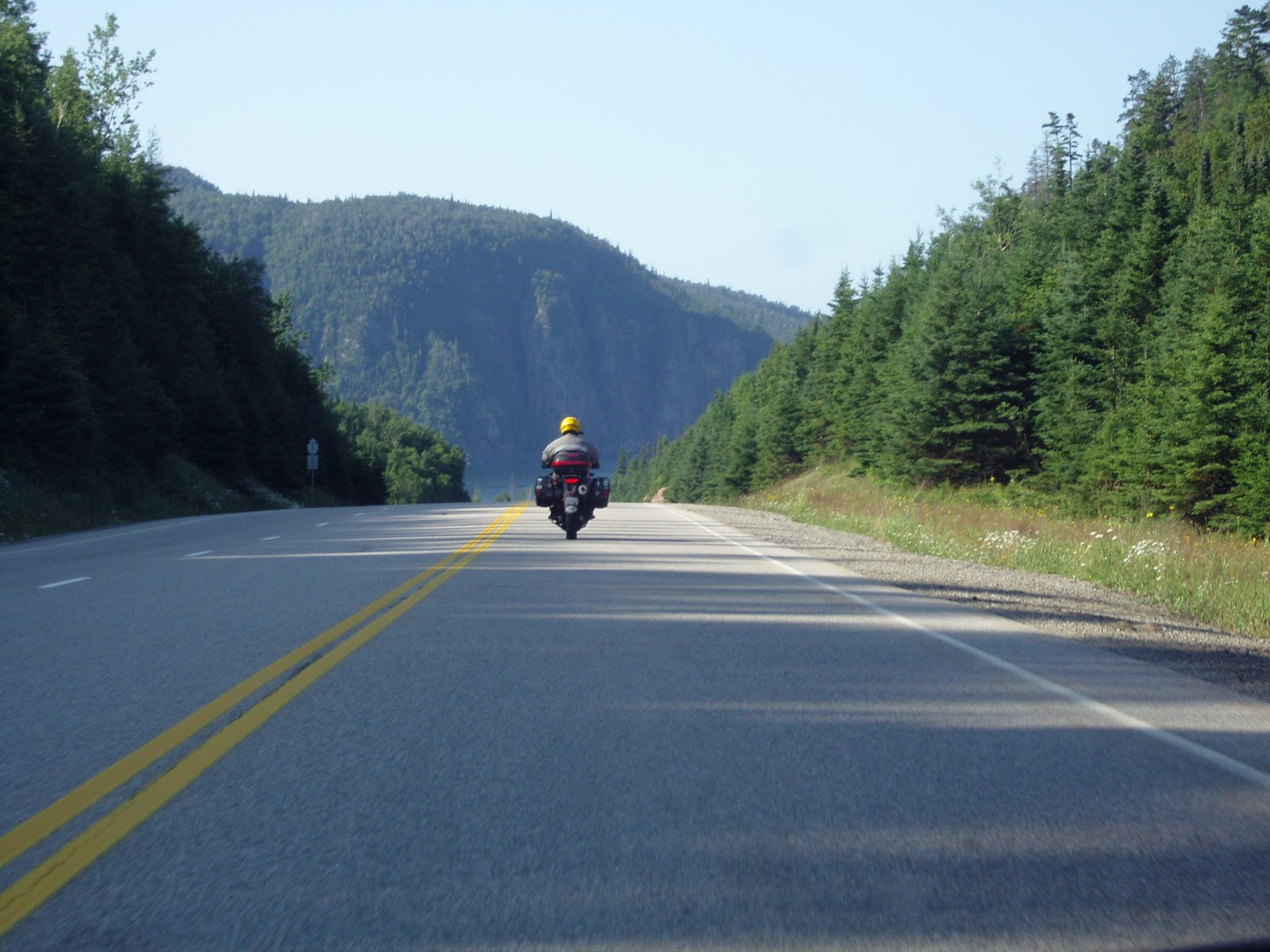
In early-summer 2011, my brother, Larry, and I began to plan to make a weeklong loop around Lake Superior. I’d done the Superior loop a few times before, always by myself, always in hurry, and always taking the east-to-west section through Canada and short-circuiting the return from Sault Ste. Marie straight back to my home near St. Paul. If I take the shortest, quickest path possible, the whole circle amounts to less than 1300 miles and can be ridden in one hard day or a more relaxed day-and-a-half.

Larry wasn’t interested in participating in a marathon blast around the lake or sleeping on the ground, so I promised to behave myself and packed my 250cc dual-purpose bike for the trip. With Larry on my 650 road bike, he would set the pace and our trip would be more vacation than long distance (LD) competition.

Taking this approach meant we’d be taking advantage of a motorcycle’s best qualities, too. A motorcycle can go practically anywhere. Those narrow, rough, out-of-the-way country roads that are always awkward and often practically painful in a car, even an SUV, are perfect for motorcycles. Ian Ellis described motorcycle travel, ““For me, motorcycling is an adventure and it’s not convenient. I’m not trying to make it as easy as possible, but I am trying to make it as much of an adventure as possible. I’m sure if I took a ten-day trip and it didn’t rain at least once, I’d feel cheated.  

When you travel by motorcycle, you’re mostly by yourself, even if you are in a group. I see my brother once every two to five years, so using that time for a motorcycle adventure means that most of the trip we’re no more in contact with each other than if we were back home. However, we both love motorcycles. We’re both grumpy old guys, me more than Larry. Picking a destination and hanging out when we stop is a good compromise between togetherness and our hermit-ish natural selves. Travelling by motorcycle, we get the best of both worlds; at the end of the day and during breaks, we get to hang out with each other but during the bulk of the ride we get to be on our own.

For a motorcyclist, the Lake Superior Circle Tour (also known as the “Lake Superior Loop”) can represent almost any kind of trip you want it to be. On the highways around the greatest of Great Lakes, you will see any brand or style of motorcycle and any type of motorcyclist. There are comfortable routes that are no more demanding than freeway travel and there are roads and trails that will test hard-core adventure riders. You can camp in remote wilderness sites or you can stay in historic five-star hotels so luxurious and formal that they require a jacket and tie for dinner service.

Since 2007, crossing the US border from Canada has required a passport. In 2009, Canada required passports from US citizens. So, before you head for the border, get your paperwork sorted out. If your driving record is less than spectacular, Canada may not be an easy travel destination. If you have had a DWI, DUI, or other criminal conviction in the last 10 years, you will not be admitted into the country.[1] If you have a criminal record, entering the US from Canada can be complicated. The US does not prohibit visitors for a DUI/DWI, but if you have multiple convictions and/or other misdemeanors on your record, you may be denied entry.[2]

For those of you who like to feel the wind in your hair, part of this trip is going to require some adjustment. Minnesota and Wisconsin only require helmets for 18-and-under riders and passengers, but both states require eye protection. Michigan and all Canadian provinces require helmets for riders and passengers. There are a few other concerns to consider, too. For example, Minnesota and Wisconsin require daytime headlights and Canada prohibits radar detectors and in-helmet music.[3]

The two main Lake Superior border crossings are open 24-hours/day, but getting through the checkpoints can be time-consuming. The International Bridge that separates the two countries at Sault Ste. Marie is a busy location, with lots of larryonbridge truck and commuter traffic. It’s not unusual to spend an hour or two watching ships unload while parked on the bridge. On a hot summer weekend, that can get uncomfortable in riding gear and a helmet. I recommend carrying a fair amount of water to stay hydrated. Traffic moves slowly enough to push the bike over the bridge, but if you can’t do that be sure to fill up before you get into the border crossing traffic. There are no fuel stops between the two national checkpoints.
Motorcycle tourism is a big deal on the Ontario side of the lake. Paul Pepe, manager of the Tourism Thunder Bay Office, said, “The ‘Ride Lake Superior’ initiative (www.RideLakeSuperior.com) started last spring to capitalize on the growing popularity of motorcycle touring and capture what has already been a growing market for communities around the Lake.

“Lake Superior is simply an epic ride destination. At 1300 miles (2000 km) this coastal ride weaves through one province and three states. It’s a unique international ride right in the heart of the continent. The popularity of it is that its mainly two-lane blacktop that weaves along spectacular coastline that changes regularly. It’s also peppered with a plethora of unique, authentic, and eclectic communities, attractions, events, and some amazing pristine parks and protected areas.”

There are also resources to help you plan your trip around the lake from the US side. UP Cruising (http://www.UPCruising.com) produces a “free Motorcycle Guide to the U.P. of Michigan” that you can find at any of the Michigan Welcome Centers. The guide lists motorcycle-friendly businesses across the Michigan UP.

On the east end of the Wisconsin peninsula, Highway 13 takes you along the coastline, into historic fishing villages, and through some of the best views of Lake Superior from the Wisconsin side of the lake. For the dual-purpose rider, there are an assortment of dirt roads that take you into the forests and parks of the peninsula and for the rest of us, well-maintained two lane highways loop the area. Bayfield is a great stopping place, including a variety of hotels, motels, and bed and breakfasts. The Bayfield Ferry to the Apostle Islands is well worth a day trip. You can ferry your motorcycle across and explore Madeline Island and stay in the great campgrounds in Big Bay State Park.

The main road toward Michigan’s Upper Peninsula, Highway 2, takes you through old mining, logging, industrial, and railroad towns, several of which are now casino towns with low cost lodging options. If you are more adventurous and can manage at least 150 miles between fuel stops, stick with the coastline following Wisconsin County Highway 519 into Porcupine Mountains State Park. This route sets you up nicely for a back roads route to the Great Sand Bay and some amazing scenery and isolated camping, cabin, or motel accommodations along Michigan’s Highway 26 right to the tip of the UP. The roads are good, but fuel and food stops can be hard to come by. One of the advantages to a motorcycle tour is that road condition is less important than when you are in a car (known as “cages” to motorcyclists). I worry about beating up my car and passengers, I look forward to an adventure on my motorcycle.

2011 Lake Superior Trip 147 The 1940’s and 50’s were the economic boom years for many of the towns on the Circle Tour. A lot of the motels reflect the years when Americans first hit the road in the family station wagon, in that great tradition called “the family vacation.” Experienced motorcyclists value the added security of being able to park the bike close to the room, which is one sign of a “motorcycle friendly” motel.

Highway US 41/WI 28 across the UP toward Sault Ste. Marie is a scenic route past the Hiawatha National Forest, Pictured Rocks National Lakeshore, Seney National Wildlife Refuge, Newberry State Forest, and the Sault Ste. Marie State Forest areas. Every one of those amazing parks is connected to the main highway through side roads that offer adventure and camping. There are more fun side trips on this route than you will have time to explore, but don’t let that stop you from going off the main road and into the parks and small communities.

Sault Ste. Marie, Ontario is a motorcyclists’ hometown. The city is home to Honda, Yamaha, Kawasaki, and Harley Davidson dealers. There is no shortage of motorcycle service shops, either. The motorcycle-friendly attitude of the city’s commercial and state-owned facility employees make it possible to leave fully-loaded motorcycles and explore the parks and businesses.

SNC10653 As much as there is to see in Sault Ste. Marie, one of the reasons for circling the Big Lake is the road out of town; King’s Highway 17. Just north of the city, the Trans-Canada highway hugs the lake and provides some of the best views of the trip. The cities along the coast of Pancake Bay Provincial Park are picturesque and inviting. One of the many highlights of the Loop is Lake Superior Provincial Park. From either direction, the park is an exceptional experience. This section of Highway 17 provides an excellent combination of mountain-like riding with a coastline on the south shoulder of the road. Every rest stop and every scenic view turnoff is an opportunity for spectacular views and accessible adventure.

The road pulls away from the lake near Wawa, Ontario, but that doesn’t diminish the ride or the scenery. There are hundreds of lakes, marshes, and wetlands along this section and you want to keep your eyes open for wildlife. There are 80 mammal species, 400 varieties of birds, and numerous reptiles, amphibians, insects, and all sorts of specialized plants along this section. If you are riding at dawn or dusk, keep your eyes open for wildlife on the road. Meeting a Woodland Caribou, moose, or Timber Wolf at speed could be a catastrophic end to your vacation plans.

There are an easy half-dozen off-highway excursions worth exploring between Rossport and Nipigon, including the amazing Ruby Lake just east of Nipigon; and that many again between Nipigon and Thunder Bay. Minnesota rider, Tony Kellen, recommends a “stop at Rainbow Falls Provincial Park. You ride uphill a short distance on a twisty road and park in the lot. You can walk a short distance to view the falls from multiple positions.” Sleeping Giant Provincial Park is high on that list and the road to the well-named Silver Islet is an off-the-beaten-path gem. Silver Islet was home to one of Ontario’s first silver mines and today it is a cross between a ghost town and private summer cottages.

Thunder Bay is another motorcycle-friendly Canadian city. It’s early in the "Ride Lake Superior" promotion, but there are already several businesses sporting "Ride Lake Superior motorcycle parking only" spots and many places had marked motorcycle spaces from before this promotion began. The city is home to several motorcycle dealerships, including Moto Guzzi, KTM, Kawasaki, Harley Davidson, and Yamaha.

Finally, no real motorcyclist making the Superior Loop can avoid stopping at RiderWearhouse in Duluth; the home of Aerostich, the original all-weather motorcyclist gear. Stop in, meet Mr. Subjective (Andy Goldfine), and tell him “the Geezer sent me.” Andy is one of two motorcyclists to have crossed frozen Lake Superior from Minnesota to Wisconsin and he and his company are motorcycling legends.

Once you’ve done the Loop, it becomes a regular destination. After circling the lake three times, I still find places I missed and that just means I have a good excuse to do it all again.

Additional Information:

Some other motorcyclists have contributed their favorite Lake Superior Loop goalposts and I can’t ignore their excellent advice:

Chris Hughes (KTM Adventure)

Mike Etlicher (Honda ST110A)

Ian Ellis (Aprilia Futura with his son on a Suzuki SV650)

  • · I absolutely love coming down the hill into Lake Superior Provincial Park and the park itself!

Brad Kopp (Moto Guzzi California 1100ie)

Molly Gilbert (Yamaha FZ1)

  • · Mackinac Island is (or should be) your destination—voted one of the best island destinations in America and featured in November's Vanity Fair—this island is also accessible only by boat or plane. Its 600 year-round residents get around by foot, bicycle, or horse-drawn carriages. One of the main attractions here is the magnificent Grand Hotel; boasting 385 rooms & built by the The Michigan Central Railroad, Grand Rapids and Indiana Railroad, and Detroit and Cleveland Steamship Navigation Company. The Grand Hotel was named by the National Trust for Historic Preservation as One of a Dozen Distinctive Destinations.

Loop Experience Interviews:

Thomas Day “I have never made a trip around the circle without a guide. At least once every trip, I’ve had an eagle or hawk swoop down in front of the bike no more than twenty feet above me. They always lead me down the highway for several hundred feet before they fly off. I don’t feel a trip around the lake is even started until I have found my flying escort.”

Liz Young (Brad Kopp’s wife), when talking about their trip around the lake, “What a fabulous trip! Brad takes me to places that are so exquisite. The ride was so wonderful because it wasn’t just the lake, we weren’t always close to the lake. It was all the hills and the trees. The sunrises were beautiful. The sunsets were beautiful. I have seen a lot of places. I have lived in a lot of places; I’ve lived in Colorado, California, the Caribbean. I have never seen a sunset like what we saw over Lake Superior. Brad and I went to school in Duluth. We had known Lake Superior for a long time. For both of us, it has been a great place to vacation, but together on the motorcycle, it was even better.”

The advantage of seeing the lake by motorcycle, over car travel is “I can feel it. Even as a passenger, you can smell it, you can hear it. It’s so tactile. It’s so in your face. It’s almost exhausting. When we stop, we can’t even talk for a while because we’ve taken in so much. Then, we compare. We say ‘Oh, did you see that? Did you see this?’ I get goosebumps. Sorry.”

Her memory of their trip was that “It was so perfect. The bike was so comfortable. It held everything we needed it to hold. It never broke down. We’ve ridden to Seattle, Colorado. I’ve seen a lot of the country that I wouldn’t have seen if I hadn’t been on a ‘Guzzi.”

Ian Ellis has done the Lake Circle with his son, Nathan, as a passenger and with his son on his own motorcycle. His favorite memory of the Circle comes from Superior Provincial Park, “When you come down that hill and you first see that massive Old Woman Rock, it’s just an amazing view from a motorcycle. I love that park for the waterfalls, geology, and white sand beach.”

“For me, motorcycling is an adventure and it’s not convenient. I’m not trying to make it as easy as possible, but I am trying to make it as much of an adventure as possible. I’m sure if I took a ten-day trip and it didn’t rain at least once, I’d feel cheated. My son, Nathan, wrote a successful college entrance essay about getting wet on the motorcycle and how he turned what could have been a miserable day into a fun adventure.”

“Another thing that happens for me on the bike that doesn’t happen in the car is that I see stuff and I go exploring. One of the years that Nathan and I were in Ontario, we went to the amethyst mines and the road was washed out. I was on a Ducati ST2 loaded down with our luggage and Nathan was on the back. It was really cool to be able to make it up there and it was something to feel a sense of accomplishment about. Where as if I went up there in a car I might have turned around or though ‘I got the car dirty and didn’t enjoy that.’ When I sold that bike it still had that Ontario clay baked onto it.”

“I stop more spontaneously on a bike than in a car. Whether it’s a photograph, or a bite to eat at a bakery, it just seems more like it’s meant to happen that way. The Nanboujou Lodge, for example. It’s a hotel from the 1920’s and the interior is amazing. It is a time capsule. We saw the place and thought, ‘Let’s go there for lunch.’ A couple of years later, I took my wife there.”

“We probably would not have explored Superior Provincial Park in a car. We probably would have just got out, taken a couple of pictures, and we wouldn’t have walked all the way down to that gorgeous beach.”

“You sleep better having done it on the bike. Whether it is because you’re cold and wet or you had a really good day.”

“Traveling with a child is absolute torture for one of the two of you, while you’re in the car. On a bike, it’s an absolute joy. I don’t know how you explain that to someone who’s experience is only in a car, but it’s intended to be a silent, parallel pursuit while you are riding. And then you stop and talk about all the cool things you’ve seen. By the way, I do not like communication units. You end up with the same experience as in a car. I prefer to try and make mental notes, ‘I want to remember this’ and a few days later you remember ‘Oh, I forgot to mention this. Did you see it?’”

“When my son and I talk motorcycles or travel together we don’t argue. If we were to travel in a car, that probably wouldn’t be the case.”

Mike Etlicher “You see a lot more of the country that you’re driving through than when you’re in a car. Your head is on a gimbal. You can look up and see the gulls above you. While a a convertible can almost do the same thing, sitting on a couple hundred pounds of steel is way different than being  surrounded by several thousand pounds of steel. You’re literally and figuratively more part of your surroundings.”

Mike has done the Circle three times, “four times, if you include the Team Strange [long distance events] rides.” He explains, “It’s a different experience every time. It’s like reading a book. You experience something different every time you read a book, even though you’ve read it several times over your lifetime. I experience things differently, depending on who I’m with. I’m sure I’ll do it again, someday. ”

One trip was with some friends, who left before he could get away. “They were leaving on Wednesday, from the Cities to Duluth and doing the trip clockwise. I couldn’t leave until mid-afternoon on Friday. Since I move more quickly than that group and cover more ground in a day, I joined them in Wawa the next morning.

On the way to catching up to the guys, I was riding along in rain and fog in really crappy night time riding weather. My [Honda] Pacific Coast didn’t have the best headlights. Every once in a while, I’d barely miss a moose. I didn’t see it until it went past my elbow. Unless you really have a good reason to be out there, it’s probably not a good idea to be riding at night.”

“I have a ride that I organize every fall. We go to Grand Marais for Friday night, have dinner, and hang out in the pub. Saturday morning we go to the trail center and have breakfast. Every year in the past ten, I hear people say they’ve seen a moose on the Gunflint Trail. I’ve never seen a moose there. Going across Superior through Canada, I’ve never not seen one.”

“Cars are Point A to Point B devices, while motorcycles are certainly that but are fantastic for meandering. I’m more apt to explore on a bike than I am in a car.”

One trip, the day after a day of riding in perfect fall weather, “I woke to 3 ½ inches of slushy snow covering the bike and the road. My cell phone didn’t work up there and I was nervous about being able to get back to work on time. So, I felt motivated to keep moving. Riding in slushy snow in the middle of the Canadian wild between Marathon and Wawa was an experience. I stopped in a café in Marathon and I was never so happy to have something warm to eat and drink.”

“Up near Bayfield, a lot of the filling stations are no longer open. Some of the areas up north, fuel is pretty scarce.”

Molly Gilbert has been around the circle as a passenger, a long distance competitor, and as a solo rider. She rides the Circle because, “It’s the largest body of water in Minnesota.  It allows you to feel as though you’re riding next to the ocean. You have the smells, the sights, and the sounds of that. You also have people participating in events like the Minnesota 1000 [a long distance riding event]. I’ve done a few of the Minnesota 1000’s and the Great Lakes Rally, that was all five great lakes in a few days. Mark Kiecker got me into it with two-ups (rider and passenger) and we won second place in the Team Strange Great Lakes Challenge.”

“Riding gives you the hyper-awareness that you don’t need in a car. The extreme alertness that you need on a motorbike allows you not only to feel the wind in your hair, but against your body. Nature is coming at you from all directions and you’re not protected by a big metal cage. You’re out in the open and that’s about as exposed as you can get. Most people have to fly to California and ride the Pacific Coast Highway to get the kind of feeling you get riding around Lake Superior.”

“On the way back, on my own on my very first bike, an R65 BMW, I decided ‘I don’t want to do the usual route’ and I ended up going off the main road and got lost. I ended up deep in some forest at dusk, worrying about deer, and I’m all alone, not an experienced rider. I have never felt such fear in my life.” She explained why that experience made her want to go back, “I went back during the day and planned it out well. But that story describes how important the elements are when you’re on a bike. You don’t have to think about how dark it’s getting in a car, or how cold, or if it’s raining, or it conditions are about to change. You have to be so in tune with nature. Nature is a big draw to the lake and that area and it’s what draws a lot of us to motorcycles. You have to watch the skies, the patterns, the clouds, and the wind direction. Who does that? No one does that in a car. All of a sudden you’re altering your route because you’re seeing a very large front come through and you’ll alter your route by a couple hundred miles to avoid that.”

Molly has taken the roads less travelled, often, but “I can’t tell you where they were or what roads they were. I just go until I get lost. I have no sense of direction. I should have a GPS, but I’ve never owned one.”

“I’ve done the Circle both directions, but I prefer going up on the Michigan side and coming back the Minnesota side. Most of us go to Duluth, first, because Aerostich is such a huge draw for all us that we go that way so we can get there.”

Larry Day rode the Circle for the first time this summer. His strongest memories of our ride was the North Shore, “It was more mountainous, hilly, and it feels like riding in the Rockies with an ocean on one side. There was a lot to see in that area. It was so overwhelming that it’s hard to pick out a highlight.”

“I think you’re more likely to take off-roads because you’re out in the elements and you see a lot better. You should probably see them the same, but you don’t. It’s easier to take off on a whim and go down that road and look around. You’re more adventurous on a motorcycle. I know I am.”

Larry’s strongest memory was when he pulled off of the road near Gravel River Provincial Nature Preserve. “I went up on a road, way up high. There was a parking space and a bench at a scenic view. I sat on top of the hillside waiting for you for a while. It was a great view in both directions.”


[1] It is possible to be “rehabilitated,” as little as 5 years after you’ve served your sentence. You can apply this waiver through the Canadian Citizenship and Immigration offices, but allow 6-8 weeks for the paperwork. http://www.cic.gc.ca/english/information/applications/rehabil.asp

[2] The U.S. Customs and Border  Protection website provides information about applying for non-immigrant temporary entry. http://www.cbp.gov/xp/cgov/travel/id_visa/indamiss_can_info.xml

[3] For a quick review of other motorcycle-specific regulations, check out http://www.calsci.com/motorcycleinfo/PrintLaws.html.

Jan 7, 2012

The Pace or the Ride

Sev Pearman, my Minnesota Motorcycle Monthly editor and long-time friend and co-conspirator, sent me an article written by Motorcyclists' Nick Ienatsch called "The Pace." In the article, Ienatsch extolls the virtues of a particular sort of group ride. After several people on Sev's email list responded, I felt compelled to put my $0.02 worth of bullshit into the mix.

"Responsible? A bit. Educational? Probably. Fun? Most certainly not.

"Nothing about any sort of group street riding sounds rational to me. The opportunities for misjudging the surrounding riders, for getting overwhelmed with input data, or for becoming so bored that I drive off into a ditch to keep from falling asleep and to provide myself with a little entertainment are all reasons why I always "get lost" in group rides. Make one wrong turn, and you own the road again and don't have to worry about who fell down up front or who's about to run up your tailpipe on a boring straight section or where you're going to sit when 70 bikers decide to descend on a hapless coffee shop or greasy spoon. There is an aspect of 'togetherness' that many people link to motorcycling that is, as my hero Eric Cartman would say, 'Lame, dude. Totally lame.'"

Yep, I felt pretty good about that opinionated opinion. I'm still about half-doped up with my morning dose of 15mg of morphine sulfate and 5-325mg of oxycodone-acetamineophen (Percoset), so I could be wrong.

Sev whipped right back with, "I'm gonna disagree w/ you on this one, Thomas. There are times when I LOVE riding w/ 1-5 other riders of similar skill and mindset. Parade rides of pirate-costumed riders on clown bikes? No Thanks But a spirited ride among a small group  of riders can be invigorating."

Which, finally, brings us to the point of today's Geezer rant. As you know, I can't tolerate disagreement; unless I get a beer out of the deal. When it comes to off-road riding, I'm sort of in agreement with Sev, although my group size would probably be smaller (1-3, with 1 being exponentially better than 3). I found, on my trip around Superior last fall, that I'd rather be in a cage if I'm trying to hang with someone (preferably with them doing the driving) than do the group ride thing. Economically, ecologically, practically, and socially, it makes more sense.

The conversation and, probably, the drugs brought up some old memories that had been almost entirely in the old age fuzz. Must be the morphine or Alzeheimers.

In Colorado, there were a group of three guys I hung out with for almost everything. We worked together, explored Colorado's cities and mountains and ghost towns, fixed cars, did off-road remote controlled car racing, hot-wired the company's intranet so we could play networked Doom and Hell on Earth (Doom II) all weekend, and generally hung out a lot. When I first moved to CO, I was the only active motorcyclist in the group, so we naturally did a lot of stuff in our cages and the "driver" of the event picked everyone up and sort of set the tone for whatever we were going to do. The two vehicles of group excursion choice were often my hippie Toyota van, which had no back seats, but was "decorated" in two large beanbags (for camping), an icebox, and a great surround system and a 1960 Pontiac Catalina convertible with an even better surround system. We covered a lot of ground in those two vehicles, including trips to New Mexico and Wyoming, an excursion to visit my family in L.A., fishing on Colorado's Arkansas River, road trips up Mount Evans and Pike's Peak, and at least one lap around Colorado's state RC off-road electric championship series.

A couple of years later, everyone decided they needed to become motorcyclists. We started to try to do the same things we'd done in cages by bike. It was a miserable experiment. Our skill levels were all over the place. Every trip ended up with one of the rookies in a ditch or dragging his ass back home with parts dangling from their poorly maintained bikes. In the end, I took to planning the route and heading for the end point at my own rate, expecting to spend an afternoon in that spot while the other guys straggled in hours later. On a Denver to Pike's Peak trip, I rode the whole mountain, twice, performed a thorough maintenance on my bike, had a long conversation with one of the Peak's railroad engineers, and had lunch before the other three guys straggled into the parking lot. Around that point, I decided group rides weren't going to be my deal and I have avoided them since. I will always miss the road trips we took, but none of the motorcycle adventures.

May 3, 2011

My Alaska Adventure

All Rights Reserved © 2008 Thomas W. Day

When I was a kid, growing up in flat-as-a-pancake and boring as television western Kansas, I led a kind of Walter Mitty life. On the surface, I was a normal kid. I went to school during the week, went to movies and church on Sunday, played sports, threw a paper route and had part-time jobs, and tried to act normal. Under the surface, I read science fiction and adventure books, listened to jazz records, and planned my escape. My two favorite writers were Mark Twain and Jack London. My two favorite escape destinations were California and Alaska. I lived in California for almost a decade and discovered that frontier had been overpopulated long before I got there. Alaska is different.
I read about Twain and London's adventures in the wilderness and among men who risked their lives for a chance at doing something unusual and imagined myself living that kind of life as soon as I ran away from Kansas. I imagined myself saddling up a couple of horses and taking off for some remote part of Canada or Alaska, never to be seen again. The phrase, "this isn't Kansas anymore, Toto" held nothing but positive connotations for me. I couldn't wait to get as far from the Midwest as I could travel. Life didn't turn out the way I'd imagined and I've spent most of my life near the center of this country, including a dozen years in Minnesota. Now that my kids are grown and on their own and I'm in pretty good shape, financially, and in reasonable shape, physically, some of that old wanderlust returned to itch at me.
Three years ago, my 60th birthday was on the horizon and a collection of unrelated events jumpstarted my interest in traveling to Alaska. I began to seriously plan an extended trip to Alaska in the spring and summer of 2007. "Extended," for me, meant more than two weeks. I've been employed since I was 14, so two week vacations have been the limit of my adventures for more than 45 years. I planned to take 30 days to ride to Alaska and back. I mapped a route through northern Minnesota, North Dakota and Montana, up through Alberta, nicking British Columbia, into Alaska. I'd hoped to hit every significant historical and natural high point in the Alaska before I headed back down through British Columbia into Washington. I had a fairly extensive route planned for my return, too. There was a lot of wiggle room in my plan, because I'm usually pretty spontaneous once I get on the road, but I had a specific set of goals in mind for my first real adventure.
Then my wife stepped in and starting maneuvering some "security" into my plans. She, apparently, decided that I'm too old and fragile to do something like this on my own, so she recruited a work friend, Michael, to ride with me. She and I had dozens of conversations about how this wasn't going to happen, but I lost. "Conversation" is the word wives use for "argument" and "agreement" is the word they use for "I won."
For 50-some years, I have done almost every cool thing in my life on my own. I backpack alone, scuba dive alone, bicycle alone, and I dislike riding in a group, even for short distances. A "group" is two or more people. Having someone else along on my first month-long trip was a major concession for me. "Concession" is the word I use for "losing."
Michael and I met once, in January, as part of my wife's plot to get me to take on a co-rider. My wife introduced us. Michael asked when I wanted to leave. I said, "the first of June."
He said, "That's too early, it will be cold."
I said, "That's when I'm going."
He said, "Huh."
He rightly seemed to think I was far too stupid to ride with, if I thought Alaska in June was a good idea. I figured that ended that and went back to planning my trip. In May, my wife mentioned that Michael had put in for his vacation days and had been given the time off from work.
I said, "Huh?"
She had, apparently, continued recruiting him for the trip all through the winter and he'd decided that June was good enough for him. Now I had a co-rider, so I began to rationalize how this might turn out to be a good thing. By mid-May, I'd almost convinced myself a traveling companion would be less uncomfortable than a sharp stick in the eye. I figured we could start off together and, if it didn't work out, we could go our own ways. We'd both been on long solo motorcycle trips and we'd proven we could do it alone. That's the ointment I used on myself to keep from giving up on the trip altogether.
We had one more meeting, a week or so before June 1, and I discovered that Michael had his own route planned and it was a lot different from mine. I assumed we'd be going our own ways a lot sooner than I expected. You know what "assume" means, I assume.
Due to two cases of Midwestern Guilt and both of our well-evolved desire-to-get-along genes, it took us ten days to split up. The first 3,500 miles of my trip plan were scrapped for a route that Michael picked and one that only included a few hundred miles of my plan. I'd waited more than 50 years to make this trip. Some of Michael's plan was better than mine, but I'd have rather gone where I wanted to go. We went north, mid-Montana, into Saskatchewan instead of making the crossing at Glacier National Park where I’d planned to exit the US. We attempted to ride the Dempster Highway to Inuvik, where I crashed, separated a shoulder, cracked a collection of ribs, bruised a kidney, busted a bone in my right hand, and gravel-rash’d my bike and luggage. The Dempster had not been on my route plan, but I'd hoped to make a run at the Dalton Highway to Deadhorse. 

In Glennallen, Alaska after a day of rest and maintenance, I was sort of back on track; although I was off schedule and busted up. Michael and I shook hands and began two different adventures. He needed to get back home for work. I needed to get used to being on my own with my mending injuries. I arrived at the base of the Dalton Highway, just north of Fairbanks, where it took me an hour of staring at the road to accept the fact that I was too beat up to take on 1,000 miles of dirt road. As I turned south to explore more of Alaska and Canada, I also realized that I was completely in charge of where I’d go next. The next 6,500 miles and 18 days were some of the best moments of my life, let alone on a motorcycle. Nothing beats being by yourself, in the middle of nowhere, knowing that you are in control of everything that happens in your life at that moment.

So, if my wife ever tries to recruit you into going on a motorcycle trip with me, she's working on her own agenda, not mine. If she tells you I'm old, feeble, incompetent and suicidal, she's probably right. If she tells you that I need someone to take care of me in the wilderness, she's still probably right. If she says I want someone to ride with, she means she wants someone to ride with me. She is working from the purest of motivations. However, she is also working with poorly socialized material; me.

I'm as likely to want company on the road as I am to want you to slide your foot into my airport bathroom stall. I'll call you if I want company, otherwise, I'll be on the road; alone and enjoying my solitude.

Aug 29, 2009

On the Road Not Alone

My road trip this week with my grandson, Wolf, was something I haven't done for a long, long time. A trip like that would reminded even a crotchety old fart like me why people take trips with other people.

I used to take a couple of trips a year with one of my girls, when they were teenagers. We used to pick a direction, sometimes even a destination, and ride up the coast of California together. Every one of those trips is burned into my memory among the best moments of my life. It's a personal flaw that I can't do much with, but traveling with more than one other person is nothing but draining for me. Our family did some trips all together, but not many. It might have been just me, but it always seemed like we ended up more stressed from our vacations than we were when we left. But traveling with one of my family members was always fun.

Traveling the back roads of Minnesota and Wisconsin with Wolf was a throwback to those good old days. We saw and did things I wouldn't have done on my own. We stopped more often, we stayed longer, and I enjoyed myself more than I ever do traveling on my own.

There was a period, between 1996 and 2006 when I hardly went anywhere on my motorcycle during the summers. Wolfe was the reason. Nothing I could ever do on my own would be as cool as the stuff I could do with my grandson. We hung out almost every weekend for 8 years and most weekends for the following two years. As he gets older, he's less interested in being slowed down by an old guy, so I've gone back on the road for bits of my summers. If I'm not with my kids, I'd just as soon be alone. So there you have a reason why I'm a solo tourist.

For a while, I'm going to have the best of both worlds, motorcycling places and doing it with my grandson. It's hard to top that for as long as it lasts.

Jul 5, 2009

July: All the News that Didn't Fit

Beware of Germany and France
According to Aviva Insurance, crashing your bike in Germany can be an economic disaster. The average German motorcycle crash bill is about $4880US and the equivalent price tag in the rest of the EU is about $3180US. The data for this claim and some useful tips for traveling in Europe can be found at http://www.aviva.com/media/news/4977/.

Semper Ride
After suffering the most fatalities in 10 years of recording data, the Marine Corps is trying a collection of tactics to try to lower the corps’ motorcycle fatalities and injuries. One tactic is a motorcycle safety video called Semper Ride (http://www.mcieast.usmc.mil/semperride/) that was Marine-financed and heavily promoted on bases across the world. The Marines are also providing one-day Commanding Generals' comprehensive off-duty recreation and motorsports safety fairs at MCB Camp Lejeune, MCAS Cherry Point, MCAS New River, and MCAS Beaufort. Along with requiring full gear, training, and the usual advice, the Marines are strongly pushing dirt biking and road racing experience as the core to becoming an expert rider. This is not your mom’s kind of advice; this is practical advice from James Stewart, Keith Code, Ben Bostrom, and Teach McNeil.

Jun 27, 2009

Homeward Bound, ASAP

Monday, I woke to the sound of rain on the tent. I went back to sleep. At 8AM, I gave up waiting out the rain and struck camp wet. It was a little chilly, about 58F, as I packed up but it warmed up quickly. It didn’t dry out, though. I drove a couple hundred miles before breakfast. It rained all the way.

On my way south, I hit a couple of museums and took pictures of myself next to Minnesota stuff, but I was ready to be home by noon.

My route took me through Hibbing, mostly out of Bob Dylan curiosity. The town is amazingly devoid of anything Dylan-esque. There is one street sign, hidden by a business awning, announcing “Bob Dylan Avenue.” The library has a “collection” of Dylan stuff, but every Dylan fan I know has more stuff than that library. There is a bar called, “Zimmies” that announces some connection to Bobby, but I failed to see anything interesting and their window neon signs are probably the proudest the place gets to showing its association.

Here’s what The R&R Hall of Fame has to say about Bobby, “Bob Dylan is the uncontested poet laureate of the rock and roll era and the pre-eminent singer/songwriter of modern times.” Before they discovered Dylan, the Beatles were singing “Love, Love Me Do.” After Dylan (through the Byrds), they became interesting. Dylan invented the singer/songwriter category and made us all expect songwriting from any pop artist deserving respect. I could go on, but to cut it short I’ll just say Hibbing embarrasses itself.

Minnesota is notoriously ashamed of or jealous of its famous people; especially entertainment people. Dylan, Garrison Keillor., Johnny Lang, the Cohen brothers, Terry Gilliam, Vince Vaughn, and others have described nearly becoming social outcasts because of their success. I don’t think any of those people still live in Minnesota. In fact, the only celebrity I know of in Minnesota is Kevin McHale, the ex-Timberwolves coach, and he’s regularly savaged in the media and by fans. Homer loyalty doesn’t seem to be a big issue in the state.

It’s pretty easy to imagine Dylan’s ex-high school jocks taking over the town and demonstrating the famous Minnesota jealousy at Dylan’s massive success and world-wide influence. A “damn guitar-playin' geek” who became more famous than the state's most famous football or hockey player?

When I dropped into the Duluth/Lake Superior Valley, I could have sworn the temperature fell near freezing. I zipped up everything and considered putting on my liner. It was only 48F, but it felt much colder. I stopped at RiderWearHouse and got a tear in my jacket repaired and bought a fix for the weak link in my riding gear, my leaky “Goretex” lined boots. Aerostich makes an “Emergency Boot Cover” that does for my feet what their Triple Digit Glover Covers did for my hands. Better late than never? We’ll see.

Jun 23, 2009

The Arrogance of Blogging.

The whole journaling/blogging thing is really arrogant, isn’t it? It’s a pretty New-Agey-sort-of-idea-gone-mid-tech; which makes all the right wing journals seem funnier than usual. “Journaling” is the kind of crap that English majors substitute for actually writing something that others might want to read. I have first hand experience, trust me. Once a writer turns into an author and mutates even further into a “famous author,” wannabe writers expend a lot of energy reading the famous author’s journals looking for a clue into becoming one themselves. I’ve found that to be pretty fruitless work. With the “advent of the blog,” any damn fool can pretend to have passed Go and moved right into having something worthwhile to say. And here I am.

While I was at the North Dakota Heritage Center (a pretty New Agey title itself), I read a collection of journal entries from a private at one of the remote North Dakota forts (Is there any other kind, “remote” I mean?). When he was first posted to the fort, he wrote quite a bit. He introduced his audience to the other soldiers. He described the fort, the daily tasks, the occasional sightings of Indians, the wild life, and the weather and the bleak scenery. After a couple of months, he was down to “this guy is in the brig, this guy is on watch, it’s cold as hell today.”

One of the reasons I do these sometimes-painful solo trips is for inspiration. As I crossed the great North Dakota plains, an entire story wrapped around that soldier’s journal played out in my head, complete with soundtrack. I’ll let you know how that works out for me. Maybe it will be my route to “famous author.” Hell, I’d settle for author-of-anything at this late date in my life.
I can sympathize with that private. At the two ends of a life, boredom and excitement, it’s hard to talk about what’s going on in your day because it’s either too boring to think about or taking the time to write takes time away from doing that exciting thing you’re on the road to be doing. I write while I’m eating. It slows down my usual digestive habits and there is usually nothing interesting to look at in a restaurant. Usually.

Jun 20, 2009

Got Friday on My Mind

I don’t even know how to begin describing this day of the trip. It started nicely--clear sky, light wind, and dry—and went so far uphill I thought I might be dead. Fats Waller supposedly used to say, when he was really rockin’, “Somebody shoot me while I’m feeling good.” Friday, I should have been shot.

I hit the road with a questionable back tire. It was good enough to get me home, for sure, but I hoped to rack up another 1500 miles before going home. It is, maybe, not that good. Probably not.

So, I decided to try for Lee Klapprodt’s favorite shop, the Cycle Hutt the internet home for all things KTM, and see if they had a tire that might work. I’d take almost anything that would fit, if it’s not adventuring touring it will be a perfectly fine road tire and I’ll just stick to the road. I am such a retard, I hooked up on the Interstate and managed to stay on the long worm about 20 miles, I got bored, got off, and aimed for a frontage road that paralleled the freeway. In about a dozen miles, that road degenerated into a knarly, wet clay path that put an exclamation point on my failing tire. It also hurried the failure a bit, I’m afraid.

I arrive at Mandan at about 7:15AM and drive by the Cycle Hutt just to check out their opening time and someone is there, Tami Bohn the co-owner of the shop. Mentioning Lee’s name is like flashing a $100 bill at a New York cop. After describing how much everyone at Cycle Hutt “loves” Lee, Tami tells me the store isn’t open, but it will be at 9AM and she’ll have the mechanic look for a tire for me then. She sends me to a great place for breakfast (another place Lee recommended) and I lose a half-hour zoning out eating, writing, and reading.

My waitress asks the guy at the table in front of me, “Are you looking for a tire?”

He says “no” and I say “yes.”

She tells me, “They have a tire for you.” She doesn’t know what that means, but I do.

Now I’m solidly relaxed and absorbed in my reading. I show “patience” and don’t leave for the shop until 8:30, a half hour before they open. This is obviously one of the places where everyone likes to work because a good bit of the shop is there when I get there.

Tami asks if I got the message, and apologizes, “We don’t have a tire your size.” But she tells me I can look at their stock and see if something might work. They might have a half-dozen tires to choose from. One of them is a 150/70-R17 Metzler Tourance, exactly the tire I need. It’s set aside for me and the mechanic, Chad, will install it when he gets to work.

I’m set, so I screw about in the store looking for stuff to buy that I don’t need. The other owner, Justin Bohn (Tami’s husband), and I get into a conversation about work in Antartica, the dismal economy, motorcycles, and . . . music. When he hears about my other life, he insists I call an occasional customer of his, Denny Delzer. After wasting an hour of Justin’s and a good bit of his employees’ time, I am ready to go.

Almost out of obligation to Justin, I call Denny. He invites me to his shop and that digression was the second really good thing to happen to me that Friday. Denny is a connoisseur of all sorts of collectible objects: hot rods, go-carts, Hammond organs, and motorcycles. He is, in fact, a fairly famous Vincent collector. He is also incredibly generous with his time. He gave me the $1 tour around his shop, let me ogle his motorcycles (you’ll be disgusted to know I particularly lusted after a mid-70’s Yamaha IT200 dirt bike, not the Vincents), and he was exceptionally generous with technical information about his Hammond organs. I have always loved the sound of the Hammond and I’ve wanted to hear more about how they work from an expert for decades.

Denny has four B3’s crated up and ready to ship to Hong Kong. He does a fairly brisk internet business and Billy Joel and Greg Allman are some of his more recent well-known customers.

Denny described the collector’s mindset as an attempt at explanation, “Once you have one, you may as well get another.” This was how he described how an otherwise reasonable person having collected several Vincent’s, a couple of Yamaha IT dirt bikes, a few go-carts, fifty or sixty Hammond organs and even more Leslie speaker cabinets. If you’re going to collect something, you might as well make some money out of it, which inspired Denny’s business: B3Hammond (http://www.b3hammond.com/).

After the shop tour, Denny invited me to his home to see his priced Dick Busby-built Egli-framed Vincent. Denny was between hanging out with his grandkids from Florida and setting up for a gig with his band later that evening, but he blew another hour with me showing me his hot rods, his Vincent, another 70’s Yamaha IT, and . . . sending me off for a short ride on the Egli. Before leaving and after I returned, Denny took pictures; one of which is to the right.

If he knew me better, he’d have asked for a huge security deposit. I’m renowned for my kultziness around expensive things. I managed to struggle through right-side shift and one-up-and-four-down Euro-ness, but I got tricky and tried to swing back to his place through the neighborhood, instead of simply turning around and coming back the way I’d gone, as Denny had advised. I got lost in the zillions of cul de sacs and, finally, gave up and tried to turn around. In a car-jammed deadend street, on a hill, I stalled the Vincent. The bike will absolutely not idle. Luckily, it is electric start. Not so luckily, it took a bit of figuring out to make the electric start do its starting thing. Fortunately, due to the Cheap Bike Challenge, I’d recently dealt with a vintage electric starting routine on the Honda 450 and we got going again. After what must have felt like a decade to Denny, I made it back up his driveway and returned the Vincent to its more capable owner. Now, I can say I’ve ridden a Vincent. And I didn’t crash it. You guess which of those two was more important to me.

The ride out of Bismarck was sort of a letdown. I was going through some terrific territory, but I didn’t do everything I should have done in the city; especially visiting the offices of Vintage Guitar Magazine. Oh well, a reason to return someday soon.

Once I’m out of town, I’m in the plains heading northwest. My target is the north Teddy Roseveldt park, where I’ll camp tonight. My route is too convoluted to describe. I’ll put up a map someday. I had a collection of suggested roads and historic highlights that Denny and Lee had provided and I hit about 2/3 of them. It was a great ride, I’ll have several scenes stuck in my mind for the rest of my life, and after setting up camp and taking a short sundown walk through a tiny section of the park, I was out like a deadman.

Jun 18, 2009

Waking Up Pissed

First thing (5:30AM), Thursday morning I wake up to the sound of a small motor. Just my luck, I’m two sites away from a sump pump. I put in my ear plugs and sleep till seven. The day started clear and warm, but cooled off by 7:30AM and clouded up quickly. So much for a second sunny day in North Dakota.

Turns out, it wasn’t a sump pump. It was a pair of douchbags firing up an ancient generator for some brain dead reason; probably wanted to watch old VCR tapes of their favorite Oprah shows. These same geniuses yakked late into the night, jabbering like a pair of old drunken hens. If you know who these trailer trash yokels are, smack 'em in the head just to hear it rattle.

Before leaving, I took in the reconstructed Mandam village and a bit of the old fort, especially the lookout towers at the top of the park. The reconstruction of the Abraham Lincoln Fort is a little sterile, but the Mandam houses are terrific.

Going south on 1806, I was washed in a constant hard rain all the way to the Cannon Ball River. As usual for long trips, I over-estimated the condition of my rear tire and it’s vanishing quickly. Instead of the route I’d planned, I decided to head west to catch the Enchanted Highway back to the Interstate and, if the tire looks really bad, I’ll go back to Bismarck and get a replacement.

At the Enchanted Highway, the sky looks like hell about to drop on earth. There is a dark grey wall moving east fast and pouring rain as hard as I’ve ever seen in the near distance. I found a café in Regent and parked the bike so I could pretend to be hungry and hide out the storm. I got myself inside with about two minutes to spare. The sky did, in fact, fall. Probably because it was holding a few million too many gallons of water.

I'm going to have to look up "enchanted." The highway is pretty interesting, these bird sculptures are 20-30 feet tall. You can see them from a mile away, literally. Somehow, I thought enchanted meant something a little different, though. It's the hillbilly coming out in me.
My back tire is wearing out incredibly fast. I could probably get home fine on it, but I can’t do the other 1500 miles of ND that I’d hoped to see. I’m going back to Bismarck to see if I can snag a replacement.
I’m cold and my freakin’ boots leak like a mosquito net. Why is the only Goretex that works the stuff I get in my Aerostich gear? ND has received more than double the normal rainfall and I suspect I’m lugging a good bit of it in my gear, especially my boots. Tonight, I’m going high tech and I’m going to be spending the night in a motel. I need to warm up and dry off. Plus, it wouldn’t hurt to have access to a collection of outlets to charge up all my electronic crap.

A Day at the Museum

Pun intended, get over it.

Third day out and I’m up and cruising by 6AM. At first, I thought about going north to Bismarck and hanging in the big city for a day. Some of the “ghost towns” were disappointing and I wasn’t up for more of that. It was drizzling as I got out of the tent and everything was soaked outside of the tent and bike cover. More motivation for city life, but I decided to head south and west, skipping the three ghost towns on that leg of my trip plan and getting as close to the Missouri River as possible. That turned out to be a killer plan.

"Do you know why I pulled you over?"

Ah, beautiful downtown Linton. A city with one stop sign and a full-time cop watching over it to make sure no motorcycles try “something fancy” and make a stop without putting both feet on the ground. The car in front of me didn’t even slow down for the sign, but the cop whipped around behind me and fired off his lights because I made an “unsafe” stop without touching a foot to the ground. In the end, he seemed satisfied with screwing up my rhythm and let me go with a brilliant, well-informed warning about motorcycle safety.

Every encounter I've ever had with a cop reminds me of Junior and Senior High School. Does every school bully eventually end up with a badge? It's too easy to stereotype these guys, but stereotypes are often easy to believe because they turn up in reality so often.

The river valley was wet and spectacular. My camera seemed to be stuck on blue overtones, but it was probably accurate. There was a lot of blue on the horizon, on the water, and in the air.

At the end of my north-bound route, I came to Bismarck. I spent the afternoon checking out ND history at the ND Heritage Center and the original Govenor’s mansion. At 4:30, I met Lee Klapprodt at the capitol and we went for a 180 mile ride north of Bismarck.

Most of his favorite roads are a little “stressed” by the 14” of rain the Bismarck area had received during the last 3 days, so we stayed on pavement for most of the ride. Lee is on a new KTM Adventure and he cuts a pretty quick pace, which I don’t work hard to maintain. I have to make my back tire and the rest of the bike last another 1,500 miles, so I’m not as excitable as Lee. I keep him in sight, though, and we stop often for him to explain the topography, economy, development, and history of the area. He’s a committed North Dakota booster and gives me some insight as to why people live where winters often drop below -40oF.

North Dakota’s economy is clearly not echoing the rest of the country. The state has a lot of energy; coal, oil, wind power, hydroelectric, and biofuel. At least for the next couple of decades, the rest of the country is going to be depending on those resources and that puts the state in a pretty good position. Oil rich places tend to end up being wastelands when the oil is gone. It would be nice to believe that North Dakota can avoid the mistakes of the past. To do that, they better get serious about teaching history to avoid repeating it. I wonder if any state money is going that direction?

At the end of our ride, we came back to Mandam, a Bismarck suburb. Lee took me by his favorite bike shop, the CycleHutt (http://www.cyclehutt.com/). The shop is a KTM-only dealer with a huge lot surrounding the building. They hold events right at the shop; supermoto races, stunter events, and they are building a super-enduro track behind the shop.
Lee ferried me to the Abraham Lincoln Fort State Park where I camped for the night. My first opportunity to set up camp in the dark. A real thrill. It was hot and muggy and the tent was still wet from the past two nights. I haven’t gone to sleep hot for almost a year and don’t know if I can do it, but it cools off fast and I’m out like a light.

Doing the Sheyenne River Valley

Tuesday, I’m up with the birds and out of camp at 6AM. I don’t go far, though. I stopped in Lisbon for breakfast and to watch the first hour of the day’s long rain. I gave up after doing everything I could think of, reading until I was bored, and taking an accounting course via email.

Later, I was in Valley City where the river probably isn’t as prized, since the town was swamped by the Sheyenne in April. There were still sandbags stacked against houses and businesses.
It took me a while to figure out what was going on in Valley City. I stopped at an information center/museum for a map and learned a little about the area. On advice I got at the museum, I went north to the edge of town to see the giant railroad bridge. It's pretty impressive, don't you think?

I ended up the day in, believe it or not, Napoleon, ND. This is truly Mayberry. The main drag was being dredged for new water mains, so the town wasn’t looking its best, but it’s a cool little town with a city pool, a city campground, a couple of good restaurants, and a park full of doves to sing me to sleep. $6/night for “primitive camping” which includes a shower and a couple of bucks and you’re in the pool, too.

Jun 15, 2009

Into the Farm

Going into southern North Dakota is nothing like going into the wild. ND is wilder than, say, Kansas, but pretty tame compared to Montana, Wyoming, the Yukon, or Alaska. There are farms everywhere, trucks most places, and little towns in good shape or not all over the southeast corner of North Dakota.


Selfishly, I'm disappointed that ND appears to be doing pretty well. I had a collection of ND "ghost towns" on my route sheet that I'd collected from the web. I don't know where they found their information, but most of the towns appear to be doing ok to pretty well. My first stop, for example, was Dwight; a town that appears to have weathered the worst of its losses and is rebulding. I did, however, find that Garmin's road information (especially the dirt roads) could use a little updating. Trying to get to a couple of these towns via dirt road taught me some useful lessons about turning around in a nasty spot. A lesson I never seem to get enough of.

This mediocre photo is of the third dead end I ran into on my first day. There was a very nice jacuzzi next to the river, but I didn't feel like heating 200 gallons of water with my camp stove, so I didn't take advantage of it.

This was a spot where the 250 would have been really fun, but most of the ride has been better suited for the 650. Even the 100+ miles of dirt roads were mostly better suited to the big bike because of the strong side winds and the generally decent condition of the roads.

Aug 14, 2008

Unlucky Thirteen

I gotta hope that title is bogus. But today is my thirteenth day out. After getting drowned yesterday, I can only imagine so many ways today could be worse. However, the sun is shining and the air is warm and humid. It feels like summer again. I am almost inclined to skip out on the Fort Louisbourg trip, but I won’t. I was advised that it is worth the time.

The rebuilt fort is pretty amazing, in fact. Almost every building has a reenactment actor to explain the structure and its historical significance. I was particularly impressed by the engineer’s quarters and the tens of thousands of documents he turned out in his 20 period at the job. His documentation, kept in triplicate at the fort, in Quebec City, and in France, was what allowed the Canadian government to rebuild the fort accurately. The engineer’s house and the many improvements he made to the fort put most of today’s engineers to shame. His auto-barbeque-spit was freakin’ amazing. I need one for my barbeque. His office, home, and kitchen were inspiring. His layout for the city inside the fort should be a standard study for modern city designers.

I was feeling pretty good about the position of engineering in the past (3rd on the fort’s totem pole) until I arrived at the “accountant’s” home (2nd on the pole). This example of pre-MBA evil managed to screw France out of $80 million during his rein of incompetence. The entire fort cost the government of France less than $4 million. As an early ENRON-style carpetbagger, he probably managed to screw France out of a substantial portion of the New World all by himself. When he was finally “punished,” he received a pat on the hand and was banished to the south of France with only half of his stolen money and property. France put away the guillotine way too soon. So did we. The definition of “treason” ought to include any politician or bureaucrat ripping off the public till and the penalty should be the firing squad.

The fuel and economic damage really shows in outback places like this. Obviously, Canada and Nova Scotia built this as a major tourist trade attraction. It provides lots of employment and significant support for the area, when it is working. The outgoing bus I took from the center to the fort was about 2/3 full. A guy I met at the coffee shop, before heading to the fort, turned out to be my ticket taker. He said the fort attendance was down at least 50% from previous years. I “business” would be laying off, bigtime, now. My return bus, at noon, held only me. I had no trouble taking shots of the fort that weren’t obstructed by other tourists. This can’t be the intended plan.

After that experience, I decided to go back to the road. I headed for the Cabot Trail and the solitude of ocean, road, and mountains. Several bikers told me that if I came all this way and missed the Trail, I missed Nova Scotia. So, I’m on that road and it is kind of a mini-mountain road with occasional great views of ocean from beaches or cliffs. This, of course, is what my wife would have loved to experience. She wouldn’t have liked much of the ride here, though.

Crossing from the main island to the cape, I got a dose of rain. It fell hard enough that I stopped to put on my over-gloves, but it stopped almost immediately. All the way to the top, I had great weather, great scenery, and a wonderful ride. My luck held all the way around Cabot Trail. I saw some clouds, a little mist, even some fog, but no rain. It was, in fact, a nearly perfect day on the road. I could have stopped a lot more. In fact, I could have parked the bike for a week and walked most of the park and it wouldn’t have been enough time.

This is where Nova Scotia gets its name; New Scotland. It would be easy to imagine these hills populated by sheep and herders, denuded of their trees and covered, instead, with grazing. It would be a shame, but not unbelievable or unlikely. As Robbye said about the rest of Nova Scotia, it’s obvious that not much of this forested area is old growth. Most of the pines are well under 20 years old, in fact. I have seen absolutely no large, old trees since I entered Canada. Canada has lots of things going for it, but conservation is not one of them. For such a small population, the place is highly industrialized and the ecology is “farm land” to the inhabitants.

I came out of Cape Breton wanting to cover some miles before I slept. So, I stayed on the gas through a variety of attractive towns and likely campsites. After suffering a long road maintenance wait at Antigonish, I decided to make New Glasgow, at least, before stopping. The stop-and-go traffic after that half-hour wait caught me mentally napping. I spent so much time in 5th, passing slow moving trucks and SUVs that I spaced off shifting back to 6th when I had the chance. I had plenty of fuel when I left Antigonish to make it to New Glasgow, but that assumed I would be using my transmission competently. I didn’t, so I found myself about 20 miles out of town with the fuel gauge flashing at me. I nursed the throttle, coasted down hills, and gasped into town with my tension level at stupid.

That was enough. I needed a place to camp, or plan on riding all night long. I asked the station mechanic for advice and he sent me to Trenton, a town about 5 miles back from where I’d come. His directions involved a lot of well known landmarks, none of which were known to me or visible at night. I made it to Trenton, stopped at a Tim Hortons and asked another local for directions. He used even more landmarks, no street names, and got me within ½ mile of the park. Finally, I hit a dead end in a trailer park. Some kids came out to ask what I was doing making a u-turn in their front yard. I explained my quest and one of them volunteered to put on a helmet and direct me to the park. Turns out, “follow the highway to Park Street, turn right until the street deadends into the park” would have done the job, description-wise.

The Trenton city park was closed, but the caretaker told me to find a spot and I did. Bits of my Lawson hammock are beginning to fail on this trip and one of the poles bit the dust tonight. Duct tape “fixed” it temporarily, but I’ll need a new pole or a new tent sometime soon.

I went to sleep to the sound of partying teenagers and frustrated mosquitoes.