Showing posts with label camping. Show all posts

Nov 19, 2023

A Two-Wheeled Life

That is a pretty arrogant title coming from someone as uninspiring as me. Mostly, my two-wheeled vehicles have been transportation, first, and recreational, second. For 18 years, there was also a vocational aspect to my motorcycling when I was an MSF instructor. I did have a brief, very low level regional (Texas and Nebraska) racing moment (about 10 years) with motocross, cross-country, enduros, and observed trials. That period of my two wheeled life was only partially recreational because to support that habit I ran a repair shop out of my tiny garage for six of those years and even sold Ossa dirt bikes for three of those years. Since I have been riding motorcycles since at least 1963 and the overwhelming majority of miles I’ve put on motorcycles has been commuting to work and school. My brother and I have mixed memories of when we started and which of us got the first motorcycle in the family. (He thinks I was first and I think he was.) We both remember how much our father hated motorcycles and how quickly shit could go badly when something he discovered one of his sons was doing something he disliked. (My “favorite” example was him tossing a loaned electric bass and bass amplifier down the basement stairs when he discovered I’d made more money playing in a band one summer than he made all year as a high school teacher.) Between bicycles and motorcycles, I have lived a lot of my life on two wheels.

Some people get to keep doing this sort of thing a really long time. Some of us die doing the thing we love. Most of us, get shoved off of two wheels due to old age and infirmity. I don’t know if I’m there yet, but the last few years and, especially, this fall have presented a lot of obstacles that seem ominous. In early 2019, I started to have bouts of double-vision that seemed to be untreatable until after I had been diagnosed with myasthenia gravis (MG) in June and medications (I love prednisone!) began to control the symptoms. By then, I’d sold my 2004 V-Strom both due to the vision issues and declining upper body strength that made my wonderful near-400 pound motorcycle impractical and, probably, dangerous. The next spring, at the beginning of the COVID shutdown, I sold my WR250X. At the time, I figured I was finished with motorcycling. I was 72 years old and looking at my father’s history and decline due to MG and fully expected to be in a wheelchair and trying to figure out what was happening on a big screen LCD television from a one-foot viewing-distance.

Did I mention I love Prednisone?

Thanks to terrific medical care from the Mayo Clinic’s Neurology Department and the perseverance of my doctor there, I got most of my function back by late 2020. My grandson had donated a beat-to-snot Rad Rover eBike in 2019 and I’d revived it and started riding it that winter, quickly discovering that me and ice still don’t mix. By the spring of 2020, I was on that bike for practically every local errand or half-assed-excuse to go somewhere by myself. As of this past summer, thanks to the incredibly generosity of an old friend, I have a Specialized electric mountain bike that has a suspension rivaling my WR250X. A collection of physical setbacks made riding a lot this past summer difficult, but I managed to put more than 1,000 miles on the old Rover and just short of 400 miles on the Specialized bike. That’s not impressive by any standard, I know. But it is what I managed this year.

I had some big, hopelessly optimistic goals for this past summer and I managed to achieve exactly none of them, except the bare minimum 1,000 mile goal for the Rad. Back in March of 2023, I weighed somewhere between 234 and 238 pounds. I only barely remember seeing those startling numbers on my bathroom scale and at the doc’s office, but those hefty values stuck with me. I gave myself a target to shoot for and a reward: under 200 pounds by the end of summer and a long motorcycle trip to . . . somewhere. Obviously, I didn’t make it. I’ve been stuck between 198 and 202 pounds since the end of September, which means no tour this year. My poor, setup to travel, barely-and-rarely-used 2012 Suzuki TU250X sits in the garage with far fewer miles than either of my bicycles on the odometer.

Mrs. Day is fond of saying, “It could always be worse.” Which is almost always undeniably true. About the middle of October, I woke up one morning to discover my right knee was almost useless. I couldn’t support myself on that leg at all. I think it would be safe to say this is the worst (and the first) “injury” I’ve ever experienced that wasn’t preceded by . . . something: a fall from a bike, stumbling down a cliff, landing wrong from a jump or a ladder, or some event that I could tie to why the hell my leg isn’t working. A month and a half later, it still isn’t wholly functioning, but it has cost me a good bit of the physical conditioning I’d built up during the summer. This is how old people end up in wheelchairs, they wake up after a good night’s sleep crippled. WTF!

Since I retired in 2013, I’ve had a few “this is it” scares. Sooner or later, one of ‘em will be the one that puts me into a cage for the rest of my life—maybe an ambulance, maybe a hearse, or just our Honda CRV—but a cage nonetheless. I used to tell my motorcycle safety students, “Always worry about people who are so incompetent they need 4-wheels to stay upright.” From where I wobble now, I think that was amazingly good advice.

Aug 16, 2021

No, 70 Is Not the New 50

A good friend and I are trying to plan a moderately unscheduled motorcycle trip, meeting in South Dakota and traveling up the Hills into Teddy Roosevelt and across to Bismarck, before we split up and he heads north into Canada and I go back home. At least that’s the plan as of this moment. We’re both riding Suzuki TU250X’s, so speed isn’t a thing for this trip, hence the “moderately unscheduled” aspect of the trip. We won’t be pounding out big miles, ideally. Mostly because I’m old. I mean I started this GWAG thing when I was 50-something. I thought I was old then and I was, but I am really old now.

I’ve been sleeping on the ground since I was a kid and that was a long time ago. To avoid being drug to church by my parents, I would sneak out of the house late Saturday night—with a blanket and a canteen and a flashlight and a bag of potato chips I’d smuggled into my room and had hidden in my kid’s crap pile—and cross the Highway 50 bypass to the ruins of an old Catholic school in an abandoned lot not far from our house. The only thing left of those buildings were the basements and I’d found an old wooden ladder that I propped up next to the ruins of the basement stairs of one of those buildings and that was my hideout from church “duty.” It worked for most of a year until my parents gave up and let me stay home if I would have lunch ready for the family when they all came plodding back from being preached at and scammed out of their allowances and an unreasonable portion of an already meager teacher’s salary. I was about 12 at the time. I’d still rather sleep on the cold ground than listen to a sermon.

After I moved out on my own, the summer I turned 16, I took a “gap month” after I’d dropped out of the worst community college in the planet and the band I would spend the rest of the summer touring with got a late start for the summer because the band leader crashed his Thunderbird into the only tree in Oklahoma on his way home to Little Rock. I didn’t have any real camping gear, but I remember scavenging a canvas Boy Scouts’ pup tent and a nasty looking sleeping bag I’d found somewhere. I lived along the Arkansas River between Dodge City and Cimarron, Kansas shooting squirrels and jack rabbits with my single-shot .22 and pretending to live off of the land, while occasionally sneaking into town and ripping off food from some of the south Dodge residents’ outdoor freezers and refrigerators. 

A few years later, I was living in Hereford, Texas (the place the hose goes when they give the world an enema) and struggling to make a living and clinging to my sanity as a new father, a barely-trained and unskilled electronics technician, and a failed ex-musician. The only escape from the pressure I could afford was backpacking the occasional free days in Palo Duro Canyon, mostly in the winter when no one else wanted to be there, but I hiked the Canyon any time I could get away for three years running (literally, often). About the same time, I lucked into Colin Fletcher’s The Complete Walker, one of the few books I have kept throughout the last 50 years. Fletcher taught me about gear, preparation, survival tactics, climbing and descending (with a loaded pack), and most of the “skills” I’ve used in backpacking, running rivers, and solo motorcycle camping. Sometime in the 90’s, I swapped out my trusty North Face tent for a Lawson Blue Ridge Hammock, but I still have much of the gear I started with. I’ve camped in ditches, abandoned farm house backyards, forests and windbreaks, by the ocean, streams, and lakes, and, even, official campgrounds all over the country; from California to Nova Scotia.

But I’m done with all of that now. Scott and I wrestled with all sorts of trip plans, with the assumption that camping is the safest way for old guys to stay away from the goobers spreading SARS-CoV-2 across the country. Camping just isn’t a practical option for me anymore. I might consider a trip that could guarantee trees for the Lawson Hammock, but this trip won’t be in that kind of terrain. My last trip was pretty much a disaster, but even if the “campsite” hadn’t been a dumb idea and well-tipped into idiotic if hilarious I learned that the costs of sleeping on the ground are too high now. I could do it if I had to, but I’d wake up stiff all over, the arthritis in my hands would be crippling, and that’s if I managed to sleep at all. If we’re going to do this trip, it will have to be with motel rests at night so I can boil my hands in hot water, ice my knees and shoulder, and sleep in a reasonably comfortable bed.

No, 70 is not the new 50 and anyone who says it is knows nothing. As Dr. Ezekiel J. Emanuel said in "Why I Hope to Die at 75, "over recent decades, increases in longevity seem to have been accompanied by increases in disability—not decreases. For instance, using data from the National Health Interview Survey, Eileen Crimmins, a researcher at the University of Southern California, and a colleague assessed physical functioning in adults, analyzing whether people could walk a quarter of a mile; climb 10 stairs; stand or sit for two hours; and stand up, bend, or kneel without using special equipment. The results show that as people age, there is a progressive erosion of physical functioning. More important, Crimmins found that between 1998 and 2006, the loss of functional mobility in the elderly increased. In 1998, about 28 percent of American men 80 and older had a functional limitation; by 2006, that figure was nearly 42 percent. And for women the result was even worse: more than half of women 80 and older had a functional limitation.” I was playing basketball fairly competently at 50, I probably couldn’t reliably catch a pass today. I confidently took off on a 30-day motorcycle trip to Alaska in 2007, when I was 59. I might still consider an Alaska trip at 73, but I wouldn’t have much confidence in the outcome. My 50-year-old self would kick my 70-year-old self’s ass any day of the week. So would sleeping on the ground for a week.

Aug 27, 2017

Running from the Sun

The day before the total solar eclipse, I did what I like to do the most: I took a trip in the opposite direction of everyone else.

About a year ago, our plan was to drive to Broken Bow, Nebraska and camp there the night before the eclipse. Nebraska is expecting 500,000 visitors on Monday. People from all over the continent and world have been staking out campsites since last week. The total population of that state is 1,896,190 and 1.3 million of those folks are in the greater Omaha area and another 285,000 live in the greater Lincoln area. Lincoln is sort of in the path, at least at the 90-something-percent area, but the rest of the towns and villages along that route through the state are barely able to cope with their own shrinking and struggling populations. It ain’t gonna be fun getting into or out of that state on Monday. Nebraska’s roads, away from the Interstate, are poorly maintained and marginally safe at their best: due to unskilled and distracted local and truck traffic. I love US20 across the top of that state, especially as a route to the mountains. Kearney is a town that holds a fair number of fond memories for my family. But on the best, uncrowded weekday afternoon, you can not predict when a trucker will decide to cross the centerline and test your reflexes. Kearney, on it’s best day, could probably put up 500 visitors. Grand Island is long past it’s best days.

So, we (my wife, Elvy, and I) decided to do something different. She’s hot to see the sun go dark, so she is going to try to be where ever she has to be to have clear skies at 11:30AM on 8/21/2017. Not going for the perfect 100% eclipse, but just a good look at what she can get. If it’s clear that afternoon in Red Wing, she’s going to stay home. I’ve been trying to get a few days to myself in Canada for a breath of sanity all summer. I’m back in Guitar Repair and Construction school in another week, so this is my one and only chance at the trip north. So, that’s where I went: to Thunder Bay for a week.

My long-time rule about crowds is, “See where they are going and go somewhere else.”

Jul 13, 2017

The Cycle of Life

_grandloopSo, a few years ago, this was the only camping vehicle I needed or wanted. I could go anywhere I wanted, any time I got the time to go somewhere, without worrying about anything from someone else’s schedules to what the roads are like where I wanted to go. The WR with my Giant Loop gear was the perfect touring vehicle at the time.

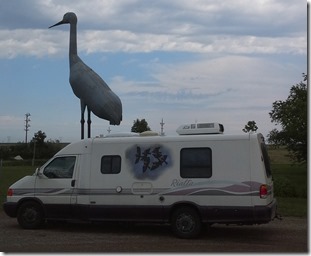
20140704_142353Then, I retired. We bought an RV. Ok, I bought an RV, but I did it because my wife wanted a few adventures now that I wasn’t working a bizillion hours a week. I mean this was a serious months long nag that finally convinced me to look for an RV that would hold both of us, that my wife might drive (since I still hate driving four-wheel anythings), and that could tow a trailer for bicycles and the WR. Being the dumbass I am, I picked the Winnebago Rialta you see at right. I wrote a whole series of rants about how awful that played out.

2016-02-16 Blizzard & RVSo, we sold the Rialta and decided to downsize and move to someplace less noisy than Little Canada and our beloved I35E backyard noise generator. We moved to Red Wing, downsized about 1600 square feet, from 2700 to 1100, lost about 35dB of average noise, Still with a jones for traveling, she decided we needed to “seperate our camping house from our vehicle,” so we bought a pickup with towing capability and a camper trailer. And there it sat, wind, rain, snow, heat, and rince and repeat for two years. This week, we finally got the damn thing out on the road, mostly to practice backing it up and parking it. She wanted nothing to do with any part of the process and decided the whole camper experiment had been a mistake. I concur.

_grandloopSo, we’re going to put the camper up for sale. Maybe, buy a minivan for short haul camping trips (that we’ll probably never take), and we haven’t decided if we’re keeping the pickup. Since I sold the bike trailer, we might hang on to the pickup and ramps. In the meantime, I’m back to my original camping rig and other than all of the hassle involved between then and now, I’m ok with that.

Jul 10, 2017

#150 Old Habits and New Fears

All Rights Reserved © 2016 Thomas W. Day

I retired in 2013 and my wife and I escaped our first Minnesota winter in 18 years in a used Winnebago RV. That was the plan, anyway. Unfortunately, I discovered a whole lot about Volkswagen and that company's non-existent product support along the way (Ducati owners beware!). So, instead of a 13,000 mile trip to the southern California and up PCH to Portland, we spent the winter (all five months of it) in Truth or Consequences, New Mexico while I troubleshot our Eurovan's electronics and contemplated going back to some kind of work since "retirement" had turned into such a disaster.

Along the way, I met some really terrific people who also owned the same POS RV (Ours was a 2000 Winnebago Rialta.) and had a bunch of discussions about what kind of person makes a "good" RV traveler. Many of us came to the conclusion that the fact that I was perfectly happy traveling by myself, staying in cheap motels or sleeping in a hammock or on the ground probably meant I would never be a "real" RV sort of guy. Some of you might know that I generally don't like driving any sort of four-wheel vehicle and would rather take the train, bus, or hitchhike than be anyone's designated driver. Sometime during my early 20's I passed the million-mile mark in work vehicles, driving 100,000+ miles a year for almost a decade, and any love I might have had for cars or trucks vanished. I own a pickup because it can carry a lot of crap, including my motorcycles and because my wife hasn't given up on that damn RV dream. On my own, I'd rent a car when I need one. 

We bought the Rialta because it was supposed to be fairly easy to drive. As long as you didn't have to back it up with a motorcycle trailer in tow, it wasn't particularly painful to pilot. I ended up doing most of the driving because my wife freaked out about the motorcycle trailer, but she did at least 20% of the driving later in the trip and that made 20% of the RV traveling tolerable for me. Mostly, I wasted most of that first year's summer getting the RV ready to travel: new flooring, transmission cooler, overhauled the A/C, new entertainment center, and a full 75,000 mile point-by-VW-point service. 2,000 miles later, after being stranded in a snow and ice storm in Carlsbad National Park for a week, the many flaws in VW's wiring and electronics put the vehicle in "limp home mode" and we eventually limped into Truth or Consequences for the next five months. In April of 2014, we drove the VW/RV back home, cleaned it up, and sold it. End of story?

I wish.

habits_fearsLike I said, my wife had not given up on the RV dream but her new mantra became, "You want your house separate from your vehicle." Slowly, I got talked into thinking about trying the mobile life again. Too many of the VW's problems came from the poorly implemented electronics that controlled the automatic transmission, so I started looking for something with a manual transmission that could haul a motorcycle and pull a small trailer. Just in time for the move to Red Wing, I bought a Nissan Frontier in great shape with a manual transmission and cruise control; the Holy Grail of traveling vehicles. After some nagging and pleading, we stumbled on to a small camper that had the layout, weight, and price we'd decided on. We bought it last fall, knowing the chances that we'd go somewhere in it were slim due to other commitments for the winter. I'm writing this in mid-July and the camper hasn't moved an inch since the previous owners parked it in our yard. Like 90% of the campers purchased on this planet, it is serving as a yet-unused spare guest room.
 
"What's the problem?" You ask.
 
"General disinterest, marginal backing up skills, and practically no familiarity with towing anything other than a U-Haul trailer," would be the answer.
 
I'm perfectly happy with a tent and sleeping bag, and rolling down the highway on two wheels. I don't need to learn the new skills required to setup and drive a vehicle pulling a 3,000 pound trailer. My wife's interest in traveling by RV is still strong. She, on the other hand, is expecting me to find the motivation to not only do all of that crap but to teach her how to do it, too. We've been married almost 50 years and all of our worst moments have been when I was stuck being her coach or teacher. I am a professional teacher, but she is a life-long stubborn resistant-learner. She has absolutely no self-teaching skills, instincts, or motivation and I would rather hand feed an alligator tiny pieces of steak than be forced to teach my wife anything difficult.
 
And there is the problem.
 
My memories of our five months "camping" are mostly of me trying to sort out VW's well-hidden and inaccurate service information, crawling around under that damned Eurovan POS or disassembling the interior or engine wiring to find the three cobbled-together engine and transmission computers or worrying that I would be abandoning our $20,000 RV investment in New Mexico (the home of many abandoned retirement dreams). The "good moments" of that winter were mostly spent on my WR250 bombing around Elephant Butte Lake's dried up shores relearning how to ride in deep sand. I've been told that when fellow campers heard the bike fire up they'd drag lawn chairs to the lake-side of their campsites and place bets as to how long it would take before I endo'd into a pile of sand. I rarely disappointed them. Other fine camping moments were when I'd given up hope on the VW for the day and settled down with a few bottles of beer and my Martin Backpacker to sing Kink's songs to the coyotes. The best moments where when I'd given up on the VW entirely and loaded up my camping gear and headed into the Gila National Forest mountains for a couple nights of solo camping while my wife stayed with the camper and dog and our new friends at the hot springs in Truth or Consequences. 
 
Speaking of the dog, the obvious problem here is getting and old dog to learn new (not particularly desirable to the dog) tricks. The idea of driving a fairly large pickup with a camper in tow is just not inspiring. I am really nervous about the whole concept. It seems claustrophobic and dangerous and complicated and expensive. In fact, at the moment I'm a lot more inspired to start the process of convincing my wife that we'd be better off selling the camper and giving up on the whole idea of traveling together than I am to learn how to be a competent RV'er. When I see something like this moment appear in my motorcycle students, I do not encourage them to press on. Maybe pulling a camper isn't the same kind of risk as riding a motorcycle, but it does feel like the kind of thing that you shouldn't be doing if you can think of a better way to travel. I don't, honestly, have any faith that I'm going to be good at pulling a trailer and I have absolutely no motivation (other than making my wife happy) to learn how to pull a trailer safely. "Why me?" is the phrase that comes to mind every time I look at the thing parked in my yard.
 
Twenty years ago, even ten years ago, I'd have bulled through the fear and loathing and learned how to do this thing that I really don't want to do. At almost 70, not so much. The only good to come from this moment, so far, is that I have a lot more empathy for my motorcycle students who really don't want to be out on the range learning how to ride a motorcycle to please someone else.

 
POSTSCRIPT: As of this week (July 11, 2017), our R-Pod has only been used as an occasional office for me and my brother Larry stayed in it for a couple of weeks this month. After watching Larry and me wrestle with getting the pickup hooked up to the trailer and--after discovering the 7-pin electrical connector was wired wrong--drive off to practice backing up and parking the damn thing, my wife decided she wasn't as hip on the camping idea as she'd thought. Now, she wants to sell it and buy a mini-van.

May 6, 2017

Product Review: Giant Loop Pronghorn Straps


All Rights Reserved © 2015 Thomas W. Day
PHS16-fastener
A Giant Loop-supplied picture of the alleged "unbreakable fasteners." (Photo supplied by Giant Loop, Harold Cecil)
Friends say I'm unrealistically biased positively toward Giant Loop Products. Could be. I own and love several of the company's fine products: the Giant Loop Coyote Saddlebag, Dry Bag, Diablo Tank Bag, Kiger Tank Bag, and the Great Basin Dry Bag. All of that gear is fiercely waterproof, tougher than rhino skin, and brilliantly designed for backwoods motorcycling. When I received a trio of Pronghorn Straps to test, I pretty much assumed this would be another brilliantly designed product that would become an indispensible part of my travel kit. Turned out, that was pretty much a no-brainer assumption.

PHS-pronghorn-straps-web
The three Pronghorn Strap options (Photo supplied by Giant Loop, Harold Cecil)

The first thing I felt needed to be challenged was the claim that the fasteners are "unbreakable." As a retired reliability engineer, I am compelled to test any such claim because I absolutely do not believe such stuff. In the interests of truth and the American Way, I will admit that I received these straps as "media samples," so I had no money invested in the following abuse/tests. Likewise, earlier in my career--when I was paid to abuse/test industrial electronics, music equipment, professional audio equipment, medical devices, software, firmware, and hardware--I did not pay for that equipment, either. Fair is fair.
Practically speaking, what kind of abuse would something like these straps and their buckle expect to experience? First, serious abrasion and tension stress under a variety of temperatures. Second, impact damage from crashes within the same range of temperatures. (For example, 0oC to 40oC.) Finally, an outright attempt to find the breaking point of the strap or buckle, whichever comes first would be typical test engineering experiments. I decided that I would limit my tests to semi-destructive because I wanted to long-term test the straps on our RV excursion during the winter of 2013-14. First, I measured the strap's total pre-test length for a distortion/elasticity baseline (32.1cm).

So, I started with simple abuse. I clamped one of the red straps (the size I thought I was most unlikely to use) to my vise and whaled away with my 4 pound sledge at the buckle and strap for a bit. The buckle showed abrasion signs of abuse afterwards, but it didn't break. The strap looked a bit scratched up, but it didn't appear to be weakened, either. So, I froze (at -5oC) the same strap in my basement storage freezer for a few days while leaving it under tension with an expansion clamp extended far enough that the buckle distorted significantly. After leaving it frozen for a few days, I pulled it out and gave the clamp a few more squeezes which stretched the buckle and strap even more, but didn't break it. Next, I tossed the strap into my wife's food dehydrator (80oC) and left it for a week while she dried pears on the other three trays. (Yeah, I know. I probably poisoned us with the plastic out-gassing. At our age, poisons will have to be pretty aggressive to matter much.) Out of the dryer, I put the strap back into the clamp and stretched it to 125% of it's relaxed length and left it in the clamp for a day. That ended the bench testing phase of my procedure. After that abuse, the 20oC resting length of the strap was 32.23cm, 101% of it's original length. The buckle retained it's original shape, compared to my untested copies. The strap didn't even retain the clamped form and appeared to be returning to the packaged shape after a few days on the bench.

A month later, I used two of the red straps to secure my Giant Loop Dry Bag to my WR250's tail rack for a camping trip along the St. Croix. (So much for my ability to guess which size strap I'd use most often.) One of the two straps was the one I'd abused in my earlier tests. I'd imagined that this trip would be pretty benign because the fall had been wet and I didn't plan on going off-road much between the Cities and Two Harbors, but once I got out of town I ended up letting my GPS guide me northward with the instruction that I waned to avoid freeways, major highways, toll roads with a high preference for dirt roads and "ferries" (in case I ever get a chance to cross the St. Croix on one). Pretty soon, I was bouncing along on a heavily farm-equipment-rutted road enjoying the hell out of my all-time favorite motorcycle. 350 miles later, I was still south of Duluth by 50 miles and looking for a place to hang my hammock for the night. As either a testament to my faith in Giant Loop products or my simplemindedness, I hadn't check my load once in the last 250 miles. It was all there, though. Ten minutes later, I was swinging between two trees reading my eBook with the sound of the river in the background, mosquitoes in the foreground, and birds and bats in between until the light failed and I fell asleep.

A few weeks later, I used five of the Pronghorns to secure bicycles,hardware, and the WR250X to my customized Harbor Freight trailer and we headed south for our first winter in retirement. Somewhere around 6,000 miles into the trip, weather, vibration, and metal fatigue caused one of the brackets I'd used to hold a bicycle in place snapped and a blue Pronghorn strap between the bike ramp and the bicycle's lower frame was all that kept my mountain bike from being abandoned on the highway in New Mexico. I didn't discover the failure until we stopped for the night.

I started collecting information for this review in 2013 and, somehow, the final article ended up sitting in my computer for three years after any formal "testing" ended. I regret that I didn't stay on this because the Pronghorn straps have more than exceeded my expectations and have lived up to their "unbreakable" claim, at least with any semi-normal use. I love 'em.

Jan 31, 2017

Product Review: Giant Loop Kiger Tank Bag

All Rights Reserved © 2015 Thomas W. Day

Giant-Loop-Kiger-Tank-Bag21

One of the most hostile reviews I've ever written and had published was of my frustrating experience with my Wolfman Enduro Bag. As much as I've hated that damn thing, I didn't find a suitable replacement for a V-Strom tank bag until Giant Loop came out with the Kiger. To sum up this review in one sentance, everything I had come to dislike about the Wolfman bag is a non-issue on the Kiger.

First, even with the rain cover, the Wolfman (and practically every other enduro-style tank bag) isn't particularly water-resistant. The first day I installed my Kiger I taught a Basic Rider Course at Century College where, about two hours from the end of the range-portion of the course, we were hit with a gully-washer. I had my V-Strom covered, but I had to pull the cover because the wind was so strong the bike was rocking hard enough I thought it might topple off of the centerstand. I hadn't double-protected my stuff with the Kiger's optional dry bag and the storm hit so quickly I didn't have time to latch one of the bag's buckles. 40mph-plus winds blew the rain parallel to the ground for a half-hour, blowing over half of our motorcycles, flooding the drains, and drenching everyone and everything; except the stuff inside of my Kiger tank bag. At least three inches of rain fell in that short cloudburst and none of it, not one drop, made it into my tank bag. First test, passed.

Giant-Loop-Kiger-Tank-Bag

The Kiger and my V-Strom on an urban "adventure" during the Minneapolis Art-a-Whirl.

The next big issue I had with the Wolfman Enduro was stability. The Wolfman bag's "laminated foam sides" quickly turned to saggy pillows that took up space in the bag while providing ziltch for support. Initially, the Wolfman Enduro bag was the only substantial-sized bag I could find that was narrow enough to stay out of my way when steering, but when the foam sides failed so went the steering clearance. The Kiger's zipperless-clamshell design and materials make the bag almost rigid. The zipper-less, clamshell lid defines the top portion of the bag's structure and the foam-reinforced 22-ounce vinyl-coated polyester foundation holds the overall shape. The 4-point security system keeps it all exactly where I want it. The zipper attachment to the harness makes the bag easy to swing aside for a gas fill and the whole thing (except the harness) comes off easily so you take the bag with you. The Kiger is a 9 liter bag--rear 9.5″ tall, front 6″ tall, 8″ wide, 12″ long--which is large enough for a bike cover, gloves, boot covers, some tools, with space left over for stuff in the interior mesh pocket.

I'm still unclear on how this works, but it does. The clear vinyl map pocket is touchscreen-friendly; even when I'm wearing my Aerostich Deerskin gauntlets. This is a big deal, since I'm cheap and my Garmin GPS is a long ways from waterproof. There is a water-tight route for a power cord (USB on mine) into the map pocket, so running out of juice can be avoided.

Everything I wanted for this bit of travel storage was provided by Giant Loop's Kiger. It's a great bag and one that I fully expect to outlive my V-Strom and end up on whatever my next bike turns out to be. As always, the best place to buy Giant Loop products is directly from the company's website: https://giantloopmoto.com/.

Dec 13, 2013

Product Review: Giant Loop Coyote Saddlebag, Dry Bag, & Diablo Tank Bag

All Rights Reserved © 2011 Thomas W. Day

_grandloop
The left side view of the whole caboodle packed and ready for a camping trip to Wisconsin.
After a moto-camping trip to Canada, I realized that my small bike luggage had a few faults. My Motofizz "camping seat bag" (reviewed in August 2008) is a great commuter packer, but it is far from watertight. Four days of rain in the morning and 100F+ muggy afternoons and my gear smelled like a boy's gym and made my skin crawl with bacteria when I went for a "fresh change." My 15 year old Eclipse P-38 saddle bags were pretty leaky when i bought them, but now they provide as much weather protection as a fishing net. It was time to step up to something more serious.

MMM has reviewed Giant Loop gear before (Giant Loop Great Basin Bag and Fandango Tank Bag, Winter 2010 the Giant Loop Saddlebag, June 2008) and  the consensus was always positive. So, I went for the whole shootin' match with the company's new Coyote Saddlebag and Dry Bag and the Diablo Tank Bag. If you've ever used canoe or kayaking dry bags, you're already familiar with the construction materials Giant Loop uses on this series of products. The shell of all three of these bags is made from Giant Loop's Bomb Shell™ “trucker’s tarp.” This is tough, waterproof stuff and the abrasion points at the bottom of the tank bag and the bottom and leading edge of the Coyote Saddlebag are reinforced with 1050 Nylon Ballistic Cordura™. The zippers are heavy duty and, the full length zipper on the Saddlebag and the Diablo are waterproof and protected by storm flaps. The Dry Bag seals up with a side-release buckle, canoe bag-style.
_grand3
The exceptionally hip sleeping bag stuff sack and the Coyote Saddlebag's interior compression bindings.
 
The Coyote Dry Bag neatly straps to either the front or back of the Saddlebag and is big enough for both my sleeping bag and the pad with extra space for camp shoes and light clothing. The Saddlebag is shipped with three really heavy duty "contoured" stuff sacks, including one that is pre-curved to fit  The stuff sacks and the full length zipper makes it possible to get to any of your gear without having to remove the stuff you don't need at the moment.
 
_grand5
The Diablo stuffed with rain gear, wheel lock, flashlight, cold weather gloves, air guage, tools, and camping utensils.
The Diablo has a rear divider for immediate stuff and a water-tight window that you feed from inside the bag through a zipper in the lid's mesh backing. This window setup is making me reconsider my Streetpilot GPS setup for the first time since 2004. You could use any battery-powered GPS protected inside this bag, including a multi-function phone; no need for a motorcycle-specific and over-priced waterproof unit. The bag unzips from the base to allow removal and incredibly easy access to the gas cap. This feature, alone, puts the Diablo in the stratosphere of  "best ever" tank bags. A 4-liter tank bag may seem too small for practical use, but there isn't much of a choice on a small dirt bike or sport bike. 8 1/4" x 12" isn't a lot of real estate, but it's enough for compact gear you need to get to in a hurry while still being able to maneuver your bike without steering-lock restriction.

_grandloop2
The right side view of the small bike Giant Loop Coyote camping rig.
In real-world use, this combination of gear is a giant improvement over my old rig. Packing light, I had a little room to spare after stuffing all of my camping gear and four days of clothing and snacks into the three bags. The first evening out, I was hammered with a monster downpour and my gear and clothing was as dry as when I packed it. I spent one night on a mid-August trip sleeping on a picnic table where I only used the gear stored in the Diablo and the Dry Bag for a short, marginally legal night's sleep. The convenience and access to my stuff, without having to load and unload everything I'd packed, allowed me to spend a night for free and stay off of the road when the hoofed rats came out when a planned campsite was closed due to flooding. 

A deal, for me, with my WR's luggage, is the height and mounting restrictions. I'm old, inflexible, beat up, and short. My WR is young, nimble, and taller than me. My old camping rig often snagged a boot as I swung my leg over the tailbag and was inclined to send me and the bike crashing to the ground at particularly awkward moments. My Wolfman Enduro tankbag pushed my seat room back into the tailbag and saddlebags, which increased the odds that I'd land in a heap when getting on or off of the bike. One reason I ended up mounting the Dry Bag at the front of the Saddlebag is that kept the overall height of the rig low. That mounting position keeps the weight more centered, too.

grandloop
Packing into the bug-infested trails of Wisconsin.
As in any motorcycle packing situation, it's important to keep the weight as low and centered as possible. You want to pack the heavy stuff at the bottom of the Saddlebag and keep the weight evenly distributed. This probably isn't a big deal on a Triumph Thruxton, but on a 275 pound dirt bike, maneuvering through a twisty trail packed weight matters. When that weight is unstable, it's an even bigger deal. The attachment system Giant Loop uses on these three bags is flawlessly stable. It stays in place banging through rough terrain, in high winds and torrential rain, and for long distances.I will admit that the Coyote Saddlebag is a little weird looking, but it is exactly what I needed for my WR's touring rig and, altogether, this setup is better than my wildest dreams for my mini-touring bike..

_grand6_grand7

POSTSCRIPT: I have had my Giant Loop gear for three years, now. There isn't much more to say about the stuff except that is has worn incredibly well, is still water-tight, and the more I use it the more I like it. If you've followed my grumpy career, you know that is saying a lot. The zippers still work and are actually slightly easier to use than they were the day I loaded up the WR and headed out for my first weekend camping trip. Unbelievably, the map window on the Diablo is still crystal clear and it has seen almost 20,000 miles of use and abuse on the WR, including being strapped to the tank all last winter behind our RV. 

I'm not ashamed to admit that the Dry Bag has seen use both on the WR and my V-Strom but in the canoe and kayak. It is an amazing product and has outlived two REI dry bags and survived dozens of canoe trips loaded with boating camping gear.

Nothing I can say will adequately describe how much I like the Coyote Saddlebag. It is simply the ultimate dirt bike camping bag. Nothing else even comes close.

Nov 29, 2013

PRODUCT REVIEW: MotoFizz Camping Seat Bags

All Rights Reserved © 2007 Thomas W. Day

motofizz_front

Partially loaded, fully compressed (minimum size) large MotoFizz camping seat bag.

I snagged this bag late in 2006, moments after the riding season ended. On a trip to Duluth and a visit to Aerostich RiderWearhouse. I had some assistance in picking out a seat bag that I should have listened to more closely. Andy Goldfine, the wizard behind all things Aerostich, showed me a collection of seat bags and suggested, several times, that I might want to consider a bag that was more waterproof than the MotoFizz bags. I, however, kept bringing him back to the strongest selling point of the MotoFizz bag; "this one has a coffee thermos holder." After trying to convince me that I didn't need the large bag, but would find the small or medium MotoFizz bags held more than enough gear, Andy gave up and acknowledged the incredible value (to me) of a cup holder on a motorcycle and let me use my own lame judgment to choose my seat bag.

After this introduction, I'm sure you can guess what the major fault in the MotoFizz bag turned out to be; it isn't waterproof. I also found that after cinching the bag down tight, I could have easily made do with the medium bag or, probably, the small bag. Even worse, I couldn't find a way to mount the bag where the coffee thermos holder didn't co-function either as a really scary butt-plug (see the fully loaded photo) or a thermos ejection device. I left the thermos home for the trip. The small or medium bag would have carried the thermos holder in a less exciting position, since it's mounted on the side of those bags.

motofizz_buttplug

Partially loaded, partially compressed large MotoFizz camping seat bag with the coffee butt-plug in service.

The major fault in this product is the lack of waterproof-ness and the bag's rain cover. The rain cover doesn’t work at all. It’s an over-simplified design that is destined to let your gear get drenched from top to bottom. The rain cover is “secured” with a lightweight shock cord, instead of a more rational and traditional drawstring. A little wind, a few miles, and the shock cord stretches, comes apart, the bag flies away like an aimless parachute, and the MotoFizz is converted to a seat-mounted nylon swimming pool. After seven days of experiencing wet clothes, wet camping gear, and wet everything else, I relegated this bag to the simple task of holding waterproof gear. I made it about 3,000 miles into Canada before I tired of rescuing what was left of the rain cover and decided to try re-engineering it. The shock cord had popped like cotton string; first near the cord clamp and, later, where the cover was held in place by security straps. At a motel, I repaired the cover with a piece of 1/8" nylon cord which worked pretty well, but not well enough to trust the bag to things I wanted kept dry. RiderWearhouse stocks the rain cover, separately, because they are so easily lost.

The lack of waterproofing was disappointing because, as I might have mentioned, the MotoFizz has a coffee thermos holder. The MotoFizz bag is a well-designed, spacious bag that can be secured to practically any platform. Cinched down, the MotoFizz is incredibly stable wherever you position it on your bike. It is built to outlast you and your motorcycle, comes in three sizes (small, medium, and humongous), and is flexible and expandable to meet a variety of load conditions. My "large" bag is capable of storing most of a deer's carcass and the tools to butcher the deer, although it would leak blood all over my bike.

motofizz_filled

Totally loaded, fully compressed (minimum size) large MotoFizz camping seat bag.

The bag is edged by heavy duty zippers and made of heavy duty (water-resistant, but not waterproof) Cordura nylon. The bag's compression system is clever and practical. Once you get your gear into the bag, you can start tightening the straps down until you’ve reduced the size and stabilized your load. The small accessory storage bags (only on the large bag) are useful, but they aren’t water resistant.. They are anchored to the main bag with the side cinches, so they don't flap in the wind or work loose from their buckles. There are at least five different anchor points for tying down external gear (tents, sleeping pad, etc) and MotoFizz has included a lightweight elastic net for securing a towel or wet clothing. Every piece of hardware on the MotoFizz bag is well designed, if not over-designed, for intense touring. There are lots of good things to say about this bag, if only it kept out the rain. I recommend you consider the small or medium sized bags over the large bag.

MotoFizz Camping Seat Bags Revisited

All Rights Reserved © 2009 Thomas W. Day

motofizz_small

Partially loaded, fully compressed (minimum size) small MotoFizz camping seat bag.

I reviewed the MotoFizz large bag in 2007. Mostly, I liked it. However, I had complaints about the waterproof-ness (lack of) of the bag and the kinky position of the all-important coffee thermos holder. When I got back from Alaska that year, I gave up on making the large MotoFizz bag work and replaced it with a hard tailcase. A friend now has my large bag permanently mounted on his 1992 Yamaha 850 TDM and loves it. Every time I see it, I suspect I made a mistake. It looks much neater on his bike than it did on mine. Of course, he isn't stuffing a month's worth of camping gear, clothing, and food into the bag.

Last summer, when I needed to find a camping tailbag for my 250 Super Sherpa, there was no contest. I bought a small Motofizz bag and found that everything I liked about the large bag was there in the small size, plus the rain cover worked much better on the smaller bag and it has two all-important thermos holders which are mounted on the side of the bag where they do not do double-duty as a butt plug.

motofizz_small-1

Partially loaded, partially compressed small MotoFizz camping seat bag.

Note to Mr. Subjective: When a less-than-brilliant customer is overcome by the thought of having readily available access to coffee, suggest the two smaller bags because they will hold twice as much caffeine. You probably did that and I ignored your sage advice, right?

I had the new bag on my Super Sherpa for exactly two weeks when it was stolen. Like Monty Python's King of the Swamp Castle ("When I first came here, this was all swamp. Everyone said I was daft to build a castle on a swamp, but I built in all the same, just to show them. It sank into the swamp. So I built a second one. That sank into the swamp. So I built a third. That burned down, fell over, then sank into the swamp. But the fourth one stayed up."), I bought a second MotoFizz for the Sherpa. So far, I still possess this one. If I lose it, I will buy another one.

The small Motofizz bag, like the medium and large, is constructed to withstand a hurricane and sticks to the bike as if it were designed for it. The multitude of zippered storage pouches, plus the plethora of tie-down loops, makes the bag perfect for securing enough gear for a several day outing. Motofizz, apparently, listens to complaints because they replaced the silly elastic shock cord on the raincover with a much more secure nylon cord and are now using a much heavier material.

The small Motofizz, plus moderate-sized saddlebags, is a terrific minimalist touring rig. I'm going to put it to a real test this summer when I tour North Dakota on the 250. [Since I’ve used this bag on a daily commuter basis for four years, I think it’s passed the “real test.” For camping, touring, or just as a large daybag, the small MotoFizz is hard to beat. It would be nice if it was waterproof, but it’s not.]

As usual, Motofizz gear is available from RiderWearhouse.

Nov 15, 2013

PRODUCT REVIEW: MSR Whisperlite Internationale™ Multi-Fuel Backpacking Stove

All Rights Reserved © 2007 Thomas W. Day

whispe1

Whisperlite Internationale & fuel bottle. Photo courtesy of MSR.

If you've followed any of my search for the Ultimate Motorcycle, you'll know that I think everything ought to serve several purposes. The perfect motorcycle would excel everywhere from the freeway to the motocross track, at least. So, when I began to plan for my exodus across the northwestern portion of this continent, I wanted a stove that could serve some other multiple purposes. Propane stoves are light, fuel is reasonably available, and the stoves are easy to use, but what else can you do with propane? (Apologies to Hank Hill) White gas stoves are messier than propane, fuel is equally easy to find, and you're still stuck with the problem of the single purpose white gas.

I wanted a stove that would run on the same fuel my motorcycle used. I found the MSR Whisperlite Internationale Backpacking Stove. What makes this stove Internationale is the fuel possibilities, white gas, naphtha, kerosene, and unleaded auto gas. Couple the fact that you can carry unleaded gas in the aluminum MSR fuel bottles and you have a flexible, practical motorcycle touring stove. Carrying extra fuel on the motorcycle always makes me nervous, but MSR makes an aluminum 33oz fuel container that is as durable and secure as anything I've found. So, I have a super-portable camp stove and extra fuel storage in secure containers. The only thing left is to see if the stove works well enough to be practical on the road.

I don't think there is any way to handle gas without spreading the pungent smell of fuel over everything. That was my first concern, finding a way to handle and store the stove and fuel without spreading unleaded joy all over my camping gear. The stove comes in a nylon stuff sack, which includes a pair of folded aluminum wind shields and radiant heat reflectors. The aluminum base shield provides a little protection from spilling fuel on your campsite and starting a forest fire. Still, you have to be very careful in handling the fuel and starting the fire to keep from having a fuel spill that turns into a runaway fire.

The first time I tried the stove was in my backyard, as my grandson and I were shaking out my camping gear and trying out equipment to see how it would work in the field. We fired up the stove on a small wooden picnic table and it, immediately, got out of hand. I missed some bits of the ignition instructions, printed in at least a half-dozen languages and spread over several confusing pages, and managed to spill fuel on the table and start a fire that spread to the table-top. We hosed it down and tried again, after struggling through the somewhat disorganized owner's manual. The second time, I started a very hot, very concentrated fire that boiled a small pot of water in a few moments and we cooked up a batch of re-hydrated soup. I used the stove a few more times before adding it to the Alaska camping gear and it always started fairly easily and without hazard. It worked well camping, too. I cooked up several meals on the stove and it is a quick, efficient multi-fuel stove that is easy to use and packs small and light.

The MSR fuel bottles are a good buy and a practical way to carry extra fuel, too. I can fit three of the largest size bottle, 33oz, into my Chase Harper 1150 tank bag and that amounts to a little more than 3/4 gallons of extra fuel. That's not exactly an Iron Butt "fuel cell," but it's enough to add 30-45 miles to my bike's range and that could be the difference between walking or riding to the next fuel stop. These heavy duty aluminum bottles are built almost like air bottles, have a secure, leak-proof screw-top, and add very little (dry) weight  to your camping gear.

I found the Internationale stove, locally, for about $55 and the fuel bottles sold for $10 each, on sale. That's about as cheap as the best price I found on the Internet, too.

Jul 19, 2013

The Lawson Blue Ridge Camping Hammock

All Rights Reserved © 2005 Thomas W. Day

lawson_entryI admit that I'm a camping wimp in my old age.  I used to enjoy sleeping on the ground after a long day's hike or ride, but I have too many marginally healed bones, worn out joints, and a fragile back.  The basic camping adventure is outweighed by the pain and lack of sleep.  So, a couple of decades ago, I started carrying a small nylon hammock in my gear and a nylon tarp in case it rained.  I sleep like a baby in a hammock and am about as happy swinging from a tree as I am in a Motel 6 (except for the lack of hot showers) .

A few years ago, on a business trip to Florida, I found myself with a few spare days to burn in the Keys.  After renting a kayak and setting paddle for some small islands, I bumped into a camper comfortably holed-up in a really cool looking hammock/tent.  He was hanging from a clump of Mangrove trees, suspended over the water, reading a book, and ignoring the cloud of bugs that were attached to the hammock's mosquito netting.  Back home, I searched for the kayaker's gear on the Net.  I found several tent/hammock manufacturers and Backpacker Magazine had done a "shootout" a couple of years earlier.  That article pointed me toward the Lawson Blue Ridge Camping Hammock. 

During last year’s 4th of July holiday, I did a two day trip to the Apostle Islands where the camping conditions were varied enough to constitute a motorcycling "test" of my hammock.  Day one, the temperature was in the mid-90s most of the day and the Minnesota state bug/bird was in full attack mode.  The only way I could get any rest outdoors was to quickly put up my hammock and dive into the protective netting.  The fact that I could find a site, put the unit together (in a way that provided comfort and a view), and load it and seal it up with myself and my reading material in less than five minutes made rest stops practical. 

lawson-rainfly Friday night, my island was hit with a rain storm that left the ground soaked and littered a few leaves on the rain fly, but I slept through it and can not report on the storm's severity.  In the morning, I was dry and comfortable and that's about all I can tell you about the night's weather activity. 

Saturday night, I thought I’d found the perfect isolated campsite until about 4AM when some drunken brats showed up in their shiny new brat-trucks.  I gave up on sleep and fired up a reading headlamp and finished the book I'd started earlier that day.  About 20 minutes after the brat-pack got their mini-forest fire started, a monsoon blew in to our corner of the island.  The weather flipped from calm and mostly warm to gusty, pouring rain, and downright cold in about ten minutes.  The brats ran for their club cabs and watched their campsite and most of their food blow into Lake Superior.  Screaming obscenities, they drove back to mommies' hotel room or wherever morons go for shelter. 

lawson_inside_view I buttoned up the rain fly and swung in the wind for the next hour or so.  Lightning was so intense (and close) that I could read by it through the netting and rain fly. Other than being a bit nervous that the trees I'd tied myself to might end up blowing out to sea, I was comfortable through the part of the storm through which I stayed awake.  I drifted off and the sun woke me up about the time my stomach began its usual demands for food. 

I'd parked my bike on a large flat rock, so it was where I'd left it and the buttoned-down rain cover had kept my gear dry and in place.  There were several trails of moisture from the sides of the hammock to the low point of the hammock, about where the middle of my back had been during the night.  My bag and back were slightly damp and I was a little chilled.  The temperature had dropped to the low 50s during the night and I'd have been chilled without being a little wet.

lawson-bagged_smallThe hammock, poles, and rain fly fit, without the stuff sack, in one side of my Eclipse P-38 saddlebags.  There is room for a light blanket, a sleeping bag liner, or a small amount of gear in the same bag.  The hammock weights about 5 lbs and (if you can't find trees to hang it from) can be used, with a couple of tie lines and four tent stakes, as a one-person tent.  For one-up adventure touring, I'm convinced that this is the way to go.  Now that my hammock has proven its weather resistant capabilities, I'm planning on a lot more weekend bike camping trips.

Mar 20, 2013

Because They're Water Soluble?

Redverz Gear Series II Motorcycle Tent
You probably didn't know you needed this product: a tent with a motorcycle garage. It turns out that there are a few versions of this silly-assed idea. The Redverz Gear Series II Expedition pictured at right costs $449 and is is a 13 1/2 pound, 3-season, 3-person, 16 3/4 foot long, "expedition grade" tent  with "anodized tent poles."

Harley-Davidson Rider's Dome Tent
As always, when a really dumb consumer product turns out to have a large, rich, and brain-dead market, you would expect Hardly to jump right in and they have. Since they are the largest manufacturer of dissolve-able motorcycles, I'm sure their product is sold purely as a service to their suck . . . customers. The Harley-Davidson Rider's Dome Tent sells for "only" $229and is slightly less dorky/cool than the Redverz Gear tent, but half the price. It is also nylon and uses fiberglass poles, presumably not-anodized. Harley's 4-person tent-plus-garage sports features like breathable mesh roof panels, front and rear doors with bug screens, inside zipper storm flaps, "clearview" windows on the rainfly, and the desperately needed "motorcycle vestibule." The whole thing weighs 12 pounds.

Finally, a company called "Catoma" sells a series of "Lone Rider Adventure Shelters Motorcycle tents" that Sears sells to the poncho biker crowd (Yep, that's a Frank Zappa reference.). I'm not gonna bother with a picture of that company's silly shit because Lone Riders apparently only need normal popup tents with a trendy name.

Aerostich Ultralight Bike Cover covering my fully-loaded V-Strom.
Unless you desperately feel the need to sleep with your bike, you might know that I've recommended the Aerostich Ultralight Bike Covers (I use small for the WR250X and large for the full-bagged and ready-to-tour V-Strom 650) in a previous life on this very blog. You can't sleep with your bike using one of these covers, but it will keep your gear dry on the seat during some pretty nasty weather. I know, I've tested it under conditions that practically floated away my North Face tent..

Dec 10, 2012

US Camping Data

A few years back, I had a great time camping and riding across as much of North Dakota as I found interesting. Three weeks and about 2,500 miles and I could have spent another week on the eastern edge without getting bored. I'm fooling around with another summer tour for 2013 and it would be hard not to put North Dakota on the route sheet on the way to Alaska. Two things jam up those plans: 1) for the next couple of years, North Dakota is going to play the oil boom game and the cost of staying anywhere between Bismark and the western edge of the state is out-of-sight and 2) after my experience in Texas (Dallas-Fort Worth tap water smells like a weird combination of sulfur and carpet cleaning chemicals), I'd like to avoid any more consumption of fracking contaminated water than absolutely necessary.


It turns out that avoiding that mess isn't as difficult as it might have been. Since the EPA is pretending to monitor underground water contamination (and they are doing little more than pretending), they have created a few maps marking off the territory where this practice is . . . popular. It sucks that one of my favorite national parks, Teddy Roosevelt National, has been contaminated by this shortsighted corporate welfare practice, but it is what it is.

Canada, on the other hand, is a problem. A lot of my favorite places are in the gun sights of the oil companies. My favorite part of the trip, the Top of the World boarder crossing puts me right in the path of this ecological mess. I guess all that long-term water contamination explains why east coast water is so nasty, too.

I suppose the upside is that petrochemically contaminated surface water will be as hard on mosquitoes as it is on me. Maybe taking a shower in the stuff will work like "Alaska aftershave."