Showing posts with label old riders. Show all posts

Jul 20, 2024

My Pace, My Path, My Objectives

For more than 60 years, the ONLY time I have been in total control of what I’m doing, how fast I’m doing it, and why I’m doing it have been on a motorcycle. I came from a fairly large (5 brats and two semi-adult parents) family and I was the oldest and designated babysitter, cook and bottle-washer, and the official family black sheep. When I abandoned my father’s nuthouse the summer I turned 16, I went from that over-complicated situation to even crazier 1960’s rock-and-roll bands, marriage at 19, and the next 40 years of occupational and parental over-stimulus non-stop; unless I was on a motorcycle.

Other that a few trips with close friends and one decidedly wrong start to the trip of a lifetime with someone Ms. Day had picked to babysit me and one anniversary trip with Ms. Day and a small portion of my 2008 Nova Scotia Canadian tour, I have always traveled alone by motorcycle. Even when I have been on a ride with a friend, my preferred plan is to designate a general time and specific place to meet at the end of the day and for each of us to find our own way to that location at our own pace.

For almost all of my 76 years I have been the poster boy for failing at “to thine own self be true” because I had no idea who I was. In the early 80s, in a “Career Planning” class at OCC, I took the Myers-Briggs Personality Test. Say what you will about how obsolete that test is, but when I received my dot-matrix printout of my personality results (INTP) it was all I could do to keep from crying during the class. It was the first time in my 35-years that I felt anyone actually “knew” me and that “someone” was an 8-bit, IBM mini-computer.

I am not just “a little” INTP, either. Those measurement bars were pinned to the far end of each characteristic. The intended outcome of that test was for us to plow through a 4” thick book of occupations and find jobs that were suitable for our personality types. INTPs are fairly rare (not in a good way) and, at that time, that giant book of occupations recommended only four occupations. Not helpful, especially for me since “engineer” was not one of the four and I had been making a living as an electronic engineer for a dozen years by 1984.

Worse, everything about being a 1950s kid ruled against the “I” characteristic in my personality type. When I grew up, in the age of How to Win Friends and Influence People, “introversion” is old psych-jargon for homosexual or worse. Giving in to my natural inclinations was the fast route to unemployment and social stigma. So, for the next 40 years I ignored the “I” and concentrated on making the best of “NTP” (my Intuitive, Thinking, and Prospecting traits). And that, occupationally, worked for me right up to when I retired, mostly. It kept me employed, anyway.

For my family and friends, however, ignoring my introversion meant that i spent a lot of my “off-camera” time suffering from an “introvert hangover”: “a metaphorical state of emotional and mental exhaustion. It occurs when an introvert has spent an extended period interacting socially, leaving them drained and depleted.” “Drained and depleted” enough that I would rather risk being bitten by a rattlesnake backpacking alone in the Texas desert or left injured and stranded anywhere from Baja, Mexico to Alaska to the empty backroads of Newfoundland and New Brunswick to Montana or Wyoming’s empty, abandoned wastelands than talk to one more person, no matter how much I loved them. And that is where motorcycles came into my life in a dominant way from around 1969 until a few years ago.

I had been backpacking the wilderness of every place I’d lived, from Kansas when I was a kid to California when my daughters were teenagers, but backpacking usually required a lot of prep time and energy and, often, I didn’t have those resources in any quantity. At the most hectic period of my life, when we lived in California and our daughters were teenagers, I would often have to escape for a weekend or a day or two more and my trip “planning” involved stuffing camping gear into saddlebags along with a couple changes of clothing and flipping a quarter while I sat on my motorcycle to decide if I was traveling north or south out of Huntington Beach: often as far as well into Baja, Mexico or right up to the Canadian border on PCH. Sometimes, I’d make the same trip (with the same planning) in my ‘73 Toyota Hilux with a kayak tied to the rack and a bed full of scuba gear. (“Fuck a lot of ‘dive buddy’ crap, I need to go where nobody else ever goes.”)

If you peruse this blog, you’ll see “reports” of my solo travels that cross about 50 years of my life. I have never had a job that didn’t generate substantial “introvert hangovers” and busting out of my life alone and mostly directionless has been the cure until I retired in 2013. When I retired, two friends gave me copies (one paperback and one eBook) of Quiet: The Power of Introverts in a World That Can't Stop Talking, And I thought, “Why the fuck do you guys think I need a book about introverts?” Seriously. After being trapped in a screwed-up VW camper for several months in a New Mexico campground waiting for parts, information, or shop time I started to read the book. By the time I had that crap VW Eurovan back in running condition and we’d relaxed into our original driving and camping

In 2018, myasthenia gravis put an end to that hangover cure, but being retired also diminished the requirement. It got a lot worse before it started to get better and, assuming it wouldn’t get enough better to matter, I sold my beloved 2004 Suzuki V-Strom and my even more precious Yamaha WR250X. Thinking that the worst was past, I gambled on a Suzuki TU250X in late 2019, but it didn’t get better as the eyesight problems were soon replaced with hands that refuse to function usefully or reliably and riding skills that had deteriorated to the point of no return.

Bicycling, my primary transportation for as many Minnesota months as I can stand it, is not the same.

Dec 31, 2020

From Diapers to Trikes and Back Again

I live in an old fart’s town in southeastern Minnesota. If you visit one of our remaining mid-Covid plague restaurants on a weekday you’d assume the average age here must be close to 100. On summer weekends, the old fart Minnesota biker crowd might bring that median down to 75 or 80, but it’s pretty much the same people wearing leather and gangster patches. Sans motors, we have some fairly popular bicycle trails and, likewise, the typical person on our bike trails is only slightly younger than the biker crowd. There are few things more scary looking that a trio of old spandex-clad bicyclists attempting to draft each other without clue how to stop, steer, or maneuver around the occasional trail obstacle. The worst of that bunch are on three-wheeled recumbents. Not only do they take up 2/3 of the trail, but they are usually riding those speedy wheelchairs because they are incompetent, demented, or both.

Earlier this summer, I was coming back from a bicycle ride downtown when I rolled up behind a bearded old fart on a Hardly three-wheeler trying to pull away from a stop sign on an uphill grade. Not much of an uphill grade, mind you, but it was more of a challenge than this oldster could manage. While I waited for him to move his hippotrike out of the intersection, it struck me that this was a perfect example of life: we start out in diapers, progress to tricycles, wander around a while, and end up on trikes and back in Depends.

Mobility ScootersWith that in mind, the ads from Polaris, Can-Am, HD, Kymco, and the rest of the three-wheeled power wheelchairs are pretty funny. Like Coke and McDonald’s and Budweiser, the manufacturers want their customers/suckers to imagine ourselves to be young, hip, and fast while the real customer base is about a half-step away from being Medicare-provided Hoveround candidates or electrically powered adjustable hospital beds. [Before I committed to using Hoveround as a baseline, I check that company’s website and found no pictures of young, vital, active people fitted to electric wheelchairs. I have to suspect Hoveround is missing an obvious marketing ploy; selling lifestyle over reality is an American marketing tradition.

Depends for Men (or women), on the other hand, isn’t missing any part of that bet. Like Viagra or Cialis, the people pictured in the adult diaper ads appear to be barely old enough to be worrying about boxers or briefs. If you are as young as this guy and you’re worried about crapping or pissing your pants, you shouldn’t be grinning like an idiot. You should be seriously rethinking your life’s choices and/or cursing your flawed genetics. Also, you might be a good candidate for AA or a friendly intervention.

The rush to dump cars and concentrate SUVs has been all about auto manufacturers looking for a way around EPA emissions regulations. Likewise, the Polaris Slingshot and Can-Am’s Spyder are a lame attempt to make a car without the nasty safety, noise, and emissions regulations that encumber actual vehicle manufacturers. If you’ve driven (not ridden) either of these goofy hippotrikes, you know how incredibly lame they are. The upside is that, like those low-slung, noisy cars from The Marching Morons future, they really feel like they are clipping right along when they are barely keeping up with traffic on a rural road. Go-carts have the same effect as does not looking where you are going on a regular motorcycle. When you are sitting right next to the pavement (or looking down at it), a fast walking pace seems like rocketing at near-death speeds. Cruisers provide the same false sense of power and speed, but not nearly so dramatically as when your butt is actually a few inches from the pavement on a trike. They are a long ways from safe, though. I’ve had both of these vehicles tailgating me on our rural county road and they are absolutely invisible in a Nissan Frontier pickup’s rearview mirror. Worse, the drivers appear to have the same entitled opinion of their position in society as the pirate bikers. The only “effort” they seem to be able to make to contribute to their own safety is to illegally mangle their vehicles’ exhaust noise. Hate to break it to you, kiddies, but I can’t hear you inside my pickup with the air conditioning or heater going and the stereo at a comfortable volume. Sound doesn’t work the way you think it works.

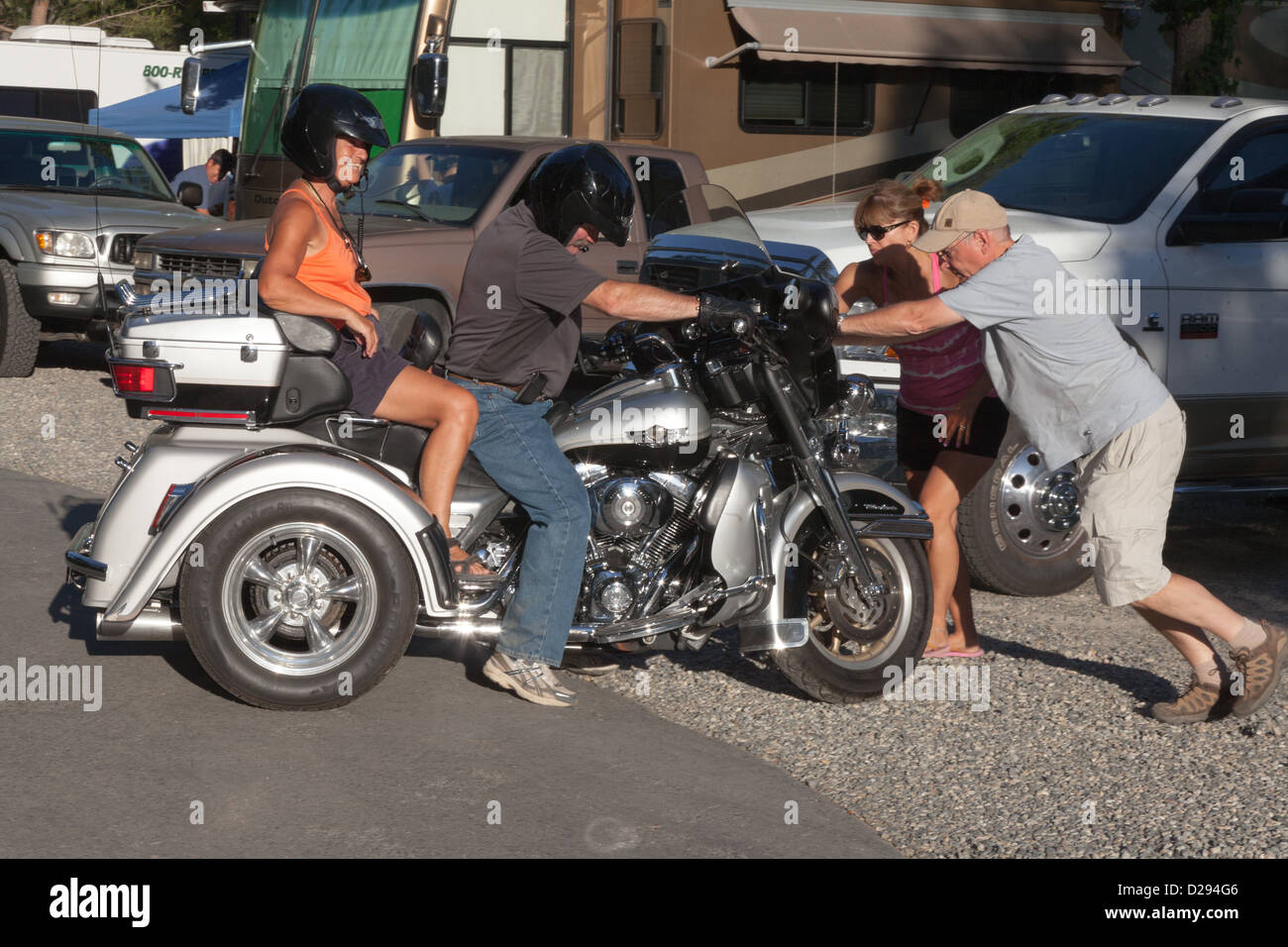
Harley Davidson Trike High Resolution Stock Photography and Images - AlamySo it goes that we begin life pooping and pissing in our pants and we end that way. We move from four-wheel baby strollers and being tucked and strapped into car seats (although not when I was a baby). We stop fouling our diapers and progress to our first Radio Flyer tricycle to a bicycle with training wheels to an actual bicycle. After what feels like a few years, we start leaking again. Around the same time, some of us get the urge to abandon the demands of balancing on two wheels and we buy a $30,000 tricycle. That is a huge red flag, because not long after that comes the four-wheel old fart stroller/Hooveround and being strapped into a wheelchair waiting for a nurse to move us to the crapper and back to bed. I recommend not rushing that chain of events. Stay away from the trike as long as possible.

Apr 6, 2020

Assigning Blame, Taking Responsibility

A blast from my past called this weekend, wanting to talk about his summer’s misfortunes. We’ll call him “P” to protect his ego and our relationship. In early August (2019), P was sailing down a country two-lane, minding his own business, and assuming that Minnesota country roads are, somehow, safer than urban freeways and byways. (Statistics consistently demonstrate that this is a motorcyclists’ delusion. In 2018, for example,31 of 57 or 54% of the state’s motorcycle fatalities were in areas with populations under 10,000 and the majority, 22, were in rural, unpopulated areas. 913 motorcyclists were injured that year and 49% of that total were injured on those same low population roads.) 2 motorcyclists were killed and 102 were injured in the state’s over-250,000 cities; the Twin Cities, in fact. P, oblivious to the hazard of country roads, was riding somewhere between 55 and 65mph on a sparsely-populated stretch of the road, when a pickup pulled into his lane, partially shielded by a downed tree next to the driveway the pickup was exiting from. Mayhem resulted and P ended up with a multitudinous-fractured femur, a broken back, and a separated shoulder.

Fortunately for P, he was wearing actual motorcycle gear including a full-face helmet and armored jacket. As he said, “I didn’t spill a drop of blood.” Unfortunately for P, he has a long recovery ahead of him and he is not fond of physical therapy. He’s been here before. Several year ago, he was riding in fairly congested traffic and, bored with the pace of movement, he was occupied trying to read the call sign of a passing small airplane when he struck the stopped car in front of him. He flew over the car and, while he was airborne, he decided, “I don’t want to hear Tom lecturing me about not wearing a helmet while I recover from this” and he shielded his head with his arms just before tumbling into a ditch. The end result of that crash was a severely massacred pelvis from which he has yet to fully recover. To his credit, P took total responsibility for both that crash and his less-than-complete recovery. He also started wearing a full-face helmet and, at least, an armored jacket when he rode. A life-long Harley guy with a long history of spectacular crashes, the bike he crashed on the last two times was a big BMW touring bike.

I’ve ridden with P, maybe twice, but definitely once. We met at a small town a few miles from his place, for a Fourth of July fireworks show. Afterwards, for whatever reason, we decided to go back to his house before I headed back home. Both of our spouses were riding passenger on that trip. P immediately took off in the dark, on familiar country roads, putting some distance between us. I made a half-hearted effort to keep him in sight, but I do not ride fast, ever, with a passenger and since I knew where we were going I was not particularly upset to make most of the trip “unguided.” Since then, he’s often reminded me of that incident and of the fact that he was a “lot faster” than me on those mostly-gravel country roads. I do my racing, when I do it, on closed courses and I am never impressed with people who imagine racing on public roads is something to brag about. My wife would make short work of me if I ever play-raced with her on the bike.

Like many motorcyclists and bikers, P’s problem is that he imagines that he is seen, because he is a big guy riding a “big bike.”  While P’s BMW didn’t have loud pipes, P has ridden bikes with minimal muffling for most of his life and always deluded himself into thinking physics is his friend when it comes to sound and defensive riding, he suffers the false idea that people are looking for motorcycles. Even in a fairly motorcycle-friendly state like Minnesota, there aren’t enough motorcycles on the road any given day for a typical cager to have any reason to be watching for them. When we don’t amount to 0.001% of the total traffic on good days, asking drivers to “Start Looking for Motorcycles” is as silly as asking them to watch out for unicorns. Bicycles, pedestrians, old men on power wheelchairs, and kids on tricycles are far more likely things to be looking out for than motorcycles; especially motorcycles approaching a blind intersection (or driveway) at 60-65mph.

This is exactly the kind of situation where motorcyclists have to be watching out for everyone else. Even if, as in P’s case, the cager gets the blame for the crash, P might still be crippled-for-life or dead . . . but in the right. The price for being right is higher than I want to pay. To be clear, I am not afraid of being dead, but I practically terrified of being maimed and crippled. During the brief period when the MSF’s Basic Rider Course actually talked about risk management, I used to tell my motorcycle students that any crash short of a tree falling on you or a tornado blowing you to Kansas was the motorcyclist’s fault for not anticipating and avoiding the situation. If you think everyone else is looking out for, or responsible for, your safety, you will be disappointed and, probably, hurt or killed.

May 1, 2019

Show Stoppers

For the last month or so, my 71-year-old vision problems have multiplied into what appears to be a show stopper for what I had hoped might be my last years as a motorcyclist. Last year, about the same time, I had a sudden bout with double-vision that took me out of the driver’s seat until I ended up with a variation in my glasses prescription that involved prisms. (I have no idea how that works, but it did for about a year.) Early March, this year, it happened again, but way worse. Another visit to the optometrist and I learn that my eyes’ offset has flipped and that is an indication of something serious going wrong. So far, none of the various tests I’ve undergone have enlightened either me or the docs. 

I don’t know about you, but I am not inclined to be a one-eyed motorcyclist. I’ve put in a bunch of miles on the bicycle this spring, one-eyed, and it sucks. When I was young and even more foolish than now, I imagined that losing my hearing would be worse than losing my eyesight. I’ve been involved in music for my whole adult (and most of my youth) life and my hearing was once something I took some pride in. Old age, noise exposure, stupidity, and bad luck have taken a toll on my hearing. I’m at the age Sir George Martin was when he decided it was time to hang up his golden ears. I don’t think I ever had golden ears, but they were pretty damn good for a lot of years. Now, they aren’t. Following that realization comes the current problem with my eyes.

Luckily, my close vision hasn’t been much effected. Which is why I can write this without being driven nuts. All this likely means that I might be selling off my only motorcycle, my 2008 Yamana WR250X yet this spring. I sold my V-Strom last spring, after discovering that I no long had the strength or will to wrestle with a 400 pound motorcycle. If I were capable of loving a motorcycle, that amazing 2004 650 was as close as I will ever get. It just never let me down and was always a delight to ride. My WR is a close second, but I will likely never end up spending as much long-distance, day-after-day time on the WR unless I get a couple more years with some cure for this vision problem. If I sell the WR, I will likely be done as a motorcyclist.

I might also be done as a cage driver. My overall sight in my right eye (the good one) is pretty sad. My distance judgement was never great, even with glasses, but one-eyed it is non-existent. My father had similar probably at about my age and ended up having his license taken away after several rear end crashes that were all his fault. I am not going to do that. I have always believed that one crash in the back of another vehicle should disqualify someone from ever driving anything heavier than a bicycle. It means you are stupid or physically disabled enough to be incapable of safe driving. That applies to me, too.

Sep 17, 2018

Things I Wish I Knew

All Rights Reserved © 2011 Thomas W. Day

A few years ago, I had picked up my wife at the Halifax, Nova Scotia airport. As we headed off toward our four day home base, about 90 miles east along the coast, the sun went down. 10 miles later, the sky fell and we rode into a waterfall. I haven't experienced such darkness since I was a kid in rural western Kansas. Joseph Lucas and his heirs would have been proud to see such an illumination void. Every village we passed was pitch dark; no street lights or signs, no open businesses, no lights in homes, no sign that anyone still lived in those places. To make things worse, about fifty miles of the road had been recently resurfaced and there were no centerline or shoulder markings. It was barely possible to see the edge of the road with my V-Strom's excellent headlights. There was a festival in Halifax and the Eagles were playing a reunion concert that night (seriously), so turning back to find closer accommodations was pointless and we were committed to making it to our destination. This was a test ride of almost everything I know about motorcycling. 
 
When I first started riding street bikes, I thought I was a good rider. I'd raced, off-road, for almost 15 years. I even taught a regional motocross program for a year or two. In the spring of 1983, I loaded up my 1979 CX500 Honda for the move from Nebraska to California and I was convinced I knew everything I needed to know to make that ride safely. I was a clueless moron. 
 
Leaving Omaha in late March that spring, I encountered strong winds that tossed my heavily-loaded Honda about like a small sailboat in high seas. Most of that instability was due to my lack of knowledge of how motorcycle steering actually works. From years of riding small bikes off-road and from a lifetime of misunderstanding two-wheel bicycle physics, I was used to applying a lot of body English to my steering corrections. By the time I made it to my parents' home in western Kansas, I'd wrestled my bike for 300-some miles and stressed my upper back muscles so badly that they are still a source of occasional pain. Today, I know that applying counter-steering pressure on the handlebars will achieve what fought to accomplish with all that wasted effort. Today, high winds bother me less on a heavily loaded 250cc dirt bike than I suffered on a road bike in 1983.

Less than predictable paved road surfaces used to baffle me; which might seem weird since I came from a riding background of completely unpredictable road surfaces. However, since traction was always in short supply off-road, I had never given predictable traction much thought. Dirt from hard-packed to freshly plowed, gravel lubricating the surface of a packed clay track or knee-deep desert sand, wet and slippery clay or slushy muck that sucks rider and motorcycle into the earth's sticky maw, my solution was always "go like hell until you crash." My cornering style was pretty much "throw the bike into a slide, bounce off of a berm, and hammer the throttle out of the corner." That is a pretty violent tactic on pavement, so I used a wimpy variation of brake-and-pivot for more than ten years before slowly including some reliance on good traction in my cornering style. When I began my MSF coach career in 2002, I began to look more seriously at my outlook on traction and adopted a more optimistic tactic for turning on pavement. That has given me more control of how I use the space available on the road and allows me to adapt to the more consistent surface variations provided by regular highway maintenance. The first step to being smooth is in having a plan for entering and exiting each and every corner you approach. Counting on luck and youthful reactions is not a practical or reliable long-term strategy.

Even after having broken a few bones and ripping apart muscles and tendons that were designed to remain attached, it took me most of my life to realize I am mortal and a lousy patient. I do not tolerate extended pain well. Staying shiny side up has become a bigger deal to me in old age. I take longer to heal; physically and mentally. That knowledge inspires me to work on basic riding skills, wear the best protective gear I can afford, to avoid hazardous situations, and to limit my risk-taking tendencies. In other words, I slow down, as a riding tactic, at least as often as I pin the throttle. For twenty years, my solution to almost every emergency situation was "drop the hammer and get one or two wheels into the air." That's plan is not as universally useful as I once thought it was.

The more luck I have experienced, the less I trust my fortunes to remain constant. As I look back on the bad things that didn't happen to me, I realize how close to the margin I have been. I have avoided close encounters with deer and other varmints, cagers and truckers, falling rocks and collapsing highways, and disaster caused by my own inattention. I do not trust good fortune any more than I trust good intentions. That is a lesson it has taken a lifetime to appreciate.

I have been a fan of preventative maintenance for most of my life, but I'm even more precautious in my geezerhood. I walk around my motorcycle, looking for loose hardware and worn out bits, habitually. "If it ain't broke, don't fix it" is a saying that doesn't make a lick of sense to me. "If it ain't broke, it's about to be" seems to be a lot more realistic. I carry tools, spare parts, and double my fuel stop time with inspection habits. I have never liked surprises, even surprise birthday parties, and I like them even less the older I get. (Consider my opinion of cell phones for reference.) Maintenance prevents surprises.

With those lessons and more behind me, after 40-some years of riding my brave and long-suffering wife and I slogged through those 90 dark miles of torrential rain without incident. Because the road and conditions were so severe, I was running totally on habits and experience, concentrating on the edges of the road for deer and anything that might require even more attention than I was already using staying on pavement. It wasn't a quick trip, but we made it to the resort wet, exhausted, and safe. The next four days were warm, sunny, and we had one of the best vacations in our 44 years together exploring the highlights surrounding our temporary home.

Looking back, I can think of a thousand things I wish I knew when I started motorcycling. Some of those lessons required a smidgen of common sense, so they would have been unavailable to me until I turned fifty. The stuff that I could have figured out with a less limited attention span and minimal ability to listen to advice, could have come faster and easier. The fact is, I really did love jumping on my bike and flinging it around a race track without the slightest clue how I could get better. Maybe it all worked out for the best, but there were some hard lessons that could have been less painful.

May 17, 2018

Not Dead . . . Yet

So, today was the first day of this season that I actually fired up a bike and took it out for a short ride. Mostly, I rode to a friend’s house in Wisconsin to return some CD’s I’d borrowed a generation ago. I’ve been down with a flu for a couple of weeks and today was the first day since our warm-up two weeks ago I felt good enough to give the bike a try. Red Wing is an easy ride, so no challenges there. The V-Strom needed a new battery and a massive clean-up before I try to sell it this spring, so the WR250X it is.

Without having kept up my flexibility training for a couple of weeks, I almost assumed getting off and on the WR would be a catestrophe. It wasn’t. After dropping the CDs off and blowing smoke at each other for an hour or so, I headed for the old Southeast Tech training course, which I figured would be almost unreadable after two seasons of disuse. Worse, it was coated with a layer of dirt from a destruction project at the back of the school. So, my baseline was tested on several levels. Riding the course was the least of my problems. Finding it was the hardest part. I did just Ok on the figure-eight in the box. I did fine the first pass through on the 135 degree curve and my stopping distance is still excellent. I can’t decide how I did on the swerve. It was a bitch to see until I was right on top of it. I might need to bring some cones with me next time.

My goal was, “So, every March from here out I'm going to go through the old routine but after an hour or so of practice, I'm going to run through every one of the nine BRC exercises and the day I can't do all of them ‘perfectly’ (no cones hit, no lines crossed, fast enough, and clean enough) the bike goes up for sale and I'll fill the space in the garage with a small convertible. I might buy a trials bike, but that will be the end of my street riding days.” I was too wore out for the hour of practice. The flu really kicked the snot out of me and I’m still short of wind. Like I said, I did ok. I’m going to give it a few days and try again. I wasn’t perfect today, but I was good enough to pass the Ridercoach exam.

Dec 14, 2016

Is This Like the Others?

During the parade season, there is never a shortage of noise makers in clip_image001Red Wing. However, as a motorcyclists’ location . . . not so much. I don’t know why that’s a fact, but it is. When I first moved here, I set out to distribute MMM to the various places I thought might attract motorcyclists (not necessarily bikers, but actual motorcyclists). I hit the college cafeteria, local restaurants, the library, and the bike shops. After a couple of months, I got the bike shops set up with their own supply of magazines, but I quickly noticed that there was no point in replenishing the other locations because the first set of issues were still there. Two years later, some of those first magazines are still waiting for readers.

Lucky for me, Red Wing has a decent Suzuki and Yamaha dealership, but I don’t know why. The dealership seems to retain the same collection of “new” and used bikes for at least a couple of seasons, probably until another dealer or wholesaler takes them off of their hands. If it weren’t for boats and ATVs and snow machines, I suspect we’d lose that dealer. The Polaris/Victory dealer never seems to have customers and I’d guess someone is burning up a trust fund with that venture. Likewise, the local community college offers a summer full of motorcycle safety classes, but 3 out of 4 of my last season’s MSF classes cancelled due to lack of interest, including an Intermediate Rider Course that wasn’t supposed to cancel under any conditions. On a typical work day, it’s rare to see more than one of two bikes on the road and most of those will be touring riders passing through town.

It’s a mystery. Red Wing and the surrounding territory is a massive riding resource. We have twisty roads and small towns with history and good food and recreation. You can’t beat the river valley for upper Midwest scenery; it’s the closest thing to mountains we have for 650 miles. As a mostly-dirt rider, I have more interesting country roads and marginally maintained back roads than I know what to do with. It is incredibly easy for me to burn up a tank of gas in an afternoon without doing more than crossing pavement every 50 miles. There is even a few sections of actual off-road riding from abandoned farm roads that haven’t yet been converted to farm land.

Outside of the summer pirate parades, it feels like motorcycling is on its last legs here. All of the riders I know are over-50 and most of them are on the edge of giving it up. The kids I meet who talk about buying a bike and learning how to ride just talk about it. It’s not a practical thing for them, for whatever reason. There is some off-road activity in Elsworth and I should get over there to check it out. But . . . it’s Wisconsin and a battlefield of starving small towns and bankrupt counties all overstaffed with highway patrol and sheriff’s deputies haunting the backroads to make their quotas. I cross the river only when I really need to.

May 31, 2013

Dumbest Thing Yet?

When I got back from a short ride and hang with Chris Luhman yesterday, I did some slightly-put-off maintenance: oil change, chain clean, lube, and adjust, cooling system flush. As I began the usual process, I flashed back on a rushed oil change I did, near the end of last season, on the V-Strom last year that might take the prize for being the dumbest maintenance move I’ve made in my fading memory.

I did a crap-load of stuff on the bike; from the usual to the once-in-10,000-miles stuff. I intended to do more, but while I was wandering from task to task with no real focus or check-list, I managed to dump a whole gallon of expensive synthetic oil into the fill-hole before discovering that I had yet to replace the drain plug. After smacking myself around the garage for a few minutes, I installed the plug, filled the crankcase with my backup oil (not synthetic), and terminated the maintenance session.

I still need to repack the steering head bearings, but in the mood I was in after blowing $25 in a few moments of stupidity I decided discretion was “the better part of valor” and my bike, too.
Some days, maintenance brings out the really stupid in me and on those days I try to be flexible enough to find something else, something easier, to do rather than continue on the path that will likely end in a screwed up motorcycle and additional expense. How ‘bout you?


May 18, 2010

Your Opinion, My Opinion

All Rights Reserved © 2009 Thomas W. Day

On a web mail list, I stumbled into a discussion about air filters and it quickly turned into a pissing match between a guy who hated everything about the brand of filter that I've used for almost 30 years and he was pretty unimpressed with all other filtration options. I was a little put off by the dude's venom, so I bailed out of the discussion and fired up my word-processing software to write this column.

In my life, I have been rightly described as someone who is overly-dependent on personal experience and practical application. I'm all for science and theory, as long as it doesn't get between me and getting something done, but I'm not dependent on the advise of sanctioned experts or popular opinion. I've personally known quite a few of the folks the media uses for expert opinions and I'm not particularly impressed. They are all good men and women, but just like you and me they have opinions and their opinions are no more founded in fact than yours or mine. Sometimes, less so. In the end, if something I've been doing has worked for me, I'll keep doing it even when the experts claim it doesn't work. I'd rather spend my time fixing the things that are broke and the things that aren't will get my attention in my next life; the life where I will be born rich and with lots of idle time on my hands.

Sometimes, even well-intentioned scientifically conducted studies don't impress me. Of course, some scientific studies don't live up to the name, either. (I wasted a decade in medical device manufacturing and saw more of that kind of science than I want to think about.) Often, the constraints of a study limit the value of the study to rare conditions. For example, if a rat has a forced daily diet of one-fourth of his body weight in a given substance, he will get fat. Therefore, said given substance is fattening. Yeah, I'll keep that in mind the next time I sit down to a 50pound dinner.

In the case of the aforementioned air filter discussion, the one and only test I found on the subject assumed the user would improperly clean and prepare the filter and, therefore, the filter would be ineffective. On the other hand, I have subjected my bikes to above average dirt road and trail exposure and have seen no signs that my applications of this same filter are allowing above factory filter contamination into the engine. In fact, I have seen signs of contamination on the intakes of other bikes using stock or aftermarket paper filters that I never seen in my bikes. I was told that a poorly functioning filter won't necessarily leave signs on the intake manifold. 2-strokes, especially, tend to produce dust accumulation on the manifold, since the fuel-oil mixture provides a little glue for the contamination. Obviously, engine wear would increase with poor filtration, too. I see those signs of air filter failure on others' bikes when I maintain them, I don't see it on mine, for what it's worth.

I do not know what it's worth. I only know that I'm likely to change my behavior when I see evidence that what I'm doing doesn't work. The older I get, the less inclined I am to experiment with things that seem to work for me.

On the practical side, when I go on a long, backroads trip I don't worry about being able to find a clean filter after a couple thousand miles of dirt roads. All I need is a little soap, warm water, and a small can of filter oil. I don't need a Suzuki dealer, of which there seems to be a short supply in Canada or Alaska or North Dakota, for example.

In the mid-70s, when I first started using this brand of filter, a cross country race in western Nebraska provided a pretty severe test. About twenty miles into 120, the racers got hammered with a dust storm so thick that it was hard to see twenty feet ahead. In the dusty valleys, visibility dropped to less than ten feet. It was a Dust Bowl quality storm, a huge black cloud of sand and dirt that rose out of the southwest horizon and swept over the land like some kind of Hollywood supernatural evil. On top of the dust, the terrain was difficult and dry and the race would have been dusty, even without the storm. With the storm, bikes fell to the side of the road --sputtering and dying--like diseased animals in a plague. When I finished the first lap, I stopped to replace my choked up goggles and my wife and daughters got a kick out of my racoon-eye'd appearance. My mouth and nose were full of dirt, and I spit out the first half-gallon of water I tried to drink as it turned to mud in my mouth.

I took of for the second lap as the storm really turned ugly. About halfway through that lap, the event organizers threw in the red flag and called the event. Out of the original 50-or-so bikes, there were about a dozen of us still running. We cut across the course in a blizzard of dirt and fumbled out way back to our cars and trailers.

Some racers headed for Ogallala, where they planned to hide out in a bar or motel until the storm passed. I had to be back at work on Monday, so I pointed my car east and hit the freeway trying to out run the storm. A few miles later, my car's hydraulic clutch died. Both the master cylinder and the slave were seriously leaking fluid. Without a clutch and towing a trailer, getting back on the road was a hassle, but I had enough fuel to get home and planned to run every stop sign and light that didn't cooperate with my objective. Fifty miles later, my brakes became suspiciously soggy, but they still worked and I escaped the storm and made it home without any additional problems.

After repairing the clutch and brakes on the car and hauling a bucket of sand and dust out of the interior, I started getting the bike ready for the following Sunday. When I pulled the top off of the bike's filter box, I was amazed to see how much dust surrounded the filter. It was nearly buried. To keep from pouring crud into the cylinder, I pulled the whole air box off and dumped it out before removing the air cleaner for service. Still, not a speck of dust to be found in the intake manifold. I raced the bike for another year, sold it to a friend, and it lasted one more year off road before it died. The little Rickman ended up in the old motorcycles graveyard because the new owner tossed the air filter when it became so packed with river sand that the bike stalled. He almost made it back home before the motor seized. I don't know what that proves.

I've been using the same brand of air filters for exactly the opposite reason on my cars (older cars, anyway) and dirt bikes since the 1970s and I'm always amazed at how clean my intakes have been after some really nasty events and LD rides. Maybe it's the preparation and maintenance that bothers others? I put 380k miles on a 1973 Toyota HiLux pickup over 20 years and it was running strong when I sold it. Its whole life was spent with a the same filter. My CX500 gave me 130k miles with only a timing chain problem all with the same filter. All of my dirt bikes, from an OSSA Phantom to a Yamaha XT350 to my current 250 Super Sherpa breathe through that brand. So does my current bike, a Suzuki DL-650. I just have no motivation to change, so until some catastrophe inspires me to amend my opinion I'm sticking with what has worked for me.

I'm not trying to convince you to go with my brand. I'm not trying to convince you of anything except that the old adage "don't fix what ain't broke" isn't a bad way to go. It's not rocket science, but that's not all it's cut out to be either.

Aug 3, 2009

My Picture of Over-40 Riders

For a year, I subscribed to Motorcycle Consumer News. I like the concept of this magazine and I really wanted to like it, but I mostly was disappointed. Many of the articles are poorly written, some are as silly as the advertiser-based magazines, and a couple of the regular writers are downright irritating (kettle calling the pot "black," I know). However, some of the reviews are not only super-detailed but MCN will look at bikes the other magazines barely notice (like this month's review of Suzuki's TU250X).

As I was digging through the crap in my MSF classroom bag, I stumbled on an old issue that cemented my disinterest in renewing my subscription back when that subscription was about to run out: "A Portrait of the Over-40 Rider." This article, written by Wendy Moon, was supposedly an analysis of a survey pasted inside a previous issue. The survey received 122 respondents and Moon makes some amazing conclusions from the results. This was a survey placed in an out-of-the-way spot in the magazine a few months back. So out-of-the-way that I had to paw through my old issues to find it. I hadn't even noticed the survey while I was reading the magazine.

With her tiny collection of responses from MCN's odd group of subscribers, Moon attempts to dispute the findings of NHTSA's crash data (and several other studies) from previous years. According to her survey results, 57% of motorcycle riders are in their 50s and 23% are in their 60s, leaving 20% of riders for the 16-49 and 70-up year-old categories. I'm not even close to buying that. Since she concluded that such an overwhelming percentage of riders are geezers, the fact that 50% of all fatalities are old folks doesn't bother her. Her conclusion was that, "In contrast to the media's portrayal, they could be said to be the safest riders on the road."

A statistic that is missing in all of the significant studies' data is miles driven, but Moon's average of 11,968 miles per year is so far from NHTSA's 2,411 and anything any reasonable person could believe that the rest of the article loses what little credibility it might have had. A substantial number of her polled riders claimed an average of 50,000 miles per year on their bikes. Hell, I don't even believe NHTSA's 2,600 mile estimate. I think most US bikes barely collect 2,600 miles before they hit the scrap heap. Asking a bunch of geezers how many miles they ride is as useful information as asking SUV owners about their gas mileage. People lie and people really lie about stuff that they think points out superior strength or weakness.

Moon and MCN's other conclusions were:
  • 83% "always wore a helmet"
  • full-face helmets were the "overwhelming" choice
  • 75% said they "never" drank and rode
  • 85% were self-taught and 60% had "some kind of training"
  • 70% rode year-round in spite of the weather
  • only 14% rode with a group of any kind
  • 54% claimed to be daily commuters
  • 40% claimed to be crash-free
Somewhere in all that silly data, common sense was totally lost. In everyone else's data, many of the douchebags getting killed on motorcycles are over the alcohol limit. While it's true that the majority of motorcyclists in the US are over 40, I doubt that they contribute much to NHTSA's average 2,600 miles traveled per year. The garage candy crowd aren't dressed well enough to experience more than a 2 month riding season in most of the country, It's tough to put on big miles when you have to self-medicate yourself every 50 miles because of your crappy suspension and awkward riding position.

Like hearing the mpg data from an SUV owner, I put very little faith in the big mileage claims of most cruiser characters. The best someone claiming 50,000 miles a year can expect from me is a polite smile. I work on that expression often. I am a firm believer in disbelieving practically amazing story I didn't witness. [How's that for a convoluted sentence?]

How does a wide range of motorcycle riders manage to put on 11,000 miles a year and while 40% of them manage to avoid any sort of crash? Not buying that, either. If you ride, you crash. If you ride a lot, you crash a little more.

She also quoted a study that concluded, "those individuals who took beginning rider training courses were more likely to be involved in an accident than those who did not, and that those who took the beginning course more than once were much more likely to be involved in an accident."

Now, that I believe. If you can take the MSF BRC and fail the test afterwards, you are incompetent as a motorcyclist. The test is insanely simple. Honestly, I suspect that most folks who are forced to take the BRC to get their license are a bit handicapped in the hand-eye coordination skills territory, anyway. There is no such thing as a "difficult DMV" test in these United States. If you can't pass that test, you are either riding a worthless pile of crap or you are not capable of managing a motorcycle. The test ought to be 200% tougher, if anyone ever really wants to reduce motorcycle deaths. For those of us over 55, it ought to be re-administered ever couple of years to check the decay of our skills.

What MCN proved is that getting useful motorcycle data is tough and that publishing sketchy data is a formula for losing credibility.