Showing posts with label united states. Show all posts

Jan 28, 2017

The Dominoes Are Falling?

Erik-EBR-1900RXOnly a short while after Polaris announced the Victory Motorcycles are goners, Eric Buell Racing gives up, again. In their January 28 press release, the company said, “The company, which is the sequel to Buell Motorcycle Co. that Harley-Davidson Inc. owned for more than a decade before dropping the brand in 2009, says it will begin a wind down of production operations next week.” And “This difficult decision was based primarily on EBR facing significant headwinds with signing new dealers, which is key to sales and growth for a new company. In addition, EBR has had limited production in 2016 and 2017 that was under goal. The combination of slow sales and industry announcements of other major OEM brands closing or cutting production only magnified the challenges faced by EBR.”

Well, nuts. That is about it for US production of anything resembling a world class competition motorcycle.

Mar 1, 2013

Liars, Damned Liars, and Statistics

One of the things that I'm enjoying the most about The Geezer with a Grudge: Average Mileage spreadsheet is the arguments about how invalid the data is. NHTSA, the states, the AMA, and insurance companies simply make up the data they use for motorcycle fatalities per mile traveled because they are too lazy to get real data. If they wanted real data, all they have to do is use the information we're all forced to provide every time a motorcycle is sold: the manufacturer, VIN number (which can easily be linked to model, engine size, year of manufacturer, etc.), and mileage at the time of the sale.

The fact is, what the database is showing so far is about what I expected to see; the average motorcyclist could get by with a 100cc scooter. With the big mileage riders skewing the data to the high-side, average miles/year is moving towards 1500/year. Still, it's hard to justify more than 250cc if that's all you're going to do with a motorcycle. This is what statisticians call a "fat-tail curve," though. There are going to be a few bikes on the right side of the curve and a crap-load of bikes on the low side. I'm not even a little surprised.

All of my life, I've bought my motorcycles by cherry-picking the 80% of motorcycle buyers (Note: I did not call them "motorcyclists."). Using good old Pareto Principles, 80% of the people who buy a motorcycle are unlikely to use it for much. Apparently, based on our current data, the more the bike costs the less likely it is to be ridden. More importantly, for me, the trendier the bike the more likely it will be found super-cheap a year after the trendiness wears off.

For example, my 1999 Suzuki SV650. I bought that bike in mid-2000, after the press had raved this bike into unobtainium for two years. My local dealers had no SV's in stock and were asking a slight premium for next year's 2001 production. However, I kept an eye on Craigslist around the Midwest and found about a half-dozen for sale for about 1/2 list price with less than 100 miles on the odometer. A young "motorcycle buyer" fell for the hype, bought a new SV for full list-plus, put the recommended farkles on the bike, dropped it in his driveway, and decided motorcycles were too dangerous. Five years and about 30k miles later, I sold the SV for slightly more than I'd paid for it and bought a year-old 2004 V-Strom (the "next big thing") for the same amount with less than 1,400 miles of local use (owned by an old guy who dropped the bike once and gave up). Well-used V-Stroms were going for serious money in 2005, but I waited for the usual suspects to show up and was not disappointed. I expect to unload my 2004 V-Strom for close to what I paid for it 50-some-k-miles later.

As our data is demonstrating, most motorcycle owners are not motorcyclists.

Feb 25, 2013

Motorcycle Miles Traveled

One of my least favorite aspects of motorcycle safety statistics is the wildly optimistic "miles traveled" numbers that seem to be spouted by everyone from the dreaded AMA to the MSF to NTSA. I do not believe the average mileage traveled by motorcyclists is anywhere near 10,000 miles per year. But how do we get real numbers?

It struck me this morning that we have a ready source of data, CraigsList and eBay. So, I started paging through CraigsList ads this afternoon, copying down the bike year and miles advertised, tossed them into a spreadsheet, and did some calculations.

Observation and experiences are powerful tools. I realize that what appears to be isn't always what is, but I also realize that people making political claims are often motivated to tell less than the truth about . . . anything. One of my least favorite statistics is the "miles traveled" numbers that are used for motorcycle safety data. I simply do not believe that there are nearly as many motorcycles on the road as the industry, safety organizations, and, even, the government claims.

The Kelly Blue Book, for example, posts the following statement, "Obviously mileage will vary from year to year and model to model. A simple guide could be to consider the type of bike you are looking at: If the bike is a sportbike 600 c.c. to 999 c.c., and since these bikes are traditionally weekend only bikes, you can expect to see lower miles, about 3,000 miles per year. Tourers or Sport Tourers usually see a lot of miles, but these are generally freeway miles, between 5,000 to 6,000 miles per year." Those are silly numbers, based on fantasy. NHTA is considerably more conservative with an estimate of 1,943 miles per year for the average motorcycle. I'm not sure I buy that, either.

When people sell their motorcycles, they are pretty much forced to provide credible mileage numbers, so places like CraigsList, eBay, and local newspapers are pretty useful resources. In about a half-hour on two different days, I collected data on 60 motorcycles. So far, my data indicates the average mileage is about 1,425/year with a standard deviation of 863 miles. So far, there are some radically low-mileage outliers. The most annual mileage I've seen is 4,700/year over a 12 year lifetime. My own mileage tops that, but I'm trying to ignore anecdotal data and only collect "for sale" data to keep the information consistent and believable.

I created my own data gathering tool, a Microsoft Excel spreadsheet, that allowed me to enter data that I found in various locations and make some statistical assumptions from that information. Because I'm lazy, old, half-blind, and don't feel some kind of compulsion to do all of this on my own, I' originally posted the spreadsheet on my website for others to play with. A much smarter guy, William Wahby, transferred my Excel sheet to a Google Docs format:(Geezer with a Grudge: Average Mileage) where any of us can add data. If you want to add some bikes from your region, you'll see we've included the following data entry fields for you to work with:

State Date Sampled Make/Model or Description Year Miles

These are all data entry fields. The rest of the data fields -- Miles/Year, Miles Driven, and the statistical analysis fields -- calculate mileage automatically when you enter data into the Year and Miles fields. Please just enter the traditional two-letter State designation into that field. The date format is automatic: DD/MM/YYYY. I'll take pretty much anything for Make/Model. 

This is the kind of data collection that you'd think/hope NHTSA and the states would be collecting and using for analysis proposes. From what I've been told, they don't bother.  To the right is a charty of what our data looks like, so far. Pretty disgusting, don't you think? One thing this absolutely points out is that the overwhelming majority of riders don't need a bike bigger than 150-250cc. Any damn bike will hold up for less than 2,000 miles a year and how fast do you need to go if you're only going to be on the bike for less than twenty hours a year?

Jul 15, 2012

The Problem with Statistics

I'm reviewing Pat Hahns' new book, Motorcyclists Legal Handbook: How to handle legal situations from the mundane to the insane, for MMM. As always, I ended up with too many words for the magazine publication. As always, I'm dumping the extra verbiage here, because it's something I want to say. Before I go into full rant mode, I want to be clear that this is a useful, well-written book that most of us can use. Like all of Pat's books (except, maybe, Maximum Control: Mastering Your Heavyweight Bike, which is unintentionally hilarious considering the subject and the author who has used my term "hippobike" as often as me), Legal Handbook is practical, helpful, technically excellent, and damn near necessary for anyone who travels interstate. In fact, I'd recommend it as required reading for the IB folks.

Here's my only conflict with the book, and my excess 400 review words: My biggest disagreement with the whole book is about the state "rideability" rating. Rideability is a statistical evaluation of the "ratio of multi-vehicle motorcycle fatalities to single-vehicle motorcycle fatalities," plus the population density and law enforcement density. Pat claims that "a high ratio, such as 75/25, is bad, as it shows in a fatal accident in that state, it is more likely that the rider got hit by another vehicle rather than simply having an accident on his or her own." I disagree with this conclusion on at least two points.

When I first glanced through a few of the states' evaluations, I took that particular ratio completely differently. I would argue that a low ratio, such as 25/75, is bad because it shows that most of the state's bikers may be drunks and incompetents and tend to ride off of the road on their own accord. Plus, simply noting that a crash was a multi-vehicle event doesn't release the motorcyclist from fault for the crash. 

Second, since most Minnesota motorcycle fatalities occur on rural roads and in small towns, I don't put much into population density as a "rideability' evaluator. Having lived in L.A., where I experienced high population density, I apply even less credibility to the density issue as a riding negative. Nebraska has a really high "rideability" rating, but some of the most insane and incompetent drivers I've ever witnessed were in that state. Driver competence is more important than population density.

 I do agree with the inverse connection between rideability and law enforcement population. However, Iowa's 5th place (lower numbers are better) in law enforcement population does not reflect my Iowa experiences. As best I can tell, every third Iowegn is in a police car. I do anything possible to avoid Iowa, even if I'm travelling to Missouri. The whole state is "erratic," to use Pat's term for unusual laws or enforcement. Texas' relatively benign rideability number must reflect the near-absence of motorcycles from the streets and roads of that state. I lived in Dallas and west Texas in the 60's and 70's and the place was hell on wheels for motorcyclists then. My daughter and her family live in Dallas and I visit fairly regularly. I can count on the fingers of one hand the number of motorcyclists I've seen in the time I've been in Texas in the last ten years. In all, I'd have to put minimal value on the book's rideability estimates. Somewhere in the mix, there would have to be a miles-driven/motorcycle crashes value for that kind of evaluation to be useful.

Oct 7, 2011

Marketing = Engineering/Invention?

This sort of off-topic, but . . . live with it. It's my blog.

All the media hand-wringing about Steve Jobs, "the 21st Century's Thomas Edison," is going a long way toward explaining to me why the country is going down the tubes. To be sure, it's a sad thing when a relatively young (55) man dies of a terrible disease (pancreatic cancer). However, I can't help but get a little cranky when a marketing guy whose claim to fame is based on his response to colors and rounded corners is regarded as a brilliant inventor. Even worse, when that marketing guy is getting credit for "inventing the personal computer" (not even close), being first to produce a portable digital audio device (not even in the running), and for creating a whole new market for "smartphones" (again, Apple was practically last to the market). This is a guy who lied to his partner about the payment for an early product design assignment with Atari, took credit for doing the design work when he was only the delivery boy, and cheated his partner (Steve Wozniak, the real founder of Apple and the only genius of the two Apple founders) out of $2,250 of the $5,000 contract.

Really? This is what passes for a great man in what's left of the United States of America?

"The Woz," as always was exceptionally generous about his memories of his "friend" when interviewed yesterday. I met Steve Wozniak in the 80's and thought he was one of the coolest, nicest, most humble brilliant and rich guys I've ever met. Another corporate CEO I knew pretty well at the time was a Jobs-worshiper, which was all I needed to know at the time about Steve Jobs. This guy was a lazy, credit-absorbing, blame-shifting shark and anything he liked I was probably not going to want to be near. Later, I got to know a few design engineers who had worked for Apple and they had been trashed and burned by Jobs at Apple and had nothing but bad things to say about the guy and nothing but hero worship for Wozniak.  Wozniak's analysis of Jobs was that he "was a good marketer and understood the benefits of technology." I think that's a near-perfect analysis of Jobs' contribution.

But that's not my point. The point is the boys and girls (none competent enough to described in adult terms) of our mass media no longer know the difference between inventors, engineers, scientists, and the people who take advantage of those skills. If perception has become that knowing how to sell crap is the same as knowing how to make it, what's the point in going through the effort to learn how to do actual productive work? Obviously, this is the conclusion young people make when they blow off science, engineering, and technology and take the easy route to business and finance degrees.

When a character like Keith Wandell, who can barely be described as a rider let alone a motorcycle engineer,  can be put in charge of a genius like Eric Buell and can conjure up the gall to shut down the only progressive division of an otherwise backwards, failing, obsolete product line, we are heading for membership in the long list of failed empires. Wandell isn't fit to take on the task of being Buell's secretary, but that's not the way business works in the declining US of A. Secretaries are running the asylum and inventors are sidelined as an unnecessary evil in a country that imagines product invention, R&D, design, and manufacturing can be farmed overseas and the easy part, marketing, will remain a US-only task.

In my experience, if you can do the hard parts you can do the easy parts. IBM discovered that when they shipped PC production to Japan and, suddenly, produced a truckload of competitors for themselves. Apple doesn't build anything these days. If you can find a "Made in the USA" sticker on anything with an Apple logo, I'd like to see it. If you can't make it, you can't design it. If you didn't design it, you're just a salesman and salesmen are a dime a dozen.

Oct 22, 2010

Insights from an Ex-Ducati Exec

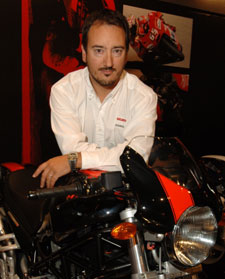
Ducati North America head Michael Lock gave an interview to the New York Times about the state of motorcycling in the US and . . .  I agree with practically everything he said.

Lock has abandoned motorcycling for a Norwegian EV company, Think, and he appears to be feeling free enough from the constraints of politispeak to say what he thinks about the state of motorcycling in the US.

For example, as to the state of motorcycle sales in the US, "September was minus 39%, which was pretty tragic considering September last year was a disaster. So I know the trend is not upward and it’s not slowing down. The industry is still contracting at quite a pronounced rate." Or his opinion on Harley's market future, "A motorcycle is a status symbol. It’s a discretionary purchase. You buy it. You feel good about life. Where Harley goes in the U.S., the rest of the industry has to follow in many respects. The shadow Harley casts over the rest of the industry is undeniable and their age demographic issue along with general economic conditions was a perfect storm."

 Like most of us, Lock believes, "Motorcycling won’t die, but it has to be substantially restructured. A lot of the fluff marketing has to go away. Maybe motorcycling has to go back to being a simpler pursuit rather than the whole posing thing and all the race replicas. It has to go back to being a simpler pleasure."

So, bring on the 100mpg 250's and out with the hippobikes! Want to kick some life into US motorcycling, ride small and often.

Mar 29, 2009

The Best We Can Do?

On the right, that showroom picture? That's "America's Most Beautiful Motorcycle." According to the 59th Grand National Roadster Show in Pomona, CA, Carl Brouhard designed and built this $175k (Brouhard's estimated value) concept-topping, prettiest-in-the-nation bike and everything else is Ugly Betty by comparison. I know, you know what I'm thinking. 

You're right. 

I'll give Brouhard's boat points for a great paint job. The Batman in Drag styling is impractically, weirdly, non-functionally uncomfortable looking; the cute girl in a wheelchair kind of look or a paraplegic weight-lifter. (If you think those comparisons were politically-incorrect, you should have heard what my wife compared it to.) For posers, this mechanical abortion is the perfect bike: all kinds of imagined power without a lick of performance, 0-ground clearance and a wide, flat rear tire so it can't tip over, and airport turn radius so . . . I don't have a reason for the yanked out fork arrangement. 

Like Douglas Adam's Vogon guard said about his job, "The hours are good, but the minutes are quite miserable," some of Brouhard's details are pretty but the whole is damned ugly. It's true. I don't get non-representational art. Jackson Pollack-style wallpaper, Chagall's my-3-year-0ld-can-paint-better-than-that portraits, or Ornette Coleman's harmony-and-rhythm-free jazz all leave me with a little less appreciation for chaos. A pile of shiny pieces, randomly glued together into a hippo of a motor, stuck in the middle of a bunch of swoopy Euro-bend sheet metal puts me in a mood to watch some X-Games moto-x'ing. I've seen some bikes, even around here, that I'd pick over that crazy looking geek-mobile at the top of this page. 

Somebody in Duluth turned a VFR into a Supermoto monster. I took a picture of it, during the 2004 World Trials at Spirit Mountain, but I fed those pictures into my data-eating Mac and that bike remains an image in my mind's eye that I can't share. That was the meanest, coolest, most sophisticated custom bike I've ever seen. I freakin' loved it. 

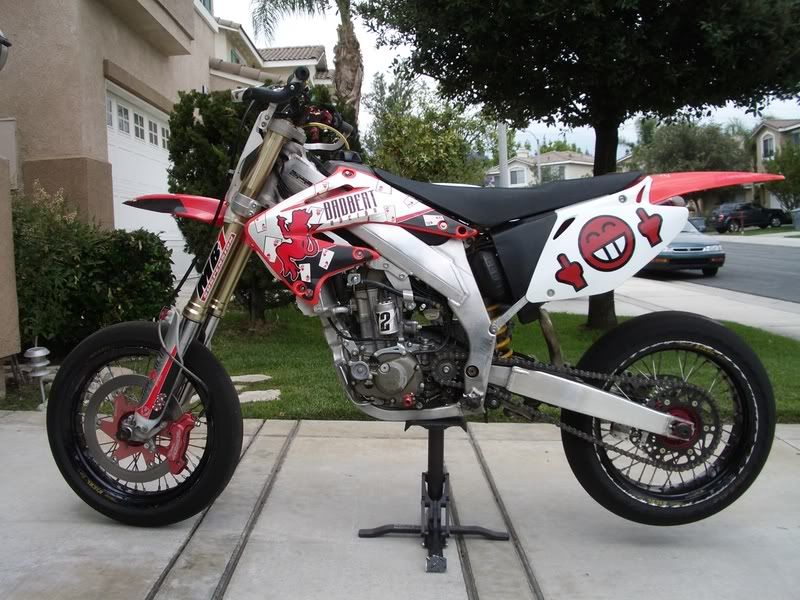
 A quick browse through Google found two other bikes I'd pick as being a lot closer to "America's Most Beautiful Motorcycle." For example, the tricked out little Honda single Supermoto MX'er (above) or the totally weirded customer VFR that looks half road bike and half Supermoto (right)? I admit it. I have a bias against motorcycle that can't be ridden. I don't much like bikes that can't be ridden practically anywhere. 

"America's Most Beautiful Motorcycle" actually has pads under the bodywork that prop the bike up for show. No kickstand, just a pair of belly-skids that work like immobile training wheels. The wheelbase must be approaching 10 feet. The motor is, by far, the ugliest aspect of a long list of ugly aspects. It is a butt-ugly conglomeration of chrome bits, randomly jutting out like a bunch of trumpets, trombones, and saxophones almost compacted into a neat pile ready for recycling. My love of functional cool goes a long ways back. I can't even guess how far. 

My grandfather was a particular fan of function. He managed the installations for the company he and my grandmother ran. He was good with tools and appreciated a good tool for its utility and appearance. I followed that with a job in Texas where I worked with an Air Force trained tech and a self-trained machinist for 3 years. Both of those men built equipment from scratch as complicated as multi-station electronic weights and measures system to as simple as a four component hitch system that could support and restrain 50k pounds and be disassembled with a single hitchpin. Both men had a gift for simplifying designs to the point that our company's design engineers refused to look at our installations because they knew they would be better than the original proposed design. 

A friend once compared my form-follows-function tastes as "fundamentalist." My wife says I'm more Calvinist. I have a feeling that either comparison is insulting, but I'm going to ignore the fundamentalist tag since I know where it came from. I'm not sure there isn't some connection to Calvinism in me, though. I'm some part English (3rd generation American), some part German (3th generation), some part Dutch (no idea what generation), and more mutt bits that are probably better left unknown (by me). I do subscribe to the philosophy that says, "don't work, don't eat." I think that came from whatever brand of rejects who survived the attempt to settle Jamestown. 

Apply it to motorcycles and you have "don't work, don't waste fuel." I can live with that. That won't be a problem for "America's Most Beautiful Motorcycle." It appears that the ridiculous thing can't move without being picked up. The only fuel likely to be found in the vicinity of this strange sculpture will be used for cleaning parts.

Feb 13, 2009

What the Show Showed

I spent a few hours staring at bikes, bikers, gear, and the usual suspects at the Cycle World Motorcycle Show this afternoon. There are, in fact, some cool new motorcycles, but (as my editor, Victor, suspects) they will probably be economic failures.

Honda, Yamaha, and Kawasaki have new 250cc dual purpose street bikes. A variety of companies have mid-sized bikes, most of which are not new. Honda put a lot of effort into displaying their new Fury VTX chopper-thingie. It is one of the silliest vehicles I've seen since my last visit to Pioneer Village in central Nebraska. The average age of the characters surrounding the Fury had to have been over 60. The same sort of geezer was seen climbing off and on of the Polaris Vision.

Friday afternoon wasn't a good day to judge the turnout or the character of the Minnesota crowd, but I talked to several people who said the show was down at least 20% at all stops. There is an air of desperation you can almost taste coming from the vendors. The customers emit something more like resignation.

I got home in time to watch a PBS movie called "Horatio's Drive" about the first cross-country auto trip, in 1903. About half way through the movie, our youngest daughter called to tell us she'd been laid off by Bank of America. She is an optimist and is convinced that she'll find a job soon. I've been through this sort of economic mess before, in the 70s through the 80s, and I hope she's right, but I worry for her and my son-in-law.

Times have been bad before. The country was less organized, more socially-segregated and stratified, and more destitute in 1930, but we don't know where we are in the curve of the current economic catestrophe.

If I get my druthers, we'll struggle through this recession/depression for long enough that many of the social inequalities and irrationalities get fixed but not so long that the nation seriously suffers. I'd like to see a little resurgence of American frugality and, along with that, a little attention paid to small motorcycles because of their economy and practicality. I don't, honestly, care if gas costs $5 a gallon at the end of the decade. That might be good for motorcycling, too. I would provide some initative for us to cut free from foreign oil.

I wouldn't mind if the whole gangster biker fad died a painful death. If the Angels, Outlaws, Bandidos, and the rest of them all end up replacing the crowd in Guantanamo, I wouldn't care. If even looking like that bunch of degenerates caused bikers enough trouble that leather fringe, bandanas, and Valley People butt-less chaps became fashion misstatements, I'm good with that.

In the end, maybe Honda will have to back off of their Orange County biker junk-mobiles and return to promoting the Nicest People. That's a future I can look forward to.