Showing posts with label motorcycle manufacturers. Show all posts

Oct 8, 2018

Can You Hear Me Out There?

When I taught the MSF program for MMSC, I’d get several questions per class along the lines of “what kind of first bike should I buy?” As you might know from following this blog, I have some strong opinions about that. (“No, you’re kidding?”) Most of the time when I’m giving this sort of advice, I feel like the deaf bluegrass banjo player whacking on a microphone saying, “Can anyone out there hear this thing?” (All bluegrass banjo players are deaf, I know.) It’s almost like teaching when the midterm or final exams get graded and you wonder if you were even in the room when those nitwits came to class. 

Mostly, I’d recommend something small, lightweight, that handles well and my ”students” would act like I’d insulted their intelligence, skill, or something and move on to the other instructor for more “manly advice.” As a habit, I recommend a bike around 250cc and one that weighs close to 300 pounds for daily riding. I’ve said this before in “A Good Beginner’s Bike” and I’ll say it again. And again.

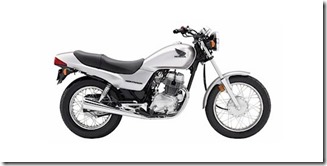
2006_Honda_Nighthawk_250There have been a couple of times, though, when I almost felt like I existed. The first time was in the first couple of years I taught the BRC. Two near-retirement-age physicians took the class, asked the question, and when I suggested they consider the Honda Nighthawk 250’s they were riding in the class. The Honda air-cooled twin is a tough, reliable, lightweight motorcycle that can more than do the job for the kind of around town riding they expected to be doing. A few years later, I was having lunch with a friend in Stillwater when the two doctors came over to our table, reintroduced themselves, and thanked me for the advice. Then, they told me about the trip they’d just returned from to Alaska and British Columbia on their 250s. It was a great story and I wish I remembed it well enough to accurately repeat it here, but I don’t.

Larry's BikeThe second time my advice didn’t die in a vacuum was when my brother asked for the same advice. I had been training on the Suzuki TU250X for a few years at the time and had the opportunity to “test” it on the police driving course at Dakota Technical College earlier that summer. The bike did everything a motorcycle needs to do, plus was fun to ride, gets great fuel economy, has a low seat height, and looks like a 1950’s British bike. Larry bought one and is driving it into the ground in Arizona as I write this. His one complaint was that it didn’t do all that well off-pavement, so I suggested a change in tires. As you can see in the picture above, he took that advice, too. He’s had it for a couple of years and 20,000 miles or so and will probably keep it until he rides it to death.

Likewise, I’m down to one motorcycle and taking my own advice it’s my Yamaha WR250X. Since I sold my V-Strom, I haven’t been riding much but I wasn’t riding much before I sold it. This fall or winter, I plan to rig up a relay so that I can run some electrical crap off of the WR’s battery without draining it when I forget to turn things off. I admit it, I’m addicted to my GPS, heated vest, heated gloves, and charging my computer while I ride on long trips. We’ll see if taking my own advice puts me back on the road and trail.

Aug 24, 2018

Ancient History, Current Situation

Guido Ebert (ex-MMM editor, current freelance writer) wrote an article for Give A Shift titled, “Motorcycle Sales in the Slow Lane.”  That November, 2017 analysis concluded with “Ultimately, the way it looks right now, the U.S. Motorcycle market could – in a best-case scenario – remain largely flat in coming years. But, despite core enthusiast riders continuing to make desired purchases, a great percentage of the potential motorcycle-buying public will continue to feel impacted by economic stressors, the market will continue to experience an aging owner demographic, and no prominent influencer for major growth appears readily apparent.”

Damn, and Guido is an optimist.

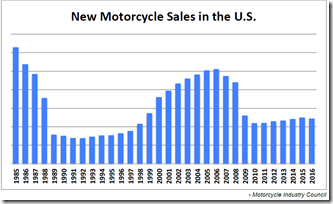
New MC SalesI am inclined to suspect he is right, though. This chart, to be really useful, should include another decade back. In the early 80’s, motorcycle hit a collection of snags that made it seem like motorcycles were about to go the way of the dodo. In 1980, there were 112 fatal motorcycle crashes in Minnesota. That was the peak year for both fatalities and injuries (2,728). By 1982, dealers were folding, manufacturers were stuck with a couple of year’s production sitting on showroom floors, and the national economy was sluggish. All of that happened again in 1988 (Remember “It’s about the economy, stupid?”).

MC by NationMotorcycle sales aren’t just going down in the USA, though. Brazil was a little late to the runoff, but for the rest of the countries documented in this chart 2007 was the beginning of a fairly substantial downturn in motorcycle sales. Australia and the UK seem to be the only countries that have shown any sort of serious uptick in sales since the Great Recession. The US sales have continued to decline since the 2016 end of this chart and nobody seems to be predicting a comeback any time soon. The 90’s downturn was about a decade long, so this moment could also turn out to be temporary.

fotw915The reasons, or excuses, for motorcycle purchases are thinning out, though. In the 80’s and 90’s, for all but the most radical sportbikes and a few gas spewing cruiser models, we could always pretend we rode motorcycles to save money on fuel. When gas was $1.25/gallon in the 80’s that was a close argument. When gas was $3.50 in the 2000’s, it would have been a more winning argument but car economy really took major leaps about then keeping the operational costs close. Likewise, for most of the time I’ve been riding a new motorcycle was dramatically cheaper than a new car. In 1973, I paid $500 for a brand new 125ISDT Rickman, for example, but my new Mazda station wagon cost $3,000. Today, you have to look deep into manufacturer’s lineup to find anything that is even a little cheaper than a car. A not-legal-in-California Suzuki TU250X costs $4600 and a Nissan Versa S costs $12,000. The low-ball Versa S gets 39mpg (highway), comes with A/C, an entertainment center, decent storage and reasonable comfort, front wheel drive and manual transmission, and a 3-year warranty. Some dealers give you a Versa S just for buying a more upscale Nissan SUV or Titan pickup. If you are looking at a motorcycle with comparable road-worthiness, you’ll discover your purchase price and fuel economy is neck-and-neck with the Versa. So much for an economics argument.

If an economy argument won’t be a seller for potential future motorcyclists, what will? While “adventure” or “freedom” is something that most motorcyclists list as their motivation for riding, most riders are anything but adventurous and pirate parades are more likely demonstrations of human herding instinct than some kind of weird take on individual liberty. Sales of “adventure touring” bikes have been disappointing, with inventory of 2016-2018 Honda Africa Twins, Yamaha Super Teneres, and assorted KTM and BMW bikes stuck on the showroom floors. Cruisers are still selling, but not at all briskly. Small bikes that should be iintroducing a generation of kids to motorcycling are failing to attract any serious attention, regardless of vintage or modern styling. I’m not seeing a bump in interest from Millenials or whatever the next generation of kids is called at the moment. I think that is a problem.

Dec 19, 2017

Horsemeat for Bikers?

121317-Worst-Motorcycle-Trends-2017-image10Some local guys were jawing on-line about the NY Times article, “No easy ride: Motorcycle industry is in deep trouble and needs help fast, panel agrees.” Like the industry, they blamed the usual suspects for the death of their favorite noise-makers: “the bubble-wrapped Millennials,” “the ultra-liberal lefties,” “tree huggers,” blah, blah, etc. Mirrors are tough on old guys. We look in them, see an accurate reflection and desperate want something else. The problem is, pretty much, us. We’re old, we’re irrelevant, and most of two generations wants to have nothing to do with imitating us.

Mostly, I read the Times article as a pretty accurate accounting of the lazy and braindead folks who represent US motorcyclists and the industry. The AMA and ABATE are just fronts for the butt-pirates who have turned off every sentient person possible with their noise, totally overrepresented crash, mortality and morbidity statistics, and general hooliganism. Nobody represents motorcycle commuters, the only motorcycle group that isn't about conspicuous consumption. The AMA is almost proud of how few actual motorcyclists are regular riders and ABATE is just a drinking club that dabbles in politics and writes sympathy/love letters to gangbanging “brothers behind bars.”

no-motorcycles-sign-k-6938_thumbAs for off-road access, it's not "liberals" who are shutting down access to public land; it's ranchers, conservationists, residents near the parks, and the people who have to provide unfunded rescue services to the nitwits who go off trail, terrorize livestock, wreak property, and end up tangled in barbed wire somewhere it will take a helicopter to bail out mommy's special little douchebag who has no insurance, no money, and suddenly believes in national health insurance. I’ve run a couple of events and watched dozens of off-road facilities go down in idealistic flames when their customers do everything possible to piss off anyone in the vicinity of the event, park, or private property. Motorcycles attract anti-social types and it’s harder than hell to cope with all of the forces that aren’t interested in putting up with spoiled children. I suspect if everyone were being honest, that would turn out to be a big part of the reason trials got bumped from Spirit Mountain and trials is the least obnoxious of all motorcycle sports. I KNOW that was why there was only one Merrick County enduro.

I freakin' love the argument promoted in the Times article that, since the motorcycle companies don't know how to sell to anyone who isn't already a motorcyclist, it's the job of motorcyclists to keep their business alive. That pretty much wraps up my argument in a Trump-quality gold plated ribbon. The industry is so obsolete it doesn’t even know how to sell its own products. How dumb is that?

Motorcyclists owe the industry their time and energy? For what reason? It's just a vehicle or, worse, a rich kid’s toy. If no one wants to play with them, they should disappear. There is no good reason for motorcycles to be the noisiest, most polluting, most dangerous, least efficient vehicle on the road and not even have to pay their own way with motorcycle license taxes (You know they don't in Minnesota, right?). You gotta provide some social value or you are just a welfare deadbeat if you still expect the public to foot your bill. By now, motorcycles should be knocking out at least 100mpg, emitting puffs of exhaust water and nothing more, and be bicycle-quiet. Instead, the stuff we get is barely 1980's technology and most of it is from the 50’s.

As for the Millennial bulllshit, you guys are just fuckin' old. You need to visit one of the boxing clubs, martial arts clubs, wall climbing clubs, bicycle racing clubs (off road, long distance, closed course, etc), and packing maker's groups. Those places are all about Millennials. Sure, there are lots of pampered Millennials. There are also lots of pampered, overpaid, underworked, barely-skilled X-gens and Boomers. My parent's’ generation paid a pittance for Social Security and jacked up the benefits until the system was almost broke before they elected Reagan who stripped that fund for his military-industrial buddies. Change just happens. Characters like Max Biaggi whined that all of that stuff crippled MotoGP riders while Rossi and the next generation just cranked ‘em up faster and leaned ‘em over further. Old people always complain about the next generation. “The children now love luxury. They have bad manners, contempt for authority; they show disrespect for elders and love chatter in place of exercise,” said Socrates. One of the fastest riders/coaches I know is just raving about Honda's auto-transmission. I love well-implemented ABS and throttle mapping, even though I don’t own a bike that has either.

Face it, 90% of everything humans do is always crap. You don't think millennials packed Washington with a bunch of superstitious, anti-science, spoiled trustfunders do you? If humans touch it, it will be screwed up. If humans deregulate something critial, it will be a disaster. Always. We’re just a braindead species desperately trying to fire off the 6th Extinction just to see which nutty death cult got it right.

That “wimp” label is nothing new, either. I have heard horse owners making the same “you are a bunch of wimps” arguments about motorcyclists since I was a kid. That is sort of valid, too. Keeping track of two empty skulls is twice as hard as managing one. That’s why I don’t ride horses. Your hippobike might seem “really big” compared to a dirt bike, but it is a twig compared to a 15-hand, 2,200 pound horse. Try laying one of those babies down in an intersection. On the other hand, try going faster than 20mph for more than a mile on a horse. Talk about limited range between extended fuel stops, horses are barely better tranportation than shoes.

Oct 27, 2017

Motorcycle Economics

Hitching Post Closed

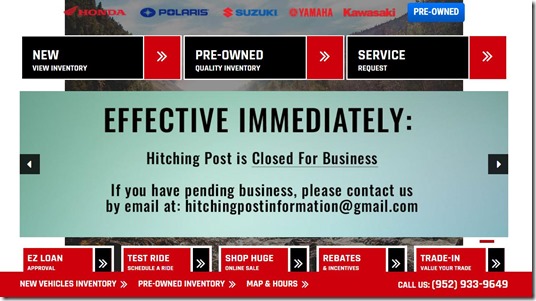
If you are a Minnesota motorcyclist, this is a heartbreaking, eye-opening wake-up call. When I moved to Minnesota, in 1996, the Hitching Post stores were the place for practically every motorcycle brand I am likely to own. The Hitching Post offered group rides for the Big Four Japanese brands every year where a rider could actually put a few miles on a bike Their service department was, at one time, pretty good (that’s the best I can say for any dealer service department). Some of their sales people were motorcyclists. Mostly, the HP stores were distributed all over the Cities and represented the motorcycle economy in our area. Now, they are gone.

Lots of that sort of thing is going on all over the country. Early this year, Polaris decided “to focus on Indian and the Slingshot” and closed down the Victory brand. Personally, I suspect Polaris is just quickly downsizing their motorcycle operation by getting rid of the largest part first. Triumph is downsizing its dealership position all over the country. Apparently, that country overestimated the demand for Triumph products. Eric Buell (EBR) gave it up one more time early this year. In the midst of the Great Recession recovery, Suzuki took the slow down opportunity to pare its dealerships by 20%. More than a few groups that had acquired facilities and brands from smaller dealer organizations gave up recently, such as Ohio’s American Heritage Motorcycles. Yamaha’s fans seem to have a better inside picture of the industry’s struggles than I get from the industry promo rags. They don’t paint a pretty picture, though. A Google search on “motorcycle dealers closing” gets you about a half-million hits with pages and pages of stories about motorcycle dealers giving up the economic ghost.

Somewhere, I read a guesstimate that if motorcycle dealers are going to survive into the next decade, they’ll have to be picked up by big pocket car dealers. Since one of my own favorite dealers used to be associated with a local car dealership, I doubt that is going to be much of a solution.

Aug 3, 2017

Foolish Motorcycle Stuff

The stock market gurus, the Motley Fool, had some foolish motorcycle statistics on their website in March. The title is a typically Wall Street puffed-up piece pretending to be a big surprise and delivering a little wisp of new information. It’s interesting to see some of what outsiders consider to be surprising, though.

https://www.fool.com/investing/2017/03/05/7-motorcycle-statistics-thatll-floor-you.aspx

12 Motorcycle Statistics That'll Floor You

The facts that explain the changing face of the motorcycle industry and those who support it. Motorcycles have come a long way since 1885, when Gottlieb Daimler and Wilhelm Maybach built the first one in Germany. Called the reitwagen, or riding car, its engine had 0.5 horsepower and a top speed of 11 kilometers per hour. Fourteen years later, the first production bike was made by Hildebrand and Wolfmuller featuring a two-cylinder engine that produced 2.5 horsepower and topped out at 45 kph.

Today's motorcycles are obviously more powerful iron horses. Harley-Davidson (NYSE:HOG) recently unveiled its new Milwaukee-Eight engine that, on the 114 cubic inch high-end model model, has four valves per head and produces over 100 horsepower.

The industry has grown over the past 132 years serving a much more diverse crowd of riding enthusiasts. Although bike makers have struggled to recover from the financial-market meltdown a decade ago, here are 13 additional facts from the Motorcycle Industry Council that will blow you away.

1. Sales gains are fleeting. There were 573,000 new motorcycles sold in 2015, up slightly from the prior year, but sales are expected to have declined around 2.1% in 2016.

2. Harley is still hogging sales. Harley-Davidson accounted for 29.3% of all new motorcycle sales in the U.S. in 2015, followed by Honda Motors at 14%, and Yamaha at 13%. Polaris Industries (NYSE:PII) represented just 4.4% of total sales that year with its Indian and Victory brands. Yet Harley reported at the end of January, and 2016 U.S. sales fell 3.9% and were down globally 1.6%. Polaris, on the other hand, said its sales were up 1%, with Indian Motorcycle enjoying mid-20% growth.

3. Gang of eight. Eight manufacturers represented 81% of all U.S sales in 2015. In addition to the four manufacturers above, Kawasaki, KTM, Suzuki, and BMW round out the list.

4. Going back to Cali. California had the most new motorcycle sales, at 78,610, or 13.7% of the total. The next closest state was Florida, at 41,720, followed by Texas, with 41,420 new bikes sold. Despite being home to the annual motorcycle pilgrimage of Sturgis, South Dakota sold only 2,620 new bikes in 2015. Two motorcycle riders on wide open road IMAGE SOURCE: GETTY IMAGES.

5. Wide open spaces. Even though California topped all states in new bike sales, because it is also the most populous state, its sales work out to just 2.9 bikes per 100, below the national average of 3.2 bikes per 100 people. Wyoming, with 7.0 motorcycles per 100 people, has the most. As a result, there are fewer bikes in the east, with 2.9 per 100, and most in the midwest, with 3.4.

6. Changing makeup of riders. Women represented 14% of all motorcycle owners in 2014, up from 6% in 1990 and 10% in 2009. It may be one of the most telling figures in why Harley is struggling; its core customer of middle-aged males has fallen from 94% of the motorcycle-owning population in 2009 to 86% in 2014. It's also part of the reason Harley introduced its Street 500 and 750 models, and Polaris came out with its Scout and Scout Sixty models to appeal to these riders newer to the market. However, IHS Automotive data says Harley-Davidson still has a 60.2% share of women riders.

7. A graying market. The median age of the typical motorcycle owner is 47, up from 32 in 1990 and 40 in 2009. And although its sales are slipping, Harley maintains a 55.1% share of the 35 and older male rider demographic. However, more troubling for the industry is the decline in riders under 18, which has fallen from 8% in 1990 to 2%, and those between 18 and 24 from 16% of the total down to 6%. Where will the new bike buyers come from if the industry is not attracting these younger people?

8. The great escape. Married riders comprise 61% of motorcycle owners, up from 57% in 1990.

9. Becoming a wealthy pursuit. Some 24% of motorcycle owner households earned between $50,000 and $74,999 in 2014, and as much as 65% earned $50,000 or more. The the median household income was $62,200.

10. And well-educated. 72% of motorcycle owners have received at least some college or post-graduate education, and almost as many (71%) were employed. Some 15% were retired.

11. Most weren't off-roading. Of all the new motorcycles sold in the U.S. in 2015, 74% were on-highway bikes, and the 8.4 million motorcycles that were registered in U.S. the year before was more than double the number in 1990. Motorcycles, in fact, represented 3% of total vehicle registrations.

12. Motorcycles do their part. The motorcycle industry contributed $24.1 billion in economic value in 2015 via sales, services, state taxes paid, and licensing fees, and it employed 81,567 people.

AUTHOR Rich Duprey Rich Duprey (TMFCop) Rich has been a Fool since 1998 and writing for the site since 2004. After 20 years of patrolling the mean streets of suburbia, he hung up his badge and gun to take up a pen full time.
Apr 25, 2017

Keeping up with the Japanese

I’m wrestling with an essay for MMM on motorcycle safety training. Mostly, writing about this subject is kicking my ass because there is so little actual information about the only thing that matters in motorcycle training: the outcome/effectiveness of training. It’s no secret that I believe motorcycles are a doomed mode of transportation and it shouldn’t be surprising that I believe the problem is that our favorite vehicle is primarily a hyper-dangerous toy and that licensing for the use of this vehicle on public roads is a joke. The fact that so many “riders” believe the DMV “test” is “impossible to pass on a real motorcycle” ought to be absolute proof that most of the characters on motorcycles are incompetent as riders and not all that bright as human beings.

As part of looking for inspiration for this article, I got involved in a discussion about why motorcycle sales have tanked (post-2008) and the recovery has been so weak. An old MNSportbike acquaintance who has been in the retail end of the business for the last decade thinks it’s because “the last two generations are pussies.” I can find no evidence to support his claim, but his argument is mostly that we’re following the Japanese model and that Japanese youth are “pussies.”

A long while back, Japan’s NHTSA equivalent decided to attack the constant over-representation of motorcycles in that nation’s mortality and morbidity statistics. The end result has been the only effective change in motorcycle safety in the world. Another result has been a dramatic drop in Japan’s motorcycle/scooter sales. Other than the industry itself, which generates almost as much expense as revenue, collapsing motorcycle sales isn’t much of a downside. The Japan Biker F.A.Q. created a page to explain the Japanese licensing system, “Motorcycle Classes and Vehicle Licensing.” The whole story is pretty much there in English and Japanese, explaining the tiered licensing system, insurance requirements, motorcyclists’ liability, laws and enforcement, and the rider costs of all of that. Honestly, I was surprised that the actual expense of compliance is so low. Insurance for the various classes isn’t out-of-line with US costs. Testing and licensing expense is reasonable. The real difference is what happens when you violate the laws: enforcement is expensive and harsh.

It’s obvious and true that if you had to be competent to obtain a motorcycle license and that getting caught riding without a license would result in serious costs and even jail time a large portion of the idiots on hippobikes would quit riding. Harley and Indian sales would disappear in a puff of logic, since obtaining that “Large Class” (400cc and over) license would require competence and riders would have to demonstrate that competence on the actual bike the plan to be riding.

Yesterday, on the way back from Alma, WI with my wife (she was driving), I got to see how far from being an actual motorcyclist the typical hippobike rider reality is. Two nitwits heading south on WI35 decided to make a U-turn on that relatively wide two-lane road with decent shoulders on both sides. The two stopped in the middle of their lane, stacked up a couple of cars behind them while they gathered their nerve to make the turn, paddled through the turn one-at-a-time, and the second of the two made his entrance into our lane about 100 yards in front of our vehicle. Being the obvious least competent of the two, he panicked when he finally noticed our vehicle (and the four behind us) bearing down on him, and he sped-up his paddling routine to get out of our way. Of course, he didn’t make the turn and paddled right into the ditch, which fortunately for him was only a few inches deep at that spot. On their best day, these two would barely deserve to posses Japan’s “Small Class: 50cc to 125cc” license. Here in Freedomville, USA, these idiots are on motorcycles 10X their capabilities.

Aug 10, 2016

Gangbanger Holiday

This past weekend, Friday through Sunday, was River City Days in Red Wing. More than usual, we had packs of loud, incompetent, badged and tatted pirates parading through town creating smog, noise, irritation, and entertainment. We made it to the downtown affair a couple of times and had an opportunity to view how motorcycles are seen by the general public in a fairly diverse crowd. It’s pretty much all negative.


If you think South Park was exaggerating, you’re delusional, clueless, and or an asshole. There are no other alternatives.

The experience got me to thinking about where years of negative stereotypes are taking the future of motorcycling. Combined with a 3,000 mile trip to the Rockies and back earlier this summer where I saw so few motorcycles doing anything other than being asshole gangbangers or asshole squids, this summer really put a point on the spear I’ve been anticipating for years. Other than a few Midwestern manufacturing jobs, who would it inconvenience if motorcycles were banned from public roads? Since motorcyclists are already classified as “terrorists” and gangsters by the FBI (and I mean all of us with a class “M” license, not just the actual gangbangers), the majority of the public considers motorcycles to be a menace (and not just in the US), and insurance companies and most motorcyclists consider their motorcycle to be purely a “recreational vehicle,” it’s pretty obvious that we’re treading on unsound territory here.

In the past (the mid-80’s), the motorcycle manufacturers have at least considered ending motorcycle imports to the US and other 1st world countries due to liability costs. If insurance companies (especially health insurance) were able to properly price their products regarding insurer risk, most of us wouldn’t be able to ride because we couldn’t afford health or life insurance. If the public could do simple math, the estimated $2/mile cost of motorcycle crashes (mostly paid by the general public, since only half of motorcyclists involved in crashes have health insurance) would drive more than a little legislative action. Economically, the only rational move any society has is to start moving toward getting motorcycles off of the public’s roads.

Again, I ask “Who would that inconvenience?” Well under 1% of the public are being supported and tolerated by the 99%. If that sounds familiar, consider how much rage there is toward that other 1% group. Lucky for us and the other 1%, at least half of the country is so stupid that they will vote for a 1%’er to save themselves from sanity and they will pretend that motorcycles are some sort of “freedom” worth protecting. But they may not be stupid forever.

Apr 7, 2012

Call Me "Doubting Thomas"

My MMM editor, Sev, is convinced that I hold grudges for too long. I hadn't thought about this much, but after our conversation and a recent event I realized that he's right about the first half. Regarding the second part of that assumption, I think I hold my grudges for exactly the right amount of time. The conversation began when I doubted the validity of the surface-skimming review we recently published on the Hyosung GT250. The two page love-fest-without-a-fault puff piece seemed to be more of a marketing blurb than an MMM review. Even the loud exhaust system was given a PR polishing ("I had to repeatedly look behind me to see what big bike was coming up on me. The exhaust sounding so powerful, I was sure I was going to get lapped."). The oversized picture of the vintage-looking GT showed too much detail because the marginal quality welds were obvious even in black-and-white. The positive side of the review was that it appeared to be, mostly, promoting a good local dealer; Mill City Motors. The negative side was that it appeared to be more of an apology to Hyosung than an actual critical review.

My history with Hyosung has to get in my way, though. That's where this discussion began. The fact is, I am a firm believer in "Screw me once, shame on you. Screw me twice, shame on me." I don't forgive and forget easily. In my studio service business, I have an unbending policy that says if you don't pay me 60 day after I invoice you, the next time you need me I'll ask for a retainer before I leave home. If I don't get it, I don't do the work. If you manage to find a way to stiff me for any amount of money, I'll block your telephone number from my business and any email will go directly to the Junk folder and be automatically trashed. I'm old. I have more work than I want. I don't need new customers and people who don't pay their bills don't even qualify as "customers." They're just freeloaders.

I was reminded of my habit, again, this past week. I did some audio work for MPR and the school where I work with students from one of my classes. We've done this project a half-dozen times with some pretty substantial local bands in the past. The most recent event was with a very local band with a minimal following and who drew a couple dozen people to the show we recorded. Afterwards, the band went prima donna on us and inserted themselves into an "approval" process of the show that will probably result in the the show's cancellation. Honestly, that works for me. And from here out, if I'm asked to do anything with that group or the group's members, I'll find somewhere else to be. Burn me once . . . you know the story.

I've applied the same logic to my vendors for decades. In the motorcycle world, I've been burned twice on motorcycles: once on a brand new 1974 Suzuki RL250 and once on a barely used 1986 Kawasaki KLR600. Both bikes were unreliable crap and the Suzuki actually cost me a bit of money when I had next-to-none. It was the second new motorcycle (and the last) I've owned. I bought it in 1974 for $1,100 and a year later Suzuki dropped the price on the RL to $700 to unload their 1974 inventory and bail out of trials forever. Obviously, I took a beating; value-wise. I didn't consider owning another Suzuki until the SV650 had been well shaken out and I bought a nearly new 1999 in 2000 for about 1/2 of Blue Book. I bought my 2nd Suzuki in 2006, when I bought my barely used DL-650 for 2/3 of Blue Book. The Kawasaki was a POS from the day I bought it and the longer I owned it, the more disappointing it was. Even selling that bike was a problem. I didn't own another Kawasaki until I bought my 2000 KL250, used and cheap, in 2005. That bike was also a disappointment and I don't expect to own that brand again. Compare those experiences with my Honda, Yamaha, and, even, Rickman/Zundapp bikes and I'm uninspired to experiment again.

There is a restaurant rule that says something like, "It takes $5,000 in advertising to get a customer to try a new restaurant and 5 seconds of poor service to push that customer back out the door. It will take 5 years of marketing to get that customer to try it again." Choose your numbers, but the fact is in a world with lots of options, you don't get a lot of chances to satisfy your customers. There are no do-overs in life or business. I may be a "moto-journalist," but that doesn't make me a sucker or a shill. I'm too old and too cranky to kiss up to a half-assed Korean manufacturer of questionable quality or character. I'll give them a decade and we'll see if they are still around to review after they've settled in a bit.

There are a collection of manufacturers that I won't buy from, based on past experience and an overwhelming number of acceptable alternatives: Tascam, Sony, Presonus, Adobe, MOTU, Toshiba (Toughbooks aren't), and ProCo are among the list. The list of companies I look for when buying is probably a lot longer. I'd bet you have your biases, too. I bet even Sev has a few. Why should I pretend to be different than I am? Why would I want to?

May 16, 2011

Dangerous Profits: Rider Education Goes to The Movies

An interesting and entertaining perspective on the all powerful Motorcycle Safety Foundation and motorcycle safety training:

The one thing that keeps me listening to the critics of the current programs is the MSF's constant reminder that safety training doesn't result in reduced crash or fatality statistics. Explain please?