Showing posts with label movie. Show all posts

Oct 4, 2013

Dust to Glory – Movie review

dust_t1

All Rights Reserved © 2006 Thomas W. Day

I am not a film festival guy, but last April I stood in line at the Riverview Theater to buy a ticket to Dana Brown's Dust to Glory.  It was worth it.  It was worth it, twice. This year, I've written a few movie reviews for this magazine, but I rarely think twice about most of the movies I've seen.  I think about Dust to Glory often.  I own about a dozen movies, only three of which I've watched more than twice.  The rest were gifts that have sat ignored on a basement book shelf. As of this writing, I've seen Dust to Glory five times [That was true in 2006. By now, I’ve probably watched DtG at least 20 times. I fuckin’ love this movie.].  I'm not even close to tired of this movie [Still true.].

I don't know who are the most incredible characters in this documentary, the riders and drivers who competed in the World's Toughest Race, the Baja 1,000, or the people who filmed it. Brown had a huge cast of folks involved in this film, over fifty cameras and a ninety person crew.  The race was filmed from cab-cams, helmet-cams, helicopters, hand-held high-def gear, and tripod-mounted traditional cameras.  Most of the unbelievable bike-cam footage was filmed by bike-riding cameramen and their riding skill is so close to that of the competitors that you can't tell one from the other. One cameraman, Lou Franco, strapped on a video camera and hung with Mouse McCoy for an incredible distance.  Later, Franco rode 12 hours after he breaks his hand slamming it into a road overhang.  Franco doesn't slow down, but he holds the hand in front of the camera a few times and curses his luck. 

Mario Andretti, the honorary race marshal, took a turn in a pickup and tore up the road fiercely enough that he killed the vehicle.  Another of racing's monsters, Parnelli Jones, is in the film long enough to introduce Robbie Gordon.  Robbie, NASCAR's money man, got his start in Baja and he's still into the desert in the PROTRUCK class; a vehicle well described by Alan Pflueger as "a controlled explosion . . . like holding a piece of dynamite and trying to keep the explosion in your hand." Gordon blew a tire and stayed near first place for thirty miles on three good wheels. Ricky Johnson, the SuperCross champion, was there riding a PROTRUCK and supporting Mouse McCoy. The trucks are, in fact, unbelievable.  When they hit the dirt, it's "a 20,000 horsepower free-for-all." The 4-wheel passing etiquette at Baja is something we all ought to emulate.  When the guy in front won't let you by, slam into his bumper so he'll know you're back there.  If that doesn't do the job, hit him harder.

An old hero of mine, 62 year old J.N. Roberts from the original off-road documentary On Any Sunday, is riding with his son, Jimmy.  J.N was the winner of the first Baja 1000, in 1967.  J.N. would be signing up for Social Security the January after the race.  The short segment of J.N. ripping by riders, making up time after a crash, was beyond inspiring. J.N.'s old "On Any Sunday" riding buddy, Malcom Smith is in Glory, too.  These guys are the first two champions of Baja. 

There are a couple of touchy-feely human interest segments that I could do without, which is what a remote control and fast-forward is all about.  I enjoyed this film for the racing and any interruption of that extraordinary activity is wasted time. I've been a Malcolm Smith fan for most of my life, but I thought the MS & Son in Baja bit went too long and provided too little information for the time spent.

In his brief moment on screen, enduro great and 12 time Baja champ, Larry Roesler, describes what it's like to ride at this level.  He still rides Baja, but he doesn't ride to win it.   Johnny Campbell, Honda's top rider and the Baja two-wheel hero, is ruthlessly in the hunt and always rides to win.  Andy Grider, on Honda's B Team, snagged the top spot from Campbell and hung on to it till he handed over the bike to his co-rider, 350 miles from the end of the race.  Grider, on the 11x bike, stole the lead from 1x and hung on to it through the silt beds and over hundreds of miles of ridiculous terrain.  The footage of this one-on-one race is my highlight of the movie.  All that work vanished when the B Team Honda wouldn't start on the handoff. This two-team competition is at the top of the best motorcycle racing footage I've ever seen.

Mike "Mouse" McCoy is the heart of the story, riding all 1000 miles by himself.  What McCoy planned to do was, according to a lot of experienced people, impossible. Almost halfway through the race, McCoy was holding on to third and having fun. Just before the sun went down and near the half-way mark, McCoy wrestled with a flat tire for 40 miles. At the pitstop, he seemed nearly delirious. Two hundred miles later, he complains that he can't feel his hands.  At 720 miles, he still has third place in sight and soon rips into second, in the dark.  His race ends soon after, in a crash, but his ride doesn't.  He eventually is the sixth bike to finish and his ride to the end is an inspiring moment for any distance race fan.

All of the racers in this film are totally out of the ordinary.  For starters, there is next-to-no prize money involved ($4,000 for the Class One Unlimited Buggies) and only limited sponsorship cash for the winners.  The Sportsman Class entry fee is $1500 and practically every kind of racer imaginable rides this event; everything from ratty old 1960s VW Beetles to totally freaked out high-buck SUVs in the four-wheel classes and bikers from the hobby class to the top off-road pros in the country.  There are teams with trainers, communications experts, mechanics and garage-in-a-semi rigs and folks who roped their bike into the back of an old pickup and had a friend drive the pickup to each checkpoint with a cooler full of Gatorade and granola bars.  The big money riders have choppers for chase vehicles. Still, this is as close to an Everyman's Race as you're likely to experience. The film is peppered with low-budget racers and their perspective on the race.

For off-roaders, the Baja 1,000 is a rite of passage. Some folks argue, "If you haven't done it, you haven't done anything." I haven't done it and, judging from this movie, I never will.  Probably the closest I'll get will be when I'm on the edge of my seat during the Dust to Glory helmet-cam sequences.  Every time the perspective shifted from overhead to helmet cam, I get tense and have compulsive desire to hang on to something solid through these intense segments.  From that perspective it's hard to believe that crashing at these speeds would not be fatal. The show adds to that with night racing footage, which I found to be seriously nuts.  Dust to Glory is as close as I'm likely to get to desert racing at this level, but it's close enough that I've learned more than a little about what it takes to be there. 

Aug 10, 2013

Faster (than you can imagine)

A film by Mark Neale, narrated by Ewan McGregor

faster2I don't own a lot of movies and I only own two motorcycle films (outside of a small collection of World Observed Trials event videos). The trials videos were all gifts. One of the two motorcycle films, On Any Sunday, was also a gift. So, the only motorcycle movie I've purchased for myself is Faster: Two Wheels, 200 MPH, Every Man for Himself. As a general rule, I can't think of a reason to watch a movie more than once. So why own the damn things? Faster is an exception to that rule. I've watched Faster three times at the theater and at least a half-dozen times at home. Personally, I think I should be able to wrap up this review at this paragraph. Enough said. Go buy Faster. However, that's probably not enough for you, assuming you haven't already seen this movie at least twice. So here are some more reasons to rent or buy this movie.

If you're a gearhead, you're going to love Faster. Listening to motorcycle commentators like Julian Ryder, factory technical experts, past-World Champs, team managers, mechanics, and McCoy himself explain how Gary McCoy's radical riding technique worked is worth the price of a ticket. Davide Trolli, from Alpinestars, provides a detailed explanation of why kangaroo skin makes the best leathers and I'm sure all you fringy leather boys will run right out and buy a roo-suit afterwards. Ex-world champ Barry Sheene describes the invention, his own, of the back protector. Track design and safety mechanisms are explained until you half-believe that it's possible to survive this freakin’ insane sport.

If you're a CSI fan, listening to Dr. Claudio Costa and Claudia Cherici, the MotoGP riders' medics of choice, explain racing injuries and psychology/pathology. You'll see x-rays of mangled limbs that defy reconstruction, but they'll be reconstructed and the riders will ride to break new records, bones, and displace organs. The doctor’s description of racer/hero mentality is a psychological study in itself and his relationship with the riders is inexplicable outside of the context of this movie. 

If you're an extreme sport fan, nothing on earth is more extreme than 250hp, 200mph MotoGP racing. Nobody crashes more spectacularly than road racers and these are the most spectacular road racers ever. Neale’s camera team had an incredible feel for catching the bikes in motion and the on-board cameras are like being there.  Especially the camera mounted on Valentino Rossi’s bike, sucking up the competition from 14th place to a win. 

If you’re into film making, Faster is a trip, too.  The editing style is almost as hectic as the racing.  Scenes snap from press conferences to the race track to crowd scenes to close shots of riders, mechanics, and anyone interesting enough to find a place in a frame or two.  The metal sound track is perfectly matched to the 500cc two-strokes and liter fours, some of the best rock guitar sounds ever stuffed into a movie.  Sometimes, the music is a power drill pushing holes through the crowd and bike noise, cranking up the pressure when you think what’s on screen couldn’t be pushed any harder.  Neale uses elapsed-time shots with a purpose. He moves us through time and speed and faces so that it almost feels like subliminal advertising.  Snap cuts from the race track to crowd shots to quick interviews and back to the track keeps the film constantly in motion.

Maybe the best parts are the insight provided by the people around the racers, Rossi’s dad, everyone’s doctor, the roadie mechanics, the ex-champs, the riders’ families, and the riders themselves. These guys are incredibly complicated people and, as such, incredibly interesting. This, in the end, is a film about people with levels of human interest that gets past the usual sport documentary. Moments like the sequence between Kenny Roberts and Barry Sheene, discussing when road racers began sliding as a steering tactic, are one of dozens of insights into ego, skill, history, and the stuff that makes these guys go . . . faster.  Way faster. Wayne Rainey’s description of the accident that left him in a wheelchair is the other side of this story.

But the racing is what really makes this movie.  Without the race scenes, Faster would be like Jet Lee without fighting.  The racing is beyond anything ever put on film before.  Hollywood special effects are tame compared to the real thing and Faster is all about the real thing.  These guys are faster than you can imagine, even after you see them on screen.  The Right Stuff, Top Guns, and magical superheroes all wrapped up in kangaroo skin and carbon fiber armor.  This is a great film.

PS: Watch the credits and listen to the world champs talk about motorcycle safety.  Maybe you'll learn something from people who know more about motorcycling than you'll ever know. The DVD extras include some great rider-perspective shots that demonstrate braking and throttle control of the masters.

All Rights Reserved © 2005 Thomas W. Day

Mar 23, 2012

The Girl with the Dragon Tattoo

There is a lot of controversy over which version of this story, the David Fincher "English" version (2011) or the Niels Arden Oplev Swedish version (2009), is the best or comes closest to the original Stieg Larsson novel or whatever criteria you may have for judging two movies about the same story. I am here to cast my vote after watching both in a couple of days.

English biking moments.

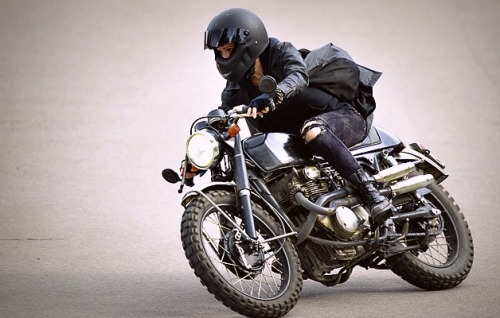
My critical judgement is mostly based on the motorcycling in these movies, since both stories are similar enough that I could watch either and get what the author/directors intended easily enough. However, the Fincher movie contains dramatically more motorcycle footage and creates a considerably more believable and interesting motorcycling character on a cafe racer-styled Honda CL350 than Oplev presents on a Yamaha WR250X (my best guess, since the motorcycle is so unimportant in the Swedish version). There you have it. I'm done. 

Swedish biking moments.

There's a little more to it than that, but not much. For my tastes, the Euro version is too dumbed-down, too slow, and a little old fashioned; editing-wise. Too much background is explained, rather than shown. Oplev's version has the main characters and secondary characters overwrought, over-defined, and the story moves slowly as a consequence. There are characters who are unnecessary, scenes that only serve to describe unimportant flashback events are repeated, and, in the usual manner, credibility in physical abilities are almost magically hauled out when convenient. [I could be talking about the Mission Impossible series here, with Tom Cruise's amazing but unpracticed ability on a motorcycle popping from thin air.]

From a motorcycling perspective, that was what I liked the best about Rooney Mara's Lisbeth. She didn't suddenly become a motorcyclist. She is a motorcyclist. She rides everywhere, not just when she can't find someone to drive her in a cage. Mara's character rides balls-out every time she's on the bike. She's got a lean on the CL when she's going straight. On the other hand, the few moments Oplev bothers to film the motorcycle it's straight up and toddling along at a sedate pace appropriate for a newbie on a tall motorcycle. She's as easily convinced to ride with an insecure cager as an old lady looking for a ride to the drug store.

For me, the credibility Lisbeth needs for every other thing she does came from the motorcycle scenes. Either she can do it, or she's just another movie-time poser. Whoever rode the bike for Rooney Mara built credibility for that character that made very other action scene believable. All of that said, both movies are pretty decent. The Euro version is a little slow-paced but it is filmed beautifully. The Swedish story is about a journalist and a girl who owns a motorcycle and rides it occasionally and some seriously evil bastards. The English version is a movie about a motorcyclist and a journalist and some seriously evil bastards. If I'm have a choice of two movies about the same story, I'll take the one with the motorcyclist.

Both movies had a severe motorcycling letdown at the end. [Possible spoiler alert]. The English version pulled the usual  Hollywood crap of having a motorcyclist get into a high speed chase in too much of a hurry to put on her helmet. As if you can actually ride a motorcycle fast with your eyes shut.  And, Tom Cruise-style, the English biker went to great efforts to get in front of the cage she was chasing, as if a diddly motorcycle can stop an SUV in flight. The Swedish movie did the helmet bit right, but missed the coolest moment possible when the motorcycling character gets off of her dirt bike to walk down a mild slope and stare dispassionately at the bad guy in the crashed cage. A real motorcyclist would have ridden down that hill and given the bad guy the stare from the badass black full face helmet.

Mar 28, 2011

One More Movie for the "Must See List"

Watch this trailer and get ready for the next "Faster." The movie is TT3D: Closer to the Edge by Guy Martin and like all great motorcycling things, it isn't coming to US theaters any time soon. We're too old, too slow, too timid/conservative, and too lame to even get movies about great motorcycle events, let alone an actual event. Yeah, I'm pissed off. Deal with it. We don't even get the DVD in US format.

Nov 28, 2009

A Little Geometry Lesson

Observed trials has always been the artistic side of competitive motorcycling. Tonui Bou's workout on this odd collection of concrete forms and natural rock seems to defy gravity, traction, and common sense. However, it is always artistic and entertaining.

The coolest thing about the video is that many of Bou's stunts are rerun in slomo in the 2nd half of the show, which doesn't explain how he does them but it does give you a great look at how he shifts his weight to maintain balance and traction and momentum.

Click on the picture to find the link.

Thanks Martin!