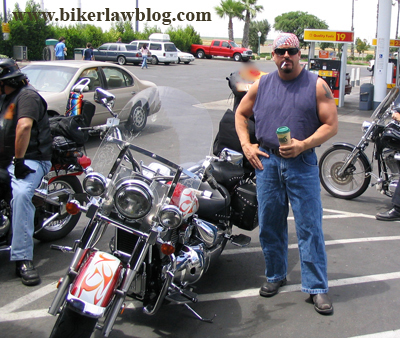
"Do you know why I pulled you over?"
"My best guess is that I didn't put a foot down at the stop sign." (And, of course, you're trying to meet your quota without expending a lot of effort.)
"That's right. You didn't come to a complete stop back there."
"Yeah, I did. I even rolled backwards a little bit waiting for traffic to settle down."
"There is no way you can come to a complete stop without putting a foot down."
"I can." (If you were paying attention, you'd have noticed that I was stopped and balanced for a few seconds before we started this inane conversation.)
"I don't care about those motorcycle stunts. Tell it to the judge. I'm a police officer and I know you can't come to a complete stop without a foot on the ground. I need to see your license, proof of insurance, and registration."
So went my first minutes in Linton, North Dakota. A minute was all I'd planned on spending in Linton, but that turned out to be a pipedream. While the cop went through his routine of checking me out for warrants and past evil behavior, I thought about all the conversations I've had with cops and judges over the years regarding the things "you can't do on a motorcycle." Considering all of the false information the law has to work with regarding something as well-documented as motorcycling, it's not hard to understand why the legal system is so incompetent when it comes to dealing with complicated things like treason, corporate and bank fraud, identity theft, environmental catastrophes, and insider trading.
Anyone who's ridden or watched observed trials knows that really good riders (not me) can spend a good bit of time not moving without putting a foot to the ground. At a 1980's US national enduro, I caught up with a trio of US pro riders at a check stop. They were sitting with a leg swung over the tank, having a conversation, with no feet on the ground, and no kickstands down; just showing off their balance while waiting to get their timesheets punched. I have never been able to do that or anything close to that. But, if I'm not concentrating too hard, I can stop and stay balanced for a few seconds while I inspect intersection traffic. I feel safer and more in control of the bike when my feet are on the pegs than when they are on the ground, so I try to stay in that position whenever possible.
I did not end up receiving a ticket in Linton, so I shouldn't look that gift horse in the mouth. I'm old, well documented, wearing Minnesota Safety Center patches on my gear, and a likely candidate to be sent off with a warning. Your North Dakota small town cop mileage may vary, especially if you don't when to shut up or you are young or if you don't look familiar and harmless.
The point is, the law doesn't often reflect what the MSF trainer website calls "best practices." The law is intended to provide "guidance" for cops and beginning riders. Riders (and drivers) looking out for John Law and worrying about what might be called illegal behavior probably causes as many crashes as it prevents; if it prevents any at all. I know that every time I see a cop I wonder what half-assed, unwritten or badly written, non-existent micro-law I might be breaking and it makes me nervous enough that I make foolish mistakes in attempting to avoid whatever weird thing I've heard cops are pulling bikes over for this week. Because of their unpredictability factor, I put cops pretty high on my list of life-threatening highway hazards.
Of the instances I can remember, in my 45 year motorcycling career I've been stopped and ticketed (or threatened with tickets) by cops for:
- "Reckless driving"; standing on the pegs while crossing obstacles (this has happened more than once),
- "Failure to keep in proper lane"; moving in the lane to increase visibility or to avoid slick spots or pooled water,
- "Careless or negligent driving"; not using hand signals along with the bike's turn signals or turning right on red when traffic is oncoming, about a 1/2 mile in the distance (right on red was legal, the cop just thought I was being too "aggressive"),
- "Signals; method required"; not signaling while merging into freeway traffic (in a state where motorcycle turn signals are not required and . . . is there any other option other than turning left into the traffic lane while merging?)
- "Driving too fast for conditions"; 3mph over the posted 65mph and at least 10mph under the velocity of the rest of traffic,
- "Parking improperly"; not parked parallel to the curb, but with the back tire against the curb and the bike pointing out toward the street,
- "Windshields to be unobstructed; wipers required"; seriously, I was wearing a 1970's Bell Motostar full-face which the cop deemed "too restrictive" for proper vision.
Motorcycling and bureaucracies combine as poorly as oil and British engineering. Back in the 70's, I argued with a Nebraska DMV employee that the state's license test advice for crossing railroad tracks or for hitting a pothole was blatantly wrong and downright dangerous. For that matter, the Minnesota motorcycle test's "best" lane position advice is questionable. In the 90's, Colorado's motorcycling pamphlet offered some pretty funny advice regarding the use of the front brake. California's motorcycle handbook might still have some really dumb advice about merging into fast-moving freeway traffic. In fact, the 1980's California DMV advice would regularly get you a ticket for "merging below the speed of traffic." This list could go on for hundreds of pages. [Feel free to contribute your experience with idiot motorcycle traffic laws or equally goofy enforcement.]
I consider all of this to be examples of bureaucratic incompetence, ignorance, and/or abuse of authority. Fortunately for me, so did the traffic court in every instance. Because I've had such erratic "luck" with law enforcement, it's hard not to keep two eyes out for official traffic traps and no eyes on other traffic and road hazards.
So, when I see one of those "public service" announcements that claims the HP or local cops are working to reduce crashes, I suspect the intent. If officialdom really wanted to save lives on the highway, they would do these three things immediately:
- Make the driving exam about 5000% more difficult and quit handing out cage licenses in Cracker Jack boxes.
- Drop the hammer on tailgaters; one rear end crash and you're a bus rider for life.
- Detach cell phone use from driving. If the phone is moving more than 3mph, disconnect the call.
All that "get tough" marketing is nothing more than justification for activity that doesn't contribute much to public safety. Once you put the fools into the flow of traffic, pretending to be protecting them with nutty traffic laws is cynical and opportunistic.
On the other hand, at the Isle of Man: