Go Everywhere, Do Anything
All Rights Reserved © 2012 Thomas W. Day
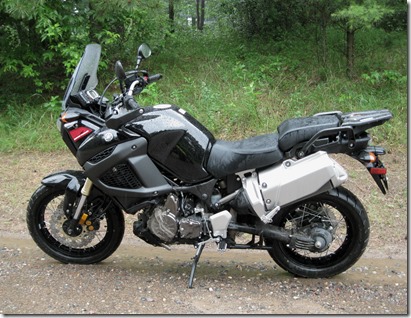 [After riding the big BMW GS, I realized how much I really liked the Ténéré. In a head-to-head shootout, the BMW would be clobbered by all of the Ténéré’s features, function, and performance. For my own money, however, I wouldn’t consider either bike “useful.” They both return a crappy 40-something-mpg and that’s disgraceful in a $4/gallon world. My fuckin’ motor home gets 22mpg, for crap’s sake and it has a kitchen, bathroom, double bed, and pulls a motorcycle on a trailer.]
Way back at the end of my trophy-less, always in the middle-of-the-pack 125cc motocross "career," a local Yamaha dealer tried to convince me that I'd have more fun on an open class bike; a YZ400. To seal the deal, they cut me loose on the YZ in a big field behind the shop for the afternoon. From that day on, my make-a-wish dream has been to be given an open class motocrosser and a couple of hours on a golf course. Man, I shredded that field. You can dig a trench on a YZ400 way faster than with anything Caterpillar makes. Not that much later, BMW introduced the "adventure touring" genre and I have always wondered what could you do with a 1200cc dirt bike?
My first impression of the Yamaha XTZ1200Z Super Ténéré (the "Ténéré" is a desert or wilderness in the south central Sahara) came last fall when Yamaha was shipping one copy of the 'Super Ten' (from here out, referred to as "ST" with my apologies to Honda) around its Minnesota/Wisconsin/Iowa dealers to show off and attract customer pre-orders. Back then, Yamaha dealers were requiring a $500 non-refundable deposit on all ST orders. Our ST review bike came from Moon Motorsports in Monticello where this model's 2012 MSRP is $14,831 and Moon's asking price is $13,499. The 2012 models come in "Impact Blue or Raven." I think "raven" must be black, since our test bike was black.
 There is a lot that feels familiar in the ST. The 270° 1199cc, dry-sump parallel twin is a distant relative of the (beloved by me) 1992-93 Yamaha 850 TDM's motor. The ultra-dependable fuel injection and large fuel capacity connects to my Suzuki V-Strom's best touring traits; all-weather starting and altitude independence. There is a lot of unfamiliar stuff, too. The ST's ABS and smart Unified Braking system (application of the front brake provides some rear braking unless the rear brake is also used), the MotoGP-heritage two-position YCC-TTM (Yamaha Chip Controlled) fly-by-wire throttle and traction control, and the modern hypoid-gear shaft drive are strange territory for me. Above all, the 1200cc torque and power is about as odd an experience, for an ex-125cc racer and 250cc commuter, as space travel: what to do with these new super powers?
The first obstacle to overcome was the 575 pounds and 34.25" seat height. I'm 5'9" and I'm old. However, swinging a leg over the ST's tiered seat was surprisingly easy and . . . where did Yamaha hide the weight? I imagine if I were forced to push the ST out of a muddy ditch, I'd discover where the weight went. However, the bike absolutely does not feel 125 pounds heavier than my 650 V-Strom. To get used to riding a "large" motorcycle, I'd spent a couple of weeks riding the V-Strom everywhere I usually ride my 250. It was a waste of time. In the saddle, the ST feels light. Flipping the bike up on the centerstand was effortless. Touching the ground from the seat means I'm was on my toes, but keeping the bike upright at stop lights or putting a foot down in tight turns was no problem. The bike feels light in motion, too. In all of the important ways, the ST feels more like my WR250X than my 650; weight, handling, and response. The steering is tight and the bike's balance is excellent. On the MSF range, I could U-turn the ST inside the 20' box and all of the MSF range exercises are easier to perform on the ST than my 650. The bike is nimble.
When I searched out other reviews' impressions of the ST, I was surprised to see several complaints about the power. As usual, I'm no expert on the kind of power-to-the-road delivery the BMW or KTM big bikes provide, but the ST does more than I need, power-wise. Passing acceleration in the "Touring" mode is absolutely beyond anything legal. Whipping past a half-dozen hippobikes strung out in a slow-moving line on MN95 south of Taylor's Falls was quick and effortless and nearly sold me the bike on the spot. To my experience, the bike is quick. It will pull hard at anything over 2k rpm and the faster you spin it, the faster it wants to go. Being a new bike, I did not take it to the 8k redline, but I did let it roll up to 6-7k for a few short moments and it takes some effort to hang on when you let all 108 of those ponies have their head. Yamaha's promotional video for the ST has a lot high speed desert racing and weird lifestyle marketing. The desert is something hard to come by in Minnesota, but the video does establish the ST's off-road credentials (if you are that good). I found the ST to be stable and comfortable on the freeway (in a pouring rain with scuba visibility), more fun than a pool full of supermodels on tight, twisty back roads, and happy as a Duc on the track on slick and wet clay and gravel roads. In fact, I was more confident in the rough and unstable surfaces on the ST than on my little WR250X.
Which brings up the ST's performance options. I tried riding the ST without the traction control and in the "Sport" fuel injection mapping mode. The bike is almost scary without the electronic babysitting. Throttle response is instant, if a little irregular. The power gets to the back wheel fast enough that I had some concern about pulling the front wheel off of the ground at speeds above 60mph. That might be the reason for buying a 1200cc "adventure bike," but I'd just as soon not have to worry about unintended front wheel levitation. After a few miles, I went back to the "touring" mode and put the traction control in "normal" status. Yamaha seems to believe riding without the traction control is not recommended. When you shut off the key, the traction control returns to "normal" mode. Under some conditions, the traction control will automatically disable itself and warning lights will inform the rider of this status change. Personally, I'd sacrifice the "mode" options for a touring cruise control. This bike is made for knocking down big miles and I don't need performance when 1200cc's is barely contained with the traction control in the mildest setting.
As for the ABS braking system, I thought it was flawless. However, off-pavement I didn't have much problem accidentally "defeating" the ABS system. On a moderate whoop on a fire road north of Sandstone, the bike came down with the ABS fault light blinking. I caught a little air and left the throttle on for stability, but I was feathering the front brake anticipating a quick turn ahead. I shut the bike off, worrying that I'd broken something, but after inspection I fired it back up and the ABS light stayed off. Later, I was playing motocrosser on a slick clay road, using the front brake while hanging on to my throttle position to slide the back tire around the corner, and the ABS light came back on. This time, I kept riding and discovered how easy it is to slide the back tire without ABS assistance. Kind of fun, but not something an old fart needs to mess with on an expensive borrowed motorcycle.
The transmission is typically Yamaha; smooth, predictable, and precise. The gear ratio seems a little close and more sportbike-oriented than dual-purpose. 75mph in 6th gear results in an engine spin of about 3,800 rpm. The same rotation rate means that 1st gear tops out at around 25mph. That's a bit quick for tight woods work, slow-going through stream beds, or sandy OHV trails. Maybe that's not the purpose Yamaha intended the bike for, but it's the kind of adventure ride they're advertising. The hydraulic clutch is predictable with a reasonably light feel.
 The battery, ABS motor fuse, and toolkit are hidden behind the right side cowling, which is removed by four 1/4-turn Allen screws. The toolkit is the typical throw-away stuff, but the compartment Yamaha designed for the kit is large enough for real adventure touring tools. Four more screws and the upper right cowling is off, exposing the the bike's other 12 fuses. The left side cowling is removed with six Allen screws and two plastic push pins. That cover hides the ultra-thin radiator and fan. The left side access brought back my least favorite memories of the TDM; too many parts that get lost in field repairs. It's hard to imagine that continuing the self-retaining fasteners from the right side to the left would have much effect on the cost of a $14,000 motorcycle. Yamaha calls the tail lights "R1 signal" indicators, but I'd call them the WR250R/X lights. Enough of the ST's parts are multi-tasked that the repair part prices are pretty reasonable.
 One British video review of the ST experienced an instant loss of engine fluids. From a view of the underside of the bike, I think the two oil drain bolts (oil tank and crankcase) are the likely culprits. Their location is handy for servicing, but they protrude beyond the bottom of the engine cases and are one of the first things the engine will contact. The shiny "oil element" cover is in the same predicament and if that piece breaks the oil pump is exposed. Yamaha has an accessory $205 welded 3mm aluminum skid plate and I would not leave home without it. The stock plastic piece is purely cosmetic.
The video above is the best off-road comparison I've seen on the bikes in this category, but it's the one where the ST dumps its engine oil about 4 minutes into the video. So, we don't learn much about how the ST stacks up against the competition.
Other Yamaha accessories include a taller windscreen and side deflectors, an engine case guard, side cases, a top case, a tank bag, a low (33.26" as opposed to the stocker's 34.25") seat, and mounting plates for your cell phone, GPS, radar detector, and the rest of the junk you play with when you should be watching the road and traffic. The aftermarket suppliers have cranked up production for this farkle magnet, too. Touratech practically has a whole catalog devoted to the ST that will allow you to add at least 120 pounds to the bike and double your investment. Other companies are cranking out crashbars, skidplates, and polished aluminum/titanium/unobtainium covers for all of the perfectly serviceable plastic, plated, and painted bits Yamaha installed on the ST.
The exhaust note is oddly loud and raspy. Not powerfully loud or Ducati-raspy, but still louder than I expected. The large (a lot of that size is a heat shield) down-pointing pipe has a catalytic converter and two-stage oxygen sensors to keep the FI system tweaked for EPA requirements, altitude, and fuel economy. The 45-component exhaust system is probably not light and the aftermarket industry has cranked up all manner of louder, lighter, more hooligan-appealing products to irritate your neighbors and knock the snot out of the bike's already-questionable fuel efficiency.
The fork spring preload setting is 8-position adjustable, along with adjustable compression and rebound damping. The rear shock preload and rebound damping are also adjustable. When I first saddled up the ST, I thought the suspension was set excessively stiff. Once I took the bike away from the freeway, I realized that, like a dirt bike, this motorcycle is designed to go straight at obstacles. The harder you ride it, the smoother it feels.
My first fill up (at 202 miles) demonstrated that the ST's mileage calculator is surprisingly accurate. The bike said it was getting 43.4mpg and I found it really got 43.9mpg. If the tank capacity is 6 gallons, the reserve warning comes on with about a 1.5 gallons of fuel left in the tank (the manual says 1.3 gallons); or with a reserve range of at least 60 miles. I am clinging to the delusion that 44mpg is not good enough for my next bike because I desperately do not want to buy a $14,000 motorcycle at this point in my geezerhood.
 The seat height can be lowered about an inch by removing a plastic bracket under the seat (see illustration). This is an incredibly clever, simple adjustment that couldn't be much easier to perform. Yamaha also sells a lower-than-stock seat that provides another inch of height advantage. The seat itself is well designed, comfortable, and allows lots of movement while providing good grip. The seat, bars, and peg position make standing for the rough stuff comfortable and practical. The top of the seat cover is made from a textured material that allows movement while preventing accidental sliding. After removing the seat with the key, pulling two screws from the front of the passenger seat and removing that seat reveals a larger carrier adding the bike's luggage capacity (the racks are rated at 11 pounds each). The underside of the rider's seat holds an Allen wrench for removing the cowling covers.
 There is enough content in the bike's console to keep most of us entertained for miles. The information available from that easy-to-read 4"x8" electronics package includes a large digital speedo, an analog tach, turn indicator, fuel status, traction control status, drive mode, a clock, the over-all odometer plus two trip odometers and a fuel reserve odometer, instantaneous and average fuel consumption data, intake air and coolant temperature, and self-diagnostics. The LCD and tach backlighting is adjustable. Two switches at the bottom edge of the console allow access to all of this information and set the time and miles/kilometers readout. A button on the left side of the console selects the traction control selection. The handlebar switches are standard, with the addition of a "drive mode" switch on the right side. There is a power connector (lighter jack) on the cowling for accessory electronic devices. The fairing is all business. Headlights, gauges, wiring, the radiator, electronics packages, fuses, brake components, cabling, are all easily accessible for maintenance and repairs. The headlights broadcast a rectangular beam that covers the road ahead and the edges of the road well enough than an old blind guy has some confidence in night riding. The mirrors are the best I've ev3r experienced. I can see what's behind me and vibration-generated blurriness is an absolute minimum.
The Yamaha owners' manual is reasonably complete, with simple procedures documented, some disassembly data, and the usual riding warnings, engine start-up and controls' operation descriptions, and "see your dealer" instructions for anything more complicated than remedial repairs and maintenance.
The brand/model options in this category come from the usual suspects: BMW's R1200GS ($14,990 for the basic bike, $16,935 with ABS, heated grips, bag mounts, hand guards, and GPS), Ducati's Multistrada 1200 ($16,999 for the standard bike, the $19,995 Sport-version, and the $21,995 Pike's Peak Special Edition), KTM's 990 Adventurer ($14,898), Moto Guzzi's Stelvio 1200 NTX ($15,990 with side-cases, ABS, etc.), and Triumph's Tiger 1200 Explorer ($15,699 with fly-by-wire and ABS). All of these motorcycles are well-suited for the intended adventure touring function. The Yamaha's pricing puts the bike in good position, relative to its competition.
Before riding the ST, I had no idea that my V-Strom's front suspension was so mediocre. Getting back on the road, on my own bike, I was almost overcome by the desire to turn back and write a check for the Super Ten. My tightwad self prevailed and after a few dozen miles, the new riding standard began to fade into the background and by the time I made it home the V-Strom seemed just fine. Really. I'm not kidding. Damn it. I'm good.
Without the exceptional generosity and efforts of Moon Motorsports, Kyle Erickson, and Matt Kobow, my portion of this review would have been impossible. I'd like to personally thank them for their kindness and assistance.
| |
| Type | 1199cc, liquid-cooled, 4-stroke 2-cylinder DOHC |
| Bore x Stroke | 98.0 x 79.5mm |
| Compression Ratio | 11.0:1 |
| Fuel Delivery | Fuel Injection with YCC-T |
| Ignition | TCI: Transistor Controlled Ignition |
| Transmission | Constant mesh, 6-speed |
| Final Drive | Shaft |
 |
| Suspension / Front | 7.48-in travel telescopic fork, adjustable preload, compression and rebound damping, |
| Suspension / Rear | 7.48-in travel, Monoshock, adjustable preload and rebound damping |
| Brakes / Front | Dual 310mm hydraulic disc, ABS/Unified Brake System |
| Brakes / Rear | 282mm single disc |
| Tires / Front | 110/80R 19M/C |
| Tires / Rear | 150/70R 17M/C |
|
| Length | 88.6 in |
| Width | 38.6 in |
| Height | 55.5 in |
| Seat Height | 33.26 or 34.25 in |
| Wheelbase | 60.6 in |
| Rake (Caster Angle) | 28.0° |
| Fuel Capacity | 6.0 gal |
| Fuel Economy** | 40 mpg |
| Wet Weight*** | 575 lb |
|
| Warranty | 1 Year (Limited Factory Warranty) |


