Because one of MMM's contributors recently suffered a catastrophic chain failure on her Versys, a bunch of us got into a conversation about shaft drive vs. chain drive vs. belt drive. My editor, Sev Pearman, is radically in favor of shaft drives over practically everything, especially chains. One of the technical contributors and a recently successful racer, Dave Soderholm, argued for belt drives. I'm old, not easily convinced by emotional arguments, and stuck with the experience of my lifetime, so I'm mostly on the side of chains and have no particular objection (other than cost) to shaft drives and seriously doubt the reliability of belts because Harley uses them and they are only found on cruisers and other toys (like electric bikes).
Here is some of the text from that discussion:
-------------------------------------
From: Cat on a Kawasaki
Sent: Sunday, August 19, 2012 6:38 PM
Subject: Why my next bike will be shaft driven
Sunday ride, nice weather, going to get my nails done then off to a barbecue. Wait, what the hell...? (I watch in my mirror as my chain spins away on the road behind me) This is on 35W southbound, south of the Lake exit and north of the US-10 W exit. ONE vehicle stopped -- ONE!!!? -- a Goldwing rider and his wife. I'm glad they stopped. And I'm /very/ disappointed with the rest of the motorcycling community.
-------------------------------------------
From: T.W. Day
Was it a replacement chain, a new/old chain, or a clip/riveted master link? I've been on bikes since the 60's and I've never had a catastrophic chain or sprocket failure. Obviously, they happen, but drive shafts fail too. I had a CX500's bevel gear toss a tooth on a trip to SoCal in the 80's. I lucked out and it happened (or jammed) at low speed. I was able to pull the final drive apart, pick out the pieces, and limp back home where I rebuilt the thing. I've had infinitely worse luck (1/0) with drive shaft bikes than chains, when it comes to catastrophic failure.
Thomas Day
Minnesota Motorcycle Monthly Magazine
http://http://mnmotorcycle.com/
http://geezerwithagrudge.blogspot.com/
thomas@motorbyte.com
-------------------------------------------
From: Cat on a Kawasaki
It was a master link on a replacement chain that had about 8000 miles on it. The chain chopped a chunk of aluminum out of the protector-thingie (I have no idea what that part is called), but there weren't any cracks or other damage. Whew! I still don't know why the clip came off. I found the master link in the chain lube goo - it was bent as if it had taken some pretty good pulling stress before it finally gave out.
-------------------------------------------
From: "T.W. Day"
Thanks for the update. That's an interesting failure mechanism. In at least a couple hundred-thousand motorcycle miles, on and off-road, I've never had that happen. I'd be suspicious that the master link clip had been installed improperly, had been reused, or that the master link plate had not been compressed all the way, allowing the clip to sit on the edge of the pin grooves rather than firmly in the grooves. There is a good reason for using riveted master links, but I've never been afraid of the field-repairable style links and haven't had a failure in 40 years of riding.
I have had three drive shaft bikes; a 1979 CX500 Honda Deluxe and a pair of XTZ550 Yamaha Visions. They were all reliable performers, if a little overweight. There is maintenance to be done to the rear drive and most riders blow it off, sometimes resulting in short drive life. The rear drive oil should be evaluated every time you replace the rear tire and that is a messy, time-consuming process. Some folks recommend changing that oil every time you replace the engine oil. Usually the splines at the end of the drive need to be greased at the same intervals. I know guys who have never changed that oil and lucked into long mileage and I know guys who blew off the maintenance and ended up with $2,000 in driveline repair costs for their lack of effort. I know at least one guy who did all of the maintenance required and still had a rear drive fail at 20k miles. "Maintenance-free" is a marketing delusion, especially if you go anywhere interesting on your motorcycle.
Rocks are a drive belt killer. A moderately hard fall can bust drive shaft cases. A long ride in a hard rain can completely de-lube a chain and set it up for early failure. You buys your toys and you takes your chances.
If you've read my stuff, you know I am unaware of this "motorcycle community" of which you speak. Motorcyclists are just people with no more connection to any overall community than the typical American voter. Waving aside (the motorcyclists' equivelant of saying "I'll pray for you" or "I'll hope for the best, assuming I don't have to put out any effort to help you"), I've had as much luck with old and young guys in pickups stopping to offer assistance as I have motorcyclists. For some reason, guys in driving pickups and wearing cowboy hats have been more valuable to me than anyone in or out of a helmet.
Mark Lawrence, by the way, is one of my favorite maintenance resources for practically all things motorcycle. His take on drive shave maintenance is worth reading. Mark was way ahead of the curve on the V-Strom 650 and his advice has kept my bike going strong through some tough times and places.
-------------------------------------------
From: Soderholm, David
Belts are the way to go - strong / light / quiet / clean / lash free / minimal input into suspension..........perfect drive for a street bike.
-------------------------------------------
From: T.W. Day
I've never had or ridden a belt drive bike. I've always questioned the strength and durability of belts. Of course, nothing I've ever owned has been a committed "street bike." Sooner or later, we're going riding on dirt roads and I suspect that could be a weak "link" for belts. Since a belt is, by design, a continuous loop, doesn't that mean considerable disassembly for replacement?
-------------------------------------------
From: Soderholm, David
That's a good point Thomas, but most belt drives have a very long to life time interval period on replacement. They are also tested for rock and gravel off road during development. They are very tough.......
-------------------------------------------
From: Sev Pearman
The shaft drive thread
Pfft Anecdotal evidence
And all 1800 Goldwings are shaking death traps. I know, cuz the innernets tell me.
-------------------------------------------
From: "T.W. Day"
If "anecdotal evidence" is all we have, it's infinitely more valuable than myth and wishful thinking.
The only discouraging word I have about the Tenere is the 42mpg bit. A shaft, one way or the other, is barely a consideration for me. I liked that bike and liked my XTZ550 Visions. If the Tenere came in a 65mpg 550 and at least $4k cheaper, I'd be on it. My point is that shaft drive is a wash, in the long run. And I've had a few of these bikes for long runs. I've never had a single sided shafter, though. That might have some serious advantages, maintenance-wise. The Honda Hawk is one of my favorite machines, concept-wise. I don't know anyone who put big miles on one, though. I know people who have them, I'm just not impressed with 15k miles of use
Does the fact that BMW put a chain on their F800GSe do more than provide "anecdotal evidence?" (I know, the picture was on the internet.) At one of the first Cycle World bike shows I attended in Minnesota, BMW displayed one of their their non-factory Paris Dakar boxers, which was chain drive. I have always wished I'd taken a good picture of that bike. I never seem to have a camera out or an audio recorder running when it really matters. Clearly, I do not belong in the news business.
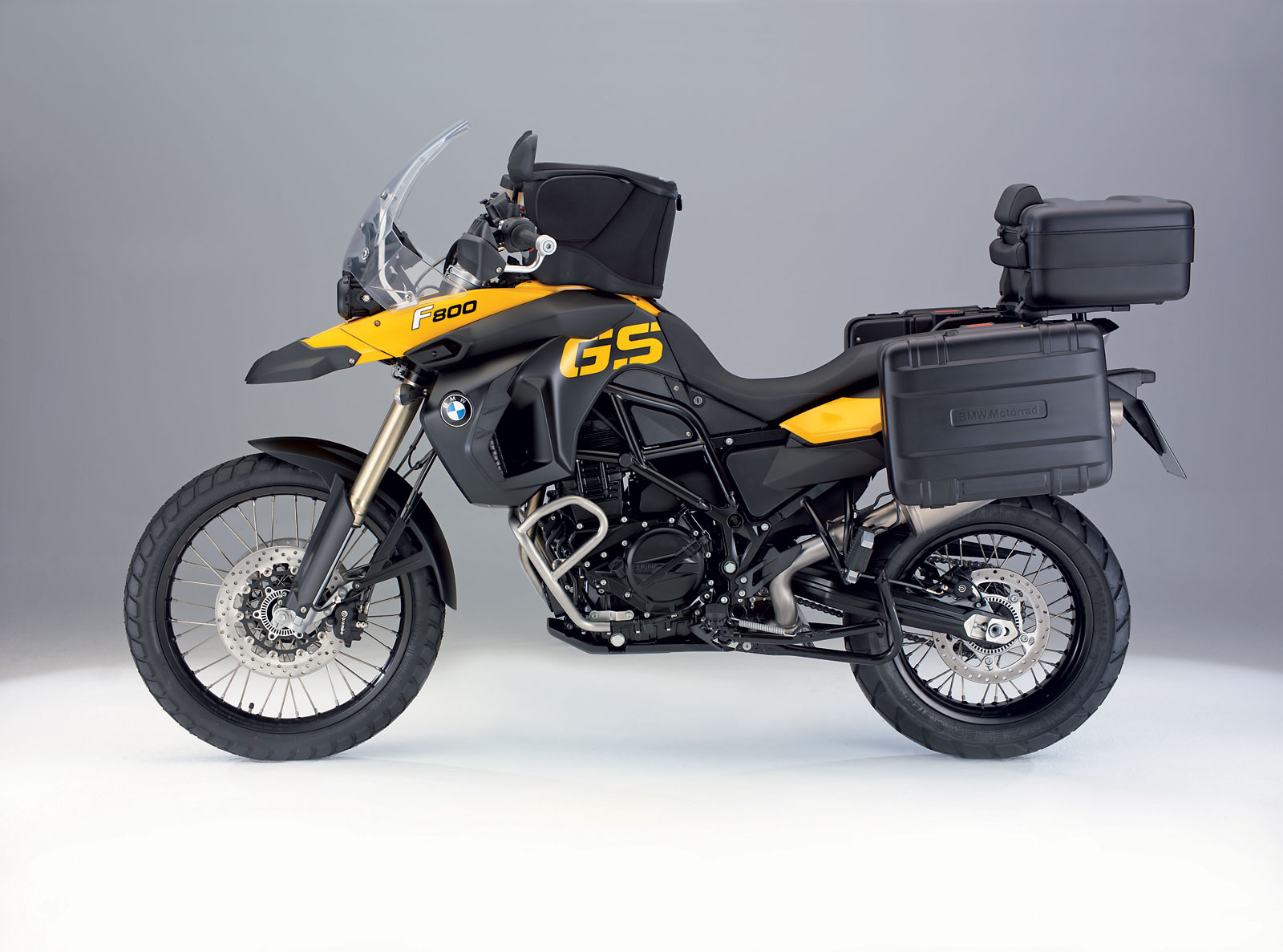
Let's face it, it doesn't much matter to people in my socio-economic bracket. There isn't an interesting shaft drive available in my low-ball price range. There is no chance I'm going to own a five-digit motorcycle, ever. There is little chance I'd ever want a drive-shaft cruiser, which might be in my price range but I'm not that old, yet. (I don't plan to live that long, either.) So, if there is a small reliability/price advantage, the initial cost overwhelms the conversation. If that were all there were to it, I'm sure all factory on and off-road race bikes would be belt or shafties. Since they are overwhelmingly chain driven, there is clearly more to it.
-------------------------------------------
From: Sev Pearman
I don't think that is accurate. Permit me to add this observation
Cruisers and tourers may run belts (a/o shafts) due to fixed FD ratios. No one cares to adjust it do the FD ratio is fixed. Having said that, BMW & M-G offer a variety of REAR pinion ratios to alter overall ratio
Sport bikes and offroad machines have stayed w chain because it is easy to adjust when gear ratios are changed
If not, a rider would have to stock x different length belts for as many possible FD gear ratios
This is a question of final drive ratio adjustment, not reliability
I pity the poor salesman who has to sell you any machine
:•D
-------------------------------------------
From: T.W. Day
I always buy used from owners, never dealers, at the lowest price I can beat out of the seller, and rarely want anything badly enough to worry about the deal if it falls through. No salesman wastes much time on me because it is, apparently, obvious the moment I walk through the doors than I'm just looking. I bought my first and last new bikes in 1974 and only new car of my life in 1973. "Fool me once, shame on you. Fool me twice, shame on me." I rarely go back for a whipping twice, unless getting my ass kicked at the race track counts.
Do you have evidence that chains are standard because of the adjustibility or is that opinion?
I doubt that a lot of gear ratio modifications take place in the Dakar or in enduros and cross country races, Isle of Man, and the rest of the endurance racing world and I suspect that if reliability was a serious issue with chain drives, even road race tuners would find a reasonable way to adjust gear ratios; as you've mentioned BMW and MG do already. I don't think the drive issue is as clear and simple as you appear to believe. I think the racetrack is equivalent to tens of thousands of miles of "normal" use, so if drive shaft systems possessed reasonable power-to-weight and efficiency performance and provided a reliability advantage, we'd be seeing them on the track.
The fact that belts are practically non-existent outside of the low-performance, maintenance-ignorant cruiser market says a lot to me. I have no objection to drive shaft power transfer, but I'm unconvinced they are the bulletproof, no-maintenance, cost-effective drive line you're hoping they are.
I'm also unconvinced that encouraging already-barely-conscious riders to buy "let's pretend these are no maintenance" bikes is a good idea. Going over the chain is just a small part of what ought to be good, regular maintenance. It's not difficult to make daily maintenance a reasonably clean activity. It does force us to look at axle bolts and adjustments, and to scan other parts of the bike. It gets us closer to the "Zen" of motorcycle maintenance and that's always a good thing.
Now, when you get back from 2,500 mile (2,000 off-pavement) North Dakota ghost town tour and can still say, "Time on Victory bikes has made me a believer in belts as well," I'll reconsider. Until then, I'll see your "pfft" (although I'm not sure what means and raise you a couple of "humphs." A few piddling miles around town doesn't convert me to abandoning a system that has only improved dramatically in my lifetime.
-------------------------------------------
Some of you folks are more experienced, technically more capable, and bigger thinkers than me. What are your thoughts, opinions, and what facts can you bring to this debate table?
